
Executive Summary
Pushdown accounting lets an acquired company reflect the acquirer’s purchase price on its own standalone books. Few decisions made in the ninety days after a deal closes carry more quiet consequence. They shape the balance sheet, the covenant package, and the story a finance team tells its board. Executives tend to assume that once control changes hands, the accounting simply follows. It does not. Under ASC 805 and ASC 810, the election is optional, and it is irrevocable once made. It interacts with step acquisitions in ways that surprise even experienced deal teams. That surprise lands hardest when a company builds ownership gradually. A single-transaction purchase of control does not carry the same risk.
Years spent on the finance side of acquisitions across cybersecurity, gaming, and private equity diligence show that pushdown accounting can become the difference between a clean post-close story and unexplained swings that spook lenders and board members alike. This article covers what pushdown accounting is, when it belongs in a deal, how step acquisitions complicate the remeasurement math, and the discipline that gets the election right the first time, since nobody gets a second attempt once the books go out.
What Is Pushdown Accounting, and Why It Rarely Gets the Attention It Deserves
Every acquisition requires purchase price accounting at the level of the acquirer’s consolidated financial statements. That part is not optional and no CFO debates it. Pushdown accounting asks a separate, narrower question: should the acquired company, the acquiree, also restate its own standalone books to reflect the fair value adjustments to assets, liabilities, and goodwill that arose from the deal. When the answer is yes, the acquiree pushes the fair value step-up onto its own ledgers rather than leaving it trapped in consolidation entries at the parent level.
Historically, SEC guidance for public companies permitted this treatment only in narrow circumstances. ASU 2014-17 changed the calculus by giving FASB’s blessing to any acquired entity electing pushdown accounting once a change in control occurs, generally defined as obtaining more than 50 percent of voting interest. The election sits with the acquiree’s management, not the acquirer, and management must make it the moment it gains control. Once management elects it and the issued financial statements reflect it, the choice locks in for good.
What Is Pushdown Accounting in Practice?
In practice, what is pushdown accounting comes down to a balance sheet reset. Fixed assets, intangibles, and goodwill move from historical cost to fair value on the acquiree’s own books, and the transition typically eliminates prior retained earnings. Practitioners rarely stumble over the mechanics; the ones who pay the price are the ones who treat the election as a bookkeeping formality rather than a decision with real consequences for depreciation schedules, covenant calculations, and years of reported earnings ahead.
When Pushdown Accounting Should Be Applied (and When It Should Not)
The election is a judgment call, and the accounting team should never make it in isolation. The CFO, working alongside legal, tax, and investor relations, needs to weigh the implications before the deal closes, not after.
Pushdown accounting tends to make sense when:
- The acquiree will continue operating as a standalone reporting entity after the deal
- External stakeholders, including lenders and minority shareholders, need financials built on a fair value basis
- The parent wants its integrated reporting to carry full transparency into the transaction’s economic impact
- Tax, statutory, and management reporting all need to align to the new fair value basis
Pushdown accounting tends to be the wrong call when:
- The acquiree will be absorbed quickly into the parent with no separate reporting obligation
- The deal was structured deliberately to avoid a step-up in basis for legal or tax reasons
- The entity is headed for dissolution, merger, or spinout shortly after close
In one buy-side engagement supporting quality-of-earnings and integration risk work on an IT services acquisition target, the pushdown question came up before the letter of intent was signed. Surfacing where reported earnings diverged from economic reality, and where post-close basis decisions would ripple through future covenant tests, changed how the buyer structured the deal. That sequencing, thinking through pushdown implications during diligence rather than after signing, tends to separate a controlled close from a scramble.
The Layered Complexity of Step Acquisitions
Step acquisitions add a dimension that a straightforward control purchase does not have. A company builds its ownership position gradually, crossing the control threshold only after one or more earlier, smaller purchases, and ASC 805 requires the investor to remeasure its previously held equity interest at fair value the moment it obtains control. That remeasurement gain or loss runs through the income statement on the acquisition date, whether or not it reflects any change in the underlying business.
Consider a scenario that plays out often enough to be familiar to anyone who has lived through one:
- A company owns 30 percent of a manufacturing joint venture
- In the third quarter, it acquires an additional 25 percent, bringing total ownership to 55 percent
- At that point, consolidation is required, along with fair value adjustments across every asset and liability
- The original 30 percent stake must also be remeasured, generating a gain or loss against its prior carrying value
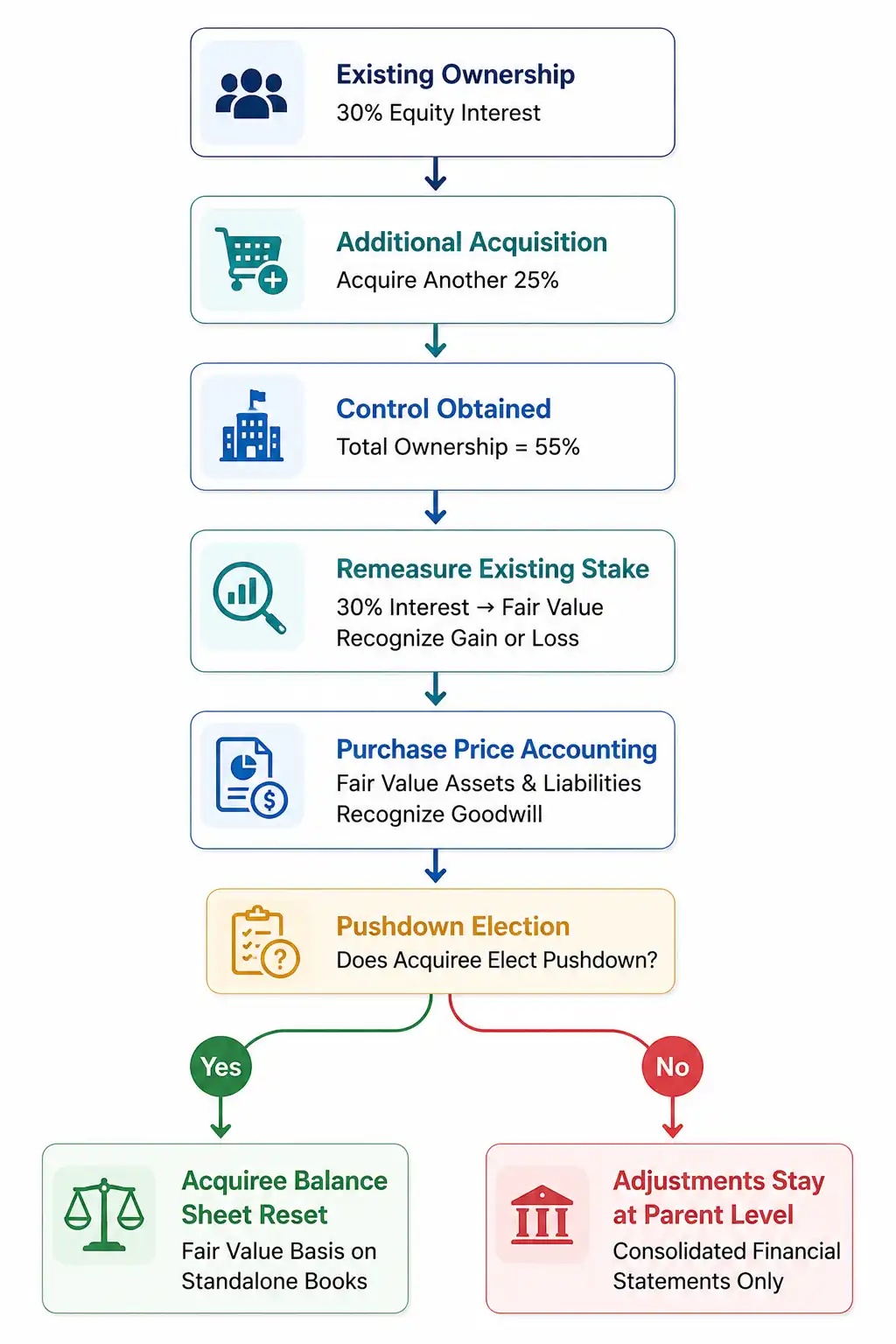
If the acquiree also elects pushdown accounting, it resets its own balance sheet to the new fair value basis, compounding the remeasurement effect with a full step-up across its books.
How Pushdown Accounting Reshapes the P&L and Balance Sheet
Pushdown accounting and step acquisitions do not stay confined to footnotes. They move the numbers that boards, lenders, and analysts actually watch:
- Depreciation and amortization rise because of the stepped-up basis in fixed assets and intangibles
- Goodwill and intangible impairment become more probable in volatile markets, since the new basis leaves less cushion
- Non-cash remeasurement gains or losses can create income swings that have nothing to do with operating performance
- Deferred taxes require recalibration against the temporary differences created by the fair value step-up
These are not abstractions. At a high-growth cybersecurity and identity access management company with close to $30M in annual recurring revenue and delivery teams spread across the United States, Canada, Mexico, India, and Nepal, an acquisition of an offshore delivery partner moved through this exact pattern while serving as the de facto head of finance. Crossing 50 percent ownership triggered pushdown accounting, and revaluing in-process development work and customer relationships produced a one-time remeasurement gain of $4.3M. The larger story was the second-order effect: amortization of the newly recognized intangibles pulled adjusted EBITDA down by 400 basis points, enough to trigger a covenant conversation with the lending group, even though nothing about the underlying operations had changed. The drop was purely an artifact of the accounting, but explaining that after the fact is a weaker position than modeling it before close.
Internal Controls, Communication, and Board Readiness
Pushdown accounting should never be a last-minute election bolted on during the audit. Finance leaders carry a handful of responsibilities that determine whether the transition goes smoothly or becomes a fire drill:
- Model both the consolidated and the pushdown scenarios during diligence so the financial statement impact is understood before signing
- Bring in auditors and legal counsel early to confirm the election is supportable and properly documented
- Align tax systems, the ERP, and reporting infrastructure to the new basis of accounting ahead of close
- Educate the board and internal stakeholders on how the election will move KPIs, segment reporting, and valuation models
As Chief Financial Officer of a Euronext Paris-listed gaming and digital entertainment company operating across the United States, France, the United Kingdom, Singapore, and South Korea, the mandate included over $100M in cross-border M&A execution with full due diligence and post-merger integration responsibility, reporting into a public-company board that expected pushdown implications explained in plain language before a single adjustment hit the books. Board members do not need the technical mechanics; they need to know what changes in the numbers they will review next quarter, and why.
Pushdown Accounting versus Purchase Price Accounting
A common confusion is treating pushdown accounting as interchangeable with purchase price accounting. They are related but distinct questions, and finance teams need to track both.
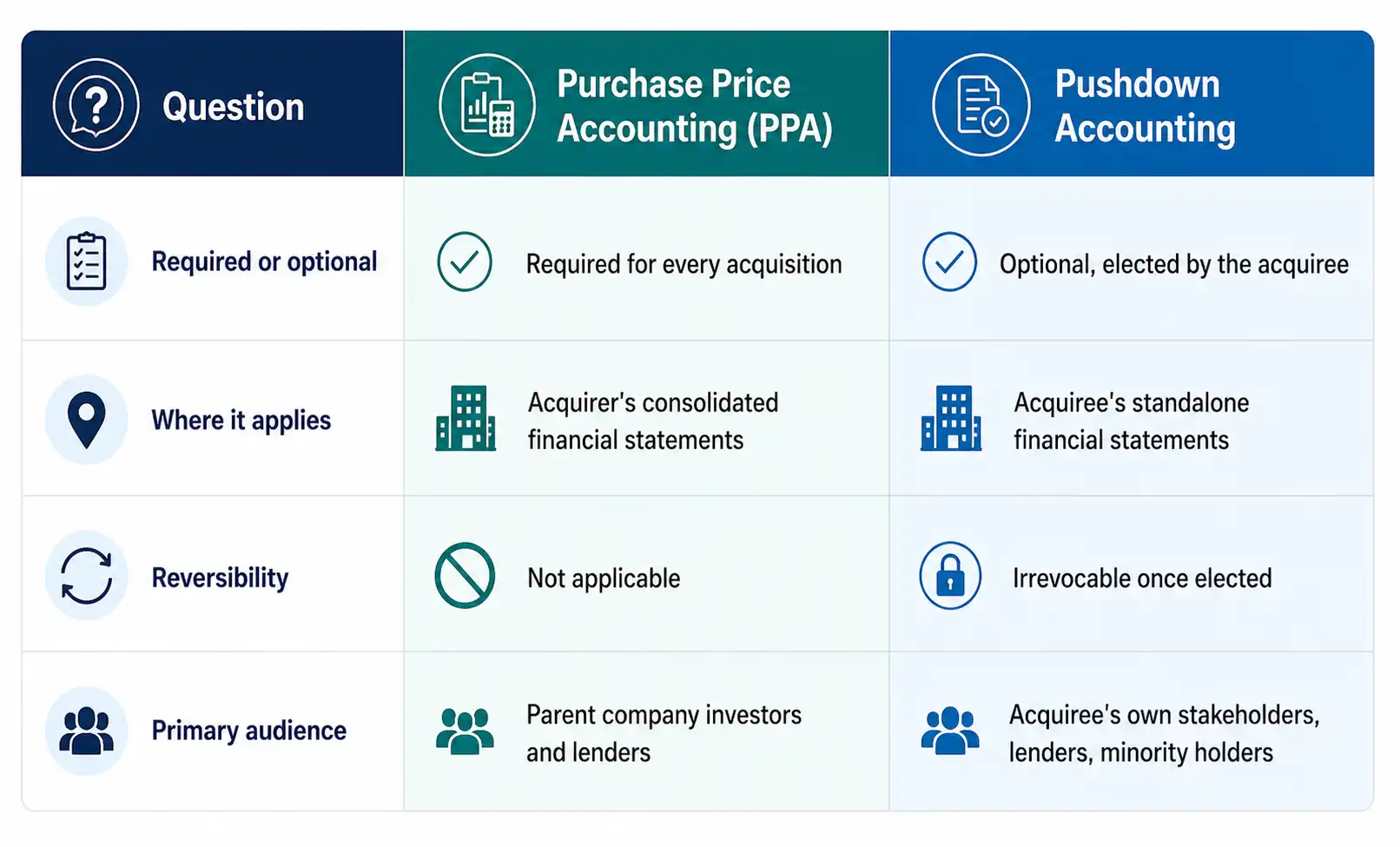
PPA happens on every deal, without exception, at the consolidated level. Pushdown only happens if the acquired entity chooses to carry the fair value basis onto its own books, which is why finance teams that keep entities separate for statutory, tax, or investor reasons need a deliberate answer to both questions rather than assuming one settles the other.
Three Key Takeaways
- Pushdown accounting is an election, not a default, and the decision belongs to the acquiree’s management working alongside the CFO, legal counsel, and auditors well before the deal closes, since the choice cannot be reversed once reflected in issued financial statements.
- Step acquisitions compound the analysis because the previously held equity interest must be remeasured at fair value the moment control is obtained, and layering a pushdown election on top of that remeasurement can produce earnings swings, covenant pressure, and amortization effects that have no connection to operating performance.
- The finance function that models both the consolidated and pushdown scenarios during diligence, aligns tax and ERP systems ahead of close, and briefs the board in plain language before the adjustments hit the books is the finance function that turns a technical accounting election into a credible piece of the deal narrative rather than a distraction from it.
Disclaimer: This article is intended for informational purposes only and does not constitute legal, tax, or accounting advice. You should consult your own tax advisor or counsel for advice tailored to your specific situation.
Hindol Datta is a four-time CFO and senior finance executive with over 25 years of leadership experience across cybersecurity, SaaS, gaming, logistics, digital marketing, medical devices, consumer products, and nonprofit organizations. He has led more than $120M in fundraising and over $150M in M&A transactions while building the financial and operational systems that let complex businesses scale with confidence. He is the author of seven books in the Systems CFO Series and holds active CPA, CMA, and CIA credentials.
AI-assisted insights, supplemented by 25 years of finance leadership experience.