
Executive Summary
A liquidation preference decides who gets paid first when a company exits, and how much they receive before anyone else sees a dollar. Founders often focus on the headline sale price. Investors go straight to the cap table and the liquidation preference stack, because that stack, not the ownership percentage, controls the actual payout.
This guide explains how liquidation preferences work, including the non participating liquidation preference structure most common in early rounds, walks through a full worked example of an exit waterfall, and lays out the practices that keep founders and employees from being surprised by their actual payout.
Understanding the Exit Waterfall
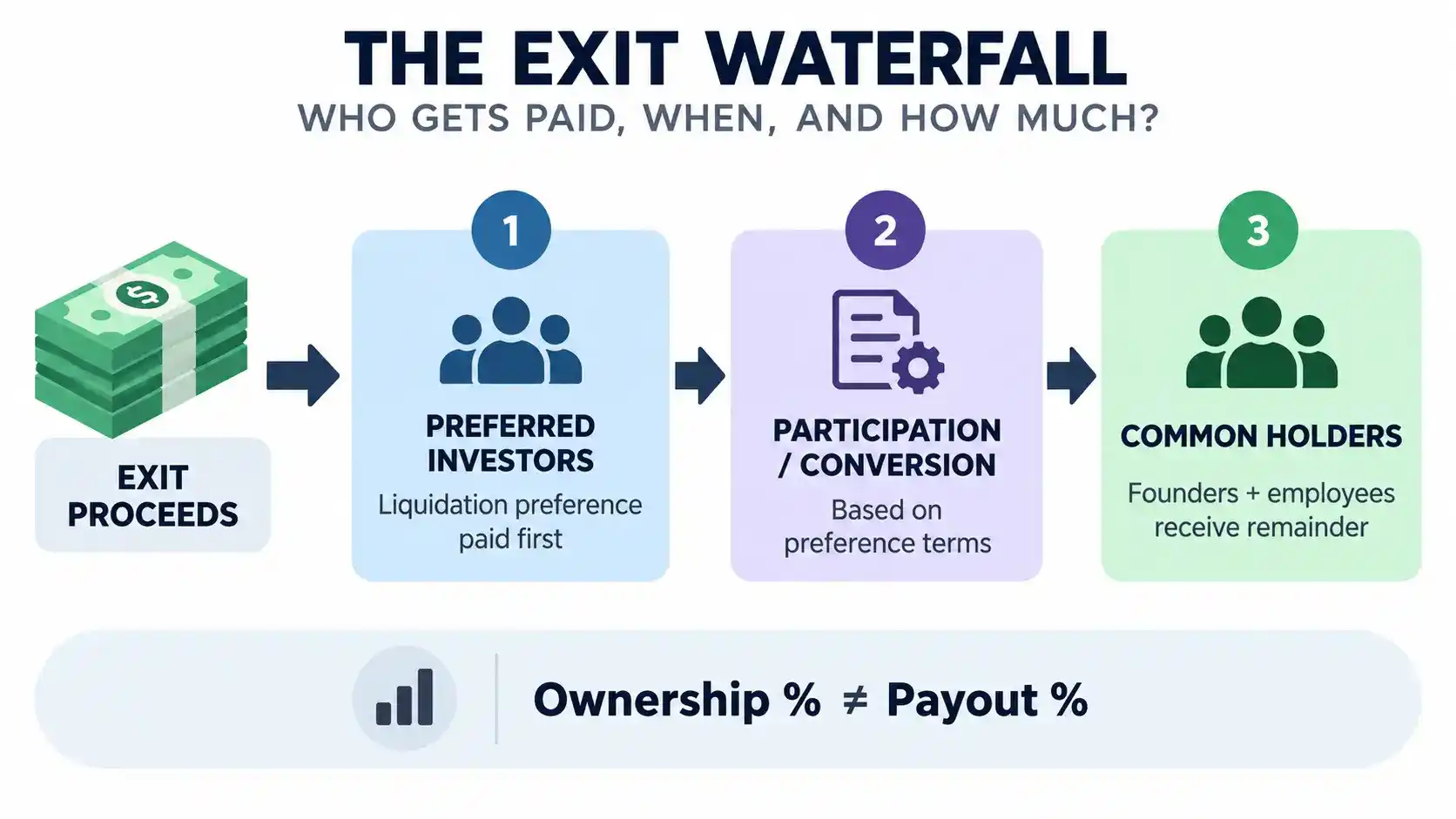
An acquisition, IPO, or merger promises a payout to everyone who held equity along the way. But the exit waterfall is not a simple, proportional split based on ownership. It is a legally structured order of priority based on the class of equity each stakeholder holds.
Liquidation preferences live inside preferred stock agreements and activate during a liquidity event. The waterfall, the sequence in which proceeds actually flow to stakeholders, depends entirely on those terms. Founders who misunderstand this sequence sometimes celebrate an eight-figure deal only to discover their real payout is a fraction of what they expected. Modeling, explaining, and governing this flow is squarely a CFO’s responsibility, since investors already understand the mechanics and founders and employees deserve the same clarity.
Liquidation Preference Mechanics: 1x, Participating, and Non-Participating Structures
The 1x Non Participating Liquidation Preference
This is the most common preference structure. Preferred shareholders receive 1x their original investment before common shareholders receive anything.
- Series A invests $10 million at a 1x preference
- The company sells for $25 million
- Series A receives $10 million off the top
- The remaining $15 million goes to common shareholders based on their equity percentages
2x and 3x Preferences
These appear less often, typically in down rounds or distressed financings. They grant investors two or three times their original investment before anyone else receives proceeds.
Participating Preferred
This structure gets more aggressive. Investors receive their preference first, then participate pro-rata in whatever proceeds remain.
- Series A invests $10 million and owns 25 percent of the company
- The exit is $40 million
- Series A receives $10 million as the preference, then 25 percent of the remaining $30 million, or $7.5 million
- Total payout to Series A reaches $17.5 million
Some agreements cap participation, often at 2x or 3x total return, to limit how far this structure can outsize other structures. Investors also frequently hold the option to convert preferred shares into common stock when doing so produces a better outcome, which tends to happen in a strong exit where pro-rata ownership exceeds preference rights. A CFO needs to model both paths to see which one triggers conversion, since legal documents set the thresholds but the underlying economics drive the actual decision.
Order of the Liquidation Stack
Companies that have raised multiple rounds carry multiple classes of preferred stock. These classes stack by seniority, with later rounds typically senior to earlier ones, or sit pari passu, where every class is treated equally.
- Amount invested per round
- Liquidation preference terms per round
- Participation rights and any caps
- Conversion thresholds
- Order of seniority across classes
Without these five inputs, a waterfall model is just a spreadsheet. With them, it becomes a strategic tool that shows exactly what each outcome means for each stakeholder.
Modeling a Real Exit Waterfall
Consider a company with Series A ($5M invested, 1x non-participating), Series B ($15M invested, 1x participating with no cap), and Series C ($30M invested, 1x non-participating). Ownership splits as 40 percent common, 15 percent Series A, 20 percent Series B, and 25 percent Series C. At a $100 million exit, preferences get paid first, totaling $50 million, and Series B’s participation right claims a share of what remains.
| Class | Invested | Preference Type | Total Payout at $100M Exit |
| Series A | $5M | 1x, non-participating | $5M |
| Series B | $15M | 1x, participating, no cap | $25M |
| Series C | $30M | 1x, non-participating | $30M |
| Common (founders and employees) | — | 40% ownership | $40M |
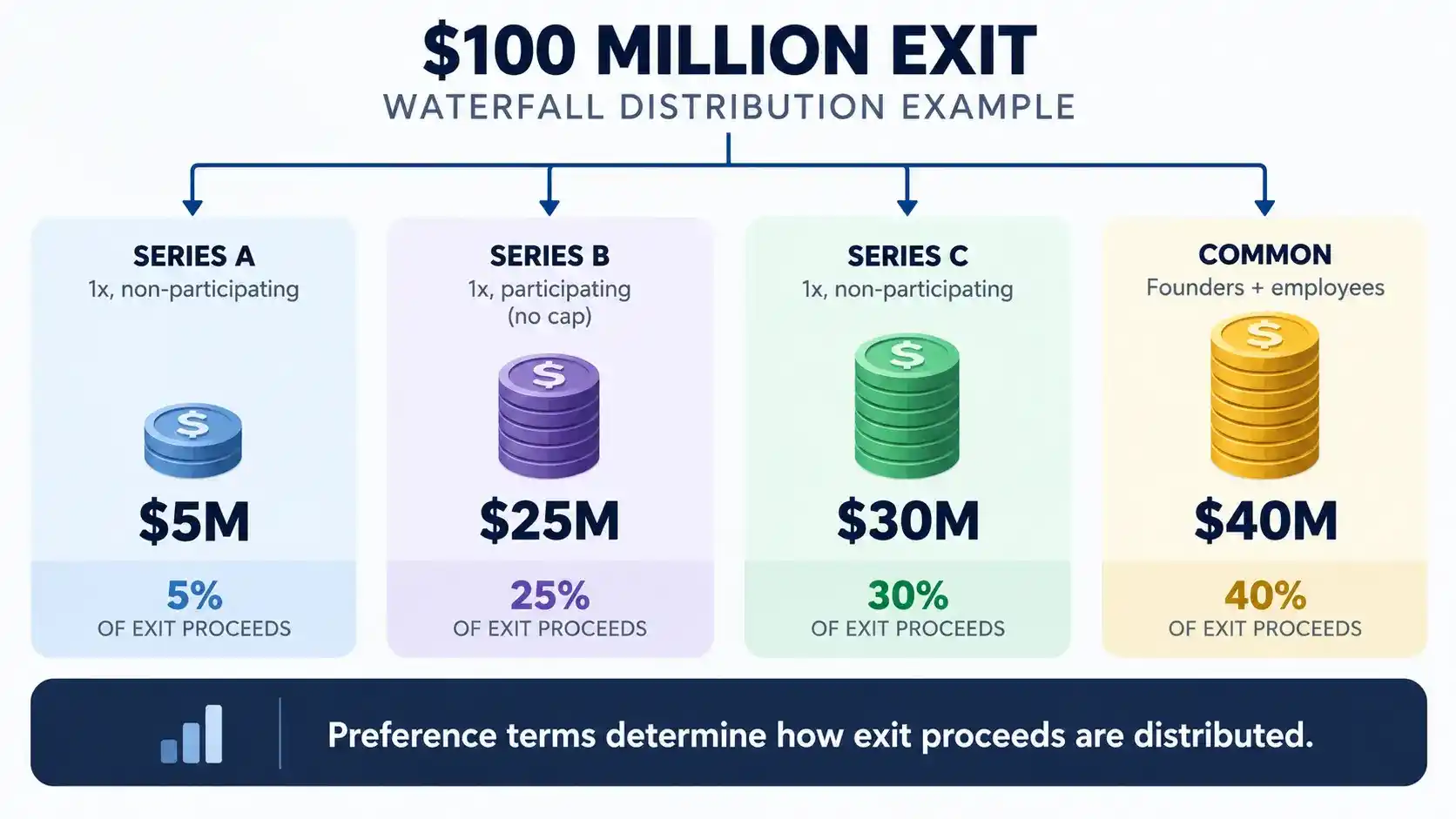
Common holders, including founders and employees, receive 40 percent of total proceeds in this scenario. Had the exit landed at $60 million instead of $100 million, common holders would have received nothing once the preference stack was paid. An employee who believes a 1 percent stake means 1 percent of exit value can be badly mistaken until the preference stack clears first.
Best Practices for Aligning Structure With Strategy
Build the Waterfall Early, and Maintain It
Waiting until an exit is in sight is too late. A waterfall model should start at Series A and update with every new financing round, including preferences, caps, and stack order, living alongside the broader financial model.
Communicate Realistically to Stakeholders
Employees deserve honest clarity about their equity. Exact payouts stay speculative until an exit happens, but teams should understand whether their equity carries current value, potential upside, or only long-term liquidity. Misalignment on this point drives turnover and disappointment.
Negotiate Preferences With Eyes Open
Participating preferred is worth avoiding unless truly necessary. When it cannot be avoided, negotiate a cap, and push for pari passu structures over senior stacks. The goal is not denying investors protection. It is preserving alignment between founders, employees, and investors.
Use Waterfalls in Strategic Decision-Making
Every financing or M&A offer deserves a waterfall run before the decision gets made. If the deal does not work for all stakeholders, terms such as equity carve-outs, bonuses, or retention pools can restore alignment.
Educate the Board
Not every director understands preference modeling in depth. Board literacy on this topic matters most when evaluating term sheets, recapitalizations, or strategic transactions.
Document Everything
Legal clarity matters as much as the model itself. Every preference term, cap, and participation right needs a clear home in the charter and term sheets, reviewed by counsel who understands venture dynamics and can stress-test the assumptions.
Three Key Takeaways
- A liquidation preference, not an ownership percentage, determines the actual order and size of payouts at exit. A large headline sale price can still leave common holders with far less than expected.
- The non participating liquidation preference is the most common structure, but participating preferred, caps, and conversion rights can all shift the math meaningfully once real dollars are on the table.
- A waterfall model built at Series A and maintained through every round turns exit planning from a guessing game into a tool that shows founders, employees, and the board exactly what each outcome means for them.
Disclaimer: This article is intended for informational purposes only and does not constitute legal, financial, or investment advice. Please consult your professional advisors before making decisions related to equity, liquidation preferences, or exit planning.
Hindol Datta is a four-time CFO and senior finance executive with over 25 years of leadership experience across cybersecurity, SaaS, gaming, logistics, digital marketing, medical devices, consumer products, and nonprofit organizations. He has led more than $120M in fundraising and over $150M in M&A transactions while building the financial and operational systems that let complex businesses scale with confidence. He is the author of seven books in the Systems CFO Series and holds active CPA, CMA, and CIA credentials.
AI-assisted insights, supplemented by 25 years of finance leadership experience.