Executive Summary
Most first-time founders treat a startup cap table as a spreadsheet to update after a financing round closes. In practice it is the single document that records every ownership decision a company has made. It records every decision the company will need to make again. Reading it correctly means understanding who owns what today. It also means understanding how that ownership shifts. A bridge note conversion can change it. So can a down round, or an option pool top off before the next raise.
This piece walks through the mechanical building blocks of a cap table. It explains why cap table management deserves the same rigor finance teams give the balance sheet. It also shows how founders can operationalize the discipline before an institutional investor forces the issue during diligence.
What a Startup Cap Table Actually Represents
Founders tend to distribute equity the way people hand out chips at a friendly card game, five percent here, two percent there, without registering that every allocation is also an allocation of future control. A cap table is not a static ledger. It is a running record of trust, risk, and leverage, and the finance function, even at the earliest stage, has to treat it as the central artifact of alignment between capital, people, and control rather than an administrative afterthought.
In one pre-Series A AI governance company, the finance function built the entire financial backbone from nothing, including the capital strategy and investor narrative behind the raise. No one inherited the cap table; the team designed it line by line, knowing that every early grant set precedent for every grant that followed. That is the deeper truth of cap table management. The document previews how ownership behaves under stress, in a fundraise, an exit, a down round, or an employee termination, long before any of those events occur.
Breaking Down the Core Elements of a Startup Cap Table
Fluency in a few terms separates founders who negotiate from a position of strength from those who discover, mid-term sheet, that they misunderstood their own ownership.
- Authorized shares are the ceiling set in the company charter, the total the company may ever issue. Many early companies authorize ten million shares not because they need that many immediately but because it avoids repeated board approvals for routine issuance.
- Issued shares are what the company has actually granted, typically concentrated in large founder grants at incorporation.
- Outstanding shares include all issued shares currently held by stockholders. This is the figure most investors use to calculate ownership percentage, and it excludes unexercised options.
- The option pool, reserved but unissued, is a quiet line with loud consequences. Companies set it aside for employee and advisor grants, typically running from ten to twenty percent of fully diluted shares. They often structure it pre-money, which dilutes founders in a way that is easy to miss until someone runs the math.
- Fully diluted shares represent the total that would exist if every convertible instrument, options, SAFEs, notes, converted at once. This is the number sophisticated investors care about because it reflects their real post-financing ownership.
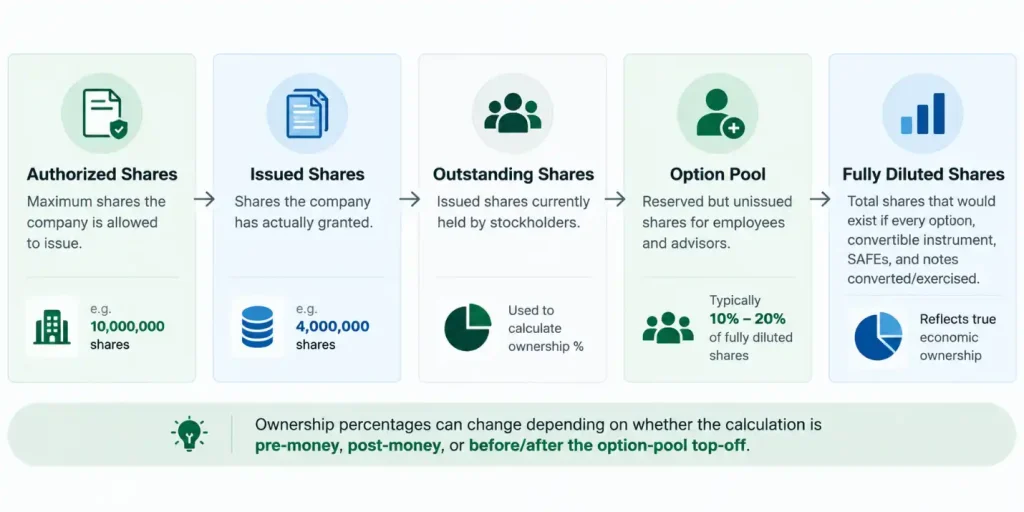
The most common failure point is loose language around percentage ownership. When a term sheet references twenty percent, the founder needs to know immediately whether that figure is pre-option pool, pre-money, or post-money, because each variant shifts dilution in a different direction and by a different amount.
A Worked Example of Dilution Pressure
The table below shows how a routine investor request, topping off the option pool before a raise, can move a founder stake without a single new hire.
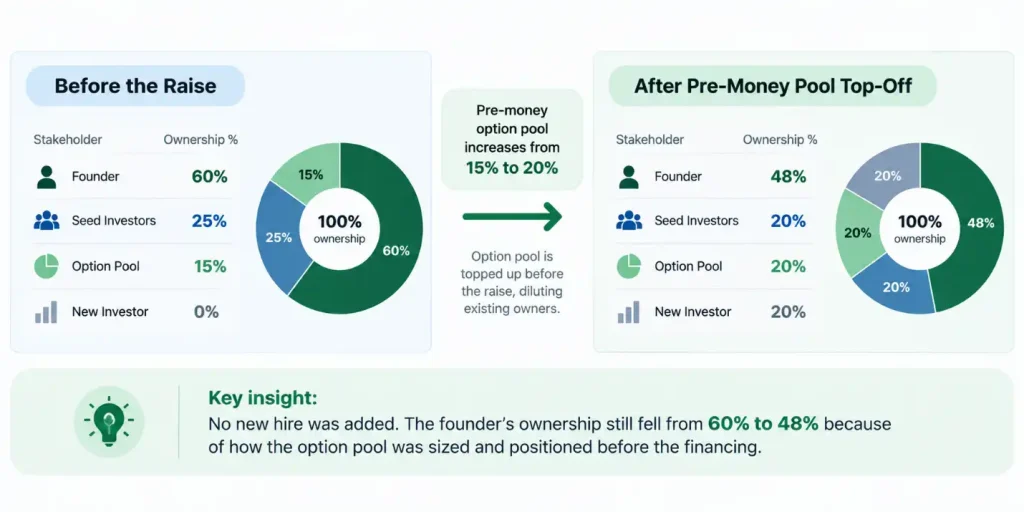
Nothing about the team changed in that scenario. The only thing that moved was the mechanism sizing and timing the option pool. That timing detail separates a founder who negotiates well from one who signs a term sheet without asking where the pool sits in the sequence.
Why Cap Table Management Matters More Than the Balance Sheet Early On
For an early-stage company, the balance sheet rarely carries the real story. Cash burns, the company leases equipment, and revenue is often aspirational. The cap table is where the substance sits. This looks like the passage you just approved is there a specific Yoast flag on it (e.g., sentence length, passive voice) you’d like me to fix, or did you mean to paste something else?
In a venture-backed digital marketing company that scaled revenue from $9M to $180M in twenty-four months, the finance function had to build cap table discipline while raising $36.5M across three rounds and closing three acquisitions in parallel. Every acquisition added new share classes and every round layered new liquidation preferences on top of the old ones. Without a cap table that modeled these interactions in advance, a board conversation about the next round would have started from guesswork rather than fact.
Cap tables also anticipate conflict long before it surfaces. What happens when an advisor holding three percent disappears after full vesting. What happens when former executive asserts repurchase rights. These are not hypotheticals confined to legal training manuals. They are structural exposures sitting quietly inside a spreadsheet, and sophisticated investors diligence a cap table with the same scrutiny they apply to a financial model, hunting for phantom shares, mispriced options, and equity promises that were never properly documented.
Operationalizing Cap Table Management the Right Way
Spreadsheets are adequate in the earliest days. They offer control and force the founding team to learn the mechanics directly. Once institutional capital enters the picture, however, treating the cap table like a personal project stop being defensible. Purpose built platforms such as Carta, Pulley, or Shareworks exist for a reason. They enforce discipline that a shared spreadsheet cannot, above all around 409A valuation support, board reporting, and audit preparation.
A properly operationalized startup cap table supports scenario modeling that answers real questions. What happens to ownership under a down round. What is the dilution impact of a fresh ten percent option pool. Who receives what under a $100M exit with a 1x liquidation preference stack. These are not academic exercises. They are the scaffolding for decisions that get made in a single board meeting and live with the company for years.
Governance discipline matters as much as software choice. Every equity grant needs board approval on record. The option pool needs to be reflected accurately in the financials. Every share transfer needs documentation the day it happens, not reconstructed months later when a diligence request arrives.
Cap table management is inherently cross-functional. Legal sets the boundaries of what is permissible. Finance owns the data and its accuracy. HR administers the grants that finance has modeled. Leadership communicates what all of it means to the people affected by it. Coordinating those four functions, so the story each one tells matches the others, is where a startup either builds credibility with its investors or slowly erodes it.
In a mission-driven education and research institution, a $37M raise across equity and venture debt required this same kind of coordination, with the finance function owning investor narrative and board relationships while structuring a capital stack that would not compromise the institution’s long-term mission. The lesson travels well beyond nonprofit finance. Equity is not currency to spend loosely. It is a lever for alignment, and it has to be deployed with the same care applied to any other scarce, non-renewable resource.
Three Key Takeaways
- A startup cap table is a living record of every trust-based commitment a company has made, not a static ledger, and it should be modeled under stress scenarios such as bridge conversions, down rounds, and exits well before those events actually occur.
- Precision about ownership percentage terms, whether a figure is pre-option pool, pre-money, or post-money, prevents the single most common and costly misunderstanding founders encounter when negotiating a term sheet.
- Cap table management only holds up when legal, finance, HR, and leadership operate from the same documented facts, supported by purpose-built software rather than a spreadsheet that nobody outside finance can interpret.
Disclaimer – This article is intended for informational purposes only and does not constitute legal, tax, or accounting advice. You should consult your own tax advisor or counsel for advice tailored to your specific situation.
Hindol Datta is a four-time CFO and senior finance executive with over 25 years of leadership experience across cybersecurity, SaaS, gaming, logistics, digital marketing, medical devices, consumer products, and nonprofit organizations. He has led more than $120M in fundraising and over $150M in M&A transactions while building the financial and operational systems that let complex businesses scale with confidence. He is the author of seven books in the Systems CFO Series and holds active CPA, CMA, and CIA credentials.
AI-assisted insights, supplemented by 25 years of finance leadership experience.