Executive Summary
Cap table hygiene is not a compliance chore tucked away in a spreadsheet somewhere. It is the record of every ownership promise a company has ever made. Investors, acquirers, and underwriters read that record closely. The most common cap table mistakes rarely surface the day they are made. This includes phantom equity promises and unmanaged option pools alike. They surface later, at the worst possible moment. A diligence team pulls the thread, and it does not hold.
This article breaks down the six most common cap table errors that quietly erode founder credibility and equity value. It also covers the practices experienced finance leaders use to prevent them. None of this requires exotic tooling or a large finance team. It requires discipline and a documented process. A clean cap table is a form of institutional readiness. That readiness compounds in value with every round, every hire, and every year the company survives.
Why Cap Table Hygiene Is a Governance Discipline, Not an Administrative Task
A cap table starts simple: one founder, ten million authorized shares, full ownership on a clean page. It does not stay that way. Advisors join, employees are granted options, SAFEs and convertible notes accumulate, and rounds are priced. Somewhere in that accumulation, the cap table stops being a ledger. It becomes the structural memory of every decision the company has made about who owns what and why.
Cap table mistakes are dangerous precisely because they are quiet. A verbal promise to an advisor rarely looks urgent. Neither does an option grant that never made it into the system. Nor does a spreadsheet version that drifted from the one the board approved. They look urgent during a 409A valuation, a fundraise, or an acquisition. A diligence team compares the cap table against every board resolution the company has produced. It checks every grant agreement too. A gap turns up.
Boards and public-market gatekeepers alike treat cap table management as a proxy for how a management team runs everything else. A gaming and digital entertainment company preparing for its S-1 and an IPO-readiness process learns this quickly. A single unreconciled equity line can stall the process. By then, underwriters or Big Four auditors have already caught it. Months of work and significant legal spend are on the line. The lesson generalizes well beyond public companies. Clean cap tables signal discipline, and messy ones invite the kind of scrutiny that slows everything else down.
The Six Cap Table Mistakes That Cost Founders Credibility and Equity
The following six errors cause most cap table hygiene problems. They tend to surface during fundraising, 409A valuations, and exit diligence.
- Phantom equity and unpapered promises – A founder verbally offers 0.5% to an early advisor. There is no board approval, no grant agreement, and no vesting schedule, just an email or a handshake. Years later that person resurfaces with a claim the company cannot easily dismiss. The fix: no equity is promised without board approval and legal review.
- Outdated or inconsistent records – Spreadsheets are fine early on, but only if rigorously maintained. Versions multiply, updates lag, and one document says an employee holds 10,000 options while another says 15,000. Investors read that inconsistency as a preview of how the company will handle their capital. Migrating to a platform such as Carta, Pulley, or Shareworks before a priced round helps. These tools enforce version control and audit trails automatically.
- Unallocated or misused option pools – Founders sometimes dip into the option pool without reference to a hiring plan, granting ad hoc amounts never benchmarked to role or level. Grants expire unnoticed and true dilution becomes hard to see. A driver-based hiring model, tracked against grant usage and expirations, keeps the pool sized to the business rather than the last request.
- Failure to track convertible instruments properly – SAFEs, convertible notes, and warrants accumulate quietly, and few founders track precisely how each converts, at what cap or discount, or in what priority. When a priced round arrives, these instruments convert into more dilution than modeled. A pro forma conversion model, updated with every new instrument, removes the guesswork.
- Missing option grant agreements or vesting schedules – Some companies extend options via offer letter and never complete the grant paperwork or set a vesting schedule. Without vesting, options can become immediately exercisable or disputed, and an employee who departs after two months may retain years’ worth of equity. Every grant needs a board-approved resolution, a signed agreement, and a standard schedule, typically four years with a one-year cliff.
- Failing to reclaim unvested shares after departures – When someone leaves before vesting, the unvested portion should revert to the company automatically. Many startups never enforce this, and the cap table fills with inactive stakeholders who still count against the fully diluted share count. Repurchase rights and clawback provisions, executed promptly after every departure, keep the table representative of who is actually building the company.
How Cap Table Hygiene Compounds Over Time
None of these six mistakes is dramatic in isolation. What makes cap table hygiene a compounding discipline rather than a one-time fix is the way small gaps accumulate quietly across years and rounds, invisible until a diligence process forces a reckoning:
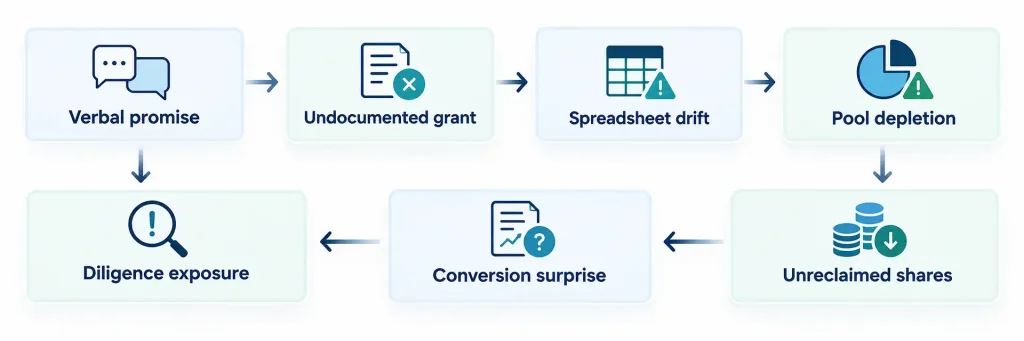
Every arrow in that loop represents a decision that was easy to defer and expensive to unwind later. Breaking the loop is a matter of process discipline applied consistently, not a heroic cleanup exercise undertaken once a round is already at risk.
Operationalizing Cap Table Discipline
Cap table hygiene is not a one-time cleanup; it is a system that has to survive turnover, growth, and the pressure of a live fundraise. In a mission-driven education and research institution that raised $37M across equity and venture debt, the audit committee and board reporting cadence existed specifically so that ownership questions never became surprises during a capital raise. Building that kind of durability generally requires attention to the following:
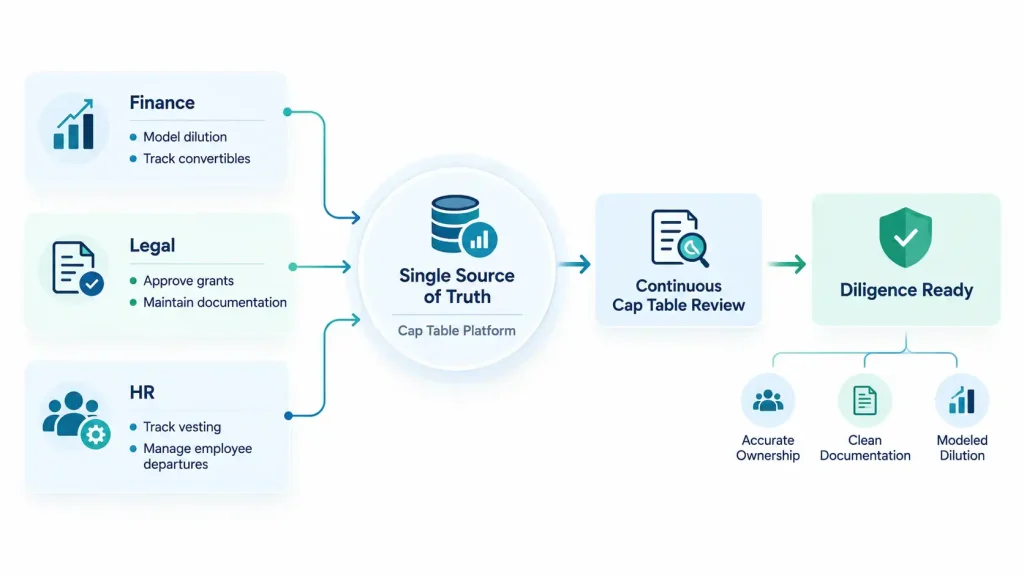
- Adopt a cap table platform early – Tools such as Carta, Pulley, and LTSE Equity automate option tracking, board approvals, 409A coordination, and document storage, and they remove most of the human error that spreadsheets invite.
- Write an equity administration policy – Document grant sizing by level, vesting norms, the approval process, departing-employee treatment, and pool refresh timing, so the policy becomes the company’s internal constitution on equity rather than a set of ad hoc judgment calls.
- Align finance, legal, and HR – Equity touches all three functions: HR administers grants, legal enforces terms, and finance models the dilution impact. A venture-backed digital marketing organization that raised $36.5M across three funding rounds while completing three acquisitions could not have kept its cap table coherent without those three functions operating from the same source of truth at every stage.
- Educate stakeholders – Founders, executives, and employees who understand what the cap table says, and does not say, make fewer verbal promises and ask better questions before signing anything.
- Prepare for diligence continuously – Every cap table should be diligence-ready at all times: current documentation, clean ownership records, accurate fully diluted share counts, modeled convertible instruments, and 409A alignment. A high-growth cybersecurity and identity access management company carrying roughly $30M in annual recurring revenue-maintained board-grade reporting and a documented equity ledger for this exact reason, and that discipline carried the business cleanly through acquisition diligence when the moment finally arrived.
Cap Table Hygiene as Strategic Infrastructure
Equity is the most expensive currency a startup ever spends, and every share granted, promised, or forfeited carries weight well beyond its economic value. The cap table functions as scoreboard, legal record, and foundation of trust all at once, and companies that treat cap table management as strategic infrastructure rather than administrative overhead attract better investors, retain stronger talent, and walk into exits with confidence instead of exposure. Those that neglect it eventually pay in legal fees, in credibility, and in leverage lost at the exact moments when leverage matters most. Good infrastructure, when it works, goes unnoticed. When it fails, the cost lands on everyone at once.
Three Key Takeaways
- Most cap table mistakes are not created by bad intentions; they are created by deferred documentation, and the fix is a standing rule that no equity commitment exists until it carries board approval, a signed agreement, and a vesting schedule.
- A cap table platform is not a luxury reserved for later-stage companies; the version control, audit trail, and workflow discipline it enforces prevents the inconsistencies that slow diligence and erode investor confidence at the worst possible time.
- Cap table hygiene compounds like any other discipline, so the companies that treat it as continuous governance rather than pre-round cleanup are the ones that walk into a raise, a 409A, or an acquisition with nothing left to explain.
Disclaimer: This article is intended for informational purposes only and does not constitute legal, tax, or accounting advice. Readers should consult their own tax advisor or counsel for advice tailored to their specific situation.
Hindol Datta is a four-time CFO and senior finance executive with over 25 years of leadership experience across cybersecurity, SaaS, gaming, logistics, digital marketing, medical devices, consumer products, and nonprofit organizations. He has led more than $120M in fundraising and over $150M in M&A transactions while building the financial and operational systems that let complex businesses scale with confidence. He is the author of seven books in the Systems CFO Series and holds active CPA, CMA, and CIA credentials.
AI-assisted insights, supplemented by 25 years of finance leadership experience.