Executive Summary
Every early-stage founder eventually faces the same question: should they raise capital through a SAFE or a convertible note? Which one protects the company when the priced round finally arrives? The honest answer is that both instruments solve the same problem. They trade a formal valuation conversation for speed and simplicity when a company needs capital now. But neither one removes complexity. Both just defer it. A cap table that looks clean on signing day can look unrecognizable eighteen months later. Caps, discounts, and accrued interest all convert at the same moment, and the ownership picture shifts fast.
This article walks through the mechanics of each instrument, the difference between SAFE and convertible note in legal and financial terms, and the discipline required to model conversion before it happens rather than after the founders are surprised by it. None of this is theoretical. The dilution math shown below has played out, in one form or another, across cybersecurity, consumer products, education, and digital marketing companies at very different stages of growth.
The Real Stakes Behind the SAFE vs Convertible Note Decision
Founders raising their first capital are rarely choosing between good options and bad ones. They are choosing between instruments that trade one kind of risk for another. SAFEs and convertible notes exist because priced equity rounds are expensive to negotiate and slow to close, and early-stage companies frequently cannot afford either the time or the legal cost of a formal valuation. Both instruments let a startup access capital quickly while pushing the valuation conversation to a later date, which sounds like a convenience until the deferred complexity compounds across several rounds.
A finance leader who has built the operating model and investor narrative for a pre-Series A AI governance platform from nothing has watched this pattern up close: the very first capital raised through simple instruments often becomes the hardest tranche to model correctly later, precisely because nobody built the conversion math at the time it was signed. Understanding how SAFEs, convertible notes, and priced equity interact is not a legal exercise. It is a cap table modeling discipline, and the CFO who treats it that way avoids the compounding surprises that hit hardest during a priced round or an exit.
How a SAFE Works: Structure, Caps, and Discounts
A SAFE, short for Simple Agreement for Future Equity, is not equity today. It is a contractual promise of equity tomorrow, and understanding that distinction is the starting point for any serious comparison of SAFE vs convertible note structures. Developed by Y Combinator in 2013, the SAFE allows an investor to provide capital immediately in exchange for shares that materialize later, typically at a discount, a valuation cap, or both. There is no maturity date attached to a SAFE and no interest accruing in the background, which is precisely what makes it faster to negotiate than a convertible note.
A SAFE’s terms determine everything about how favorably it converts, and three characteristics matter most:
- No maturity date and no interest, which removes the repayment pressure that a note eventually creates
- Conversion tied to a priced equity round or a liquidity event, not to a fixed calendar date
- A valuation cap, a discount, or both, layered on top of the eventual conversion price
The valuation cap sets a ceiling on the valuation at which the SAFE converts, so if the next priced round comes in above that cap, the SAFE holder converts at the lower, capped valuation and receives more shares for the same dollar invested. The discount works differently, offering a fixed percentage reduction, commonly between 10 and 20 percent, off the next round’s share price when the cap itself is not the binding constraint.
Reading the Valuation Cap and Discount Together
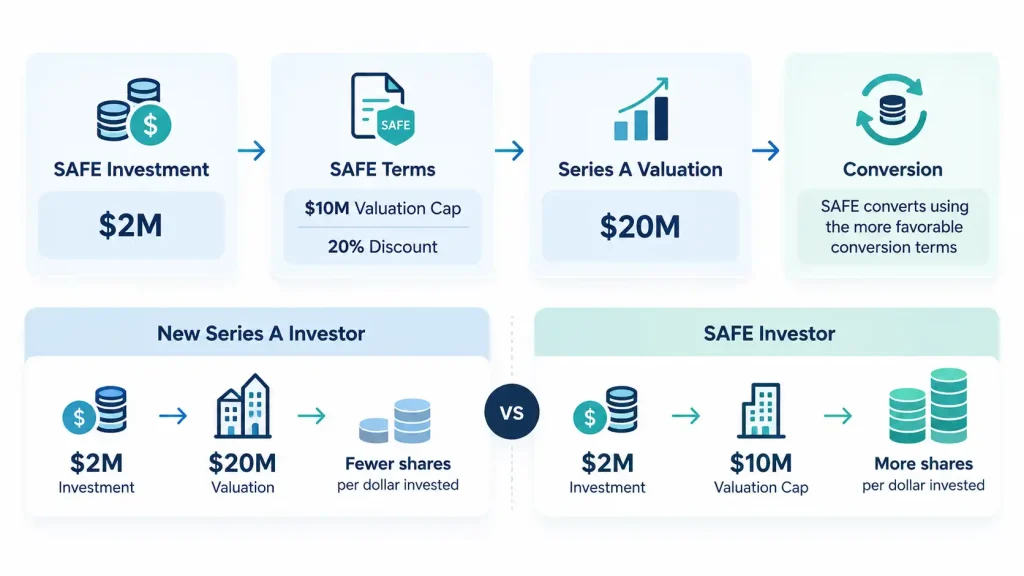
The two mechanisms rarely operate in isolation, and the investor generally receives whichever version of the math is more favorable. Consider a SAFE structured with a $2M investment, a $10M valuation cap, and a 20 percent discount, where the company later raises a priced round at a $20M valuation. The SAFE converts as though the company were worth $10M, not $20M, which hands that investor roughly twice the ownership a new Series A investor receives for the identical dollar amount.
The consequence for the cap table is that a SAFE creates dilution that stays invisible until the moment of conversion, and it converts before new investor ownership is even calculated, which is exactly why founder modeling so often excludes it until it is too late. A cap table carrying five or six SAFEs from different rounds can produce a genuine conversion shock at the priced round, leaving founders with meaningfully less ownership than the number they had been carrying in their heads. The disciplined CFO builds the full conversion model long before that priced round shows up on the calendar, not the week the term sheet arrives.
Convertible Notes: Debt That Behaves Like Equity
A convertible note is the direct predecessor to the SAFE, and the difference between SAFE and convertible note terms comes down almost entirely to the debt characteristics a note carries that a SAFE does not. Legally, a convertible note is debt, which means it accrues interest, typically in the 4 to 8 percent range, and it carries a maturity date, usually somewhere between 18 and 24 months out. Like a SAFE, it converts at a discount, a valuation cap, or both, but unlike a SAFE, it can also include repayment rights if maturity arrives before any qualifying conversion event.
Take a $500K note carrying 6 percent interest, a 20 percent discount, and an $8M valuation cap. At maturity or at the next priced round, whichever comes first, the noteholder converts at whichever produces the better outcome between the capped valuation and the discounted price, and the accrued interest increases the total amount converting into shares. If no priced round has occurred by the time the note matures, the company faces a note that has technically come due, which can force an uncomfortable negotiation at exactly the moment cash is tightest.
Interest, Maturity, and the Pressure They Create
The finance leader who ran full ownership of financial and operational systems for a mission-driven education institution, including a $37M raise across equity and venture debt, has seen how a maturity date changes the tenor of every board conversation in the run-up to it. Convertible notes are dilutive on conversion in the same way SAFEs are, but the accrued interest increases the converting balance over time, and the maturity date itself can trigger repayment pressure or force a renegotiation the company did not plan for. Convertible notes offer more structure than SAFEs, and more customizable terms for investors willing to negotiate them, but that structure comes paired with real risk: a note maturing ahead of a priced round can create a genuine cash crunch or a legal conflict that a SAFE, lacking any maturity date, simply cannot generate.
A CFO maintaining a live maturity table alongside the standard cap table, and running conversion scenarios well ahead of any note’s due date, is the difference between an orderly negotiation and a forced one. The goal is never to be surprised by compounding interest or by a conversion trigger nobody flagged six months earlier.
Priced Equity Rounds and the Moment of Reckoning
Priced equity rounds, whether labeled Series Seed, Series A, or Series B, involve selling shares at a defined price rather than deferring that conversation. These rounds set a formal pre-money and post-money valuation, update the company’s charter, and typically introduce preferred stock carrying liquidation preferences and other investor protections. This is the moment when every SAFE and every convertible note on the cap table finally converts, and where the invisible dilution both instruments were quietly building suddenly becomes visible in a single financing event.
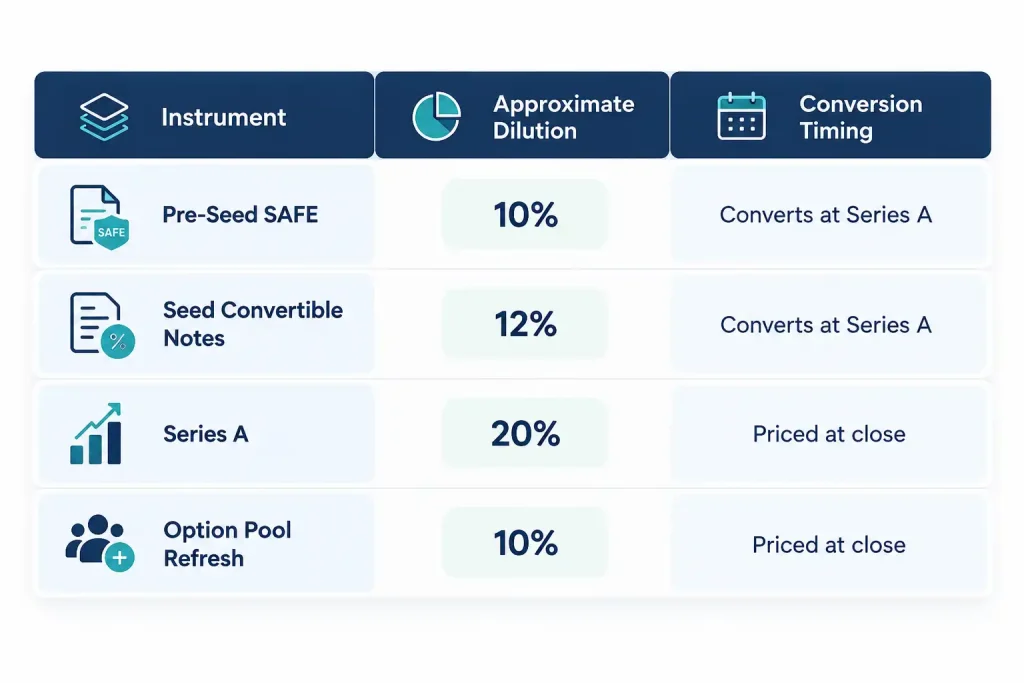
A finance leader who anchored a $20M Series B raise for a marketplace SaaS platform, building the cohort analysis and unit economics that carried the round through diligence, has watched founders walk into that round believing they still hold well above half the company, only to discover the number drops considerably once every instrument converts. The table below shows a fairly typical dilution sequence:
Founders often believe they retain 60 percent ownership right up until the SAFEs and notes convert, at which point that number can fall to 40 percent or lower. That drop is not a negotiating failure on anyone’s part. It is a modeling failure, and it is entirely preventable with a pro forma cap table-built months in advance.
Operationalizing this transition requires a few concrete disciplines: maintaining a pro forma cap table with full conversion modeling at all times, running a legal review to confirm every instrument is clean and documented against the charter, communicating changes in share count to employees and advisors before they discover it independently, and updating the 409A valuation once the new round has priced to reflect current fair market value.
Building a Cap Table That Survives the SAFE Note vs Convertible Note Debate
The instruments themselves are neutral. What determines whether a company’s cap table stays coherent is the discipline applied around them, and a finance leader who scaled a venture-backed digital marketing organization from $9M to $180M in revenue across three funding rounds, raising $36.5M along the way, has learned that the discipline matters more than the choice between any single SAFE note vs convertible note structure. A handful of strategic habits separate the CFOs who avoid conversion shocks from the ones who inherit them:
- Avoid stack bloat by limiting how many SAFEs or notes accumulate before a priced round, and consolidate instruments where the legal structure allows it
- Model every combination of cap and discount individually, since the interaction between the two determines the real conversion path, not either term in isolation
- Decide deliberately whether SAFEs convert pre-money or post-money, since that choice shifts the dilution burden in a way that is easy to overlook until the math is run
- Communicate proactively with new investors about how prior instruments convert, since surprises at the table erode trust faster than almost anything else
- Confirm the exit triggers embedded in each instrument, since some SAFEs convert at acquisition rather than at the next financing event
Early capital is essential to growth, but the form that capital takes shapes the structure a company lives with for years afterward. SAFEs and notes are efficient instruments precisely because they defer both dilution and governance questions, while priced equity rounds trade that efficiency for clarity and rigor. The operational CFO plans for both the capital the business needs today and the structural consequences of how that capital eventually converts.
Three Key Takeaways
- The choice in the SAFE vs convertible notes decision matters less than the modeling discipline applied afterward, since both instruments defer dilution that eventually surfaces in full at the next priced round.
- A valuation cap, a discount, and accrued interest each move the conversion math independently, and a CFO who models them together, rather than waiting for the term sheet, avoids the conversion shock that catches most founders off guard.
- A pro forma cap table maintained continuously, alongside a live maturity table for any outstanding notes, turns a priced round from a moment of reckoning into a well-anticipated milestone.
Disclaimer: This article is intended for informational purposes only and does not constitute legal, tax, or accounting advice. You should consult your own tax advisor or counsel for advice tailored to your specific situation.
Hindol Datta is a four-time CFO and senior finance executive with over 25 years of leadership experience across cybersecurity, SaaS, gaming, logistics, digital marketing, medical devices, consumer products, and nonprofit organizations. He has led more than $120M in fundraising and over $150M in M&A transactions while building the financial and operational systems that let complex businesses scale with confidence. He is the author of seven books in the Systems CFO Series and holds active CPA, CMA, and CIA credentials.
AI-assisted insights, supplemented by 25 years of finance leadership experience.