Executive Summary
How does dilution work across a real fundraising journey? Founder dilution by round rarely comes from one bad decision. It builds gradually through option pool refreshes, SAFE conversions, and standard financing terms that each look reasonable in isolation.
This guide traces a hypothetical company from seed through Series D, shows exactly how each round chips away at founder ownership, flags the structural errors that make dilution worse than it needs to be, and lays out the guardrails that keep a founder in control of the outcome rather than surprised by it.
How Does Dilution Work Across a Fundraising Journey
Founders often assume a strong valuation or friendly investor terms will protect their ownership. Dilution rarely announces itself that way. It happens incrementally and structurally, and most founders only notice the cumulative effect once it has already occurred. The gap between 70 percent and 12 percent ownership across four rounds is usually the compound result of standard decisions, not a single catastrophic mistake.
Dilution itself is not the problem. Capital raised wisely grows the pie for everyone. The real risk shows up when founders misunderstand the mechanics, skip the modeling, or accept terms that are structurally biased against the founding team.
Assumptions Used in This Walkthrough
- A single founder holds 100 percent ownership at incorporation
- The company authorizes 10 million shares at incorporation
- Every equity grant and capital raise is calculated on a fully diluted basis
- SAFEs and option pools appear where they typically would at each stage
Founder Dilution by Round: Seed Through Series D
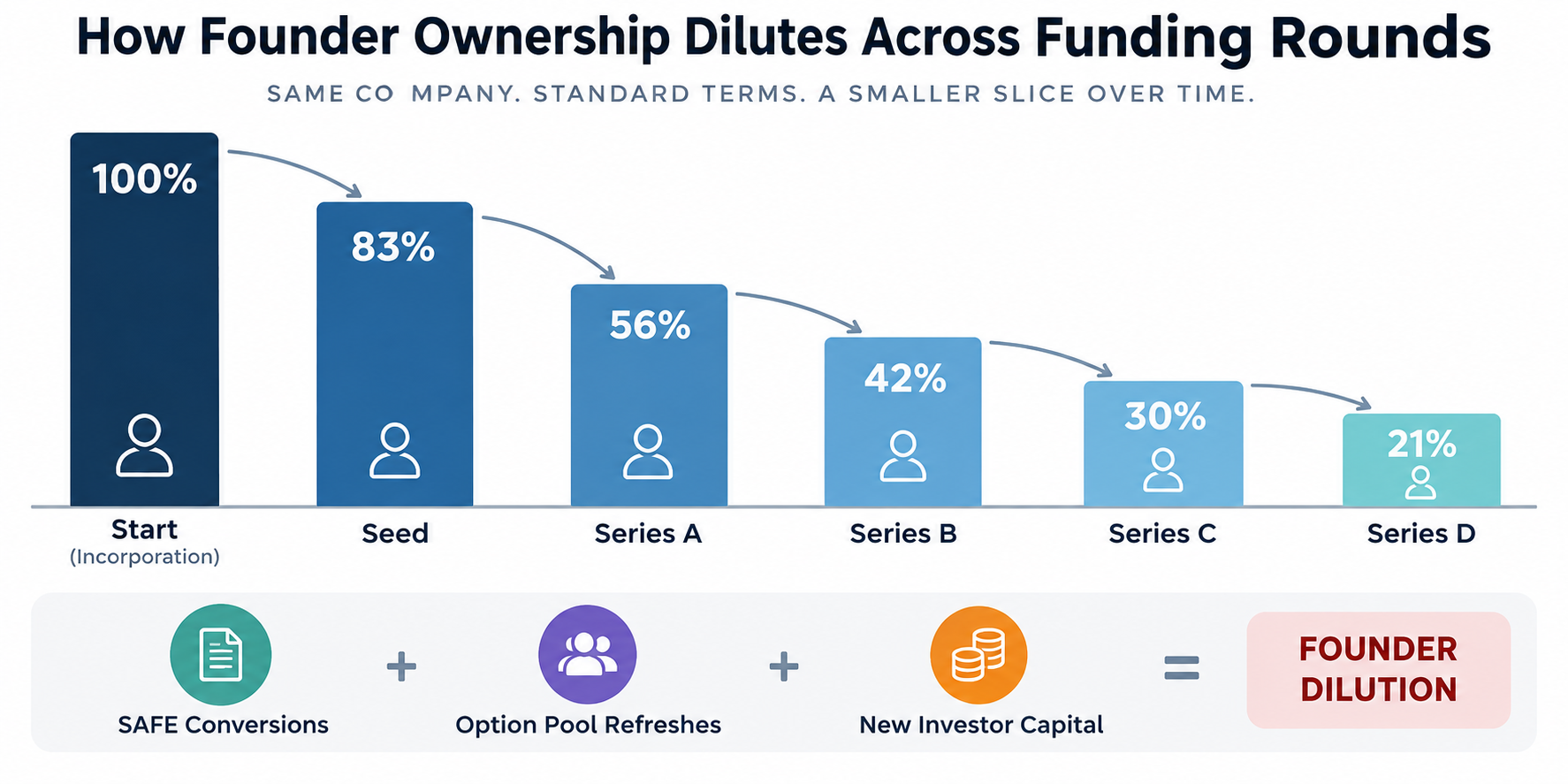
The table below tracks founder ownership through five rounds under clean, standard term sheets. Even in this ordinary scenario, ownership erodes fast.
| Round | Raise | Pre-Money Valuation | Option Pool Refresh | Founder Ownership After |
| Seed (SAFE) | $1M | $5M cap | None yet | 83% |
| Series A | $5M | $15M | 15% (pre-money) | 56% |
| Series B | $10M | $40M | 10% (pre-money) | 42% |
| Series C | $25M | $100M | 5% (pre-money) | 30% |
| Series D | $50M | $250M | 3% (pre-money) | 21% |
By Series D, the founder holds 21 percent of the company. SAFEs, option pools, and new investor capital account for the remaining 79 percent.
What Drives Each Round’s Dilution
- Seed: A single SAFE with a valuation cap can convert into more ownership than founders expect, even before an option pool exists
- Series A: A pre-money option pool refresh pushes the new dilution onto the founder and the SAFE holder, not the incoming investor
- Series B: Investors size the pool to match hiring plans, but existing shareholders absorb the dilution, and founder ownership drops below half
- Series C: New capital dilutes less as the valuation climbs, but historical dilution has already cost the founder majority control
- Series D: Cumulative rounds and repeated pool refreshes continue to compress founder ownership, even against a strong headline valuation
Where Dilution Gets Worse: Common Structural Errors
Misunderstanding Option Pool Mechanics
Founders often skip modeling how option pool refreshes stack across rounds. A pre-money pool creates dilution that looks subtle round by round but compounds severely over time. Many founders accept investor defaults of 10 to 20 percent instead of negotiating pool size against actual hiring needs.
Over-Reliance on SAFEs and Notes
Stacking too many SAFEs or notes at the pre-seed stage creates a bloated overhang. When several instruments convert at once, the founder absorbs dilution in bulk, and low caps or uncapped instruments make the effect worse.
Chasing Valuation Over Structure
Founders sometimes trade a higher headline valuation for aggressive terms, such as participating preferred stock, deep option pools, or steep liquidation preferences. A better-looking valuation can still produce worse ownership once the full term sheet is in play.
Ignoring Pro Forma Modeling
The most avoidable mistake is skipping forward modeling of the cap table. Without waterfall or round-by-round analysis, founders frequently find the dilution shocking after the round closes. Dilution should be a planned outcome, not a discovery.
Failing to Reclaim Dormant Equity
Equity still held by former advisors or departed employees becomes dead weight on the cap table. Without buyback rights or forfeiture clauses in place, that equity stays locked and cannot be reallocated to active contributors.
What Best-in-Class Founder Dilution Management Looks Like
- Forecast ownership and exit value before every round: model what each stakeholder receives at exit scenarios of $100M, $500M, and $1B, since ownership alone does not capture payout clarity
- Negotiate for real pool sizes: use the hiring plan, not the investor’s default, to justify pool size, and tie refreshes to actual headcount growth
- Clean up the cap table before raising the next round: consolidate SAFEs, reprice expired options, and cancel unvested or inactive grants
- Protect control through governance where needed: once founder equity falls below control thresholds, board composition, voting agreements, or dual-class structures can preserve control that shares alone no longer guarantee
- Build equity literacy across the team: cap table transparency helps employees understand how their equity fits into long-term value creation, which strengthens morale and alignment
Three Key Takeaways
- Founder dilution by round rarely comes from one bad round. It compounds through pre-money option pool refreshes and SAFE conversions that each look reasonable on their own.
- A hypothetical company built entirely on clean, standard terms still leaves the founder with 21 percent by Series D, which shows why modeling every round in advance matters more than negotiating any single term in isolation.
- The founders who protect ownership best are the ones who forecast exit outcomes, negotiate pool sizes against real hiring plans, and clean up the cap table before the next round rather than after a surprise appears.
Disclaimer: This article is intended for informational purposes only and does not constitute legal, financial, or investment advice. Please consult your professional advisors before making equity, fundraising, or cap table decisions.
Hindol Datta is a four-time CFO and senior finance executive with over 25 years of leadership experience across cybersecurity, SaaS, gaming, logistics, digital marketing, medical devices, consumer products, and nonprofit organizations. He has led more than $120M in fundraising and over $150M in M&A transactions while building the financial and operational systems that let complex businesses scale with confidence. He is the author of seven books in the Systems CFO Series and holds active CPA, CMA, and CIA credentials.
AI-assisted insights, supplemented by 25 years of finance leadership experience.