
Executive Summary
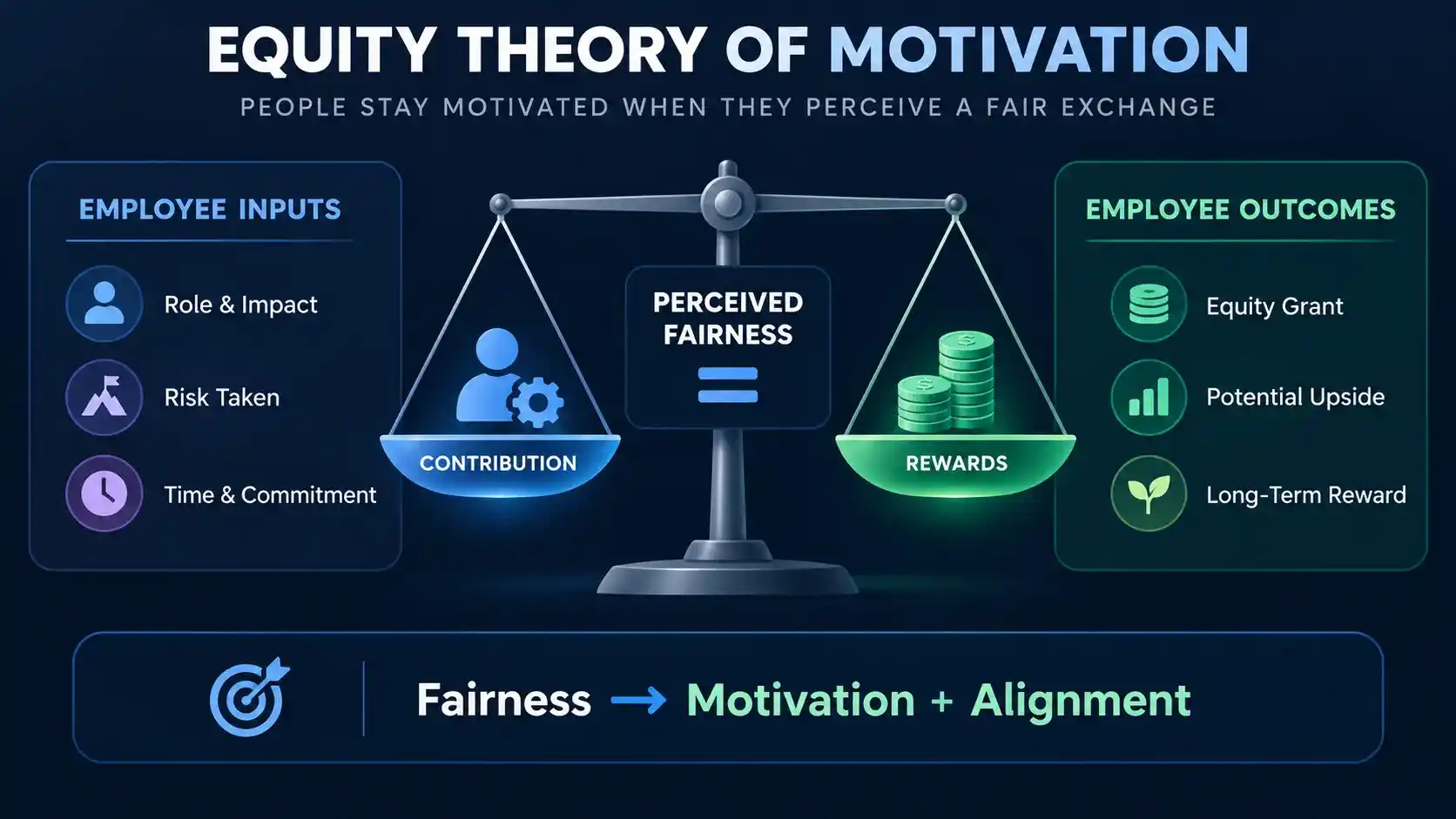
Equity theory of motivation holds a simple idea at its core. People stay motivated when they judge the ratio of their effort and risk to what they receive in return as fair, especially compared to others around them. Perceived unfairness, not the size of a reward on its own, is what drains motivation.
Startup equity is one of the most fairness-sensitive rewards a company can offer, because employees constantly weigh their grant against their role, their risk, and their peers’ grants. This guide applies equity theory to real startup practice: how to structure grants by role and risk, how to communicate equity so it actually motivates, and how to manage the option pool without diluting the people who took the earliest risk.
Equity as a Strategic Currency, Not a Compensation Shortcut
Equity functions as more than a line item in a compensation package. It carries the language of belief, alignment, and long-term commitment. Startups that cannot match FAANG-level salaries lean on equity to close that gap. Granting it indiscriminately, without a long-range plan, turns a powerful incentive into a liability.
Equity used thoughtfully builds real alignment. Equity that is misallocated or poorly understood can weaponize itself against the company: a grant that feels generous today can drag on future hiring, or breed resentment once expectations diverge from eventual outcomes.
Treating equity like capital, finite, valuable, and strategic, keeps this risk in check. That means planning allocation by role, stage, and function, tracking dilution across five funding rounds rather than one quarter, and communicating to employees not just what they receive, but what it actually means. Equity is not an infinite well. It is a reservoir of alignment, and it deserves to be spent with intention.
Structuring Grants by Role, Risk, and Retention Horizon
No universal chart dictates exact equity amounts, but clear principles guide the decision. Grant size should track the stage of hire, since earlier hires take on more risk and deserve more exposure. It should track role and impact, since executives, engineers, and product leaders typically warrant larger grants than back-office roles. It should reference market benchmarks through compensation surveys, and it should account for risk taken, since someone leaving a stable role to join a pre-seed startup carries more downside than someone joining after Series B.
Sample Fully Diluted Ownership Ranges at Grant
| Role | Fully Diluted Equity Range at Grant |
| CEO (non-founder) | 4% – 8% |
| VP Engineering or Product | 1% – 2% |
| Director-level roles | 0.25% – 0.75% |
| Senior IC engineers | 0.1% – 0.3% |
| Junior employees | 0.01% – 0.1% |
Vesting Mechanics
Most equity grants follow a four-year vesting schedule with a one-year cliff. No equity vests until an employee completes one full year. After that cliff, equity vests monthly or quarterly over the remaining thirty-six months. This structure ensures equity gets earned over time, protecting the company from early misalignment while still offering real upside to those who stay.
Refresh Grants
High performers nearing the end of their vesting schedule, or employees in retention-critical roles, often warrant a refresh grant: a new option grant with a fresh vesting schedule designed to re-align incentives going forward.
Building an equity budget alongside the headcount plan keeps this disciplined. Equity usage should track burn rate, role priorities, and hiring timing, and every future pool refresh deserves modeling before the next raise rather than after.
Communicating Equity: Turning Potential Into Motivation
Equity theory of motivation makes an important prediction here: a grant only motivates once the recipient understands it well enough to judge it as fair. Most employees, particularly those without startup experience, do not intuitively understand stock options, a 409A valuation, or a strike price, let alone how dilution affects their eventual upside.
What Employees Want to Know
- How many options are being granted
- What the strike price is
- What percentage of the company that grant represents
- What the grant could realistically be worth
- When and how the equity can be exercised or sold
Common Sources of Misalignment
- Employees assume 1,000 options equals 1 percent ownership, when it may equal 0.01 percent
- Employees assume an exit automatically means cash, without accounting for liquidation preferences
- Employees misunderstand the tax treatment of early exercise or the difference between NSOs and ISOs
An equity education program built into onboarding closes most of this gap. A simple equity FAQ, cap table literacy training, scenario modeling that shows what a $100 million exit means for a given grant, and clear documentation of grant, vesting, and strike terms all help. Transparency does not require revealing everyone’s equity to everyone else. It requires helping each person understand their own grant clearly enough to see it as fair.
Balancing Dilution and Hiring: A Strategic Approach to the Option Pool
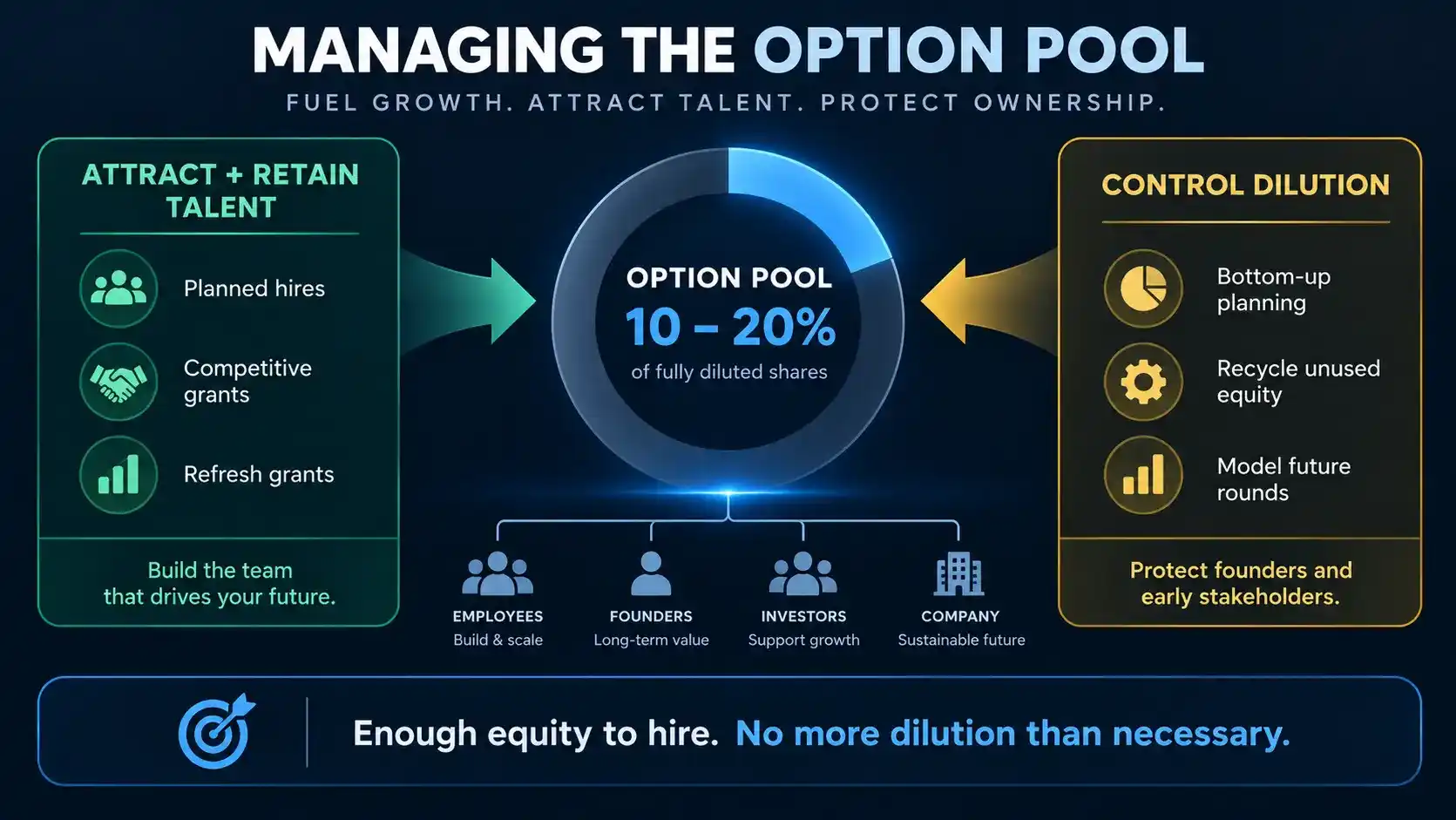
Every equity grant is a dilution event. That makes the option pool, typically 10 to 20 percent of fully diluted shares, one of the most consequential levers a CFO manages. It needs to be large enough to attract and retain talent, without diluting founders and early stakeholders more than necessary.
Five Tactics That Keep the Pool Disciplined
- Build the pool bottom-up from a real hiring plan, rather than accepting a default 15 percent figure, by mapping planned hires, roles, and equity ranges into an actual equity budget
- Time pool refreshes with fundraises deliberately, negotiating the smallest refresh needed, pushing for post-money sizing where possible, and securing board alignment on pool discipline
- Recycle unused or unvested equity when employees leave early, tracking expired options and reallocating them strategically
- Benchmark continuously against tools such as Option Impact, Radford, or Carta Total Comp, since competitive equity levels shift year to year
- Model future scenarios for each hire’s equity at exit values of $50 million, $100 million, or $1 billion, checking for over-incentivizing or under-incentivizing before it becomes a retention problem
Three Key Takeaways
- Equity theory of motivation explains why equity compensation succeeds or fails: employees respond to their perceived fairness ratio, not just the raw size of a grant, and that ratio depends heavily on role, risk, and peer comparison.
- Structuring grants by stage, role, and risk, and pairing that structure with a genuine equity education program, closes the gap between what a grant is actually worth and what an employee believes it is worth.
- A bottom-up, hiring-plan-driven option pool protects founders and early stakeholders from unnecessary dilution while still giving the company enough equity to attract and retain the people it needs.
Disclaimer: This article is intended for informational purposes only and does not constitute legal, financial, or investment advice. Please consult your professional advisors before making decisions related to equity, compensation, or cap table management.
Hindol Datta is a four-time CFO and senior finance executive with over 25 years of leadership experience across cybersecurity, SaaS, gaming, logistics, digital marketing, medical devices, consumer products, and nonprofit organizations. He has led more than $120M in fundraising and over $150M in M&A transactions while building the financial and operational systems that let complex businesses scale with confidence. He is the author of seven books in the Systems CFO Series and holds active CPA, CMA, and CIA credentials.
AI-assisted insights, supplemented by 25 years of finance leadership experience.