
Executive Summary
A common misconception about fractional CFO work is that every engagement must be built from scratch. The advice may be tailored, but the delivery does not need to be improvised. A structured business playbook gives founders a path they can see and boards a process they can trust, turning scattered engagements into a repeatable system that markets itself.
This article breaks down what a business playbook is, how a phase-based maturity model works in practice, and why the same framework that builds client trust also functions as a sales playbook that drives referrals. It closes with practical steps for building one from real engagement history.
What a Business Playbook Actually Is
A business playbook is a documented approach to how a fractional CFO engages, assesses, and elevates a company’s financial function. It is not a rigid script. It is a diagnostic tool that reduces decision fatigue for the practitioner and increases credibility with the client.
A well-built playbook typically includes the following components.
- Phase definitions, such as Foundational, Strategic, and Growth
- Key deliverables tied to each phase
- Diagnostic tools like scorecards and financial health checks
- Onboarding checklists for new engagements
- Modeling, reporting, and communication templates
The goal is not to turn the practitioner into a checklist follower. The goal is to bring order to a process that founders often experience as vague and unpredictable.
A Phase Based Maturity Model for Financial Growth
The strongest business playbooks group a company’s needs into progressive stages, each unlocking the next once specific metrics of readiness are met.
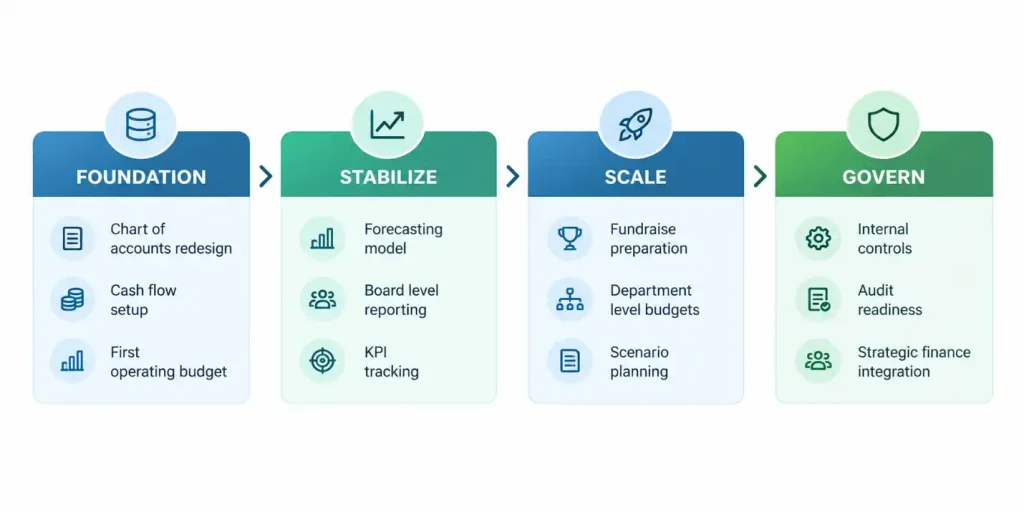
One CFO working across cybersecurity, gaming, and consumer products engagements has used a variation of this exact model, a four-phase framework covering Financial Hygiene, Operational Visibility, Strategic Forecasting, and Capital Strategy. New clients could see immediately where they stood on the map and, more importantly, where they were headed next.
Why a Business Playbook Builds Trust Faster
Founders respond to structure because it signals control in an area where they often feel exposed. A playbook shows a path, not just a person standing in front of them. Boards respond to process because it can be measured, and measured work is easier to justify at the next meeting.
In one engagement supporting a $127M global consumer products company with a supply chain spanning multiple countries, inventory turns more than doubled through demand planning and SKU rationalization, a result made possible only because the underlying diagnostic process followed a defined sequence rather than reacting to whichever fire was loudest that week. Structure did not slow the work down. It made the work repeatable enough to scale.
A playbook also helps a CFO self-diagnose gaps before they become expensive problems. A company pushing into M&A modeling while still lacking a working cash forecast is a company heading toward a bumpy engagement, and a playbook keeps that sequence honest.
Turning the Playbook into a Sales Playbook for Referrals
A business playbook and a sales playbook are closer relatives than most fractional CFOs assume. When a client can describe exactly what was done, in specific language, they become a far more effective referral source.
Compare these two statements.
- “She cleaned up our books.”
- “She took us through her Strategic Finance Framework and had us board ready in 45 days.”
The second version functions as a built-in sales playbook. It gives the client language to repeat to another founder, and that language does more selling than any pitch deck. During a scaling engagement for a venture backed digital marketing company that grew revenue from $9M to $180M in 24 months, the finance function built during that period became something the company’s own leadership referenced when discussing the CFO’s work with prospective investors and partners. The framework became shorthand, and shorthand travels.
Some practitioners have been invited to speak at accelerators and investor panels purely to walk through their models. The playbook, once documented, becomes a credibility asset that operates independently of any single engagement.
Building a Playbook from Real Engagement History
The most reliable business playbooks are not invented from a whiteboard session. They are reverse engineered from work already completed.
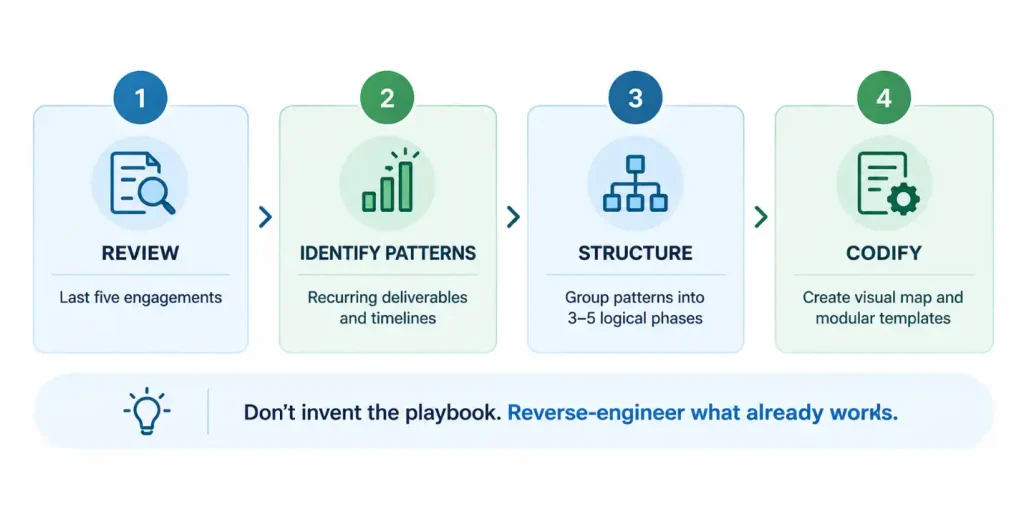
- Review the last five engagements and look for repeating deliverables and timelines
- Group the recurring patterns into three to five logical phases
- Build a single page visual map summarizing the framework
- Create modular templates for each phase so onboarding does not start from zero
A CFO who served as the first finance hire at a venture backed manufacturing company, building the chart of accounts, GAAP framework, and reporting infrastructure from a blank page, was essentially building the Foundation phase of a playbook in real time, even before naming it as such. The codification comes later. The pattern is usually already there.
Using a Playbook Without Sounding Rigid
A playbook works best as a diagnostic rather than a mandate. Timelines and deliverables should still adapt to the client’s stage, and the language describing the framework should stay conversational rather than technical.
No playbook survives first contact with a Series A company in genuine chaos without some adjustment. But a playbook framed as “here is what great looks like, and here is where you currently sit” gives a founder room to meet the practitioner halfway, rather than feeling handed a rigid checklist.
A few practical guardrails help keep the model useful.
- Tie every phase to outcomes rather than tasks. Instead of “implement a budget,” describe “establish a 12-month budget with variance tracking and a reforecast cadence.”
- Introduce the playbook during the first discovery call so it anchors the relationship from day one.
- Keep the visual simple enough to explain in under two minutes.
Three Key Takeaways
- A documented business playbook reduces decision fatigue for the practitioner while giving founders and boards a visible structure they can measure progress against, which builds trust faster than an engagement built purely on personality.
- The same framework that organizes delivery also functions as a sales playbook, because clients who can describe specific phases and outcomes become far more effective referral sources than clients who can only say the work “went well.”
- The most durable playbooks come from reverse engineering five or more completed engagements rather than designing a framework in the abstract, since the patterns worth codifying are usually already present in past client work.
Disclaimer: This article is intended for informational purposes only and does not constitute legal, tax, or accounting advice. You should consult your own tax advisor or counsel for advice tailored to your specific situation.
Hindol Datta is a four-time CFO and senior finance executive with over 25 years of leadership experience across cybersecurity, SaaS, gaming, logistics, digital marketing, medical devices, consumer products, and nonprofit organizations. He has led more than $120M in fundraising and over $150M in M&A transactions while building the financial and operational systems that let complex businesses scale with confidence. He is the author of seven books in the Systems CFO Series and holds active CPA, CMA, and CIA credentials.
AI-assisted insights, supplemented by 25 years of finance leadership experience.