
Executive Summary
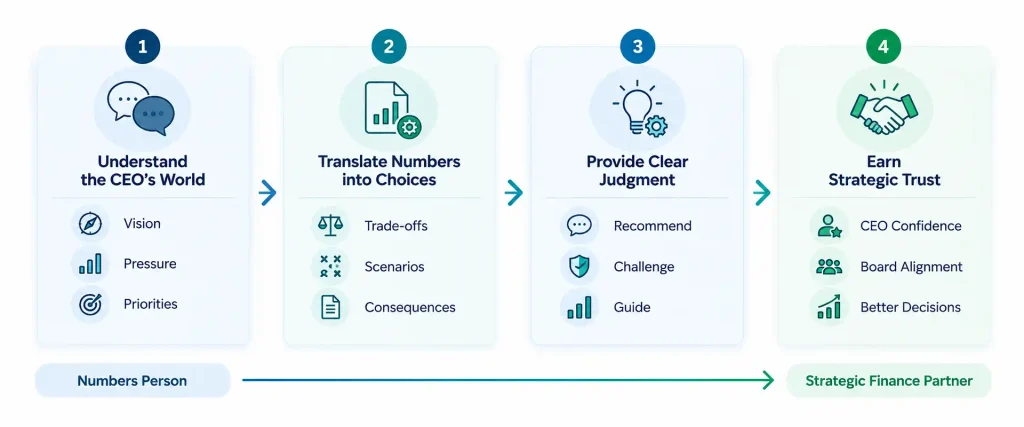
The most valuable asset a CFO can offer a founder is not a clean close or an elegant model. It is trust, and the discipline to convert that trust into judgment the CEO can act on under pressure. Becoming a genuine strategic finance partner means stepping into the founder’s world instead of observing it from a spreadsheet. That shift is what separates a vendor from someone who has earned a seat inside the company’s decision-making core.
This article examines how a CFO moves from service provider to strategic finance partner. That shift matters most in fractional or lean-team settings, where time is scarce and context arrives in fragments. The path runs through empathy, framing, and composure under pressure. It also demands sharp board translation and the willingness to say no when the numbers demand it.
Understanding the CEO’s World Before Talking Numbers
Founders live inside a swirl of competing signals. Product roadmaps slip, investors ask pointed questions, customers churn quietly, and a narrative must hold together in every conversation. Many of them feel isolated in ways that rarely surface in a board deck. A strategic finance partner starts by listening for what is underneath the financial question. The literal question asked is rarely the one that matters most.
The engagement involved a mission-driven education and research institution. The first meaningful conversation with its chief executive had nothing to do with cash runway. Instead, it centered on hiring anxiety and philanthropic timing. Underneath both sat a deeper fear: that a funding gap would become public before it could be closed. Only after that conversation did the capital structure and venture debt terms enter the discussion. The sequencing mattered more than any single number in the model. A finance leader can open with the balance sheet. But doing so before understanding the founder’s actual worry means being heard as a vendor. Not as a partner.
Three habits tend to separate the two postures. A strategic finance partner asks about vision before asking about cash. Reading the tone of an email or a Slack message often surfaces stress signals the founder has not stated directly. Every metric gets translated into a choice rather than presented as a static chart. None of this replaces financial rigor. It simply places rigor inside a relationship the founder trusts enough to use.
Framing Choices Like a Strategic Finance Partner, not a Reporter
Founders do not need another dashboard. They need someone who can turn fog into a short list of navigable paths. That is precisely the function a strategic finance partner performs when the room is uncertain. The distinction between reporting a number and framing a decision is the distinction between a controller and a partner.
Consider how the same underlying data can be presented two different ways:
- “Hiring now compresses runway to eight months, but it buys the product speed the team believes it needs before the next raise.”
- “Holding prices protects churn in the near term, but it pushes the LTV to CAC ratio below the threshold most Series B investors expect.”
A venture-backed digital marketing organization scaled from $9M to $180M in revenue across twenty-four months. During that period, the hardest recurring conversation was not whether to spend, but how to frame spend against a CAC and LTV discipline the board could trust. Rather than answering yes or no to a headcount question, the finance function modeled three hiring speeds and tied each to runway compression, revenue acceleration, and fundraising timing. That work let the board choose a middle path with its eyes open, instead of negotiating in the dark.
Staying the Calm Center When the Numbers Shock the Room
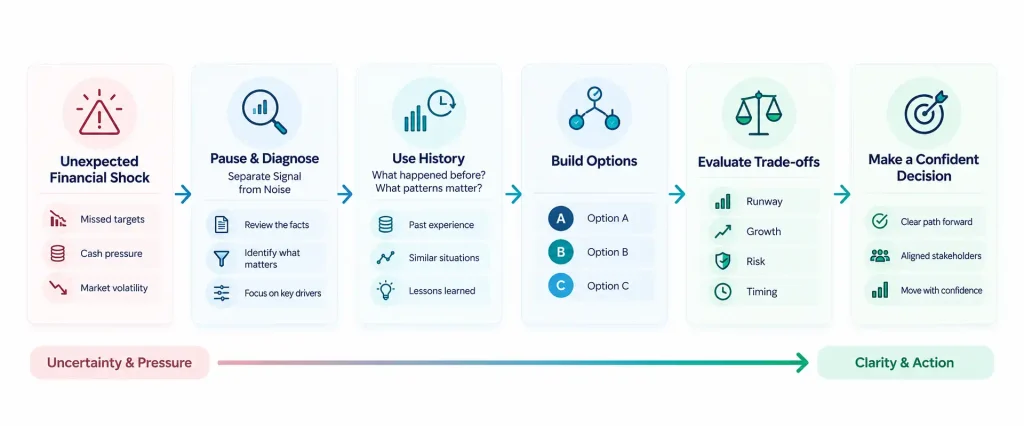
Startups are volatile by nature, and when a founder panics, the strategic finance partner becomes the thermostat rather than another source of heat. Composure is not passivity. It is the discipline of separating signal from noise fast enough that the room can make a decision instead of reacting to fear.
At a cybersecurity and identity access management company running near $30M in annual recurring revenue, the forecasting engine and capacity model built from scratch held actual results within five percent of plan for eight consecutive quarters. That predictability did more for the founder’s peace of mind than any single strategic insight, because it meant that when a genuine shock did arrive, everyone in the room already trusted the baseline enough to focus on the deviation rather than re-litigating the model itself.
Two Structural Habits Worth Naming
A strategic finance partner tends to lean on two structural habits in moments of pressure. History provides one anchor, since referencing what happened the last time a similar pattern appeared in another company at a similar stage gives the founder permission to slow down. Structure provides the other, since converting a panic-driven conversation into a simple decision tree, with explicit options and outcomes, redirects energy away from anxiety and toward analysis.
Translating the Numbers for the Board
Founders often struggle to communicate with their own boards, not because the numbers are hidden, but because the narrative around the numbers has not been built. A strategic finance partner functions as the translator between what the business is actually doing and what a board member needs to hear in order to stay confident rather than alarmed.
During an S-1 and IPO-readiness process at a Euronext Paris-listed gaming and digital entertainment company operating across five countries, board and audit committee engagement depended on a single, unified definition of revenue that could survive scrutiny under both IFRS and US GAAP. Getting five subsidiaries to report on one Oracle Financials and MicroStrategy backbone was a systems project, but the real work was translating what that consolidation meant for the story the board would tell to underwriters and Big Four auditors. A weak quarter reframed honestly as a strategic pause for repositioning, supported by real data, tends to make a board lean in rather than pull back. That is translation, not spin.
Knowing When a Strategic Finance Partner Says No
Being a partner does not mean being agreeable, and one of the clearest signals of trust is a founder who wants to hear the answer even when it is not the one they hoped for. A strategic finance partner earns the right to say no by consistently pairing pushback with data rather than opinion.
Typical moments where this shows up include the following:
- Declining a hire until revenue clears a plan threshold, rather than approving it on optimism alone.
- Flagging a pricing model that performs well in a slide deck but breaks against actual cohort behavior once it meets the market.
- Naming the gap between what a fundraising narrative claims and what the underlying unit economics currently support.
The instinct to push should never slide into silence. A strategic finance partner who disappears when the answer is difficult loses the trust that took months to build, while one who pushes with care and comes back with an alternative path tends to be the first call the founder makes the next time a hard decision looms.
Three Key Takeaways
- Trust is built by understanding the founder’s world before presenting a number, and the sequencing of that first conversation often matters more than the content of the model that follows it.
- Framing turns a CFO into a strategic finance partner, because founders need trade-offs laid out as navigable choices rather than charts that leave the decision unresolved.
- Composure, board translation, and the willingness to say no with evidence are what convert a fractional or lean-team finance function from a service line into a permanent seat at the strategic table
Disclaimer: This article is intended for informational purposes only and does not constitute legal, tax, or accounting advice. You should consult your own tax advisor or counsel for advice tailored to your specific situation.
Hindol Datta is a four-time CFO and senior finance executive with over 25 years of leadership experience across cybersecurity, SaaS, gaming, logistics, digital marketing, medical devices, consumer products, and nonprofit organizations. He has led more than $120M in fundraising and over $150M in M&A transactions while building the financial and operational systems that let complex businesses scale with confidence. He is the author of seven books in the Systems CFO Series and holds active CPA, CMA, and CIA credentials.
AI-assisted insights, supplemented by 25 years of finance leadership experience.