
Executive Summary
Board control vs cap table control is one of the most misunderstood distinctions in startup governance. Founders often assume that a large ownership stake guarantees decision-making power. It does not. The board of directors, not the cap table, governs a company’s most consequential decisions.
This guide breaks down how board composition and protective provisions actually work, walks through four real-world scenarios where governance overrides ownership, and lays out the practices that keep founders from losing control they never realized they had already given away.
The Mirage of Majority Ownership
Founders often obsess over cap table ownership, and dilution is a real concern. But ownership is only part of the story. Control, the actual power to make decisions, does not always sit with the largest shareholder.
A founder holding 70 percent of common stock might assume that stake dictates the company’s direction. But if a term sheet assigns two board seats to Series A investors, one to an independent, and only two to the founders, investors effectively govern the company. Even with 70 percent ownership, the founder may hold only 40 percent of the board.
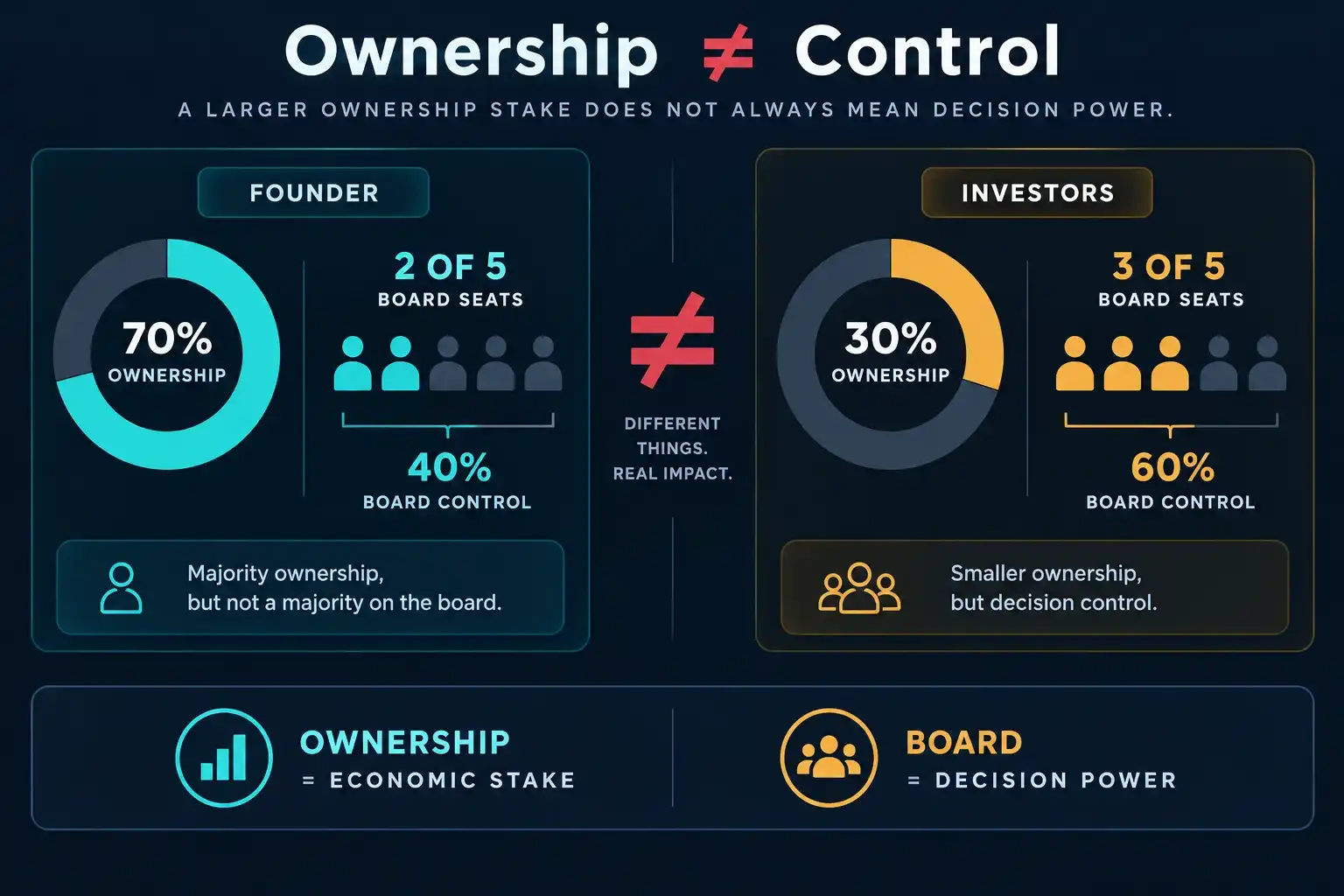
This asymmetry is not inherently unfair. Investors provide capital and carry fiduciary obligations that justify a voice in governance. The problem starts when founders mistake equity ownership for strategic control. A CFO’s job includes making sure founders understand both sides of that ledger: economic ownership and governance architecture. The two are not the same, and the gap between them determines who leads, who follows, and who ultimately decides.
The Structure of Governance: What Really Drives Decisions
The board of directors sits at the top of a corporation’s decision-making structure. It hires and fires the CEO, approves fundraising, oversees M&A, and ratifies strategic direction.
Typical Early-Stage Board Composition
- One seat for the founder CEO
- One seat for a co-founder or early executive
- One seat for the lead Series A investor
- One seat for a Series B investor, if different from Series A
- One independent seat, often selected jointly
By Series B, a five-member board is common, and founders frequently hold just one or two of those seats. Investors, directly or through aligned independents, hold the balance of power.
Protective provisions add another layer on top of board votes. Even a founder-controlled board majority can be constrained by charter terms that require investor consent for issuing new shares, approving budgets, taking on debt, selling the company, or changing bylaws. These veto rights attach to specific classes of preferred stock. They function as structural brakes written into corporate documents, not as board votes.
Stockholder consent requirements complicate the picture further. Many companies require a majority or supermajority of preferred shareholders to approve certain actions. Common stockholders can outnumber preferred holders and still lack the votes to move forward without investor class consent.
Board Control vs Cap Table Control in Practice: Four Real-World Scenarios
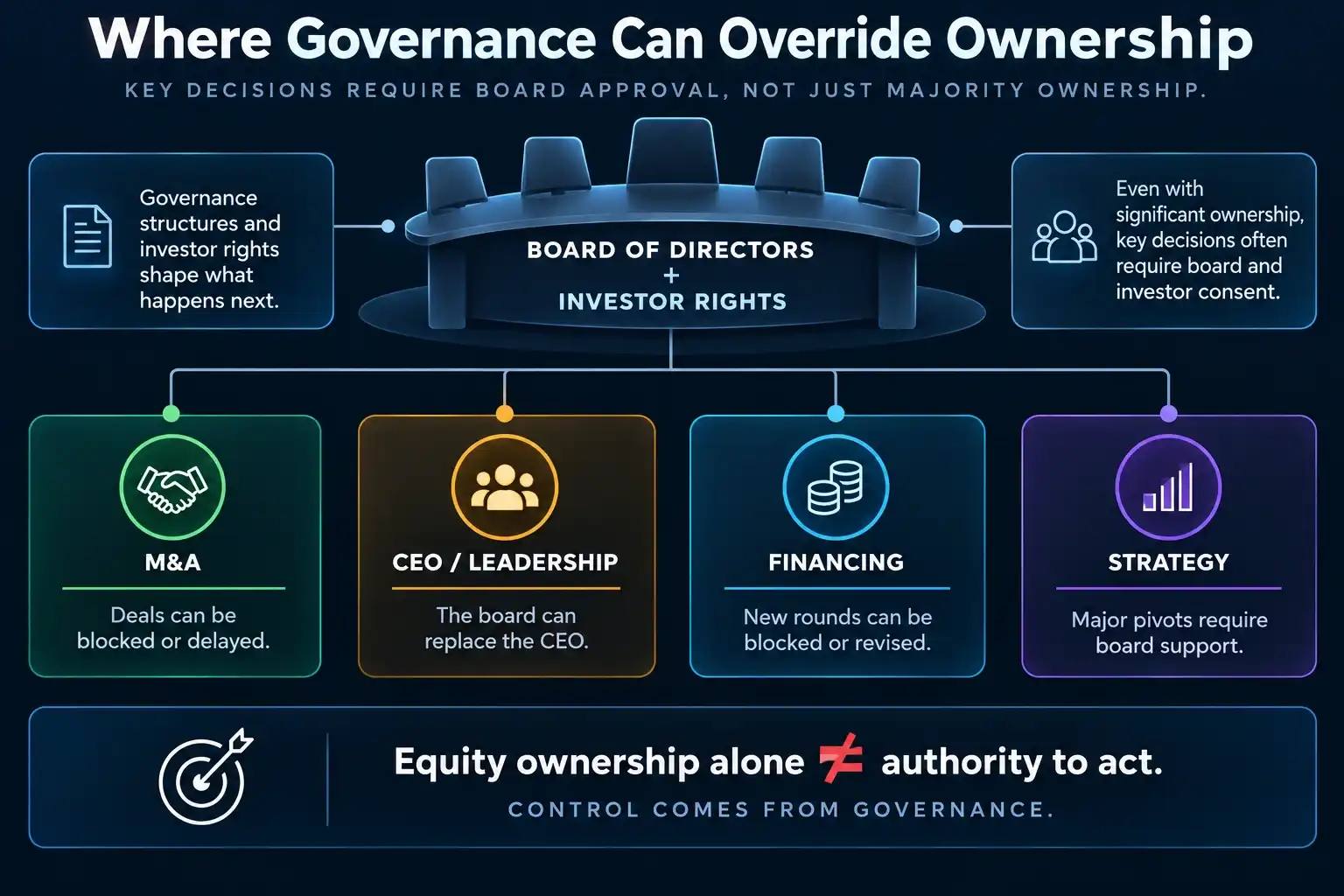
These four situations show how governance structure, not ownership percentage, decides the outcome when interests diverge.
| Scenario | Situation | Result |
| A: M&A Deal Blocked | A founder owning 30 percent wants to accept an $80M acquisition offer. Series B investors hold veto rights and expect a $200M exit within 18 months. | The investor-dominated board rejects the deal. Ownership does not give the founder the power to force the sale. |
| B: CEO Transition Initiated | Growth stalls after Series C. Investors lose confidence in the CEO and call a board meeting to search for new leadership. | Investors hold three of five board seats, and the vote passes. The founder’s ownership stays intact, but leadership does not. |
| C: Down Round Negotiation | The company needs bridge financing on aggressive terms. Series A and B investors prefer liquidation over approving the round. | The board withholds approval, and the company cannot raise capital. Ownership means little without the power to act on it. |
| D: Strategic Pivot Blocked | The founder wants to pivot the product strategy. Investor-aligned board members prefer the current near-term revenue focus. | The pivot stalls. The majority shareholder still answers to board consensus, not personal decree. |
Governance Best Practices for Founders and CFOs
Negotiate Board Composition Upfront
Founders should negotiate to retain parity or majority on the board through at least Series B. A two-one-one board, with two founders, one investor, and one independent, preserves founder influence. New board seats should be added only when new capital or new value justifies them.
Choose Truly Independent Directors
Many so-called independents are nominated by investors and serve investor interests in practice. Founders should push for joint selection, or for the right to appoint at least one independent themselves, which balances governance and adds seasoned outside judgment.
Understand and Limit Protective Provisions
Boilerplate veto rights deserve scrutiny rather than automatic acceptance. Protective provisions should stay limited to high-stakes matters such as liquidation or the issuance of senior securities, and should not reach into hiring, budgets, or day-to-day management.
Separate Economic Rights From Voting Rights
Dual-class stock structures can preserve strategic continuity for mission-driven or founder-led companies while still enabling capital access. Founders should weigh this option carefully, since it can limit investor appeal at later financing stages.
Align Long-Term Vision in Term Sheets
Good investors want alignment, not control for its own sake. Founders who articulate their vision and governance philosophy early tend to face fewer conflicts once investors have bought into that clarity.
Maintain Operational Transparency
Opaque operations invite governance friction. Detailed board updates, accurate financials, and candid strategic discussion build the trust that sustains founder influence over time.
Prepare for Transition Before It Is Forced
Professionalizing the organization early, through succession planning, executive hiring, and clear delegation, means any eventual transition happens collaboratively rather than as a forced correction.
Three Key Takeaways
- Board control vs cap table control is a real distinction, not a technicality. A founder can hold a majority of shares and still lose control of hiring, financing, or exit decisions if the board is not structured to match.
- Protective provisions and stockholder consent requirements act as governance brakes that operate outside the boardroom vote entirely. Founders need to understand these terms before signing, not after a decision gets blocked.
- The founders who keep real influence are the ones who negotiate board composition upfront, limit protective provisions to genuinely high-stakes matters, and build the transparency that keeps investor trust intact over time.
Disclaimer: This article is intended for informational purposes only and does not constitute legal, financial, or investment advice. Please consult your professional advisors before making governance, board composition, or cap table decisions.
Hindol Datta is a four-time CFO and senior finance executive with over 25 years of leadership experience across cybersecurity, SaaS, gaming, logistics, digital marketing, medical devices, consumer products, and nonprofit organizations. He has led more than $120M in fundraising and over $150M in M&A transactions while building the financial and operational systems that let complex businesses scale with confidence. He is the author of seven books in the Systems CFO Series and holds active CPA, CMA, and CIA credentials.
AI-assisted insights, supplemented by 25 years of finance leadership experience.