
Executive Summary
Most boards leave their quarterly meeting holding a thicker packet than the one they arrived with. Yet somehow, they leave less certain of what actually matters. Across more than two decades of building finance functions and sitting across the table from directors, one thing stands out. The shortfall is almost never a shortage of data. It is a shortage of decision-grade clarity. Closing that gap is the real work of corporate governance KPIs.
This article distills a practitioner’s framework. It covers designing, delivering, and embedding governance metrics that do more than document the past. Transparency, properly built, means clarity rather than volume. Board-ready metrics map explicitly to strategy, not to convenience. Reporting demands disciplined cadence. It also demands an honest narrative wrapped around the numbers. Transparency must become a cultural habit, not a quarterly performance staged for optics.
Why Corporate Governance KPIs Elevate the Board Conversation
Boards are rarely short on numbers. They are short on meaning. That distinction sits at the heart of every corporate governance KPI decision a finance leader will make. A dense deck stuffed with ratios and dashboards can create the appearance of transparency. Yet it can leave directors no closer to understanding what actually drives the business. A well-designed governance KPI framework closes that gap. It anchors accountability. It sharpens strategic dialogue. And it lets risk surface while it’s still a decision not after it has hardened into a crisis.
Redefining Governance Transparency as Clarity, Not Volume
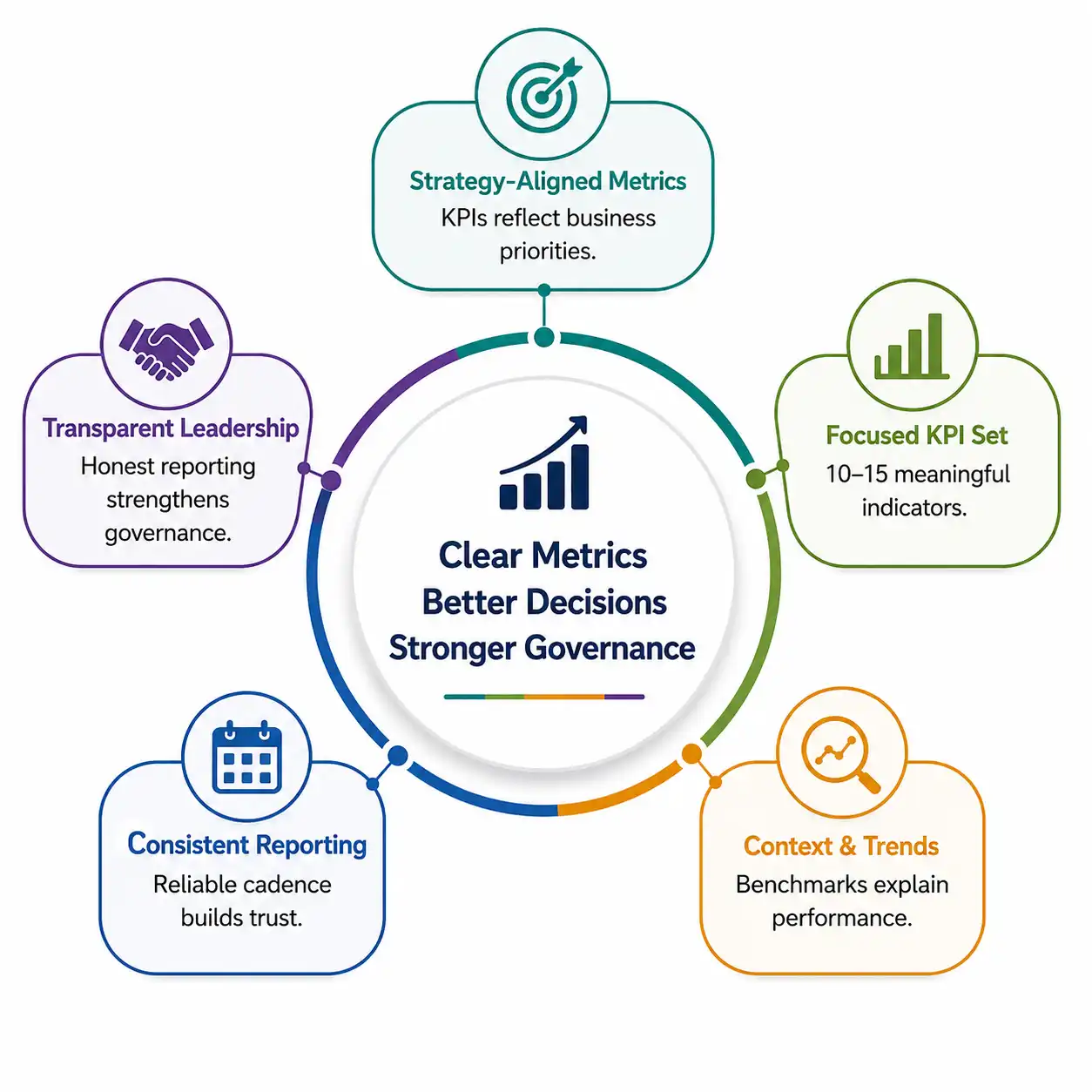
The first misconception worth correcting is the assumption that transparency means disclosing more information. In practice, density tends to obscure rather than illuminate. A board handed forty slides often walks away with less conviction than one handed twelve well-chosen indicators. A board’s fiduciary duty is not to manage the business. It is to assess how well management is stewarding it. That distinction requires metrics mapped explicitly to strategy not metrics chosen because they happen to be easy to produce.
Where Board Reporting Tends to Fail
Three failures recur most often in board reporting, and each one erodes the trust that governance transparency is supposed to build. Metrics drift out of alignment with strategic priorities, so a company built on customer intimacy still leads its board deck with revenue per account rather than retention. Benchmarks go missing, leaving directors unable to tell whether a shift in margin or working capital is meaningful or simply noise. Outcomes also arrive without causal logic attached, so a board sees that churn rose without ever learning which lever moved first.
The remedy is a curated governance level KPI suite, typically ten to fifteen metrics organized by strategic theme rather than by department, refreshed at a cadence that allows directors to recognize genuine patterns rather than react to noise. Granularity without synthesis is its own failure mode. Operational leaders need departmental detail to manage process day to day, but a board presented with a dozen metrics per function experiences cognitive static rather than insight. Consistency matters as much as content: when the same core metrics persist across quarters, directors build the fluency to challenge what they see rather than simply absorb it, and metrics that shift every time performance dips read as a signal of insecurity rather than adaptability.
Designing Board-Ready KPIs That Align with Strategy
Once transparency is redefined as clarity, the next discipline is design, and this is where most board reporting programs stall. A common failure is the overreliance on legacy metrics that once mattered but no longer reflect the strategic context the company actually operates in today. A high growth software business in its expansion phase should lead with net retention and sales cycle length rather than operating margin, while a capital-intensive manufacturer approaching saturation should elevate return on invested capital above almost everything else.
In finance transformations led across sectors as varied as identity security, manufacturing, and logistics, the boards that governed most effectively were the ones willing to retire vanity metrics in favor of a small number of indicators tied directly to the value creation thesis. When a venture backed digital marketing organization scaled from $9M to $180M in revenue over 24 months, the KPI suite evolved deliberately at each stage of growth, always anchored to what the business needed to prove next rather than what had been convenient to report the quarter before.
Conscious exclusion carries as much weight as inclusion. Not every operational metric belongs in a board deck, and burying directors under every functional scorecard invites micromanagement rather than oversight. A governance level KPI suite should also carry forward looking indicators, since a board needs to govern what the business is becoming, not only what it already is. Pipeline health, customer sentiment, and supply chain lead times behave probabilistically rather than deterministically, yet they give directors standing to challenge complacency even when the lagging results still look healthy on paper.
Operationalizing Governance Transparency Through Technology and Narrative
Even a well-designed KPI suite remains inert without the infrastructure to deliver it reliably. This is where the discipline of corporate governance KPIs meets the unglamorous work of systems and process. Board-ready transparency requires a single source of truth. That can come from a centralized data warehouse feeding a governance dashboard, or from a disciplined manual process applied with the same rigor every quarter. What matters is that every director works from the same version of the truth at the same moment not that they’re reconciling competing spreadsheets in the room.
Cadence, Narrative, and Visualization
Cadence is the second operational lever, and it deserves more attention than most finance teams give it. Boards typically meet quarterly, yet the business moves faster than that rhythm allows. A hybrid model, in which select indicators such as cash position or pipeline coverage stay visible monthly while deeper strategic review happens quarterly, lets directors catch anomalies early rather than encounter them as surprises three months later.
The third and most human element is narrative discipline. Numbers alone do not drive board decisions; the meaning attached to those numbers does. Each metric should travel with a brief explanation of what it measures, why it matters, and what management is doing in response to its trend, and this is precisely where the CFO’s role expands from scorekeeper to storyteller. Across more than $120M in growth capital raised and more than $150M in mergers and acquisitions led, including over $100M in cross-border acquisitions for a publicly listed gaming and digital entertainment company, investors and directors respond far more to candid narrative around a metric’s trajectory than to the metric itself. Visualization reinforces that discipline: a chart with color consistency, annotated variance, and comparative timeframes lets a director see a change before it is explained, which is precisely the posture a well governed board should hold.
Embedding Governance Transparency as a Cultural Pillar
The final and most durable stage of this work is cultural, not procedural. Transparency that lives only inside a quarterly deck is fragile, prone to slipping the moment a difficult quarter arrives. Transparency that becomes part of how leadership behaves, incentivizes, and communicates becomes institutional instead, and it survives leadership transitions that would otherwise erase it. When a CEO or CFO openly acknowledges underperformance and shows the board how the KPI framework is guiding the response, that candor cascades through the rest of the organization in ways no memo can replicate.
This cultural shift also strengthens credibility outside the boardroom. Investors and analysts notice when disclosed metrics match strategic messaging, and that alignment becomes a form of ballast during volatile periods, the kind of quiet credibility that does not appear on any scorecard but shows up in how quickly a board or an investor extends the benefit of the doubt. Structural reinforcement helps sustain the culture: incentive systems that reward visibility as well as outcomes, governance reviews that ask whether variance was explained clearly, and a genuine closing of the loop between a disclosed problem and the corrective action that followed it.
This dynamic showed up directly while leading a $37M capital raise across equity and venture debt at a mission driven education and research institution, where transparent, consistent board reporting was inseparable from the trust investors placed in the organization’s long-term strategy. A related lesson held during a period of steep operational reset at an early-stage digital marketing technology company, where the work of reducing monthly burn from $800K to $200K depended less on the improved number itself than on the clarity and consistency with which that number was reported to the board along the way, quarter after quarter, until the trend spoke for itself.
Governance KPI Pillars at a Glance
A mature corporate governance KPI framework is typically organized around five thematic pillars, each supported by two or three consistently tracked indicators.
| Pillar | Purpose in Governance | Illustrative Metrics |
| Growth | Assess whether strategy is translating into durable expansion | Net retention, pipeline coverage, expansion revenue |
| Margin | Evaluate the economics behind growth | Gross margin trend, unit economics, mix shift impact |
| Efficiency | Measure how well capital and resources are deployed | Free cash flow conversion, return on invested capital |
| Risk | Surface emerging exposure before it becomes crisis | Customer concentration, churn by cohort, cash runway |
| Strategic Initiatives | Track progress on the priorities the board has endorsed | Milestone completion, forward-looking pipeline signals |
Three Key Takeaways
- Treat transparency as a design discipline rather than a disclosure exercise, since a curated set of ten to fifteen governance level KPIs, mapped explicitly to strategy and held consistent across quarters, will do more for board trust than any volume of additional reporting ever could.
- Pair every metric with a narrative that explains what moved, why it moved, and what management intends to do about it, because directors act on meaning rather than on numbers alone, and the CFO who supplies that meaning becomes a strategic partner rather than a scorekeeper.
- Build transparency into incentives and culture rather than confining it to the board deck, since a governance model that performs candor only once a quarter will eventually be recognized as performance, while one that lives in how leadership behaves every day earns the durable trust that carries an organization through disruption and transition alike.
Conclusion
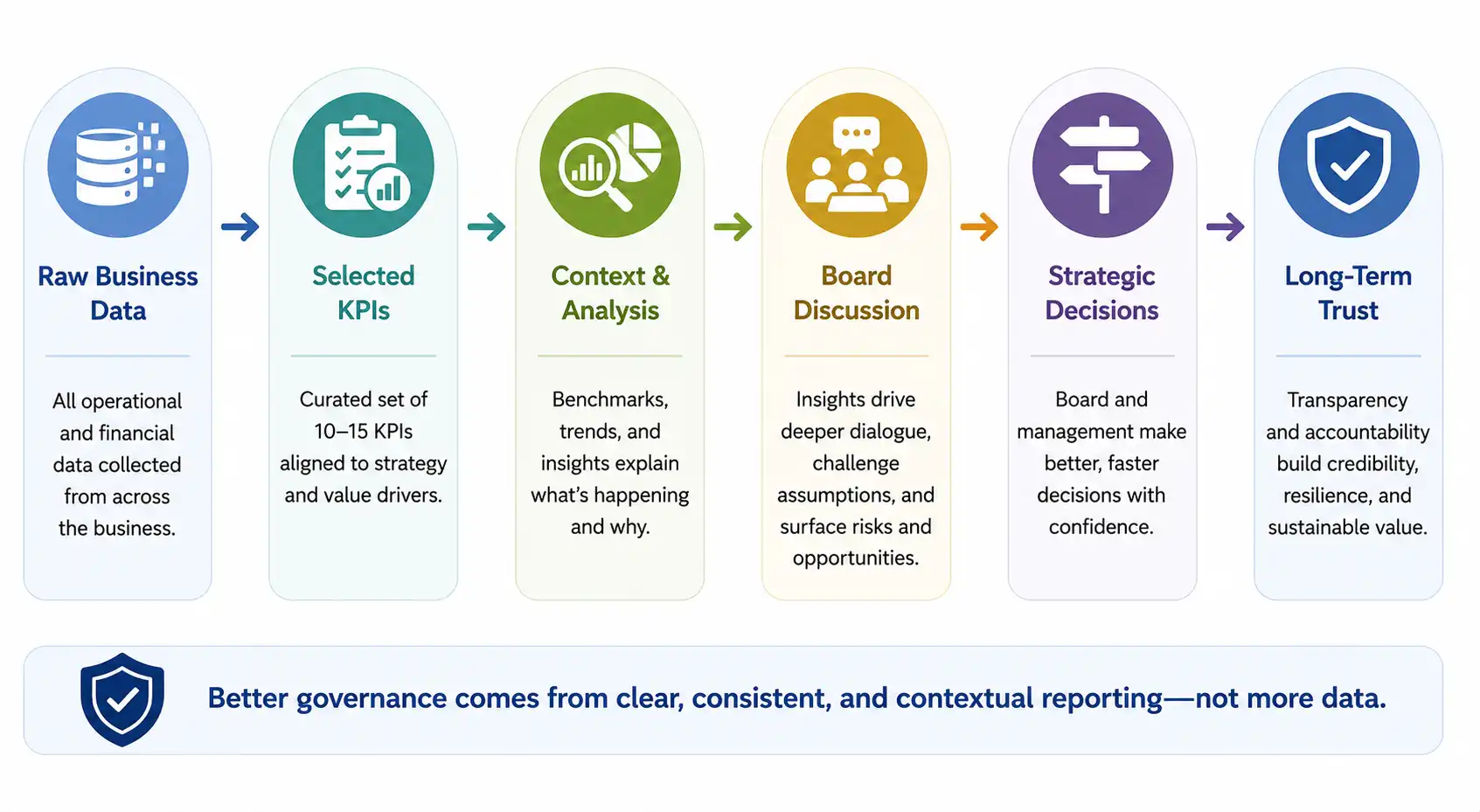
Corporate governance KPI transparency is not a reporting reform; it is a governance philosophy. Boards do not need more data. They need clarity structured around strategy, anchored by consistent benchmarks, and narrated with candor.
KPIs work when they’re curated rather than accumulated. They should map explicitly to enterprise priorities. They should be delivered on a cadence that matches the pace of the business. And they should be reinforced as a cultural norm, not a quarterly obligation. When all four hold, the board stops being a passive audience. It becomes an active partner in strategy and risk.
Across cybersecurity, SaaS, gaming, logistics, digital marketing, medical devices, consumer products, and nonprofit organizations, the pattern has held with a consistency that no longer surprises. Transparency in corporate governance builds the kind of trust that no polished narrative alone can manufacture. That trust, once earned, becomes durable capital of its own. It sustains confidence through growth, through disruption, and through the leadership transitions every organization eventually faces.
Disclaimer: This article is intended for informational purposes only and does not constitute legal, tax, or accounting advice. You should consult your own tax advisor or counsel for advice tailored to your specific situation.
Hindol Datta is a four-time CFO and senior finance executive with over 25 years of leadership experience across cybersecurity, SaaS, gaming, logistics, digital marketing, medical devices, consumer products, and nonprofit organizations. He has led more than $120M in fundraising and over $150M in M&A transactions while building the financial and operational systems that let complex businesses scale with confidence. He is the author of seven books in the Systems CFO Series and holds active CPA, CMA, and CIA credentials.
AI-assisted insights, supplemented by 25 years of finance leadership experience.