
Executive Summary
Managing multiple clients as a fractional CFO is not primarily a scheduling problem. It is a problem of mental architecture, since the real cost of a crowded client roster is not the hours it consumes but the depth it threatens to erode. A CFO who manages multiple clients well has built a system for holding several distinct businesses in working memory at once, each with its own risks and unfinished conversations, without collapsing into shallow, reactive advice for all of them.
This article lays out a practical framework for managing multiple clients while still functioning as a strategic partner rather than a part-time bookkeeper: segmenting a client base by stage and scope, structuring the week so context does not bleed between engagements, building infrastructure that keeps every client’s history visible, and protecting the discipline to say no when a prospective client will not respect the finance function.
Introduction: The Challenge of Cognitive Switching
A fractional CFO practice is built on a strange kind of professional gymnastics. The value proposition depends on serving several businesses at once, yet each business expects the undivided strategic attention of a full-time executive. Managing multiple clients therefore means switching, often within the same afternoon, between a Series A software company worried about churn and a pre-revenue climate startup wrestling with a federal grant application, without either client sensing they are one of several.
This is a mental model management challenge before it is a time management challenge. A CFO carrying a portfolio of engagements is expected to be strategic and in the operational weeds simultaneously, often on the same call, and businesses that hire fractional finance leadership are rarely forgiving of a slow ramp back into their specific context. The framework below reduces that switching cost through segmentation, scheduling discipline, documentation, and a willingness to decline engagements that will not sustain real depth.
Segment Your Clients by Stage and Scope
One of the more durable ways to preserve strategic bandwidth while managing multiple clients is to segment the portfolio deliberately, rather than treating every engagement as equivalent. A simple two-by-two grid does most of the work: stage, pre-seed or seed versus Series A and beyond, crossed against scope, transactional work such as books and cash versus strategic work such as fundraising and mergers and acquisitions.
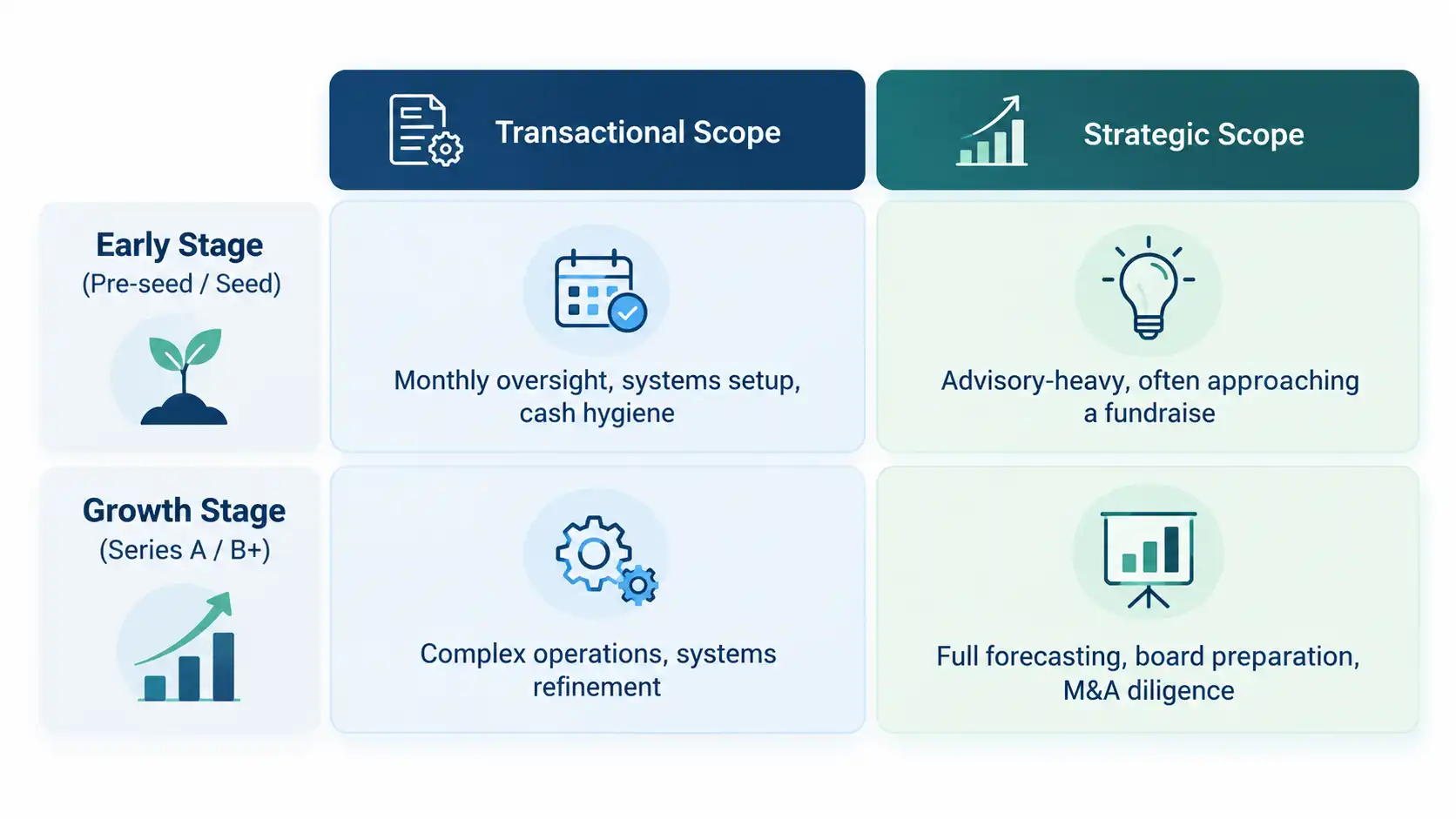
Mapping every client into one of these four archetypes clarifies the cadence of contact, the deliverables owed, and the headspace each relationship should reasonably claim. A cybersecurity and identity access management company running at roughly $30M in annual recurring revenue sits firmly in the growth and strategic quadrant, and the forecasting discipline that holds actuals within five percent of plan across eight consecutive quarters is a different kind of engagement from a pre-Series A build where the finance function does not yet exist and the task is constructing a chart of accounts from a blank page. Treating both with the same cadence wastes attention on the former and starves the latter.
Why Segmentation Prevents Burnout
The quiet danger of skipping this step is that every client begins to feel equally urgent, which is rarely true and exhausting to sustain. A portfolio segmented honestly sends the deepest thinking toward the growth and strategic quadrant while the early and transactional quadrant runs on a lighter, repeatable rhythm. Segmentation is what makes managing multiple clients possible without every one competing for the same finite reserve of strategic energy.
Use Themed Days and Context Blocks
Multitasking is the enemy of strategic thinking, and managing several clients across a week magnifies that problem unless the calendar is structured to prevent it. Time blocking by theme, rather than by whichever client emails first, keeps similar work grouped together.
A workable weekly rhythm:
- Mondays reserved for forecast and model reviews across the portfolio.
- Tuesdays dedicated to payroll and cash runway questions, which tend to be operational and time sensitive.
- Wednesdays protected for deep work, including financial models, board decks, and investor narratives that require sustained concentration.
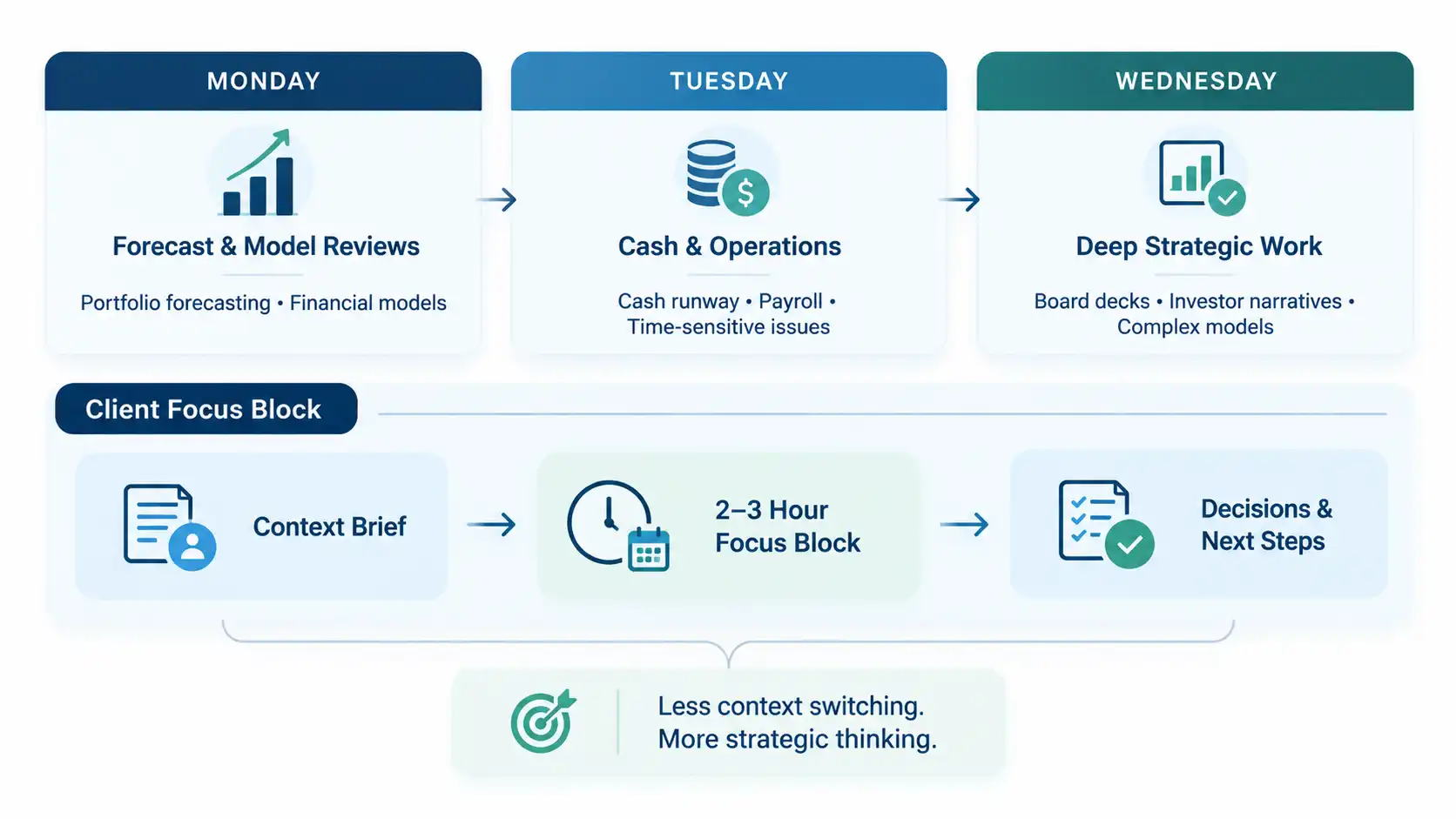
Within each themed day, blocking two-to-three-hour windows per client, rather than shorter fragments, allows enough runway to reach real depth on any single question. Opening each block with a short-written context brief, a quick reread of the prior week’s notes and the client’s stated goals, functions the same way a warm-up serves an athlete before a match; it centers attention before the substantive work begins. Borrowed assumptions from one client’s model into another’s forecast are an easy mistake once several engagements blur together in a single day, which is why the brief comes first and memory comes last.
Build a Client Operating System
A to-do list is not sufficient infrastructure for a fractional CFO practice carrying several engagements at once. The work requires something closer to an operating system, interlocking tools that track what matters for each client without depending on recall.
The core components:
- A shared workspace, in Notion or Google Drive, holding standard operating procedures, logins, and key reports for each engagement.
- A project management tool such as ClickUp or Asana to track recurring workflows, including month-end close, payroll cycles, and reporting deadlines.
- A lightweight CRM or spreadsheet tracking client status, hours logged, open issues, and upcoming asks across the roster.
Treating each client as a product with its own roadmap and metrics, rather than an undifferentiated stream of requests, separates a CFO practice run like a firm from a freelance hustle that bills by the hour. The same instinct showed up in a Series B marketplace engagement, where a consolidated reporting framework built across two countries ahead of a raise gave the finance function a foundation that withstood investor scrutiny.
Document Like the Details Will Be Forgotten
Context fades quickly when a CFO is managing multiple clients, since the mind holding Tuesday’s cash runway conversation is the same mind carrying Wednesday’s board narrative and Thursday’s supply chain question. Clear weekly summaries for each client, covering decisions made, issues still open, and the next step, solve most of this problem before it becomes visible to the client.
This discipline does more than protect memory. It allows the following Monday to begin at full speed rather than a slow re-orientation, and it makes handoff to additional help considerably smoother once a practice scales beyond what a single CFO can carry alone. The same principle governed board and audit committee reporting as CFO of a mission-driven education institution, where a board member returning after a gap needed to reconstruct the full picture from the written record alone.
Know When to Say No
Strategic clarity depends on bandwidth, and bandwidth is finite, so not every prospective client deserves a yes. A useful filter asks three questions before accepting any new engagement:
- Does the prospective client respect the finance function, or do they treat it as an expense to be minimized?
- Will they grant full access to the data and systems required to do the work properly?
- Does the engagement add genuine leverage to the existing portfolio, or will it simply compete with stronger relationships for the same hours?
An engagement that looks promising on paper but withholds data, questions every billed hour, and ignores recommendations is a familiar pattern to any CFO who has been managing multiple clients for years, and it drains attention in a way that shows up across the whole portfolio. Screening for alignment before the contract is signed, rather than after months of strategic attention have already been spent, is what allows a practice to say yes fully elsewhere. The same discipline drove a buy-side review of an IT services acquisition target, where surfacing how reported numbers diverged from economic reality mattered more than the deal’s initial appeal.
Conclusion: Capacity Is a System, not a Feeling
Serving several clients well is not a function of working harder. It is a function of building a system that keeps the work manageable as the roster grows, which is the entire premise of managing multiple clients without sacrificing the depth that justifies the fractional model. Segmenting the portfolio by stage and scope, structuring the week around themed days, building a client operating system that does not depend on memory, documenting decisions as they happen, and protecting the discipline to decline poor-fit engagements together form a coherent approach to capacity.
A fractional CFO is not selling hours. The product is clarity, and clarity requires protected attention, guarded as fiercely as a client’s cash runway, which is what allows a practice to serve more businesses without carrying the chaos of one engagement into the next.
Three Key Takeaways
- Segmenting a client portfolio by stage and scope, rather than treating every engagement as equivalent, is the foundation for managing multiple clients without exhausting the strategic reserve that the work depends on.
- A deliberate weekly structure built around themed days and dedicated context blocks reduces the hidden cost of cognitive switching far more effectively than reacting to whichever client emails first.
- Written infrastructure, including a client operating system and weekly documentation for every engagement, replaces memory as the mechanism that keeps a growing fractional practice both scalable and reliable.
Disclaimer: This article is intended for informational purposes only and does not constitute legal, tax, or accounting advice. You should consult your own tax advisor or counsel for advice tailored to your specific situation.
Hindol Datta is a four-time CFO and senior finance executive with over 25 years of leadership experience across cybersecurity, SaaS, gaming, logistics, digital marketing, medical devices, consumer products, and nonprofit organizations. He has led more than $120M in fundraising and over $150M in M&A transactions while building the financial and operational systems that let complex businesses scale with confidence. He is the author of seven books in the Systems CFO Series and holds active CPA, CMA, and CIA credentials.
AI-assisted insights, supplemented by 25 years of finance leadership experience.