
Executive Summary
Few founders frame the debate over common stock vs preferred stock correctly in the early stages of a company’s life. Founders tend to treat equity as a single pool of ownership. At the first term sheet, they discover that preferred shares vs common shares carry different rights and protections. Each class stakes a distinct claim on the business. This is not a paperwork distinction. It decides who collects proceeds first at exit and who controls board decisions. It also shapes how much upside actually reaches the people who built the company.
This article breaks down the structural divide between the two share classes. It covers the specific mechanics that make preferred stock more powerful than its name suggests. It also lays out the practical consequences for founders, employees, and investors when the exit finally arrives. Understanding preferred stock vs common stock early changes how founders negotiate term sheets and set expectations across the cap table.
Two Classes, One Company: Why the Structural Divide Exists
Founders and early employees generally hold common stock. Investors, from seed through late-stage rounds, almost always hold preferred stock. The distinction exists because capital carries risk, and investors negotiate protection against the downside in exchange for writing the check.
Preferred stock typically comes with liquidation preferences, anti-dilution clauses, and board or veto rights. These can outweigh a purely numerical ownership stake. A founder holding 40% of the company in common stock does not automatically outrank a 20% preferred holder in a sale. The preferred holder may control board seats, hold blocking rights over financing decisions, and sit first in line at liquidation. This is not a misunderstanding of percentages. It reflects a hierarchy of capital that most founders only encounter once the first institutional round closes.
In one venture-backed digital marketing company that raised $36.5M across three funding rounds while scaling from $9M to $180M in revenue, each successive round reshaped the cap table in ways that common holders felt only at the exit, not at signing. The lesson repeats across industries: the structure negotiated in year one determines who benefits in year five.
The Mechanics of Preferred Stock: Rights and Protections
Preferred stock earns its name through a set of negotiated privileges layered on top of the base ownership represented by common shares. Four mechanisms matter most.
Liquidation Preferences and Participation
A liquidation preference determines who gets paid first, and how much, when the company sells or dissolves. A standard 1x preference returns the investor’s capital before any proceeds reach common holders.
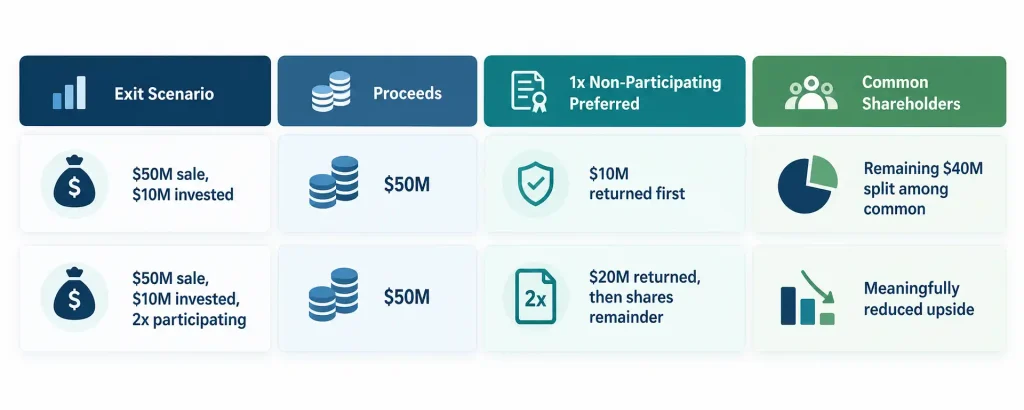
Some preferences are participating, meaning investors collect their initial capital back and then share in what remains as if they also held common stock. This double-dip can be capped, commonly at 2x or 3x the original investment, but uncapped participation compounds against common holders at exactly the moment they expect to be rewarded.
Anti-Dilution Protection
When a company raises a down round, issuing shares at a lower price than the prior round, preferred holders are typically shielded through anti-dilution provisions. The weighted average formula is the market standard and adjusts the conversion price proportionally to the size and severity of the down round. The full ratchet version is far harsher, resetting the conversion price entirely to the new, lower price and concentrating dilution disproportionately on common shareholders and the option pool.
Conversion Rights and Voting Provisions
Preferred stock generally converts into common stock, either at the holder’s election or automatically upon a qualifying event such as an IPO or acquisition. The starting ratio is usually 1:1 but shifts if anti-dilution mechanics have been triggered along the way. Alongside conversion rights, preferred holders frequently secure board seats and protective provisions covering major decisions, including new share issuances, a company sale, or amendments to the bylaws. These provisions are the practical mechanism through which preferred vs common stock translates into actual control, independent of the percentage ownership on the cap table.
The Common Shareholder’s Position: Exposure Without the Armor
Common stock is the default class, held by founders, employees, and early advisors. It carries fewer contractual protections and greater exposure to long-term outcomes, for better and for worse.
Exit Dynamics
When exit proceeds barely clear invested capital, common holders can be wiped out entirely. Consider a $40M sale following $35M raised through preferred shares with a 1x participating structure. After the preference stack is satisfied, little or nothing remains for common shareholders, regardless of how the ownership percentages appeared on paper the day the round closed. In a marketplace SaaS company that closed a $20M Series B on the strength of defensible cohort and unit economics, the preference stack negotiated at that round became the reference point every subsequent investor measured against, a pattern that holds across sectors from SaaS to consumer products.
Control and Compensation Dynamics
Majority common ownership does not guarantee final say. Protective provisions and board composition frequently give preferred holders practical control over financing decisions, strategic pivots, and exit timing. In a mission-driven education and research institution that raised $37M in equity and venture debt, board and audit committee structure carried more weight over strategic decisions than the underlying ownership percentages, a dynamic that recurs across nonprofit, for-profit, and public company boards alike.
Compensation compounds the same imbalance. Option pools are structured in common stock, placing employee equity behind preferred claims in the payout hierarchy. Left unexplained, this creates morale and retention problems when employees eventually learn how the waterfall actually works.
Common practitioner responsibilities in this position typically include:
- Translating preference stacks and waterfall math into plain terms for the board and for employees
- Modeling exit scenarios under multiple valuation and preference assumptions before a sale process begins
- Keeping the cap table current so ownership percentages and payout outcomes are never presented as the same thing
- Flagging precedent risk before a founder accepts an aggressive preference term in an early round
Structure Becomes Destiny: Strategic and Governance Considerations
Equity structure is a strategic decision, not a documentation exercise. Terms accepted in an early round set precedent for every round that follows. A 2x participating preference in a Series A tends to reappear in a Series B. A full ratchet accepted early invites the same demand from later investors.
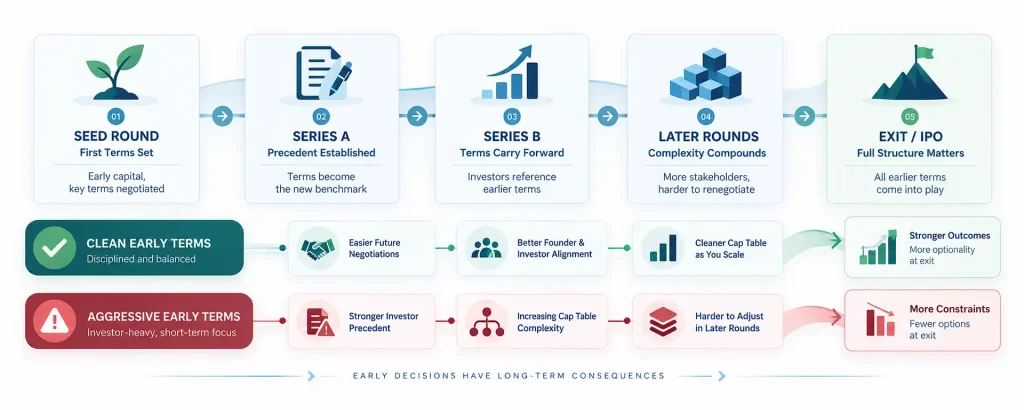
There is a temptation to trade excessive preference terms for a higher headline valuation. This can backfire, since an overloaded preference stack demotivates the common holders who are expected to build the company toward the eventual exit. Investors may win on paper and lose alignment in practice, a result that serves no one well over a multi-year hold period.
Transparency is the corrective. Employees receiving option grants without understanding liquidation preferences, and founders assuming control without reading board consent clauses, are not simple oversights. They are structural failures that surface at the worst possible moment, typically during a sale process under time pressure. A public company gaming and digital entertainment business preparing for an S-1 and IPO-readiness process learned this directly: conversion mechanics and preference terms negotiated years earlier had to be reconciled and explained to underwriters and auditors long after the original signatories had moved on.
The role of finance leadership in this terrain extends beyond tracking the cap table. It includes advocating for clean structures, modeling real-world payout scenarios rather than headline ownership percentages, and keeping founders, employees, and investors aligned as the company scales through multiple rounds.
Three Key Takeaways
- Ownership percentage and payout outcome are not the same number, and the gap between them is defined entirely by the preference terms negotiated at each round, not by the cap table headline.
- Anti-dilution and participation terms compound across funding rounds, so a preference accepted in an early raise becomes the floor, not the ceiling, for every subsequent negotiation.
- Transparency around liquidation preferences, board control, and option pool subordination protects morale and trust long before a sale process forces the math into the open.
Disclaimer: This article is intended for informational purposes only and does not constitute legal, tax, or accounting advice. You should consult your own tax advisor or counsel for advice tailored to your specific situation.
Hindol Datta is a four-time CFO and senior finance executive with over 25 years of leadership experience across cybersecurity, SaaS, gaming, logistics, digital marketing, medical devices, consumer products, and nonprofit organizations. He has led more than $120M in fundraising and over $150M in M&A transactions while building the financial and operational systems that let complex businesses scale with confidence. He is the author of seven books in the Systems CFO Series and holds active CPA, CMA, and CIA credentials.
AI-assisted insights, supplemented by 25 years of finance leadership experience.