
Executive Summary
Pre-money vs post-money valuation is the most misunderstood pair of terms in early-stage financing, and getting the distinction wrong changes how much of the company a founder actually keeps. Pre-money valuation is the agreed value of the company before new investment is added. Post-money valuation is that figure plus the new money coming in.
This article breaks down the math behind pre and post money valuation, shows how an option pool refresh can quietly shift founder ownership, and walks through the timing and definitional issues that make one $25 million post-money term sheet very different from another.
What Is Pre-Money and Post-Money Valuation
Pre-money valuation is the value investors and founders assign to a company immediately before new investment comes in. Post-money valuation simply adds that new capital to the pre-money figure.
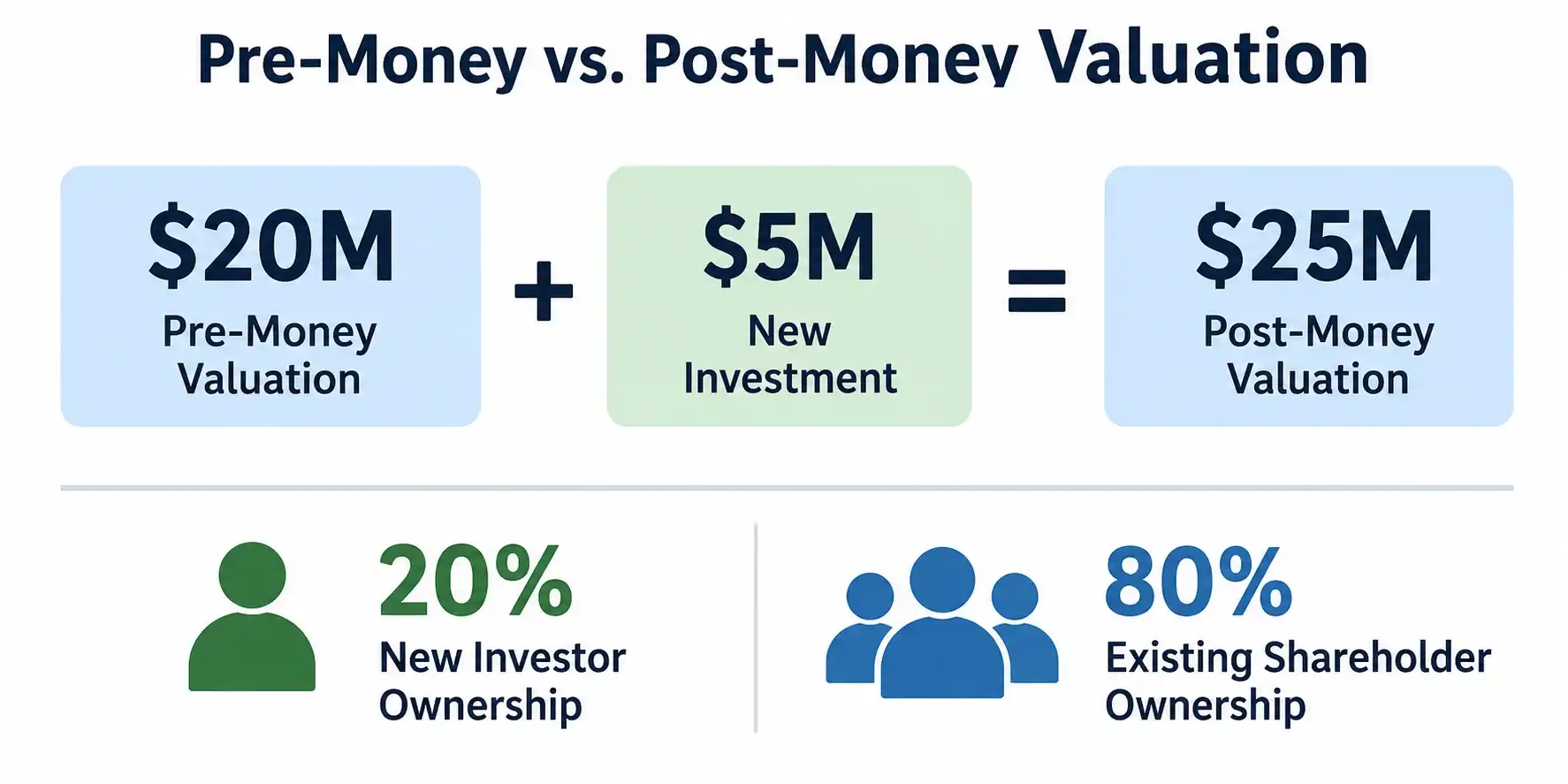
A startup raising $5 million at a $20 million pre-money valuation ends up with a $25 million post-money valuation. The new investor receives $5 million divided by $25 million, or 20 percent of the company. That much is straightforward. What complicates it is the timing of the option pool, whether convertible instruments are included, and how ownership itself is defined in the term sheet.
The Math Behind Pre and Post Money Valuation, With and Without an Option Pool
Scenario A: No Option Pool Refresh Required
- Pre-money valuation: $20 million
- New investment: $5 million
- Post-money valuation: $25 million
- New investor ownership: $5 million ÷ $25 million = 20 percent
- Existing shareholders retain 80 percent
Scenario B: Option Pool Refresh Included Pre-Money
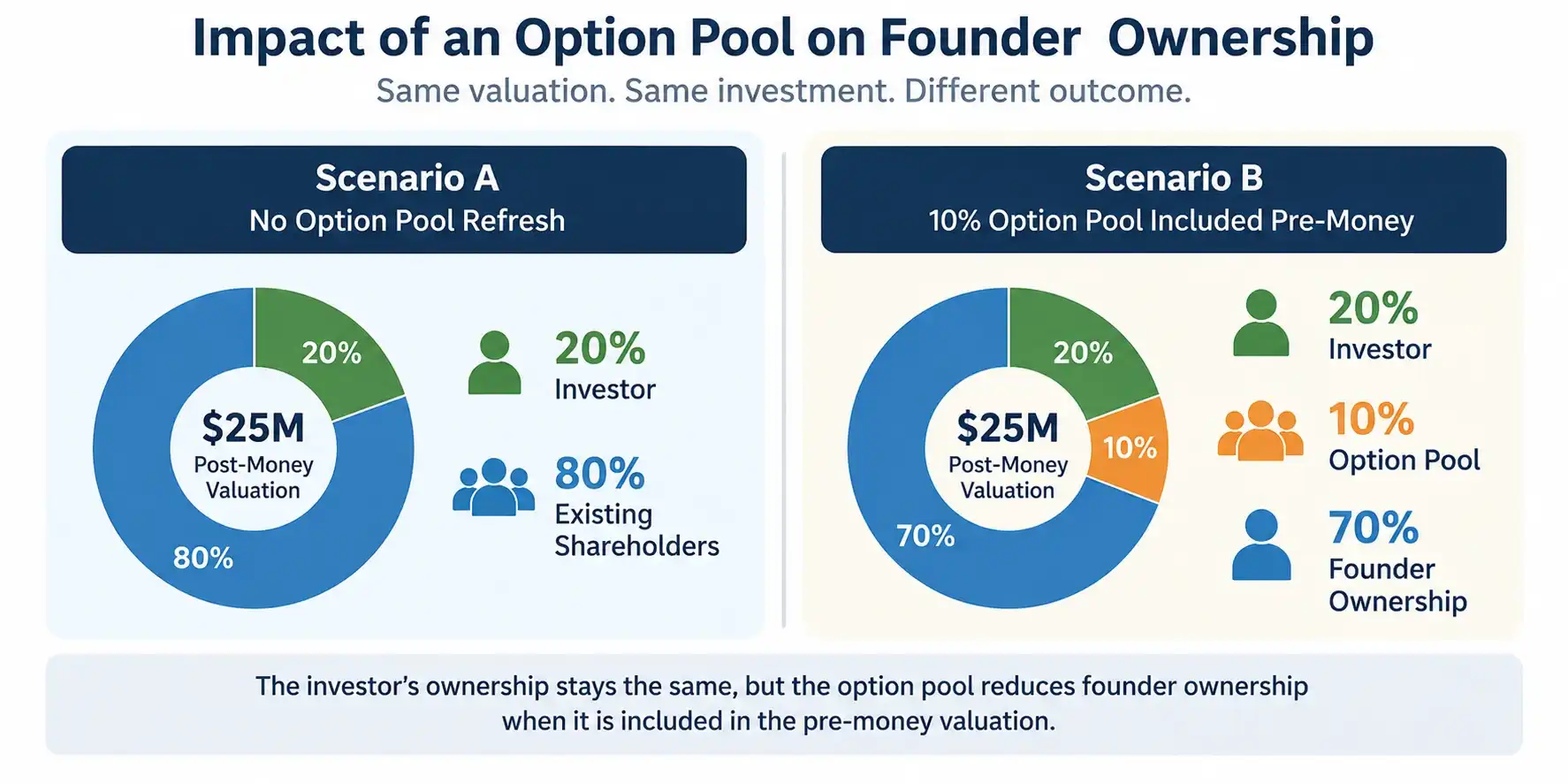
Now assume the investor requires a 10 percent unallocated option pool post-money and insists on folding it into the pre-money valuation. The investor still contributes $5 million, and the company still carries a $20 million pre-money valuation. But the founder’s stake now has to absorb the new option pool before the math sets the investor’s ownership percentage.
- Investor ownership: 20 percent, or $5 million
- Option pool: 10 percent, or $2.5 million
- Founder ownership: 70 percent, or $17.5 million
The investor contributes the same amount in both scenarios, but founders end up owning less in Scenario B, not because of the investor’s check, but because of where the option pool sits in the math. This is the gap between headline valuation and effective valuation. The pre-money number on paper stays at $20 million, while the portion founders actually keep has dropped.
Why Timing and Definitions Shift the Outcome
Option Pool Sizing and Timing
Investors often require an option pool refresh, say to 15 percent, and want that increase included pre-money. That means the dilution from the new pool falls on existing shareholders rather than on new investors. From the investor’s side, this preserves their intended post-financing ownership. From the founder’s side, it means giving up additional equity that goes toward future hires rather than toward capital raised. A skilled CFO negotiates the timing of that calculation, not just the size of the pool, since timing determines whether founders absorb the dilution alone or share it proportionately with new investors.
Inclusion of Convertible Instruments
Outstanding SAFEs or convertible notes that will convert at the next priced round raise a similar question. If they convert into the pre-money valuation, they dilute founders before new investors enter. If they convert on top of the post-money valuation, they dilute everyone. Investors will often argue these instruments belong in the pre-money calculation. The CFO’s role is to model both outcomes and negotiate the appropriate treatment based on timing, valuation caps, and prior agreements.
Different Definitions of Valuation
Not every term sheet defines post-money ownership the same way. Some include the option pool and convertible instruments in that figure, and some do not, which makes it risky to compare valuation headlines across offers. A $25 million post-money valuation might leave a founder with 60 percent ownership in one term sheet and 48 percent in another, purely because each term sheet defines the underlying mechanics differently. Valuation is not just a number. It is a structure that needs to be modeled line by line before it can be compared or trusted.
The Strategic Implications of Misreading Pre vs Post Money Valuation
Getting this math wrong is not just a modeling exercise. It creates structural problems that compound into later rounds.
Down Rounds Become More Likely
Founders who raise at inflated valuations without understanding dilution often overpromise equity to employees. If growth does not catch up to the valuation by the next round, the company risks a down round, which can trigger anti-dilution provisions and damage morale.
Founder Dilution Compounds
When the option pool, convertible instruments, and headline valuation are not negotiated carefully, founder ownership can erode fast. Across some fundraising engagements, founder ownership has dropped from 70 percent to 30 percent within two rounds, not because of the capital raised, but because of poor term structuring around exactly these mechanics.
Employee Misalignment
Employees are typically granted options based on nominal percentages or share counts. If the cap table shifts significantly after a round, particularly with a post-money pool refresh, employees may find their equity worth far less than expected, which creates real retention and motivation risk.
Future Investors Lose Confidence
When later investors review a cap table and find messy conversions, unclear ownership, or a valuation narrative that does not hold together, they grow cautious. That caution tends to show up as longer diligence, tougher terms, or a lost opportunity altogether.
Every term sheet deserves a scenario model. What happens to ownership at different raise sizes? What does an exit look like at $50 million versus $500 million? What is the cumulative dilution across every round to date? Valuation is not only a negotiation. It is an engineering exercise, and understanding the structure behind the number is what lets a founder bend the outcome in their favor.
Three Key Takeaways
- Pre-money vs post-money valuation is not just terminology. The same headline number can leave a founder with very different ownership depending on how the option pool and convertible instruments are timed.
- An option pool refresh included pre-money dilutes founders specifically, not the new investor, even though the investor’s check size stays the same. That distinction is worth negotiating on its own terms.
- Every term sheet should come with a scenario model covering different raise sizes, exit valuations, and cumulative dilution, because valuation mechanics compound across rounds in ways that are easy to miss in the moment.
Disclaimer: This article is intended for informational purposes only and does not constitute legal, financial, or investment advice. Please consult your professional advisors before making equity or financing decisions.
Hindol Datta is a four-time CFO and senior finance executive with over 25 years of leadership experience across cybersecurity, SaaS, gaming, logistics, digital marketing, medical devices, consumer products, and nonprofit organizations. He has led more than $120M in fundraising and over $150M in M&A transactions while building the financial and operational systems that let complex businesses scale with confidence. He is the author of seven books in the Systems CFO Series and holds active CPA, CMA, and CIA credentials.
AI-assisted insights, supplemented by 25 years of finance leadership experience.