
Executive Summary
Valuation multiples are the language buyers and sellers use to translate a business into a single number. Yet that number hides more than it reveals. Behind every EV/EBITDA figure, every revenue multiple, and every comparable transaction sits a set of assumptions about growth, margin durability, and risk. A CFO must unpack those assumptions before accepting a headline figure at face value. For finance leaders navigating fundraising, an exit, or an acquisition, fluency in valuation multiples is not an academic exercise. It is the difference between negotiating from strength and negotiating from hope.
This article walks through the four pillars practitioners rely on when working through valuation multiples. EV/EBITDA serves as the anchor multiple for mature and profitable businesses. Revenue and sales multiples come into play for companies still building toward profitability. Comparable transactions act as a reality check against market behavior. Cyclical forces expand or compress multiples regardless of a company’s underlying fundamentals. Each section draws on direct advisory and operating experience across cybersecurity, marketplace SaaS, private equity diligence, and public-company M&A. The goal is to ground the framework in how these numbers actually move in negotiation rooms, not in textbooks.
EV/EBITDA: The Anchor Valuation Multiple for Mature Businesses
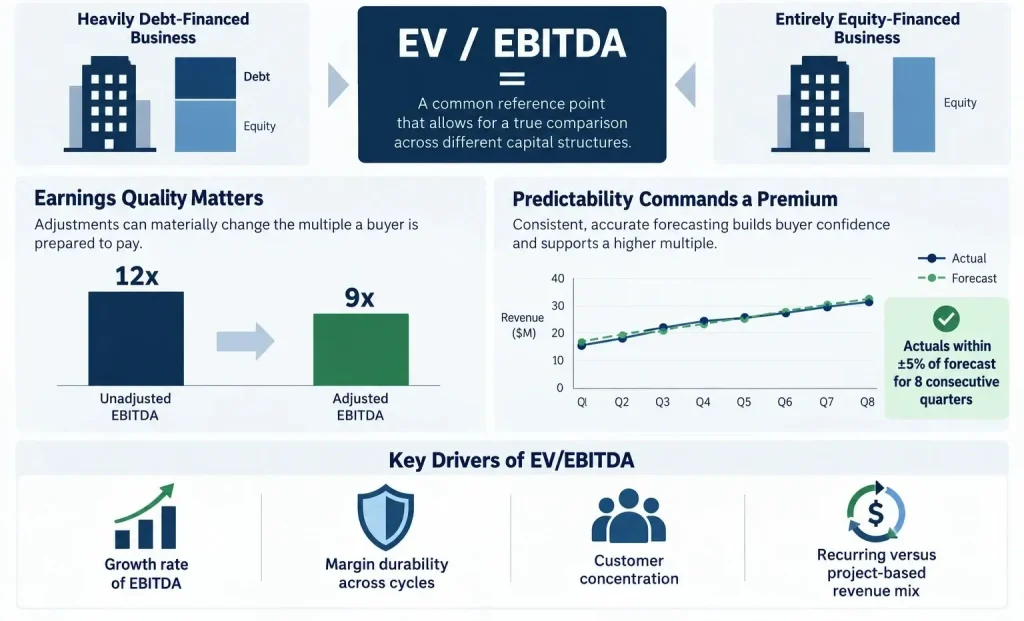
Enterprise value to EBITDA remains the most widely cited valuation multiple across industries because it strips out the noise of capital structure and focuses attention on operating performance. A business financed with heavy debt and one financed entirely with equity can be compared on equal footing once the analysis moves to EV/EBITDA, which is precisely why buyers, lenders, and boards gravitate toward it as a common reference point.
The multiple, however, is only as trustworthy as the earnings quality behind it. In one buy-side engagement supporting due diligence on an IT services acquisition target, quality-of-earnings analysis surfaced material EBITDA adjustments that had not been visible in the seller’s initial presentation, and those adjustments shifted the effective multiple the buyer was prepared to pay. A headline of 12x on unadjusted earnings can quietly become 9x once addbacks, one-time items, and normalization entries are corrected, and a CFO who has not modeled that gap walks into a negotiation blind.
Predictability drives the premium end of the range. In an advisory role supporting a high-growth cybersecurity and identity access management company generating approximately $30M in annual recurring revenue, a driver-based forecasting engine built from scratch held actuals within plus or minus five percent of forecast for eight consecutive quarters. That level of predictability, paired with clean recurring revenue and disciplined margin management, is what allows a company to command the upper end of an EV/EBITDA range rather than the lower end, because it converts the buyer’s risk premium into confidence.
Key drivers of EV/EBITDA include:
- Growth rate of EBITDA
- Margin durability across cycles
- Customer concentration
- Recurring versus project-based revenue mix
Revenue Multiples and Sales Multiples: Pricing Growth Before Profit
In early-stage and high-growth sectors, where EBITDA is negative or immaterial, revenue multiples and sales multiples become the default currency of negotiation. EV/revenue pricing is common across software, biotech, and consumer technology, precisely because these businesses are being valued on the trajectory of the business rather than its current earnings.
The risk in revenue-based multiples valuation is that a headline number can flatter a business with weak underlying economics. A company posting a sales multiple of 20x on revenue with a forty percent gross margin and heavy net burn is not automatically worth more than a competitor trading at 10x with a seventy-five percent margin and near-zero burn, yet founders and boards frequently anchor on the larger number because it appears first. During a Series B marketplace SaaS raise, consolidated reporting across the company’s United States and Polish operations, combined with cohort analysis and unit economics modeling, anchored investor diligence and withstood scrutiny well enough to close a $20M round on defensible terms. The multiple mattered less than the evidence supporting it.
Revenue quality, not the headline multiple, is what determines whether a valuation survives diligence.
Revenue quality factors that shape the multiple include:
- Deferred revenue versus billed revenue
- Gross margin profile
- Upsell and cross-sell capacity
- Contract length and churn rates
Comparable Transactions: What the Market Actually Pays
Comparable transactions provide the most reality-based benchmark available to a CFO, particularly once normalized for company size, geography, and industry, but the underlying data is frequently uneven. Private deal comps often arrive without the context needed to interpret them correctly, since the reported multiple rarely discloses whether it reflects a strategic premium, an earnout structure, or a distressed sale.
A buy-side analyst role supporting an IT services acquisition made this gap concrete: integration risk assessment and valuation modeling revealed where reported comparable multiples diverged from the economic reality a buyer would actually inherit post-close. A strategic acquirer paying a rich multiple may be buying talent, distribution, or regulatory access rather than earnings, while a financial buyer’s lower multiple may carry cleaner terms and faster certainty of close. Reading a comp stack without that context produces false confidence.
A useful comp stack should show:
- Median and quartile multiples
- Deal size correlation
- Exit route, whether strategic or financial
Valuation Multiple Expansion and Compression: Why Timing Shapes Outcomes
Multiples fluctuate with interest rates, risk appetite, and sector rotation, and a CFO who treats a multiple as a fixed attribute of the business rather than a moving target of market sentiment is planning for a deal that may not exist when the time comes. During the 2021 technology run-up, early-stage fintechs commanded revenue multiples above 25x. By 2023, the same cohort of companies traded closer to 6x, with no comparable collapse in their underlying fundamentals.
Scaling through a compressed cycle is possible, but it demands discipline rather than optimism. In a performance marketing and digital services engagement, revenue grew from $9M to $180M within twenty-four months while $36.5M was raised across three funding rounds and three acquisitions were led and integrated, work that depended on building customer acquisition cost, lifetime value, and contribution margin discipline well before the capital markets rewarded growth without qualification. Timing an exit around a favorable multiple window, rather than assuming the window stays open, is often the difference between a strong outcome and a missed one.
Using Multiples for Internal Strategic Planning
Multiples are not only external pricing tools; they are internal planning instruments. During an S-1 preparation and IPO-readiness process for a Euronext Paris-listed gaming and digital entertainment company, valuation scenarios built under different multiple assumptions helped translate abstract capital markets expectations into decisions the executive team and board could act on, from M&A targeting to incentive equity design.
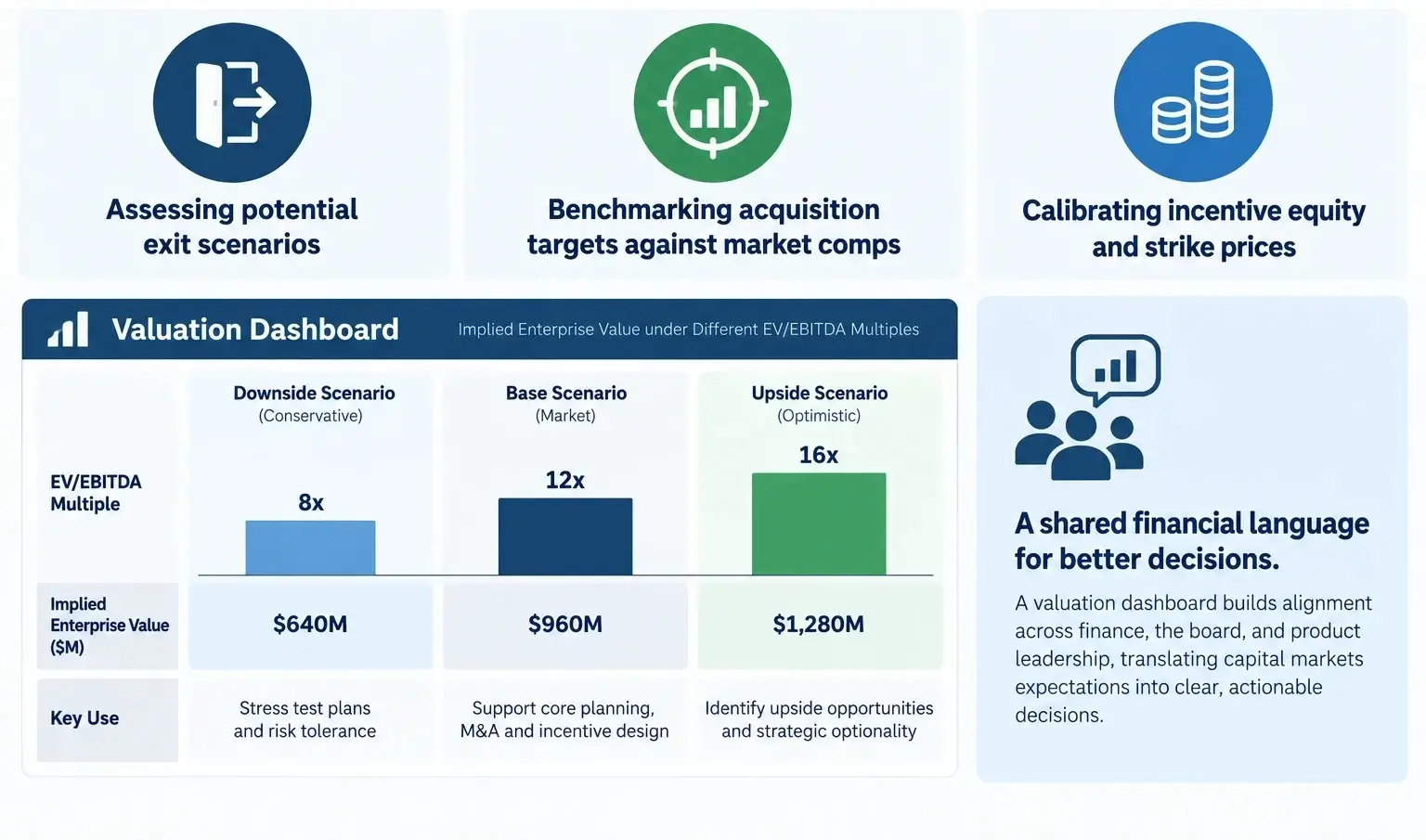
Internal applications of valuation multiples include:
- Assessing potential exit scenarios
- Benchmarking acquisition targets against market comps
- Calibrating incentive equity and strike prices
A valuation dashboard that shows implied value under three multiple scenarios, base, downside, and upside, builds a shared financial language across finance, the board, and product leadership, which matters as much for internal alignment as it does for external negotiation. Treating valuation multiples as a planning tool rather than a closing-day artifact is what separates reactive finance functions from ones that shape the deal before it arrives.
Three Key Takeaways
- EV/EBITDA rewards predictability more than scale, and a forecasting discipline that holds actuals within a tight range of plan is often what separates a 9x offer from a 13x offer on the same underlying business.
- Revenue and sales multiples should never be read in isolation from revenue quality; a lower headline multiple backed by durable gross margin, low churn, and defensible unit economics frequently produces a better outcome for a seller than a higher multiple built on fragile assumptions.
- Multiples move with the capital markets cycle regardless of company performance, which means exit timing and internal scenario planning under base, downside, and upside multiple assumptions deserve as much attention as the operating metrics that feed into the multiple itself.
Disclaimer: This article is intended for informational purposes only and does not constitute legal, tax, or accounting advice. You should consult your own tax advisor or counsel for advice tailored to your specific situation.
Hindol Datta is a four-time CFO and senior finance executive with over 25 years of leadership experience across cybersecurity, SaaS, gaming, logistics, digital marketing, medical devices, consumer products, and nonprofit organizations. He has led more than $120M in fundraising and over $150M in M&A transactions while building the financial and operational systems that let complex businesses scale with confidence. He is the author of seven books in the Systems CFO Series and holds active CPA, CMA, and CIA credentials.
AI-assisted insights, supplemented by 25 years of finance leadership experience.