
Executive Summary
Deal structuring finance rarely gets the boardroom’s attention. Yet it often determines whether the deal survives contact with reality. The purchase price is only the headline number. The buyer’s payment timing and its contingencies matter more than the multiple. The instruments chosen to bridge buyer and seller expectations carry the deal through its first difficult year.
This article covers four common instruments in M&A deal structure work. They are earnouts, seller notes, rollover equity, and bridge loans. Each solves a different problem. Together, they form the toolkit a CFO reaches for when a deal needs more than cash to close.
Financing as a Strategic Lever in M&A Deal Structure
Deal structuring is not a formality that follows the commercial terms. Deal structuring is where those terms actually get tested. A buyer and seller can shake hands on a value. They can still walk away if neither side agrees on how to pay it out. This is where deal structuring finance earns its keep. The mix of contingent payments, deferred notes, retained equity, and bridge capital shapes incentive alignment. That alignment holds long after the closing dinner is over.
This part of the transaction ranks among the purest expressions of financial creativity available to a CFO. Boardroom strategy conversations tend to focus on synergies and market position. The negotiation room is where the real decisions happen, because that is where the dollars move and when. Together, these instruments function as tools of trust and risk transfer. Until closing, both parties have every incentive to see the same numbers differently.
Earnouts: Bridging the Valuation Gap
Earnouts tie contingent payments to post-close performance. They earn their place whenever the buyer and seller cannot agree on where growth is headed. Instead of forcing one side to accept the other’s forecast, the earnout lets both be partially right and partially protected.
In one buy-side engagement, quality-of-earnings analysis surfaced this kind of disagreement in its rawest form. The adjustments found in reported EBITDA, along with the integration risks buried beneath the target’s numbers, guided the buyer’s decision. That decision shaped how much of the purchase price to risk versus defer into a contingent structure. An earnout, that engagement demonstrated, is not a way to avoid a valuation argument. It formalizes one, with defined metrics, a clear time frame, and audit rights. Those terms keep the disagreement from resurfacing eighteen months later as litigation.
Why Measurability Determines Whether an Earnout Works
An earnout succeeds or fails on the precision of its drafting. Commercially reasonable efforts clauses and pre-agreed accounting policies belong in the document before any dollar depends on future performance. Ambiguity in how the parties define revenue or EBITDA is where earnout disputes are born. The seller’s forecast in one healthtech transaction showed more upside than the buyer was comfortable underwriting two years out. A $20M earnout tied to reaching $50M in revenue closed that gap. It gave the seller upside while protecting the buyer’s downside. It also forced both sides to agree, in writing, on GAAP treatment, refund handling, and reporting cadence before close. A badly drafted earnout is a lawsuit waiting for its trigger date.
Seller Notes: Skin in the Game and Deferred Risk
A seller note is a promissory note the buyer issues to the seller, deferring part of the purchase price, typically with interest attached and a defined amortization schedule. It tells the seller that payment is coming, only not today, and it works best when the buyer’s capital runs tight or when the seller’s continued confidence in the business matters to the deal’s success.
A seller note also substitutes for stretched senior debt in a roll-up scenario. In one such structure, negotiated while leading acquisitions for a venture-backed digital marketing organization, a three-year note carrying a six percent coupon covered 15% of the purchase price, creating seller alignment without additional cash outlay at close. The tradeoff is subordination risk: a seller note sits behind senior lenders in the capital stack, and if the buyer later layers on additional debt, the seller’s claim weakens further. A finalized structure should include stress-testing seller note repayment against downside operating cases, because a note the business cannot service in a bad year turns from an alignment tool into an impairment problem.
Rollover Equity: Continuity and Shared Upside
Rollover equity involves the seller retaining a minority stake in the newly formed holding entity instead of taking full payment in cash. It is the clearest signal a seller can send that they believe in the business beyond the transaction, and it reduces the cash a buyer must raise while keeping management motivated through the transition.
In a consumer brand transaction, the founder rolled 30% of personal equity into the new HoldCo structure, keeping leadership invested well past the closing date. The rollover qualified as tax-deferred under Section 351, which mattered to the founder’s after-tax economics as much as the headline valuation did. Rollover equity, though, is rarely simple, and the following terms need explicit treatment before the ink dries:
- Tag-along and drag-along rights, so minority holders are neither trapped nor blindsided by a future sale
- Anti-dilution protections, particularly if the platform intends to raise additional capital or pursue further acquisitions
- Exit timing alignment, ensuring the rolled equity holder’s liquidity horizon does not conflict with the platform’s own exit strategy
Bridge Loans: Short-Term Capital to Close the Timing Gap
Bridge loans are temporary financing vehicles used to close timing gaps, whether that gap is regulatory approval, a delayed financing close, or an interim working capital need. They are the least glamorous instrument in the deal structuring finance toolkit, and often the most consequential, because momentum in M&A is fragile and a stalled closing can unravel a transaction after every other term has already fallen into place.
In a cross-border acquisition spanning multiple continents, regulatory review delayed permanent financing, and a six-month bridge loan funded escrow and interim working capital until the debt facility closed behind it. The bridge carried an 8% coupon, sat subordinated to the eventual senior facility, and the borrower retired it in full once permanent financing arrived. It required tight coordination with lenders and clarity on sources and uses, because a bridge loan misjudged on timing turns into a liquidity crisis instead of a solution.
Blended Structures: Why Deal Structuring Rarely Relies on One Tool
Most transactions of any complexity draw on more than one of these instruments at once, because no single tool satisfies every constraint a deal presents. A representative software-as-a-service transaction illustrates the point.
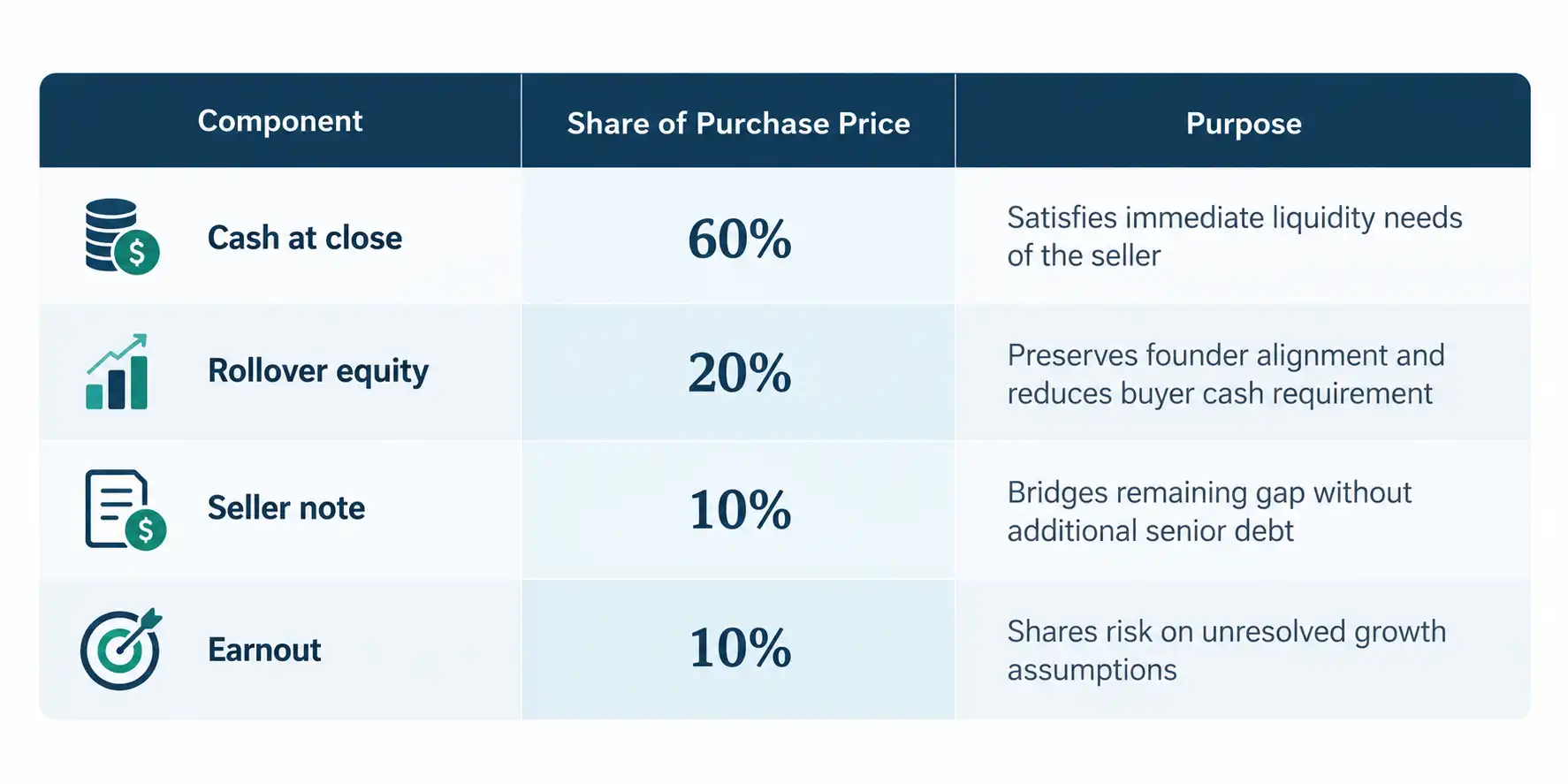
This blend balanced the buyer’s liquidity constraints, the seller’s need for upside participation, and the lender’s leverage tolerance, creating alignment that carried the business through a difficult first year. Experience executing more than $100M in cross-border M&A for a public gaming and digital entertainment company across North America, Europe, and Asia shows that blended structures outperform single-instrument deals whenever integration risk climbs, because no single party holds all of the downside.
Structuring as Strategy, Not Formality
Deal structuring finance is not a checklist to complete once the commercial terms are settled. It is a design discipline that determines how much capital a buyer needs, when that capital is needed, and how returns eventually get shared among the parties who took the risk. Every structuring element carries downstream obligations: earnouts must be tracked, notes serviced, rollover equity reflected in the go-forward cap table, and bridge loans retired on time. A post-close checklist keeps these moving parts from getting lost in the handoff from deal team to operating team.
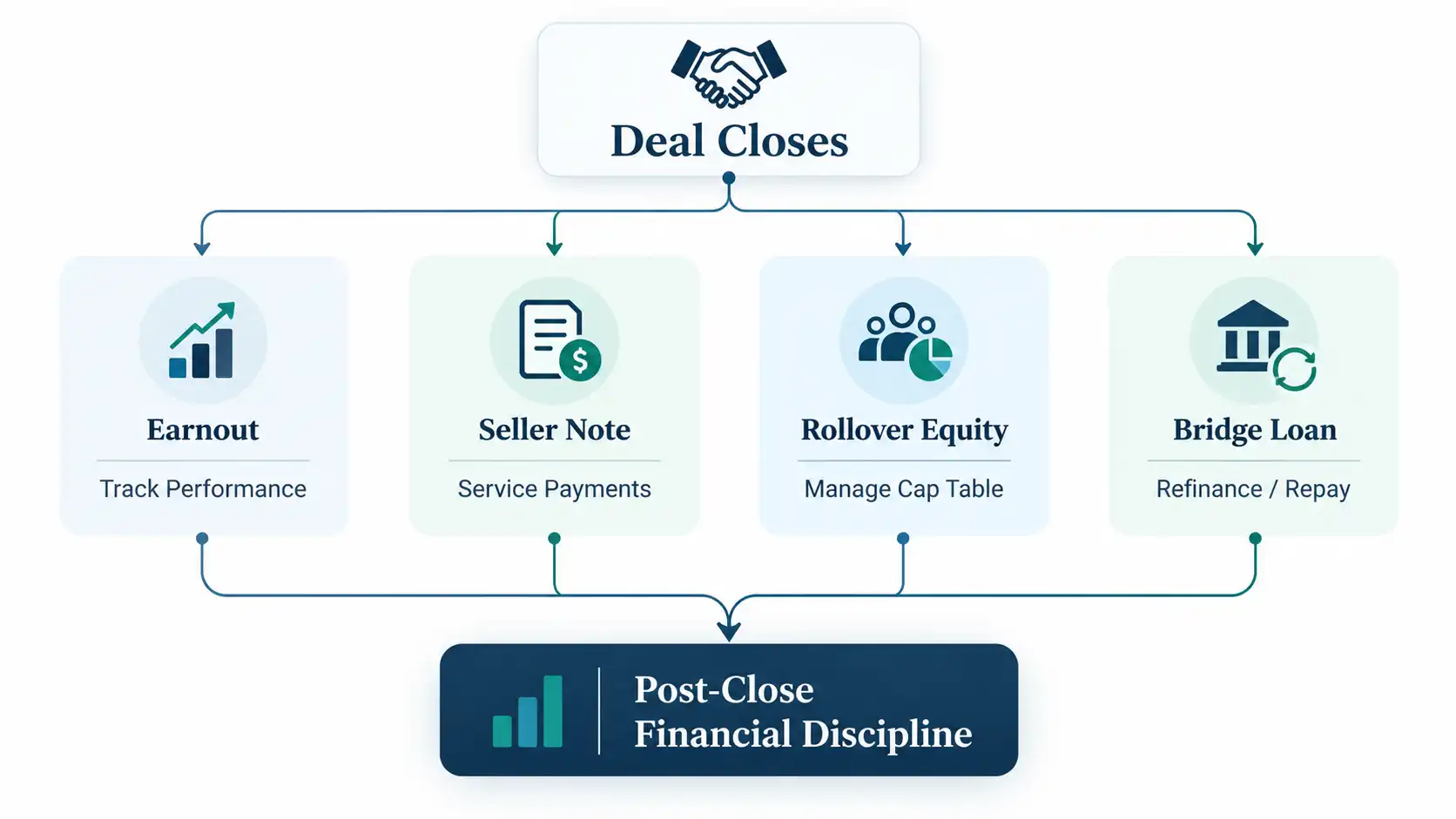
The rigor behind good structuring also builds trust. A term sheet waterfall, a sources and uses schedule, and a scenario model showing payoffs under multiple operating outcomes protect the buyer’s downside, and they signal to the seller that their risk has been genuinely considered instead of waved away.
Three Key Takeaways
- Treat every earnout, seller note, and rollover structure as a negotiated risk allocation instead of a financing convenience, and define the metrics and accounting treatment precisely enough that a dispute cannot hide inside an ambiguous clause.
- Blended capital structures tend to outperform single-instrument deals whenever growth assumptions are contested or integration risk is elevated, because spreading the payment mix distributes downside across the parties best positioned to absorb it.
- Bridge loans and seller notes both carry subordination risk that must be stress-tested against downside operating scenarios before the structure is finalized, since an instrument the business cannot service in a weak year converts an alignment tool into an impairment problem.
Disclaimer: This article is intended for informational purposes only and does not constitute legal, tax, or accounting advice. You should consult your own tax advisor or counsel for advice tailored to your specific situation.
Hindol Datta is a four-time CFO and senior finance executive with over 25 years of leadership experience across cybersecurity, SaaS, gaming, logistics, digital marketing, medical devices, consumer products, and nonprofit organizations. He has led more than $120M in fundraising and over $150M in M&A transactions while building the financial and operational systems that let complex businesses scale with confidence. He is the author of seven books in the Systems CFO Series and holds active CPA, CMA, and CIA credentials.
AI-assisted insights, supplemented by 25 years of finance leadership experience.