
Executive Summary
Deal teams often treat pushdown accounting as a footnote in deal documentation. Deal teams bury it as a routine technical election in the closing binder. In practice, it is one of three interlocking decisions that shape how an acquisition reads on the books. That effect lasts for years after the announcement fades. Fresh start accounting and purchase price allocation complete the set. Together, these choices shape reported EBITDA, goodwill exposure, and covenant compliance. They also shape the credibility of the numbers a finance team presents to its board.
This article walks through each of the three elements in sequence. It shows how pushdown accounting resets a target’s standalone financials. Fresh start accounting applies in distressed or carve-out scenarios. Purchase price allocation under ASC 805 turns a single purchase price into a set of assumptions. Auditors, lenders, and investors will test those assumptions for years. The article closes with the operational consequences finance leaders frequently underestimate. That is when a deal closes and the accounting work truly begins.
What Pushdown Accounting Actually Does to a Target’s Books
Pushdown accounting reflects an acquirer’s purchase price and basis adjustments directly on the acquired entity’s standalone financial statements. That differs from leaving those adjustments consolidated only at the parent level. The election is triggered by a change in control and, once made, is generally irrevocable under United States GAAP. International Financial Reporting Standards offer no direct equivalent. ASC 805 gives acquirers this option explicitly, and the decision carries weight well beyond the accounting department.
At one high-growth cybersecurity and identity access management platform generating close to $30M in annual recurring revenue, the finance function walked through this exact election during an acquisition. Pushdown accounting aligned the target’s standalone reporting with the parent’s consolidated view. The fair value step-up on intangible assets produced amortization that depressed standalone EBITDA for several years afterward. That single election required revisiting management bonus plans. Incentive structures tied to GAAP EBIT no longer reflected the operating performance the team was actually delivering.
The Strategic Weight Behind a Technical Election
Treating pushdown accounting as a checkbox decision misses the point entirely. The election resets the depreciation schedule, changes the goodwill balance carried on the acquiree’s books, and alters every ratio a lender or board member uses to evaluate the business going forward. A CFO deciding whether to elect pushdown accounting should ask three questions before signing off:
- Does the aging basis on the target’s existing assets already misrepresent the business, making a reset genuinely useful for internal and external transparency
- What will the resulting amortization do to standalone EBITDA, and are covenant definitions built to absorb that change
- Are management incentive plans structured around metrics that pushdown accounting will distort, and does the board understand why
Answering these honestly before the election is made saves months of explanation after the fact.
Fresh Start Accounting: When the Slate Is Wiped Clean
Fresh start accounting applies primarily in bankruptcy reorganizations, though it becomes relevant in distressed acquisitions and certain carve-out transactions where the resulting entity effectively becomes a new reporting unit. The mechanics are more severe than pushdown accounting: the existing balance sheet is eliminated, every asset and liability is revalued to fair value, and a new retained earnings balance is established as though the entity had never existed before that date.
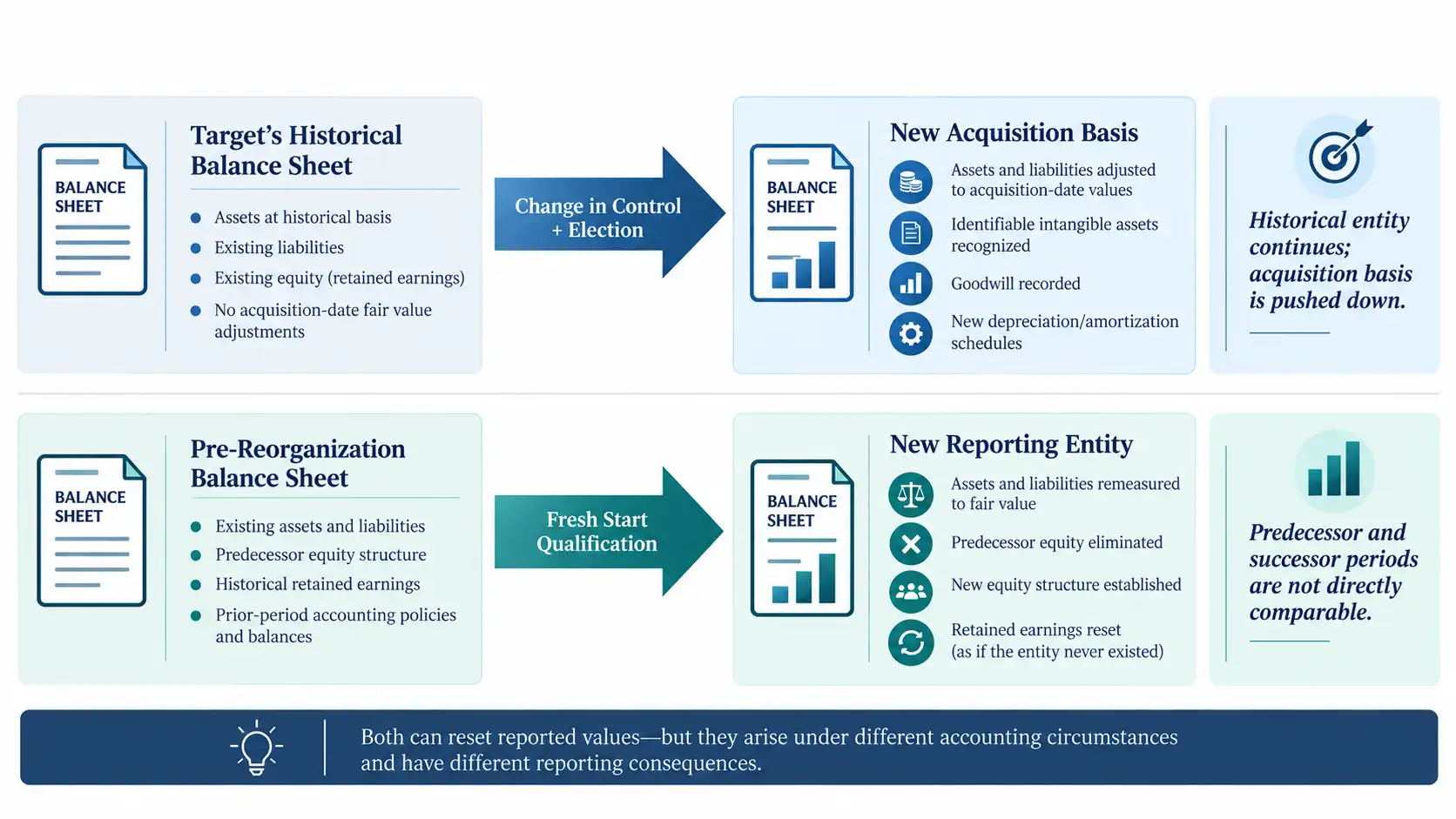
An industrial carve-out illustrates the pattern well. A divested business unit had operated under a parent company for more than a decade, with reporting that had grown inconsistent and intangible asset tracking that had effectively lapsed. Fresh start accounting drew a clean line between the old entity and the new one, which mattered enormously to incoming private equity investors who needed credible, uncomplicated financials to underwrite their thesis. The tradeoff surfaced with external stakeholders, vendors, customers, and regulators, who found it difficult to reconcile historical trends against a balance sheet that technically began on the acquisition date. Bridging that gap required detailed reconciliations built specifically for audiences outside the deal team.
Fresh start accounting is technically clean but narratively expensive. Finance teams that elect it should budget real time for communication, not just for the underlying revaluation work.
Purchase Price Allocation: Where Judgment Meets Scrutiny
Purchase price allocation is the process of assigning total deal consideration across identifiable tangible assets, intangible assets, assumed liabilities, and residual goodwill, governed by ASC 805 and among the most heavily scrutinized components of any post-deal audit. The mechanics sound procedural. The execution is anything but, because every input, from customer attrition curves to discount rates to useful life assumptions, feeds directly into tax amortization schedules, impairment testing, and the story a company tells its investors about what it actually bought.
A buy-side due diligence engagement on an IT services acquisition target demonstrates how early this judgment starts to matter. Quality-of-earnings analysis and valuation modeling surfaced material EBITDA adjustments before the deal even closed, identifying where reported earnings diverged from economic reality and where integration risk was concentrated. That upfront rigor shaped the purchase price allocation the buyer would eventually have to defend.
A Representative Allocation Framework
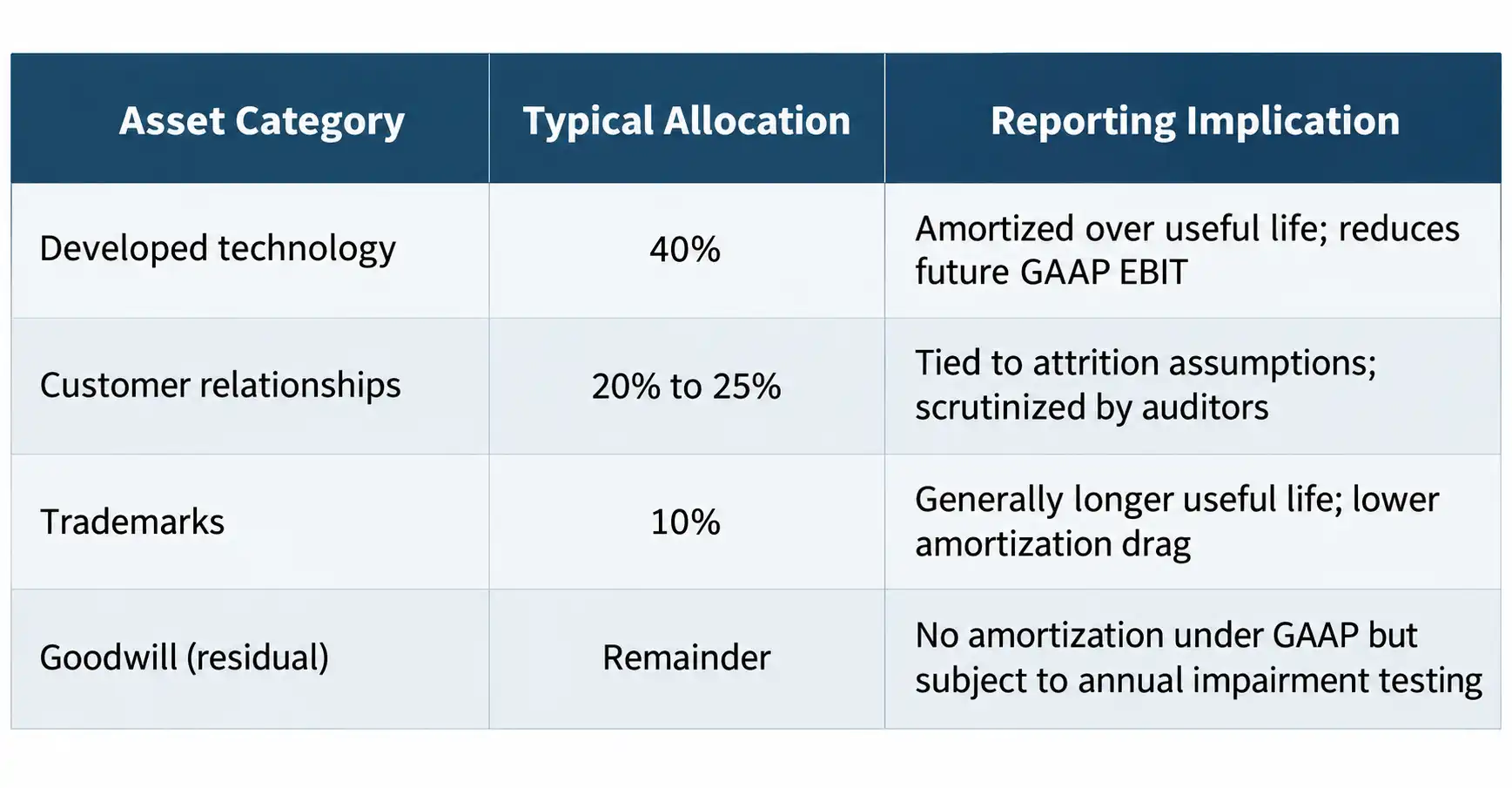
A public gaming and digital entertainment company operating across five countries, including a Euronext Paris listing, executed more than $100M in cross-border merger and acquisition transactions with full due diligence and post-merger integration responsibility. Reconciling purchase price allocation outcomes under both IFRS and US GAAP across those jurisdictions required a single, unified definition of revenue and consolidated systems capable of supporting both frameworks simultaneously. Overestimating goodwill in that environment increases future impairment risk; underestimating intangible assets reduces the amortizable basis a company can use for tax purposes. Third-party valuation firms typically perform the core analysis, but internal finance leadership must retain the authority to guide assumptions and validate the ranges those firms return.
Operational Impacts Beyond the General Ledger
None of these three accounting elections stay contained to the balance sheet. They ripple into operations in ways that catch finance teams unprepared:
- Performance metrics such as EBITDA, ROIC, and earnings per share shift once step-up amortization enters the picture
- Bonus plans and management incentives built on GAAP EBIT can become distorted, requiring board-level revision
- Loan covenants and investor agreements may need renegotiation when reported leverage ratios spike due to accounting rather than operating changes
- Future M&A planning depends on clean historical comparisons, which fresh start or pushdown elections can complicate
A $127M global consumer products company with distribution, general merchandise, and wholesale channels delivered four consecutive clean external audits while managing supply chain finance across multiple continents, a track record that mattered directly when lenders reviewed covenant compliance following accounting changes elsewhere in the portfolio. In a separate case, pushdown accounting increased depreciation and amortization enough to push a leverage ratio above its covenant threshold. The resolution required renegotiating the covenant definition to exclude step-up amortization, which meant engaging lenders early and walking them through the rationale behind the accounting treatment before the numbers arrived unexplained.
Three Key Takeaways
- Pushdown accounting is a strategic decision disguised as a technical election, and any CFO electing it should model the amortization impact on EBITDA, incentive plans, and covenant calculations before the election is finalized rather than after auditors have already signed off.
- Fresh start accounting delivers a clean reporting foundation but creates a genuine communication burden with external stakeholders who rely on historical trends, making detailed reconciliation work a required companion to the revaluation itself.
- Purchase price allocation succeeds or fails on the defensibility of its assumptions, and engaging valuation expertise early, while retaining internal control over the ranges those experts propose, prevents the goodwill overallocation and intangible underallocation that draw the sharpest audit scrutiny.
Disclaimer: This article is intended for informational purposes only and does not constitute legal, tax, or accounting advice. Readers should consult their own tax advisor or counsel for guidance tailored to their specific situation.
Hindol Datta is a four-time CFO and senior finance executive with over 25 years of leadership experience across cybersecurity, SaaS, gaming, logistics, digital marketing, medical devices, consumer products, and nonprofit organizations. He has led more than $120M in fundraising and over $150M in M&A transactions while building the financial and operational systems that let complex businesses scale with confidence. He is the author of seven books in the Systems CFO Series and holds active CPA, CMA, and CIA credentials.
AI-assisted insights, supplemented by 25 years of finance leadership experience.