
Executive Summary
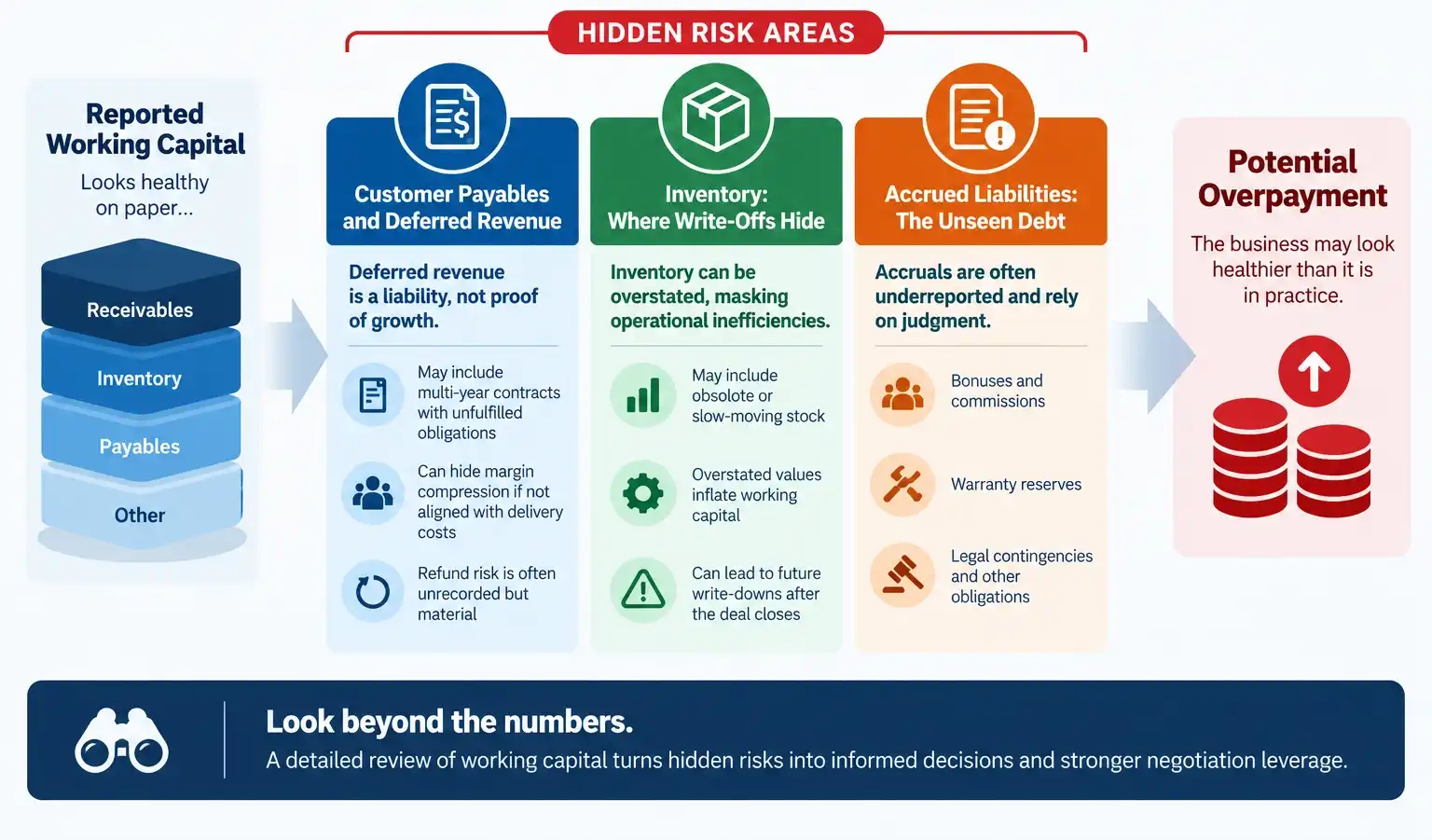
Working capital is often treated as a routine measure of operational efficiency. It is the line item confirming that a business can fund its own short-term obligations. In M&A, that assumption can be dangerous. Working capital in M&A frequently hides aggressive accounting, timing mismatches, and liabilities that never make it into a headline earnings figure. A CFO who accepts the reported balance without interrogating it can overpay. The company looks healthier on paper than it is in practice.
This article examines three areas where working capital risk concentrates most often: customer payables and deferred revenue, inventory valuation, and accrued liabilities. It also covers the true-up mechanism that determines whether the purchase price actually reflects what changes hands at close. Each section draws on direct diligence and CFO experience across SaaS, manufacturing, and technology services transactions. Together they show how working capital in M&A moves from an accounting afterthought to a genuine source of deal risk. Handled well, it becomes a source of negotiating leverage instead.
Customer Payables and the Mirage of Deferred Revenue
Deferred revenue is one of the most misunderstood line items in working capital. In SaaS transactions, a rising balance is often read as proof of growth. It is not. Deferred revenue is a liability, a promise to deliver, not a measure of cash flow health. When it is misaligned with delivery capability or the true cost of fulfillment, margin compression can follow. That compression often only surfaces after the deal closes.
In an advisory role supporting a high-growth cybersecurity and identity access management company, building the ASC 606 revenue recognition framework was central to the work. So was the controls environment behind it, which allowed the business to withstand acquisition diligence rather than stumble through it. That experience shaped a standing practice: reconcile every material deferred revenue line against its contract terms, delivery schedule, and cost trajectory. A target’s deferred revenue balance can quietly include multi-year contracts with front-loaded payments and unfulfilled obligations. Refund risk deserves the same scrutiny, since it is often unrecorded yet material in subscription businesses.
Inventory: Where Write-Offs Hide
Inventory presents a different kind of trap. It is not only a question of how much exists, but of what it is actually worth. Overstated inventory inflates working capital and can disguise operational inefficiencies that a buyer inherits the moment the deal closes.
Work on a $127M global consumer products company, with a supply chain spanning China and Vietnam, told a similar story. Inventory turns doubled from three times to seven through demand planning and SKU rationalization. That transformation only became possible once obsolete and slow-moving stock was identified and addressed rather than carried at stale values. Granular SKU-level aging analysis, tied to historical sales velocity, drives that kind of result. It separates a defensible working capital position from one hiding a future impairment charge, unlike management’s top-level roll-forward schedules.
A rigorous inventory review should include:
- SKU-level aging analysis tied to sales velocity
- Historical inventory turnover trends
- Manual adjustments or overrides in the inventory control system
- Write-down history against internal controls
Accrued Liabilities: The Unseen Debt
Accrued liabilities, including bonuses, commissions, warranty reserves, and legal contingencies, are ripe for underreporting. They depend on judgment rather than a transaction record. A target can understate a liability simply by delaying recognition until a formal event occurs, such as a board vote. This happens even when the underlying obligation is effectively certain.
Diligence work on an IT services acquisition surfaced material EBITDA adjustments that had not been visible in the seller’s own presentation. It was a reminder that accrual practices are frequently a matter of behavior rather than policy. When a target has accrued bonuses the same way for five consecutive years, the pattern itself becomes the evidence. What a pending board resolution technically authorizes matters less than that history. A month-by-month accrual reconciliation, cross-checked against board minutes and historical payout practices, closes that gap before it becomes a post-close dispute.
The Working Capital True-Up: Avoiding Post-Close Disputes
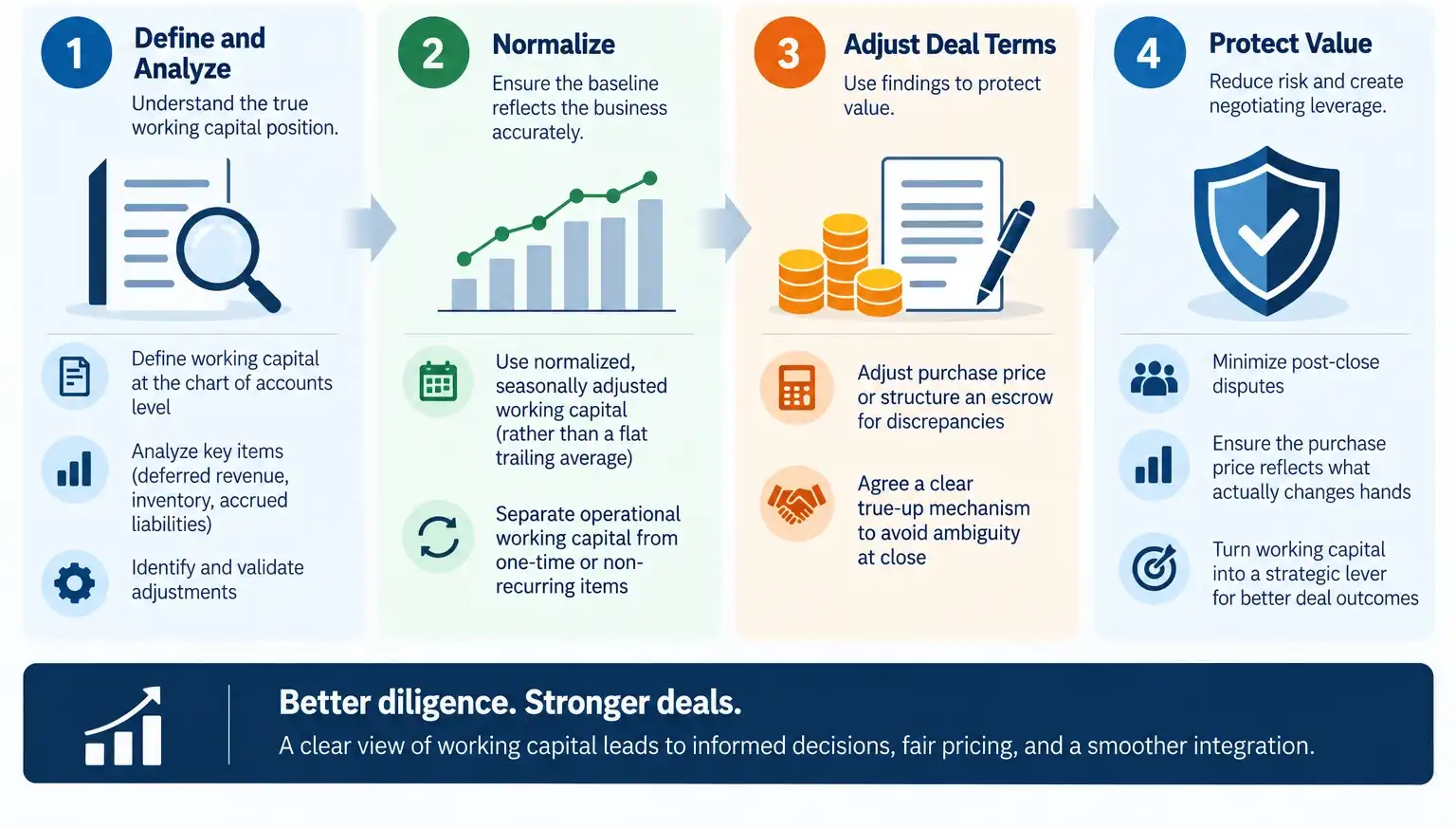
Most transactions include a working capital true-up at close. But the mechanism only works if the baseline it measures against is sound. A vague or templated definition of working capital in the purchase agreement invites disagreement once the deal is signed.
Cross-border M&A execution on a Euronext Paris-listed gaming and digital entertainment company included full due diligence and post-merger integration responsibility. That work reinforced the value of customized working capital definitions. These should be drafted down to the chart of accounts level, not borrowed from an industry template. Normalized working capital, rather than a simple trailing twelve-month average, better reflects seasonality and growth. Distinguishing operational working capital from one-time or non-recurring adjustments also matters. It prevents items such as a litigation reserve reversal from being smuggled into the peg.
A sound true-up mechanism should specify:
- Working capital definitions customized to the target’s chart of accounts
- Normalized, seasonally adjusted working capital rather than a flat trailing average
- Clear separation of operational working capital from one-time adjustments
Working Capital as Negotiating Leverage
Working capital diligence is not only a risk-mitigation exercise. When a pattern of under-accruals or unaddressed obsolete inventory surfaces before signing, it becomes a lever. Purchase price can be adjusted, or an escrow can be structured to cover future discrepancies. That kind of forensic diligence, cross-functional across finance, operations, and legal, is what turns working capital from an accounting afterthought into a strategic input. It shapes deal quality, integration planning, and covenant setting alike.
Three Key Takeaways
- Deferred revenue is a liability, not proof of growth. Reconciling it against delivery schedules and fulfillment costs before close prevents margin compression from surfacing after the ink is dry.
- Inventory and accrued liabilities are where working capital in M&A most often hides value erosion. SKU-level aging analysis paired with historical accrual-to-payout reviews turns invisible risk into a number a CFO can negotiate around.
- A working capital true-up is only as reliable as the definition behind it. Customizing the peg to the target’s accounting practices, and normalizing for seasonality, protects against post-close disputes that a generic template cannot anticipate.
Disclaimer: This article is for informational purposes only and does not constitute legal, financial, or accounting advice. Always consult with qualified professionals before executing financial transactions.
Hindol Datta is a four-time CFO and senior finance executive with over 25 years of leadership experience across cybersecurity, SaaS, gaming, logistics, digital marketing, medical devices, consumer products, and nonprofit organizations. He has led more than $120M in fundraising and over $150M in M&A transactions while building the financial and operational systems that let complex businesses scale with confidence. He is the author of seven books in the Systems CFO Series and holds active CPA, CMA, and CIA credentials.
AI-assisted insights, supplemented by 25 years of finance leadership experience.