
Executive Summary
Many companies treat financial due diligence as a defensive exercise, yet in experienced hands it becomes a source of strategic insight. The raw ledgers of a target company reveal how the business behaves when no one is watching, including its habits, blind spots, and hidden strengths. Read well, they answer a bigger question than whether to buy: what must change for the deal to create real value?
The sections ahead cover five stages of strategic financial due diligence, from reading capital behavior to testing revenue quality. They then turn to incentives, future modeling, and integration. Together they show how the CFO can move from forensics to foresight.
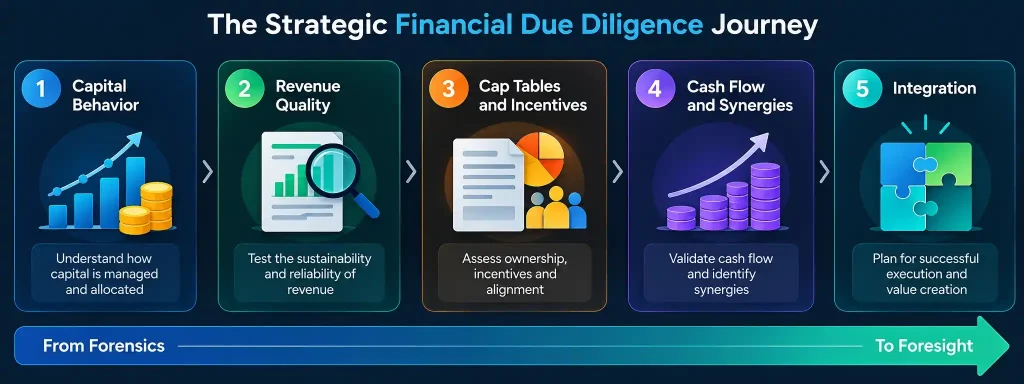
Reading Capital Behavior in Financial Due Diligence
Before the data room fills and the bankers rehearse their closing calls, the CFO begins to read the numbers the way one reads a character. Capital behaves in the image of its keepers. Some founders treat capital like oxygen, carefully metered, while others burn it as fuel for growth curves that look magnificent until they stall.
Signals That Reveal Character
Financial due diligence looks past the reported totals to the habits behind them. Several patterns expose how a business truly operates:
- Cost scaling: whether SG&A grows in line with revenue or races ahead of it
- Receivables aging: whether late payments reflect enterprise cycles or weak follow-through
- Investment choices: whether capital flows into assets that compound or distractions dressed as innovation
- Capital velocity: whether each additional dollar invested produces more or less return over time
- Metric migration: how often revenue definitions and expense labels quietly change
Falling returns on incremental capital signal more than weak performance. They suggest an operating model that has stopped thinking clearly. Frequent informal restatements do not prove fraud, but they show a business still searching for a narrative that makes its results feel coherent.
This reading turns financial due diligence into a forecast of executive behavior. It helps answer how the company will respond to pressure, allocate new capital, and adapt during its first hard quarter under new ownership.
Testing Revenue Quality and Financial Camouflage
Revenue is the headline of every pitch, yet it is also the most misunderstood and most easily shaped number in any deal. For the seasoned CFO, revenue is a question before it is a figure. The first question is simple: what kind of revenue is this?
Common Revenue and Earnings Illusions
Revenue that looks solid can rest on one-time deals, aggressive recognition, or a few customers whose loyalty is fragile. Careful financial due diligence tests each of these risks directly.
Revenue and Earnings Red Flags in Due Diligence
| Area | Red Flag | Key Diligence Question |
| Customer concentration | One client provides a large share of revenue | What happens if that client leaves or cuts spend? |
| Pulled-forward revenue | Discounts or early renewals inflate the current period | Is growth real or borrowed from future quarters? |
| Recurring versus repeat | Revenue depends on habit instead of contract | Why do customers stay, and could that change? |
| Deferred revenue | High balances that may mask delivery backlog | Can the company deliver what it has already sold? |
| Gross margin | Delivery costs hidden in sales or R&D | What does true cost to serve look like? |
| Adjusted EBITDA | One-time costs that recur every quarter | Are adjustments masking ongoing operating costs? |
The gap between revenue and cash deserves close attention. A company that grows its top line while stretching receivables is showing hope, not performance. Days sales outstanding often reveals how customers truly feel about pricing and value.
Buy-side due diligence on an IT services acquisition shows this work in practice. Quality-of-earnings analysis surfaced material EBITDA adjustments where reported earnings diverged from economic reality. It also pinpointed where post-close operational risk sat, and those findings shaped the buyer’s decision.
The goal of financial due diligence is not to assume deception. Most distortions come from funding pressure, internal incentives, or board milestones. The CFO looks for incoherence, such as revenue that does not match activity or margins that do not match labor.
The Contextual Lens: Cap Tables and Incentives
Strategic diligence asks why the numbers look the way they do. Every balance sheet reflects the expectations placed upon it, so capital history belongs at the center of the analysis instead of in a footnote.
What Ownership History Reveals
The cap table works as a diagnostic tool. A venture-backed company with stacked liquidation preferences may have made decisions to protect internal balance instead of business health. A founder-owned company funded through retained earnings may show precision and pride, along with legacy systems and underinvestment in infrastructure.
Valuation jumps between funding rounds without matching revenue growth create pressure to grow into the price. That pressure shapes hiring, pricing, and capital allocation in ways the financial statements alone cannot explain. Veto rights, earnouts, and exit-driven preferences can also bend decisions away from long-term value.
Debt history and economic context add further insight. Revolvers drawn to fund operating expenses or quietly waived covenants show how a company behaves under stress. A business built in an era of cheap money may have learned loose habits. One built during capital scarcity may carry deferred investments that a buyer must eventually fund.
Modeling the Future: Cash Flow and Synergies
If the first half of diligence is a mirror, the second half must be a window. Forward-looking financial due diligence starts with free cash flow, the metric that respects both time and truth. A baseline forecast should strip away optimism and treat every assumption about pricing, churn, and renewals as a hypothesis to test.
Building Synergies Instead of Assuming Them
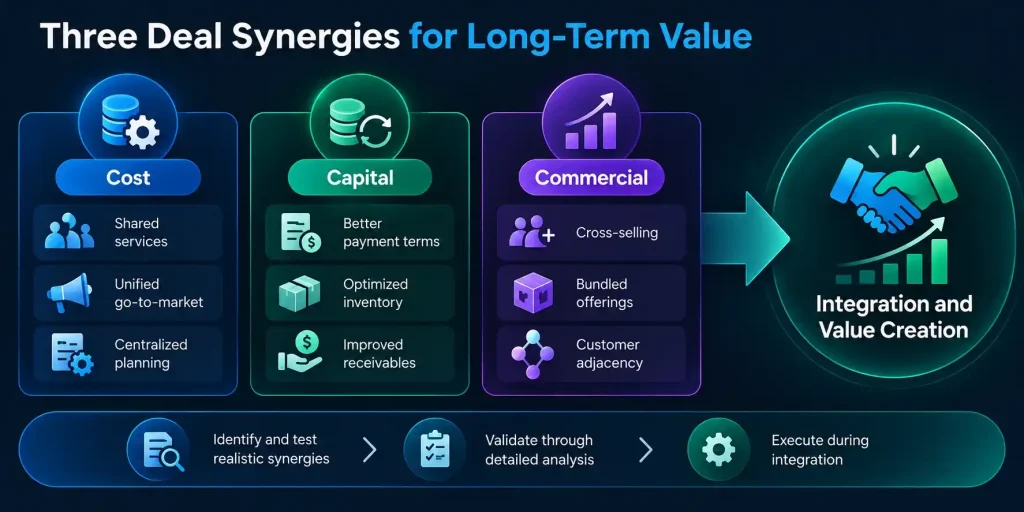
Synergies must be built, not assumed, and finance teams should test each one before relying on it in a deal model. They come in three forms with distinct risk profiles.
Three Types of Deal Synergies
| Synergy Type | Source | Main Risk |
| Cost | Shared services, unified go-to-market, and centralized planning | Often overstated and slower to realize than planned |
| Capital | Better payment terms, leaner inventory, and tighter receivables | Harder to model, yet often more meaningful |
| Commercial | Cross-selling, bundled offerings, and customer adjacency | Depends on product fit and compatible sales motions |
Every model also needs a realistic view of execution friction. Integrating systems, aligning cultures, and keeping morale intact all take time. Strong CFOs discount synergies for execution believability and sequence the work carefully. They decide what happens in year one and what should wait to preserve customer and employee trust.
A Euronext Paris-listed gaming company shows the scale this discipline can reach. More than $100M in cross-border M&A included full due diligence and post-merger integration across multiple countries. Deals of that size depend on realistic synergy timing and clear sequencing.
From Insight to Integration
A quiet pause follows every closing, and the acquired team silently wonders what happens next. In that moment, the CFO becomes the narrator of the new story. Diligence insights must leave the data room and shape how leaders run the business.
Turning Findings into an Operating Blueprint
The first step is strategic empathy, since the acquired team experienced diligence as something done to them. Acknowledging what they built, where it worked, and where it stalled opens the door to partnership. The diligence file then becomes a blueprint for reinvention.
If diligence revealed capital inefficiency, approval flows should change. Opaque cost structures call for transparency norms, and misaligned incentives call for new compensation plans. Margin fragility may justify pausing expansion, while weak working capital calls for tighter collections and renegotiated vendor terms.
A venture-backed digital marketing company that led three acquisitions, including due diligence and integration, illustrates this link. Its CAC, LTV, and contribution margin discipline gave each integration a clear set of metrics to manage against. New dashboards, rolling forecasts, and return thresholds tied to post-diligence truth keep integration honest over time.
Ownership is not one decision but a thousand small ones made after closing. Each either reinforces the insight earned in diligence or quietly betrays it. Done well, financial due diligence prepares a company to become worthy of the capital it has just received.
Three Key Takeaways
- Financial due diligence reveals how a business behaves, not just what it reports. Patterns in cost scaling, receivables, and capital velocity predict how leadership will act after closing.
- Revenue quality, incentive structures, and realistic synergy models matter more than headline growth or adjusted EBITDA.
- Diligence only creates value when its findings shape integration, from approval flows and compensation plans to dashboards and forecasts.
Disclaimer: This article is intended for informational purposes only and does not constitute legal, tax, or accounting advice. You should consult your own tax advisor or counsel for advice tailored to your specific situation.
Hindol Datta is a four-time CFO and senior finance executive with over 25 years of leadership experience across cybersecurity, SaaS, gaming, logistics, digital marketing, medical devices, consumer products, and nonprofit organizations. He has led more than $120M in fundraising and over $150M in M&A transactions while building the financial and operational systems that let complex businesses scale with confidence. He is the author of seven books in the Systems CFO Series and holds active CPA, CMA, and CIA credentials.
AI-assisted insights, supplemented by 25 years of finance leadership experience.