
Executive Summary
Every acquisition begins with a price. Months later, it ends with a structure that determines whether the deal actually earned that price. Legal counsel does not simply formalize that choice once the parties sign the term sheet. It is a decision that reshapes tax basis, liability exposure, contractual continuity, and the operational path from signing to integration. That decision belongs on the CFO’s desk from the earliest stage of diligence.
This article covers the mechanics of equity vs asset purchase structuring and the tax and legal trade-offs on each side. It also explains the hybrid tools, such as Section 338(h)(10) elections, that let buyers and sellers bridge otherwise incompatible preferences. The goal is not to declare one structure superior. It is to give finance leaders a framework for matching structure to strategy. That framework matters most before the pressure of a signing date forces the decision by default.
Why Structure Decides Value, Not Just Price
In dealmaking, the headline number draws attention, but the structure underneath it creates or quietly destroys value. An equity purchase and an asset purchase can produce the same enterprise value on a spreadsheet. Eighteen months later, once tax bills, integration costs, and inherited liabilities work through the income statement, the outcomes diverge sharply. A CFO evaluating a purchase vs acquisition decision must weigh tax efficiency against operational continuity. Rarely does one structure maximize both.
In one buy-side engagement supporting an IT services acquisition, hands-on quality-of-earnings analysis surfaced EBITDA adjustments. Those adjustments shifted the buyer’s view of where reported earnings diverged from economic reality. That work, completed before the parties finalized structure, shaped whether the deal could work as an equity purchase. Where the liability profile was too uncertain, it instead pushed the parties toward an asset-only approach.
Equity Purchase: Continuity Bought at the Price of Inherited Risk
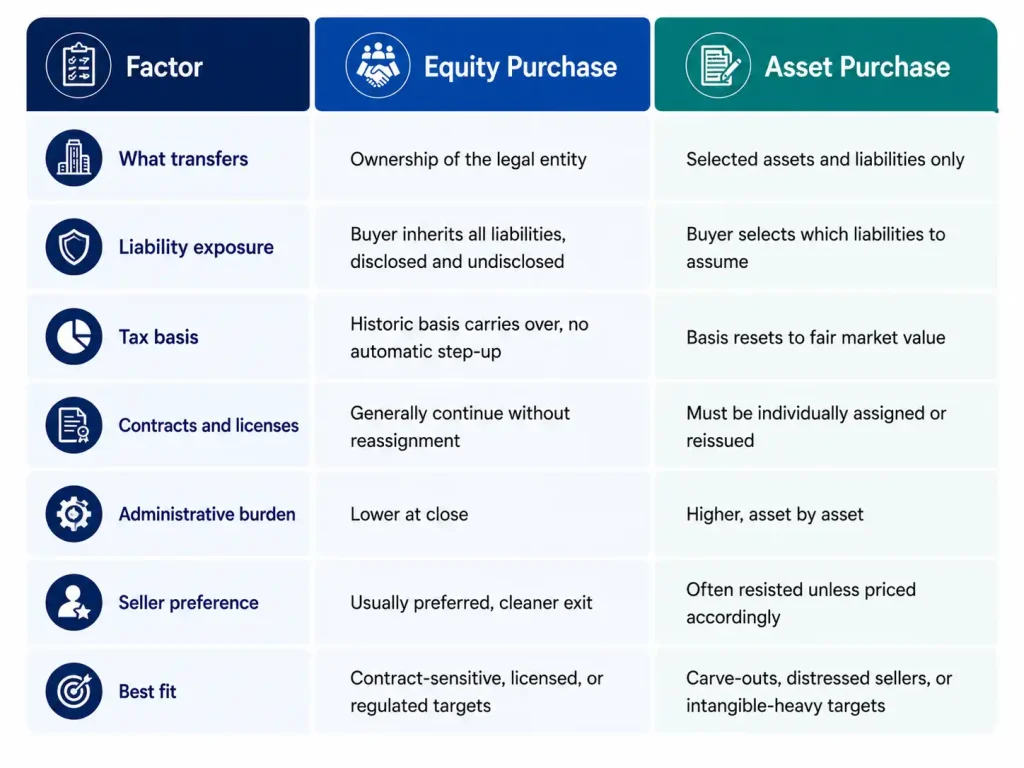
An equity purchase, sometimes called a stock purchase, transfers ownership of the legal entity itself rather than its individual assets. The buyer steps into the target’s shoes. Licenses stay intact, customer contracts generally do not require novation, and vendor relationships continue without renegotiation. That continuity is the structure’s central appeal, and it explains why equity purchase deals dominate transactions where the target’s contracts, permits, or customer relationships would be costly to disrupt.
The cost of that continuity is that the buyer inherits every liability on the balance sheet, disclosed and undisclosed. Tax exposures, pending litigation, employee obligations, and regulatory issues all transfer with the entity, which is why representations, warranties, and indemnification provisions in equity deals demand more negotiating attention than the price itself. Representation and warranty insurance has become a common mitigant, though it does not close every gap, and coverage exclusions tend to cluster around exactly the regulatory and compliance risks a buyer most wants to avoid.
There is also a tax cost. In an equity purchase, the buyer typically inherits the target’s historic asset basis rather than resetting it to fair market value, which limits future depreciation and amortization deductions unless a Section 338(h)(10) election applies.
Equity purchase structures tend to fit best when:
- The target holds licenses, permits, or government contracts that would be difficult or slow to reassign
- Customer relationships depend on contractual continuity that an asset transfer would disrupt
- The seller has leverage, such as a competitive sale process with multiple bidders
- Diligence has produced high confidence in the completeness of disclosed liabilities
Asset Purchase vs Acquisition: Precision Over Continuity
An asset purchase lets the buyer select which assets to acquire and which liabilities to leave behind, offering a level of control that an equity purchase cannot match. This structure is favored when the seller carries contingent liabilities, when the business being acquired is a division rather than a standalone entity, or when the buyer specifically wants a basis step-up.
The tax advantage can be substantial. Resetting asset basis to fair market value enhances future depreciation and amortization, which matters most in deals heavy with intangible assets such as patents, customer lists, or proprietary technology. In one cybersecurity engagement, the finance function’s work supporting acquisition diligence, including the audit-ready revenue recognition framework built to carry the business through a transaction, illustrated how much value sits in the intangible base that an asset structure can step up. Deals of that profile can generate meaningful cash tax savings in the years immediately following close.
That precision comes at a procedural cost. Contracts must be individually assigned, leases transferred, licenses reissued, and employees re-onboarded, and some jurisdictions layer on transfer taxes or VAT that were never modeled in the original purchase price. Cross-border asset transactions raise the stakes further, since employee transfer protections and works council requirements vary sharply by jurisdiction and can quietly derail an otherwise well-priced deal.
Asset purchase structures tend to fit best when:
- The seller carries known or suspected contingent liabilities the buyer wants to avoid
- The target is a division or carve-out rather than a full legal entity
- A basis step-up materially improves post-close cash flow
- The buyer has negotiating leverage, as in a distressed sale or divestiture
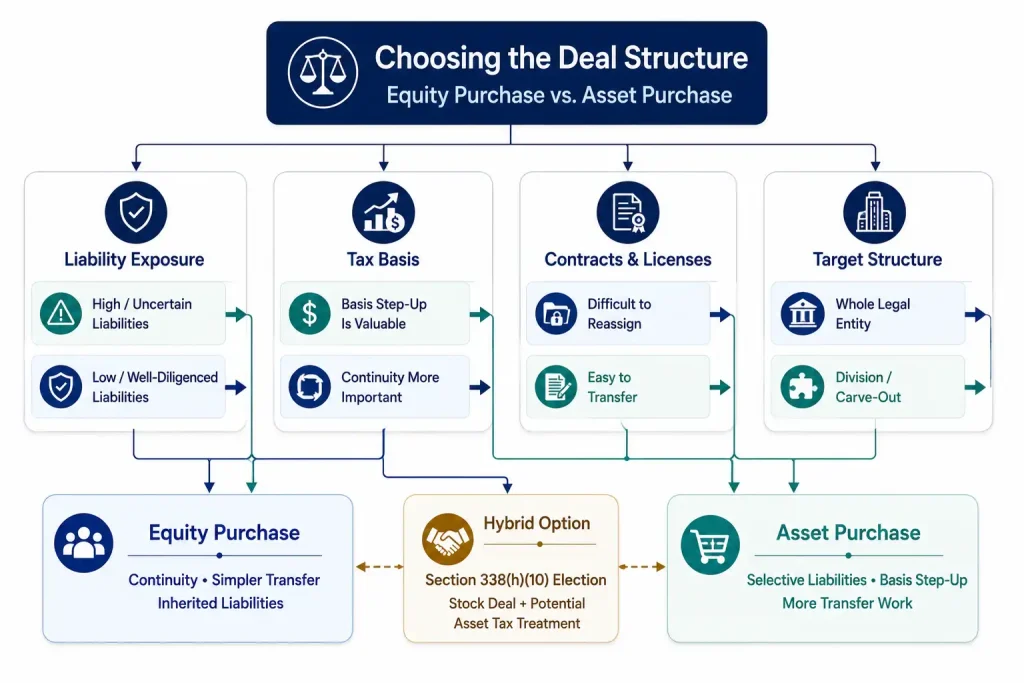
Equity vs Asset Purchase: A Side-by-Side Framework
Hybrid Structures and Section 338 Elections
Few deals fit cleanly into one box, which is why hybrid structures exist. A Section 338(h)(10) election allows certain stock purchases involving corporate subsidiaries to be treated as asset acquisitions for tax purposes, giving the buyer a basis step-up while preserving the operational continuity of an equity deal. The election requires that both parties agree, that specific filing deadlines are met, and that the seller be a corporation, and even where federal tax treatment lines up cleanly, state-level conformity is not guaranteed. A federal benefit secured through a 338 election can still leave legacy state tax liabilities unresolved if state rules do not follow the federal treatment.
Public-company M&A experience reinforces how much structural planning matters before signing rather than after. In a series of cross-border transactions executed as part of a Euronext-listed gaming and digital entertainment company’s growth, structure, due diligence scope, and post-merger integration planning were negotiated as a single package rather than sequentially, which materially shortened the time from close to operational stability.
Negotiation Leverage and Seller Considerations
Sellers generally prefer equity purchase structures because they exit the entity cleanly, with fewer trailing obligations and, in many cases, more favorable capital gains treatment. Asset deals can leave a seller managing a legal shell, unresolved liabilities, or tax treatment that differs by asset class, which is why sellers often demand a premium to accept an asset structure or reject it outright when exposure cannot be compartmentalized.
Three acquisitions led as part of scaling a venture-backed digital marketing company from $9M to $180M in revenue underscored how much of the negotiation over structure tracks the seller’s constraints rather than the buyer’s preferences. Where the buyer holds leverage, such as in a distressed sale, an asset structure can be imposed. In competitive processes, an equity purchase is often the price of winning the target at all.
Three Key Takeaways
- Equity purchase and asset purchase structures allocate tax basis, liability, and administrative burden in opposite directions, and neither structure is inherently superior; the right choice depends on the target’s liability profile, the buyer’s tax position, and which side holds negotiating leverage.
- Basis step-up is the central tax lever in any purchase vs acquisition decision, and Section 338(h)(10) elections offer a narrow but valuable bridge for buyers who want the continuity of a stock deal alongside the tax benefits of an asset deal, provided both parties qualify and state conformity is checked early.
- Structural decisions made under signing-date pressure tend to become long-term regrets; the highest-value diligence work happens when finance, legal, and tax model both equity and asset scenarios well before terms are finalized, not after.
Disclaimer: This article is intended for informational purposes only and does not constitute legal, tax, or accounting advice. You should consult your own tax advisor or counsel for advice tailored to your specific situation.
Hindol Datta is a four-time CFO and senior finance executive with over 25 years of leadership experience across cybersecurity, SaaS, gaming, logistics, digital marketing, medical devices, consumer products, and nonprofit organizations. He has led more than $120M in fundraising and over $150M in M&A transactions while building the financial and operational systems that let complex businesses scale with confidence. He is the author of seven books in the Systems CFO Series and holds active CPA, CMA, and CIA credentials.
AI-assisted insights, supplemented by 25 years of finance leadership experience.