
Executive Summary
Venture capital term sheets frequently arrive treated as a formality, something founders sign once the real negotiation, valuation, has already concluded. That assumption costs money. Valuation carries the headline of a raise, but the fine print, liquidation preferences, anti-dilution protection, drag-along rights, and board composition, determines who actually captures value when a company sells, restructures, or goes public. A term sheet is not paperwork appended to a handshake; it is the architecture that governs every future outcome.
This article breaks down the mechanics behind the clauses that matter most in venture capital term sheets, explains what each one signals about investor risk appetite, and offers a framework for treating a term sheet as an operating system rather than a legal nuisance. The goal is not to turn founders into attorneys, but to build enough pattern recognition that the next negotiation happens with clarity instead of anxiety.
The Illusion of Alignment in Fundraising
Startups raise capital on momentum. By the time a term sheet reaches a founder’s inbox, the emotional commitment to the deal is already substantial. Investors have leaned in, and counsel has been briefed. The prevailing assumption is that the heaviest lifting is already done. That assumption tends to be wrong. Even a term sheet described as standard carries mechanics that quietly redistribute risk, reward, and control.
Founders often describe a prospective investor as founder-friendly, and that description may well be accurate in spirit. Term sheets, however, are not governed by trust. They are governed by enforceable rights, not by goodwill. A founder-friendly intention carries no legal weight once the ink dries; only the provisions themselves do. Senior finance executives have guided companies through many venture rounds. That experience includes a $20M Series B raise at a marketplace SaaS platform. It also includes a $36.5M sequence of rounds at a venture-backed digital marketing company. Across those deals, they have watched founders discover years later that a mispriced liquidation preference distorted an otherwise favorable exit.
Liquidation Preferences: What the Numbers Actually Say
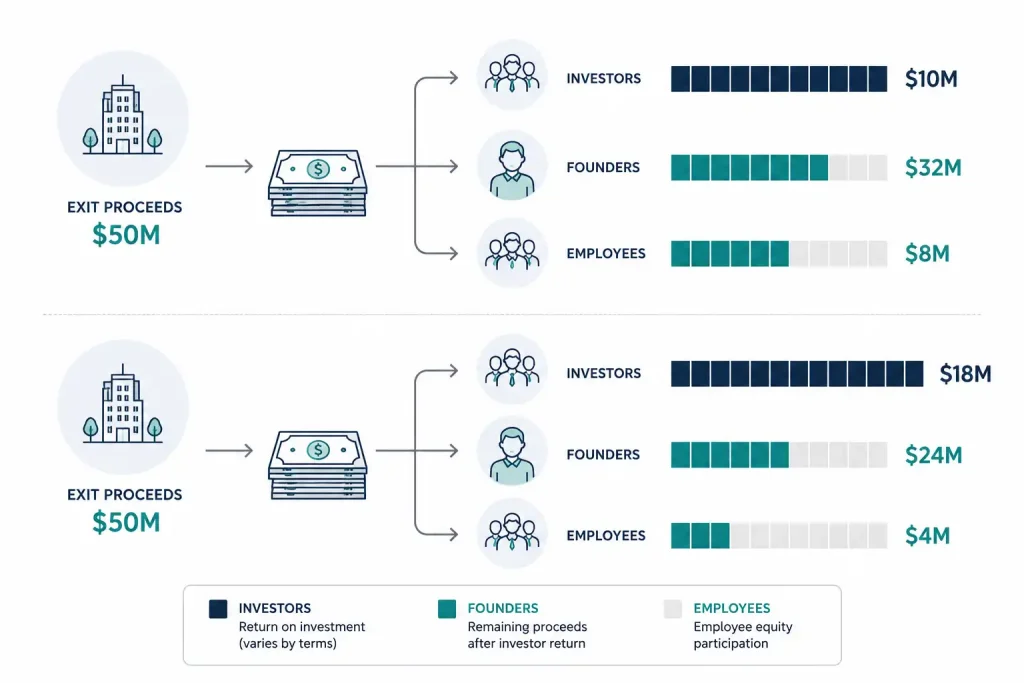
A liquidation preference determines how proceeds get distributed when a company sells, merges, or otherwise triggers a liquidity event. It is the single clause most likely to reshape who walks away with meaningful value. A 1x non-participating preference sets the industry standard. The investor recovers invested capital first, then shares the remainder with common shareholders on an as-converted basis. A 1x participating preference, however, changes the math entirely. The investor recovers capital first and then also participates pro rata in whatever remains, effectively collecting twice from the same pool.
The table below illustrates how a modest structural difference compounds at exit:
| Exit Scenario | 1x Non-Participating | 1x Participating |
| $50M acquisition, $10M invested at 20% ownership | Investor takes greater of $10M or 20% of $50M ($10M) | Investor takes $10M, then 20% of remaining $40M ($8M), totaling $18M |
| Common and employee pool share | Splits the full $40M remainder | Splits only $32M remainder |
The presence of participating preferred reveals how an investor views downside risk at the time of the deal. It often reflects caution in early-stage rounds, but a cap table layered with multiple rounds of participating preferred can leave founders and employees with far less than their ownership percentage implies, even in a respectable exit. The fix is rarely to eliminate the clause outright; it is to understand its compounding effect across every subsequent round.
Anti-Dilution Protection: A Double-Edged Shield
Anti-dilution clauses protect investors when a company raises a subsequent round at a lower valuation than the prior one. The mechanism a founder agrees to here can matter as much as the valuation itself. Weighted-average anti-dilution is the more common structure. It adjusts the investor’s conversion price based on both the size and the price of the new round, producing a proportional and generally manageable impact. Full ratchet anti-dilution is more severe. It resets the conversion price to match the new, lower price regardless of how much capital the down round actually raised, and it can materially harm common shareholders and earlier investors alike.
A few structural realities are worth holding onto when evaluating anti-dilution terms:
- Weighted-average formulas differ depending on whether they use the broad-based or narrow-based version, and the difference is rarely trivial once modeled against a full cap table.
- Full ratchet provisions are most dangerous precisely when a company is most vulnerable, during a down round, which is exactly when negotiating leverage is weakest.
- Anti-dilution pressure tends to correlate with valuations set ahead of supporting metrics, so the healthiest defense is a valuation a company can actually grow into.
Building the forecasting discipline that keeps a company inside a defensible valuation band is finance work, not legal work. It is the kind of groundwork that a high-growth cybersecurity and identity access management company at roughly $30M in annual recurring revenue relied on to hold actuals within five percent of forecast across eight consecutive quarters, avoiding the valuation resets that invite aggressive anti-dilution terms in the first place.
Drag-Along Rights and the Question of Control
Drag-along rights allow a defined majority of shareholders to compel minority holders to join a company sale. The provision exists for a legitimate reason: it prevents a small number of holdouts from blocking an otherwise sound acquisition. The detail that deserves scrutiny is who controls the trigger. If a board or a majority of preferred shareholders can invoke a drag-along without founder or common shareholder consent, founders can find themselves sidelined during the most consequential decision the company will ever face.
The stronger drag-along structures require some form of mutual consent. That might mean a supermajority spanning both preferred and common shareholders, or a dual-trigger mechanism that includes explicit founder approval. These structures preserve the original purpose of the clause: streamlining a legitimate sale. They do this without creating a veto trap that investors alone can pull.
Board Composition: Where Power Actually Sits
Board composition is one of the least scrutinized elements of a term sheet negotiation. Founders tend to treat board seats as a formality rather than a control mechanism. In practice, the board decides who sets the agenda, who hires and fires the chief executive, and whether the company raises again, merges, or sells. Consider a board built as two investor seats, one founder seat, and one independent director jointly selected by investors. That structure can become investor-controlled by design before a single vote is contested.
Board dynamics set in a Series A round tend to establish precedent that carries into Series B and beyond, which is why protecting founder representation and negotiating a genuinely independent process for the fourth seat matters far beyond the optics of the cap table. A chief financial officer who has served on the board of a mission-driven education and research institution, structuring a $37M capital raise across equity and venture debt while staffing the finance and audit committee, has seen how board composition shapes whether an organization acts decisively under pressure or becomes paralyzed by asymmetric information. The same dynamic played out at a Euronext Paris-listed public gaming and digital entertainment company, where board engagement and audit oversight across five countries demanded a governance structure built for collaboration rather than investor override.

Treating the Term Sheet as an Operating System
A term sheet functions less like a contract and more like an operating system: it encodes incentives, governance, and the mechanics of every future exit. It shapes how later rounds get priced, how the employee equity pool dilutes over time, and how decisions get made when circumstances turn difficult. A clause permitting a company to repurchase a defined percentage of common shares annually from employees, subject to board approval, can appear minor on the page and later become the foundation of a meaningful liquidity and retention program.
Provisions Worth Treating as Tools, Not Traps
- A right of first refusal with a defined expiration window, rather than an open-ended one
- Information rights tied to specific, agreed-upon metrics rather than broad discretionary disclosure
- A redemption right pushed beyond year seven, reducing the risk of forced buybacks during a difficult stretch
- A precise definition of “Change of Control” that removes ambiguity during a future strategic transaction
Bringing Counsel into the Process Early
A common and costly mistake is waiting until the final term sheet arrives before engaging legal counsel. That delay limits negotiating leverage at the exact moment it matters most. Counsel brought in early can help frame the asks, simplify a complex negotiation into a short list of priorities, and surface asymmetries not obvious from the term sheet’s surface language. Legal and finance functioning as a single team, rather than sequential checkpoints, as seen in the capital strategy and investor narrative work behind a pre-Series A AI governance and assurance platform, consistently produces sharper term definitions that hold up months later during diligence for the following round.
Three Key Takeaways
- Valuation is the headline of a venture capital term sheet, but liquidation preferences, anti-dilution mechanics, and board composition determine the actual distribution of outcomes, and founders should model each of these clauses against realistic exit scenarios before signing rather than after.
- Drag-along rights and board control provisions are ultimately governance questions disguised as legal boilerplate, and the safest structures require some form of founder consent rather than leaving the trigger entirely in investor hands.
- Engaging legal and financial counsel early in the term sheet process, rather than after the document is nearly final, preserves the negotiating leverage that founders otherwise surrender simply by running out of time.
Disclaimer: This article is intended for informational purposes only and does not constitute legal, tax, or accounting advice. You should consult your own tax advisor or counsel for advice tailored to your specific situation.
Hindol Datta is a four-time CFO and senior finance executive with over 25 years of leadership experience across cybersecurity, SaaS, gaming, logistics, digital marketing, medical devices, consumer products, and nonprofit organizations. He has led more than $120M in fundraising and over $150M in M&A transactions while building the financial and operational systems that let complex businesses scale with confidence. He is the author of seven books in the Systems CFO Series and holds active CPA, CMA, and CIA credentials.
AI-assisted insights, supplemented by 25 years of finance leadership experience.