
Executive summary
ASC 740-10, once known as FIN 48, governs how companies recognize, measure, and disclose uncertain tax positions under US GAAP. For finance teams operating across multiple jurisdictions, the standard has moved well beyond a technical footnote. It now sits at the center of audit readiness, M&A diligence, and IPO preparation. Every unresolved tax position carries the potential to become a liability that surfaces at the worst possible moment.
This article walks through what ASC 740-10 requires. It covers why global expansion multiplies the number of uncertain tax positions a company must track. It also covers how finance leaders build a tax reserve process that holds up under scrutiny. The goal is not to memorize the standard. It is to build discipline. That discipline lets a finance organization spot an uncertain position before an auditor or a regulator does.
What ASC 740-10 Requires from Finance Teams
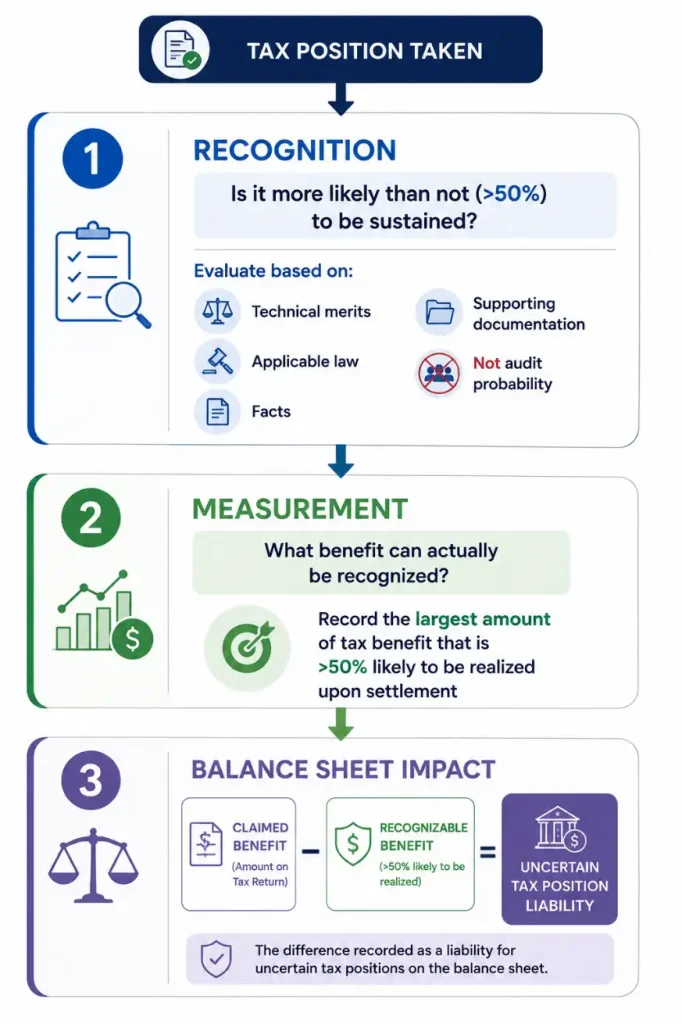
The standard asks a deceptively simple question for every position taken on a tax return. It is more likely than not that the position will sustain on its technical merits if examined. That means a probability greater than 50 percent. This evaluation happens without regard to whether the company expects to face an audit at all. Detection risk plays no role. A position stands or falls on the strength of the law, the facts, and the documentation behind it. It doesn’t stand or fall on the odds that anyone will ever ask about it.
If a position clears that threshold, the next step is measurement. The company records the largest amount of benefit it is more than 50 percent likely to realize upon settlement, not the full amount it claimed on the return. The gap between what it claimed and what it can recognize becomes a liability for uncertain tax positions on the balance sheet. Every uncertain tax position ASC 740 identifies carries two separate judgments, one on recognition and one on measurement. Both require contemporaneous support that can survive an auditor’s questions months or years later.
How Global Expansion Multiplies Uncertain Tax Positions
Every new country a company enters brings its own tax code and treaty network. It also brings its own transfer pricing rules and interpretation of permanent establishment. Each of these areas creates room for legitimate planning and for honest disagreement between the company and the local authority. A US parent that licenses intellectual property to an Irish subsidiary is a familiar structure. That subsidiary then sublicenses the same intellectual property into EMEA markets. If the Irish entity lacks the substance to support the royalties it earns, the arrangement can be challenged even before any adjustment has been proposed. Substance means it performs the development, enhancement, maintenance, protection, and exploitation functions a tax authority expects to see.
In one engagement at a Euronext Paris listed gaming and digital entertainment company operating across the United States, France, the United Kingdom, Singapore, and South Korea, consolidating a single definition of revenue across five countries under both IFRS and US GAAP was the first step before any uncertain position could be evaluated properly. Without a common chart of accounts and a common revenue policy, no amount of legal analysis could produce a reliable more likely than not conclusion, because the underlying numbers themselves were not yet trustworthy.
The compounding effect is what makes global ASC 740 tax provision work genuinely difficult. A transfer pricing adjustment in Germany can raise taxable income there while reducing a deductible royalty in Ireland and changing the Subpart F inclusion back in the United States. None of these effects stay contained within a single entity’s books. A finance team that models each jurisdiction in isolation will consistently understate the true exposure sitting on the consolidated balance sheet.
Building a Tax Reserve Process That Withstands Audit Scrutiny
The companies that manage ASC 740-10 well treat their reserves as a living portfolio rather than a once-a-year exercise. Every uncertain position is cataloged by jurisdiction, tracked with a probability assessment, a benefit range, and the underlying legal or technical support, and revisited on a quarterly cadence rather than only during audit season.
The Seven Steps Behind a Defensible Reserve
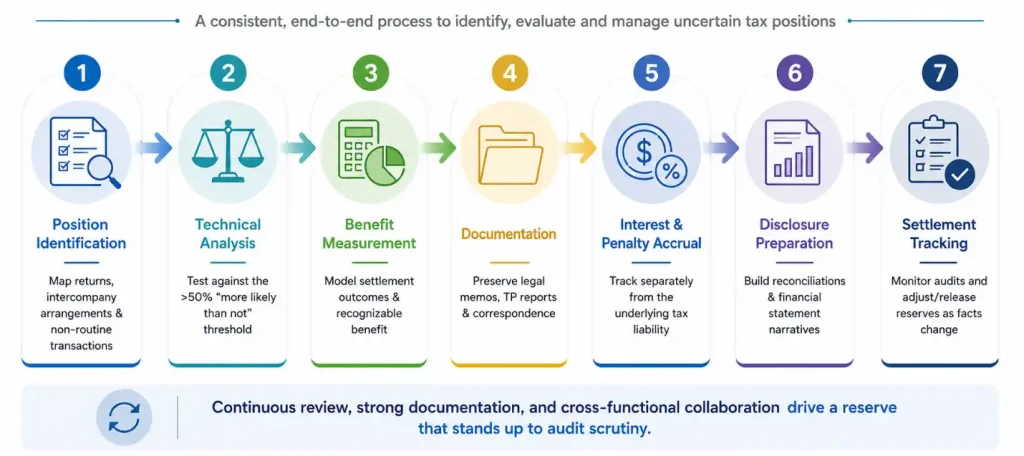
A defensible ASC 740-10 tax provision process generally includes the following steps, applied consistently across every entity in the group.
- Position identification, mapping every return filed, every intercompany arrangement, and every non routine transaction for potential exposure
- Technical analysis, evaluating statutes, administrative guidance, and case law against the more likely than not threshold
- Benefit measurement, modeling the range of settlement outcomes to determine the amount that can actually be recognized
- Documentation, preserving legal memos, transfer pricing reports, and correspondence with advisors and tax authorities
- Interest and penalty accrual, recorded separately from the underlying tax liability as the standard requires
- Disclosure preparation, building the reconciliations and narratives that support the financial statement footnotes
Settlement tracking, monitoring open audits so reserves can be released or adjusted as facts develop
In a high growth cybersecurity and identity access management company generating close to $30M in annual recurring revenue across the United States, Canada, Mexico, India, and Nepal, building the ASC 606 revenue recognition framework and the accompanying controls environment mattered as much to acquisition diligence as the uncertain tax position analysis itself. Acquirers and their advisors do not evaluate a tax reserve in isolation. They read it alongside the broader controls environment, and a reserve without documented process discipline behind it invites more questions than it answers.
Common Pitfalls in Uncertain Tax Positions ASC 740 Work
Certain mistakes show up again and again across global groups, regardless of industry or stage.
- Relying on the assumption that a position will simply avoid audit, rather than evaluating its technical merits on their own terms
- Failing to build or preserve legal and accounting memos that support complex or novel transactions
- Waiting until a position is challenged to book a reserve, instead of recognizing the uncertainty at the time the position is taken
- Applying US centric assumptions to foreign tax systems without local counsel or local guidance
- Letting finance, tax, and legal work in separate silos, producing inconsistent assumptions across the same reserve
Avoiding these patterns has less to do with technical sophistication and more to do with culture. Tax needs a seat in operational decisions before a structure is finalized, not after a transaction has already closed.
ASC 740-10 in M and A and IPO Readiness
Reserve quality becomes visible the moment a company approaches a transaction or a public listing. Buyers and underwriters read the reserve history to estimate unrecorded liabilities, judge the quality of reported earnings, and decide how much exposure they are willing to underwrite. A target with a thin or inconsistent ASC 740-10 process often sees its timeline extend or its valuation discounted, because the buyer has to build in a margin for the uncertainty the seller failed to quantify.
At a $127M global consumer products company selling through direct to consumer, Amazon, and wholesale channels with a supply chain running through China and Vietnam, four consecutive clean external audits did more to build lender and investor confidence than any single disclosure could on its own. A clean audit history is not proof that no uncertain positions exist. It is evidence that the company has a process mature enough to identify, measure, and disclose them properly before anyone else has to ask.
A well-managed reserve process can work in the company’s favor during diligence. It signals that management understands its own exposure, has controls in place around it, and is not leaning on tax positions to inflate reported earnings. That signal often matters as much to a board or an underwriter as the dollar figure attached to the reserve itself.
A Reserve Built Under Pressure Ahead of an IPO
A Series D enterprise software company preparing for an IPO once faced a real question around its APAC subsidiary, which had claimed treaty benefits and R&D incentives that local authorities had not yet examined. External advisors flagged genuine uncertainty under local law, even though internal teams initially believed the exposure was low. Rather than defer the analysis, the finance organization ran a full reserve assessment under ASC 740-10, documented the legal basis for the position, quantified the potential exposure, and brought auditors into the conversation early. A reserve was booked, interest was accrued, and a disclosure footnote was drafted well before the S-1 review began.
When the SEC reviewed the filing, the transparency of the disclosure closed off further inquiry rather than inviting it. The IPO proceeded on schedule. The underlying position was later settled favorably with the local tax authority, and the reserve release created an earnings tailwind after the listing, turning what began as a risk into a demonstration of governance.
Three Key Takeaways
- ASC 740-10 evaluates every tax position purely on technical merit, without regard to audit probability, so reserve decisions must rest on legal and factual support rather than on the odds of ever being examined.
- Global structures multiply the effects of a single uncertain position across jurisdictions, which means reserve modeling has to account for cascading impacts on related entities rather than treating each entity in isolation.
- A mature, well documented ASC 740-10 tax provision process becomes a source of credibility during audits, acquisitions, and IPOs, turning a compliance requirement into evidence of financial discipline.
Disclaimer: This article is intended for informational purposes only and does not constitute legal, tax, or accounting advice. Readers should consult their own tax advisor or counsel for guidance tailored to their specific situation.
Hindol Datta is a four-time CFO and senior finance executive with over 25 years of leadership experience across cybersecurity, SaaS, gaming, logistics, digital marketing, medical devices, consumer products, and nonprofit organizations. He has led more than $120M in fundraising and over $150M in M&A transactions while building the financial and operational systems that let complex businesses scale with confidence. He is the author of seven books in the Systems CFO Series and holds active CPA, CMA, and CIA credentials.
AI-assisted insights, supplemented by 25 years of finance leadership experience.