
Executive Summary
Double taxation is one of the most expensive problems a finance team can fail to solve. It occurs when a foreign government taxes the same dollar of income once and the United States taxes it again. The foreign tax credit system exists precisely to prevent this outcome. Claiming that relief, though, is far less forgiving than the underlying principle suggests. For CFOs running lean tax teams across multiple countries, understanding what double taxation is matters. So does knowing how to avoid it through disciplined credit management. Neither is a compliance afterthought. It is a direct driver of after-tax earnings.
This article walks through the architecture of foreign tax credits. It covers the baskets and limitations that constrain them, and the recordkeeping that carryforwards demand. The errors that most often turn a legitimate credit into a stranded one get equal attention. It closes with practical steps finance leaders can put in place before the next filing season arrives.
What Is Double Taxation and Why the IRS Offers Relief
Double taxation happens when a company earns income abroad and pays tax to the host government. It then owes tax again to the IRS on that same income. The reason is that the United States taxes residents on worldwide earnings. Without a relief mechanism, every dollar earned outside the country would carry two tax bills instead of one. Companies would have a strong incentive to keep operations domestic rather than expand into new markets.
Congress addressed this through the foreign tax credit regime. It allows a dollar for dollar credit against certain foreign income taxes paid or accrued. The credit is not automatic. That relief has to be earned. It takes correct classification, precise recording, disclosure on Form 1118, and documentation ready if the IRS asks questions. How a company manages those four steps determines whether double taxation relief actually reaches the bottom line. Otherwise, it simply exists as an unused entry in the tax provision.
Direct and Indirect Foreign Tax Credits
There are two categories of credit a CFO needs to track. Direct credits apply to taxes the U.S. parent pays straight to a foreign government. These typically arise from branch income, licensing revenue, or foreign service fees. In each case, the U.S. entity is the taxpayer of record abroad. These are the easier of the two to trace because the U.S. return can point to a specific foreign filing.
Indirect, or deemed paid, credits apply when a U.S. company owns at least ten percent of a foreign subsidiary and receives a dividend from it. The parent is treated as having paid a share of the taxes the subsidiary already paid on the earnings behind that dividend, and can claim those taxes as a credit, but only after a careful review of the subsidiary’s earnings and profits and its foreign tax pools. Since the Tax Cuts and Jobs Act, this calculation interacts heavily with the GILTI regime. The Section 245A dividends received deduction lets many foreign dividends arrive free of U.S. tax, yet it also disqualifies those same dividends from generating an FTC. Finance leadership has to weigh exempt income against foreign tax recoverability, and the right answer changes with jurisdiction, timing, and the underlying effective tax rate.
The Limits of FTC Utilization by Basket
The IRS caps foreign tax credits at the portion of U.S. tax attributable to foreign source income, and it does this separately within income categories known as baskets rather than on a blended, company wide basis. The main baskets are
- General income, covering active foreign business operations
- Passive income, covering interest, dividends, and royalties
- Foreign branch income
- GILTI, which was separated into its own basket after the 2017 reform
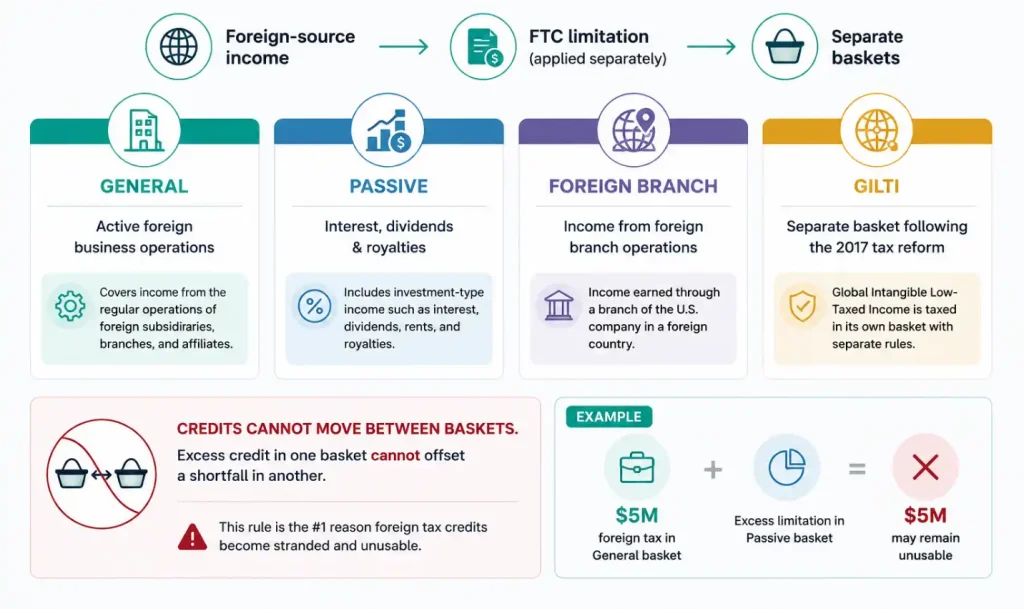
A surplus credit in one basket cannot offset a shortfall in another, and this single rule causes more stranded credits than any other feature of the system. A company might pay $5M in foreign tax on active business income while sitting on excess limitation in its passive basket, leaving that $5M unusable in the current year. Expense allocation under Treasury Regulation 1.861 compounds the problem further, since U.S. interest, R&D, and SG&A expenses get allocated across domestic and foreign income, shrinking the foreign source denominator and, with it, the room available under the FTC limitation.
In a high growth cybersecurity and identity access management company operating finance across five countries at once, the value of getting the basket classification right the first time became obvious during due diligence for an acquisition, when every credit had to be traced back to a specific jurisdiction and income type before the deal team would rely on the numbers.
Carryforwards and Carrybacks as a Timing Tool
Unused foreign tax credits do not vanish the year they go unclaimed. The IRS permits a one-year carryback and a ten-year carryforward, which gives finance teams room to sequence foreign income and credit claims across periods. A large one-time foreign tax in a year with no offsetting foreign source income can be carried forward to a year when that income materializes, and a company with U.S. tax liability but no current credits can look back one year for foreign income that generated a usable credit.
None of this works without meticulous recordkeeping by jurisdiction, income type, and year. Early-stage companies expanding internationally often skip this discipline, only to find during a financing round or an acquisition that carryforward balances cannot be substantiated with the underlying support the buyer or lender expects to see.
The Form 1118 Filing Challenge
Form 1118 is the vehicle through which corporations report foreign tax credits to the IRS, and it functions less like a disclosure form and more like an audit roadmap. It demands a country-by-country breakdown of taxes paid, the legal basis for creditability, the allocation of expenses across baskets, and adjustments to earnings and profits and foreign tax pools.
Mistakes on this form are common and expensive. Misstating a basket, applying the wrong exchange rate, or failing to trace income back to its source can each result in a disallowed credit. Not every foreign levy qualifies either. A creditable tax has to be a compulsory charge on net income, which rules out VAT, most service withholding, and non-income-based franchise taxes. Some hybrid tax regimes will not be recognized as creditable without additional support built into the filing.
Common Mistakes That Undermine Double Taxation Relief
The recurring errors in FTC execution tend to fall into a short list
- Misclassifying income between the passive and general baskets
- Skipping the required expense allocation, which overstates the limitation
- Ignoring how GILTI interacts with the credit, resulting in lost value
- Filing Form 1118 without the underlying substantiation an audit would require
- Assuming foreign withholding on services is creditable when it typically is not
These are not clerical slips. They lead to restatements, penalties, heightened audit scrutiny, and, during an IPO or M&A process, real friction with buyers and underwriters who expect the tax story to hold up under diligence.
Best Practices for Avoiding Double Taxation
Strong FTC management starts long before the return is filed, and it depends on systems and cross functional coordination rather than a year end scramble. The practices that separate disciplined finance organizations from the rest include
- Integrating tax provisioning software with the ERP so foreign income and taxes are traceable by jurisdiction in real time
- Running expense allocation models quarterly rather than annually so the FTC limitation is visible before it becomes a surprise
- Documenting intercompany pricing, dividend policy, and foreign earnings and profits on an ongoing basis
- Coordinating FP&A, treasury, and tax so withholding exposure and credit timing are anticipated rather than discovered
- Reviewing carryforward balances and expiration timelines on a set cadence rather than only at filing time
In a $127M global consumer products company with manufacturing spanning China and Vietnam, quarterly coordination between tax and supply chain finance made it possible to see how shifts in intercompany pricing and freight allocation would move the foreign source denominator months before the return was due, rather than learning about it after the fact.
A Case Study in Credit Recovery Through Restructuring
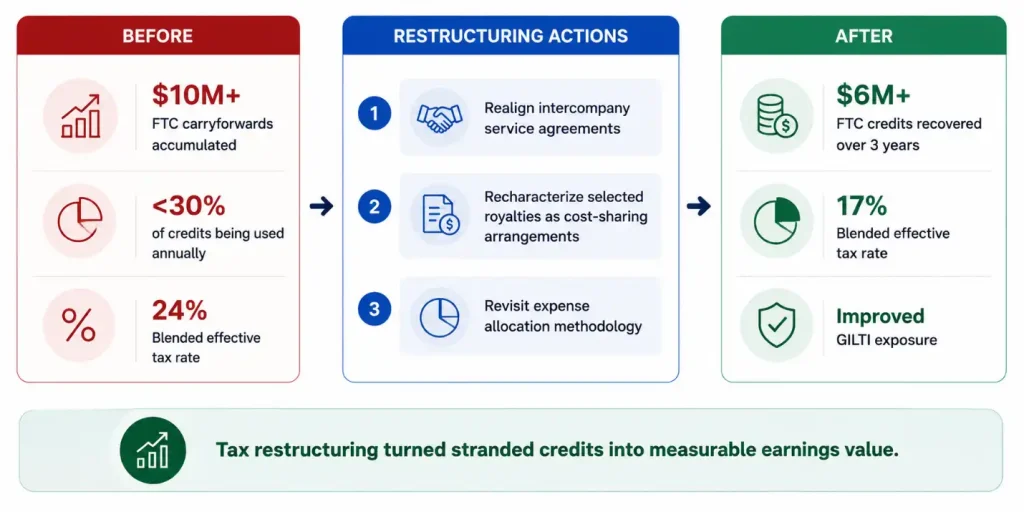
A global consumer products company with cross border manufacturing and licensing activity had accumulated more than $10M in FTC carryforwards from its Asia and Latin America operations, yet it was using less than 30 percent of those credits each year because of narrow basket limitations and expense allocations weighted heavily toward R&D. By realigning intercompany service agreements, recharacterizing certain payments from royalties into cost sharing arrangements, and revisiting the expense allocation methodology, the company expanded its FTC limitation and recovered more than $6M in credits over three years. The same restructuring improved GILTI exposure and brought the blended effective tax rate down from 24 percent to 17 percent, turning a compliance exercise into a measurable earnings outcome.
Three Key Takeaways
- Double taxation relief is not automatic. It has to be earned through correct basket classification, disciplined expense allocation, and a Form 1118 filing that can withstand audit scrutiny on its own.
- Basket separation is the single biggest source of stranded credits, so any finance team that wants to know how to avoid double taxation has to model general, passive, branch, and GILTI income separately rather than on a blended basis.
- Carryforwards, intercompany restructuring, and quarterly coordination between tax and FP&A convert unused foreign tax credits into real cash flow and lower effective tax rates, particularly ahead of financing events, M&A, or IPO diligence.
Disclaimer: This article is intended for informational purposes only and does not constitute legal, tax, or accounting advice. You should consult your own tax advisor or counsel for advice tailored to your specific situation.
Hindol Datta is a four-time CFO and senior finance executive with over 25 years of leadership experience across cybersecurity, SaaS, gaming, logistics, digital marketing, medical devices, consumer products, and nonprofit organizations. He has led more than $120M in fundraising and over $150M in M&A transactions while building the financial and operational systems that let complex businesses scale with confidence. He is the author of seven books in the Systems CFO Series and holds active CPA, CMA, and CIA credentials.
AI-assisted insights, supplemented by 25 years of finance leadership experience.