
Executive Summary
There is a moment in almost every scaling company when intellectual property has to move. At that point, intercompany IP optimization stops being a theoretical exercise and becomes an operating decision with real consequences. Expansion into a new market, an offshore hire, or a pending divestiture creates the same pressure. The company has to relocate the ownership of intangible assets. That pressure often turns into a transaction, with boards and tax counsel across the table. Handled without discipline, an outbound IP transfer erodes the U.S. tax base over time. It also invites audit scrutiny on both sides of the border.
This piece lays out the technical architecture behind intercompany IP strategy. That architecture includes cost-sharing arrangements, buy-in payments, Section 367(d), and BEPS 2.0 substance requirements. It speaks from the vantage point of the finance function. That function has to build these structures and defend them years after the ink dries.
Why IP Structuring for Expansion Becomes Unavoidable
Intellectual property moves because businesses move. A company that begins with a single engineering team in California may look different by Series C. By then, it may have meaningful headcount in Bengaluru, Krakow, or Ho Chi Minh City. That growth creates an organic pull toward aligning legal ownership of the IP with where the value actually accrues. The same pull appears when a company is carving out a product line for sale. That line needs to sit cleanly in its own entity before a buyer starts asking questions.
None of this is tax-neutral, and no one should treat it as if it were. Moving IP out of a U.S. entity and into a foreign affiliate can trigger a taxable event. That risk disappears only when the company builds the structure with intent from the outset. The Internal Revenue Service views outbound IP transfers as a plausible vehicle for base erosion. That view is why the rules governing outbound transfers sit among the most complex provisions in the tax code. Section 367(d) sits chief among them. CFOs who treat these rules as a design constraint consistently produce more defensible outcomes. Treating them as an obstacle to route around produces weaker results.
Cost-Sharing Arrangements as the Foundation of Intercompany IP Strategy
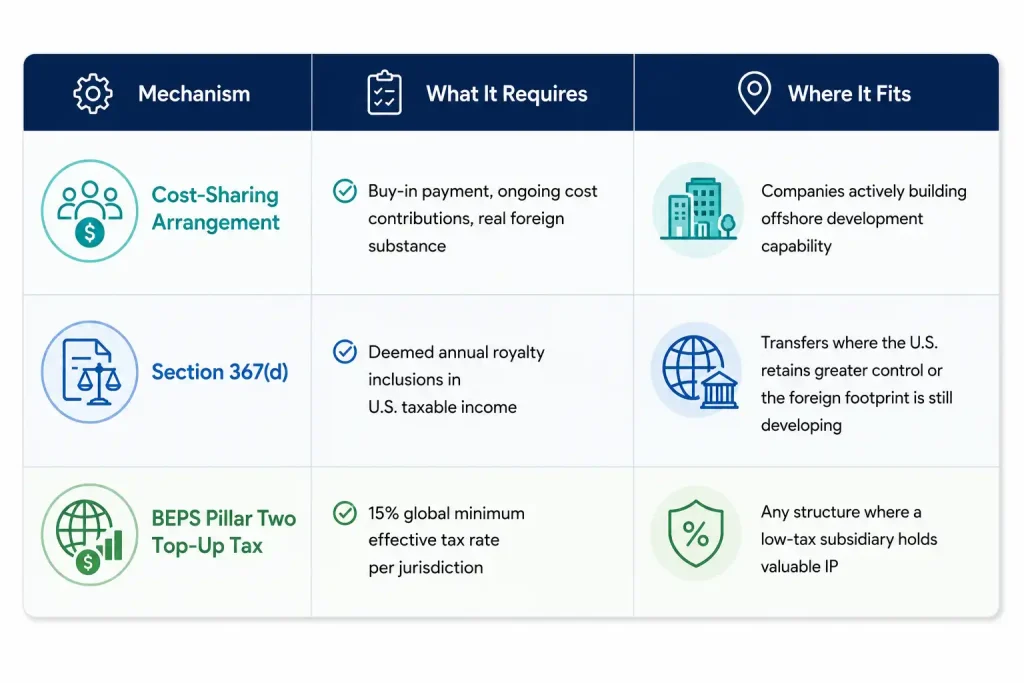
The cost-sharing arrangement, or CSA, remains the most durable vehicle for moving IP abroad. It keeps intercompany IP strategy defensible under both U.S. and international rules. Under a CSA, a foreign affiliate shares in the future income generated by the IP. In exchange, it contributes its fair share of ongoing development costs. The structure recognizes the genuine economic contribution of a non-U.S. team rather than pretending it does not exist.
In a typical arrangement, the U.S. parent and a foreign subsidiary agree to jointly fund research and development going forward. The foreign entity makes a buy-in payment to compensate the parent for rights to the existing IP. It then contributes to ongoing costs in proportion to the benefit it expects to receive. That figure needs valuation reports and transfer pricing documentation sturdy enough to survive an audit years later.
Substance Is Not Optional
The IRS has scrutinized CSAs for years. The Altera litigation is a clear reminder that courts do not always end where they start. There, the government challenged the exclusion of stock-based compensation from CSA cost pools. The lesson is straightforward: execute the CSA with rigor and keep the documentation current. A structure built once and never revisited invites the challenge it was meant to avoid.
The foreign participant also needs real substance, not a mailbox. One multi-entity architecture spanned a cybersecurity and identity access management company operating across the United States, Canada, Mexico, India, and Nepal. The entities that held meaningful responsibility employed people who made real decisions and carried real financial risk. That distinction mattered every time an auditor looked under the hood. Ireland, the Netherlands, and Singapore remain common hosts for CSAs. Authorities in all three are enforcing substance-over-form standards with more consistency than they did five years ago.
Buy-In Payments: Valuation, Timing, and Defensibility
The buy-in payment is the linchpin of the entire arrangement, representing what the foreign affiliate pays the U.S. parent for access to pre-existing intangible assets. The number has to reflect arm’s-length value, typically derived through discounted cash flow analysis or a residual profit split method, and both approaches demand judgment about future income streams, discount rates, and risk that no spreadsheet formula resolves on its own.
Getting the valuation wrong carries cost in either direction. An understated buy-in invites the IRS to argue that the transferred value was never captured, which can trigger retroactive tax liability and penalties, while an overstated buy-in creates unnecessary foreign tax exposure and draws scrutiny from local authorities questioning whether the capital deployed matches the substance on the ground. In cross-border M&A work at a Euronext Paris-listed gaming and digital entertainment company operating across the United States, France, the United Kingdom, Singapore, and South Korea, valuation defensibility was never an academic question; it was the difference between a clean close and a diligence process that stretched for months.
Timing carries its own weight. A buy-in executed before the IP starts generating meaningful revenue reads as cleaner than one executed midstream, once income has already begun to accrue in the foreign jurisdiction, and coordinating that timing across legal, engineering, and commercial teams is a project management exercise as much as a tax exercise.
Section 367(d): The Backstop Behind Every Cross-Border Transfer
Section 367(d) treats an outbound transfer of intangible property as if the U.S. transferor still owns the IP and is receiving royalty-like payments over time, and those deemed royalties are taxable in the United States regardless of whether the foreign affiliate has actually sent cash. That disconnect between recognized income and received cash is where CFOs commonly get caught flat-footed, because a forecast that does not account for a 367(d) inclusion will understate U.S. tax liability at the worst possible moment, typically right before a board meeting or a financing round. The rule also restricts the transfer of certain intangibles, such as goodwill or going concern value, absent specific exceptions, and the interplay between 367(d) exposure and a CSA structure belongs on international tax counsel’s desk before a transaction closes, not after.
BEPS 2.0 and the Global Minimum Tax: Substance as the Deciding Factor
Under the OECD’s BEPS 2.0 framework, the economic rationale for an intercompany IP strategy has to extend past the entity chart, and Pillar Two’s 15 percent global minimum tax has changed the math for jurisdictions once attractive purely for a low headline rate. If a subsidiary holding valuable IP pays less than that floor, a top-up tax follows, either locally or at the group level, stripping away much of the benefit that once came from parking IP somewhere favorable.
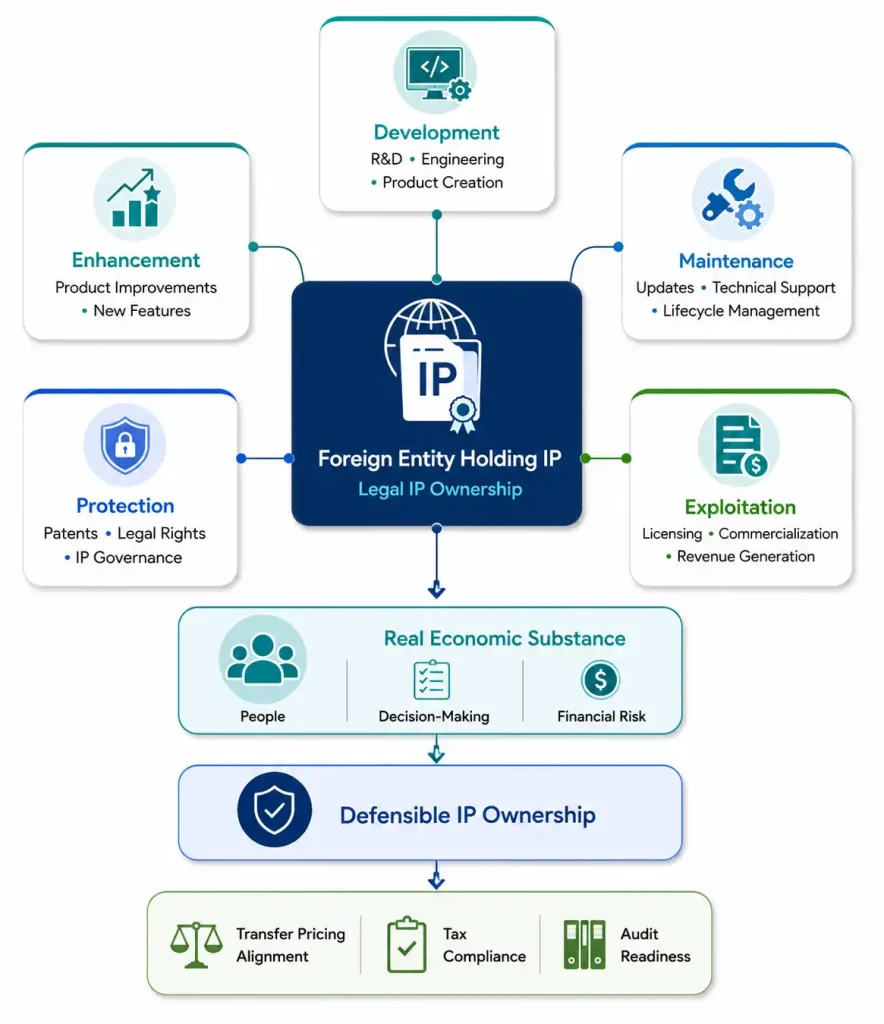
Regulators are now organized around the DEMPE functions, meaning development, enhancement, maintenance, protection, and exploitation of the intangible, and if those functions are not actually performed by the entity claiming ownership, the ownership claim itself becomes vulnerable to challenge. In the operations controllership work at a $170M global medical device manufacturer with plants in Copenhagen, Cork, and Taiwan, the standard costing and supply chain finance disciplines that governed physical manufacturing were the same disciplines that separate a defensible IP structure from a fragile one: real people, real decisions, and real financial risk sitting where the ownership claim says they sit.
Common pitfalls that undermine an otherwise sound intercompany IP strategy:
- Executing a buy-in before the foreign affiliate has staff or operational capability, inviting a substance challenge
- Letting CSA cost-pool documentation go stale after the first year
- Treating Section 367(d) as a one-time calculation rather than an annual inclusion modeled into cash flow forecasts
- Assuming a favorable statutory rate alone justifies the jurisdiction, without accounting for Pillar Two’s top-up mechanics
A Field Note on Structuring for a Clean Carve-Out
A mid-stage medtech company preparing to spin off a diagnostics business held all of its IP inside a single U.S. entity, with its future market and leadership team based in Europe. Rather than license the technology, the decision was to transfer the IP to a Dutch subsidiary as part of a CSA, with a third-party valuation firm calculating the buy-in based on projected cash flows and the foreign entity sharing development costs from day one. Local engineers were hired, a steering committee was established to own the product roadmap from Europe, and every decision was documented as it happened rather than reconstructed later. The separation held up through due diligence, and the difference between that outcome and a fragile one came down to discipline applied to valuation, documentation, and substance, not to the cleverness of the underlying structure.
Three Key Takeaways
- Intercompany IP optimization succeeds or fails on the alignment between where ownership sits and where the DEMPE functions actually happen, and no documentation substitutes for real people making real decisions in the jurisdiction that claims the IP.
- Buy-in valuation and timing deserve the same rigor a company applies to a funding round, because an understated figure invites IRS penalties while an overstated one creates unnecessary foreign tax exposure.
- Section 367(d) and BEPS Pillar Two are not competing frameworks to choose between; they are guardrails that shape how any cross-border IP structure gets modeled, and a CFO who builds both into the forecast avoids the cash flow surprises that surface when income is recognized without cash changing hands.
Disclaimer: This article is intended for informational purposes only and does not constitute legal, tax, or accounting advice. You should consult your own tax advisor or counsel for advice tailored to your specific situation.
Hindol Datta is a four-time CFO and senior finance executive with over 25 years of leadership experience across cybersecurity, SaaS, gaming, logistics, digital marketing, medical devices, consumer products, and nonprofit organizations. He has led more than $120M in fundraising and over $150M in M&A transactions while building the financial and operational systems that let complex businesses scale with confidence. He is the author of seven books in the Systems CFO Series and holds active CPA, CMA, and CIA credentials.
AI-assisted insights, supplemented by 25 years of finance leadership experience.