
Executive Summary
Cash repatriation is rarely a yes-or-no question for a company operating across borders. The real question is how and when foreign earnings come home. Which mechanism carries the lowest tax cost? Dividend, intercompany loan, or royalty, each tells a different story to a board or an acquirer. This article draws on more than twenty-five years of operating finance work across multi-entity organizations. It lays out a practical framework for cash repatriation strategy. The approach is grounded in the texture of having moved money across five countries and lived with the consequences.
Readers will come away with a working comparison of the three primary repatriation tools. They will also see a real case of a diversified structure. It brought funds home at a blended tax rate under 8%. Alongside that, they will see how Pillar Two and global minimum tax rules are reshaping trapped cash. This is not theory assembled from research. It is a record of decisions made under audit pressure, board scrutiny, and closing deadlines.
Why Cash Repatriation Demands Strategic Attention
Every multinational company eventually confronts the same reality: earnings generated abroad do not automatically belong at headquarters. Moving them there carries a cost that depends heavily on structure and timing. The 2017 Tax Cuts and Jobs Act reshaped this landscape. It ended decades of deferral and pushed companies toward a quasi-territorial system. It did not, however, simplify cash repatriation. Subpart F income, GILTI, and the Section 245A dividends received deduction now form an architecture. It punishes careless repatriation and rewards a well-timed, well-structured movement of funds.
At a cybersecurity and identity access management company with entities spread across the United States, Canada, Mexico, India, and Nepal, the temptation was always to treat repatriation as an annual afterthought, something the tax advisor handles in March. That instinct is exactly backward. A cash repatriation strategy touches treasury, legal, FX exposure, and the story a company tells its board about capital efficiency. Every dollar sitting idle in a foreign entity is a dollar unavailable for debt paydown, buybacks, or the next acquisition, and the type of tax paid on that dollar is frequently a choice rather than a fixed cost.
Dividends: The Familiar Path with Modern Complications
A foreign subsidiary declaring a dividend to its U.S. parent sounds simple, and in the cleanest cases it is. Under Section 245A, a U.S. corporate shareholder may deduct 100% of the foreign-source portion of a dividend if holding-period and anti-hybrid rules are satisfied, which can make dividend-based repatriation close to tax-free on the U.S. side. The complications live elsewhere: Subpart F and GILTI income are often taxed currently regardless of whether cash actually moves, withholding tax rates swing from roughly 5% under favorable treaties to 15% or higher in countries like China or Brazil, and jurisdictions such as India or Argentina impose central bank approval requirements that can delay outbound remittance for months.
Dividends work best for mature subsidiaries with stable earnings and clean E&P histories, where the deduction is not at risk of being disqualified by a hybrid entity issue. The board resolution and audit trail required for a dividend, while administratively heavier than a loan, tends to produce the cleanest narrative for auditors and acquirers, which matters more than people expect once a transaction is on the table.
Intercompany Loans: Liquidity Without an Immediate Tax Event
An intercompany loan moves cash from the foreign subsidiary to the U.S. parent or a sister entity without triggering an immediate dividend tax, provided the arrangement has genuine commercial substance. Interest income is taxable to the foreign lender, interest expense is deductible by the borrower subject to the limitations under IRC Section 163(j), and the interest rate itself must reflect arm’s length pricing under transfer pricing principles. The risk that keeps this mechanism from being a free option is reclassification: the IRS can treat a loan lacking proper documentation, repayment schedule, or repayment history as a disguised dividend, and thin capitalization rules in the lending jurisdiction can disallow the interest deduction entirely.
This tool tends to fit short-term liquidity needs, particularly when the U.S. entity has enough EBITDA headroom to absorb the interest expense under the 163(j) threshold. Legal documentation is not a formality here. It is the difference between a defensible cash repatriation strategy and an audit finding.
Royalties: Monetizing Intellectual Property Across Borders
Where dividends and loans move accumulated earnings, a royalty arrangement compensates the U.S. parent for the ongoing use of intellectual property, branding, or know-how by a foreign subsidiary. The royalty is deductible where paid, taxable where received, and often subject to withholding of 10% to 20% unless a treaty reduces the rate, as in Ireland or the Netherlands. The defensibility of the arrangement rests entirely on transfer pricing documentation and a clear delineation of DEMPE functions, meaning the development, enhancement, maintenance, protection, and exploitation of the underlying IP.
Royalties suit IP-heavy businesses where the U.S. parent genuinely owns the core technology, and they attract more scrutiny than either dividends or loans in jurisdictions aligned with BEPS Action 5. A classification mismatch, royalty recharacterized as a service payment, can undo the entire tax position, so benchmarking studies and license agreements need to exist before the first payment, not after an audit notice arrives.
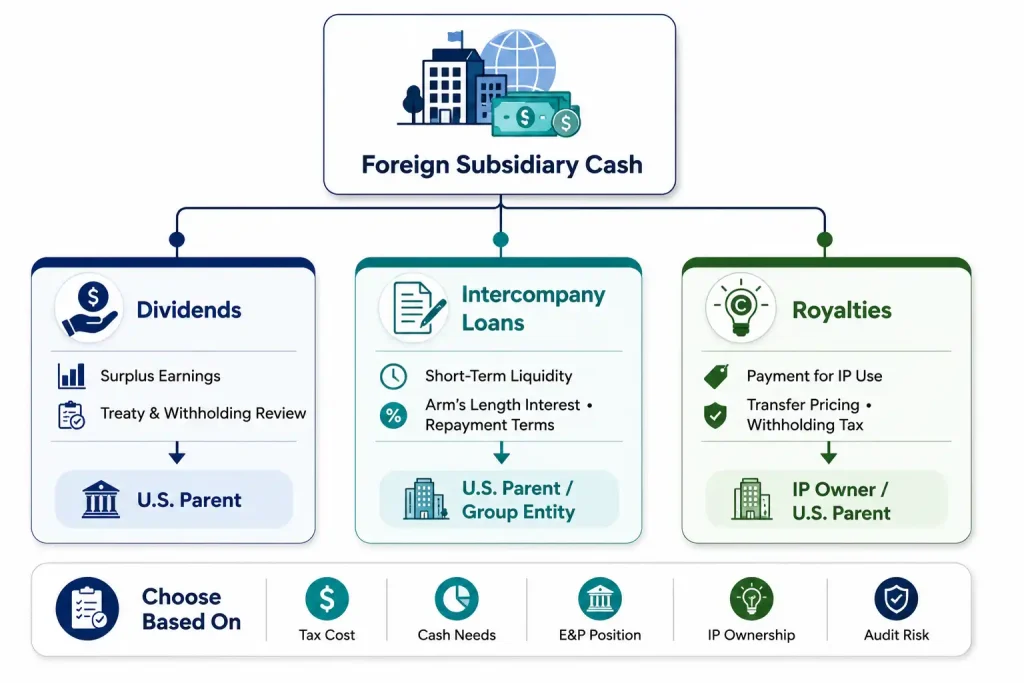
Comparing the Three Repatriation Paths
| Criteria | Dividends | Loans | Royalties |
| Immediate Tax Impact | Often avoidable via DRD | Deferred | Immediate |
| Withholding Tax Exposure | Medium to High | None | Medium to High |
| Substantiation Required | Medium (E&P, DRD) | High (loan agreements) | Very High (TP studies) |
| Operational Complexity | Moderate | Moderate | High |
| Audit Risk (U.S. and Foreign) | Medium | High | Very High |
| Strategic Flexibility | Low (once declared) | Medium (repayable) | High (ongoing flow) |
This matrix does not replace judgment. It sharpens the questions worth asking: whether the cash is idle or earmarked, whether foreign tax credit capacity exists to absorb withholding, and whether the transfer pricing position could survive scrutiny from a Big Four auditor during diligence.
A Multi-Entity Case: Blending Structures to Bring Cash Home
At roughly $30M in annual recurring revenue, with delivery centers spanning the United States, Canada, Mexico, India, and Nepal, the naive move would have been a blanket dividend sweep from every entity at year end. Instead, the finance team matched the mechanism to the entity: a royalty arrangement compensated the U.S. parent for centrally owned platform IP used by the offshore delivery centers, an intercompany loan addressed short-term working capital needs in one entity without triggering a taxable event, and a clean dividend moved surplus cash from the entities with the strongest E&P positions.
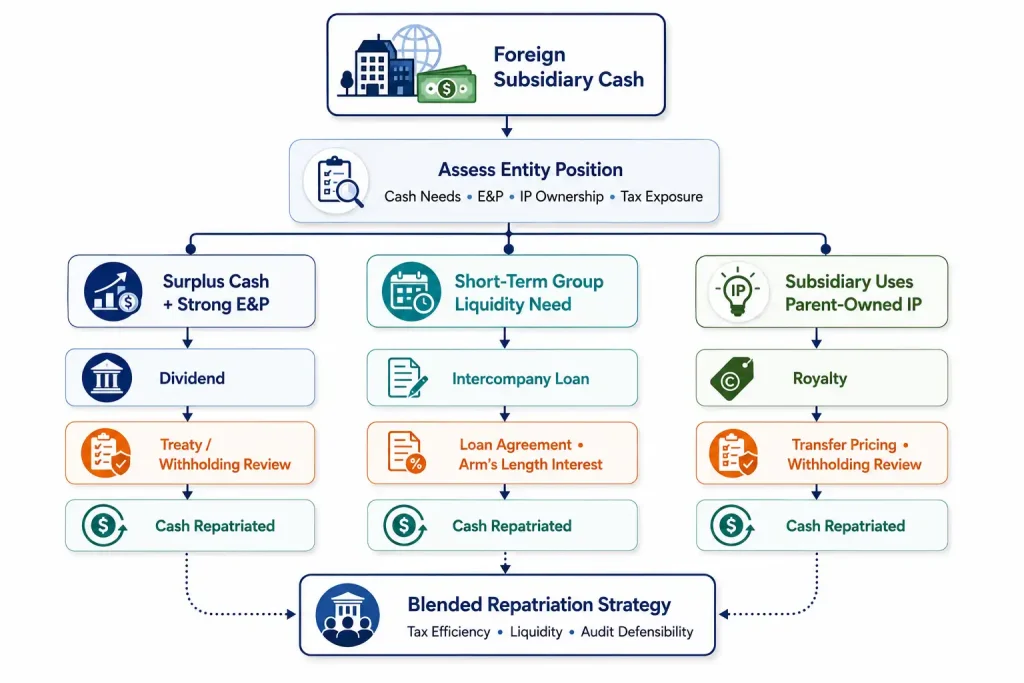
That structure kept the blended effective tax rate on the repatriated cash under 8%, and it did so while producing an audit narrative that held together across five jurisdictions during acquisition diligence. The takeaway is that a cash repatriation strategy-built entity by entity, rather than applied uniformly, is what actually survives contact with an auditor’s questions.
BEPS 2.0, Pillar Two, and the Future of Repatriation Planning
The shift toward Pillar Two minimum taxation and the GLoBE rules is narrowing the room for holding earnings offshore purely to defer U.S. tax. Substance and economic alignment, not paperwork, increasingly determine whether a repatriation position holds up. Digital-first businesses with cloud-based products and distributed teams face an added complication, because traditional royalty models can be challenged when the location of value creation is genuinely unclear, and DRD eligibility can be denied if the foreign entity is found to hold or develop the critical IP itself.
At a public gaming and digital entertainment company operating across the United States, France, the United Kingdom, Singapore, and South Korea, this tension showed up directly in how more than $100M in cross-border acquisitions were structured and how consolidated results were reported under both IFRS and U.S. GAAP. The reporting standard a board and its auditors trust is not a side detail. It is part of what makes a repatriation position defensible when regulators in more than one country are reading the same numbers differently.
Treating Cash Like Inventory
At a $127M global consumer products company with a supply chain spanning China and Vietnam, inventory turns more than doubled, from three times to seven, releasing working capital that had been sitting inert across the business. Cash trapped in a foreign entity behaves the same way idle inventory does. It looks like an asset on the balance sheet while quietly costing the business optionality, buyback capacity, and deal readiness. Treating repatriation as a continuous discipline, rather than an annual scramble, is what separates finance teams that control their capital story from those that are simply reacting to it.
Three Key Takeaways
- Match the repatriation mechanism to the entity rather than applying one method across the whole organization; dividends, loans, and royalties carry different tax timing, audit risk, and flexibility, and the right blend depends on each subsidiary’s E&P position, cash needs, and IP ownership.
- Documentation is not a formality attached after the decision is made. Loan agreements, transfer pricing studies, and E&P reconciliations need to exist before cash moves, because they are what determines whether a favorable tax position survives an IRS or foreign tax authority audit.
- Pillar Two and BEPS 2.0 are shrinking the value of holding cash offshore for its own sake, which means a cash repatriation strategy now needs to be built into the financial architecture from the start rather than treated as a year-end tax exercise.
Disclaimer: This article is intended for informational purposes only and does not constitute legal, tax, or accounting advice. You should consult your own tax advisor or counsel for advice tailored to your specific situation.
Hindol Datta is a four-time CFO and senior finance executive with over 25 years of leadership experience across cybersecurity, SaaS, gaming, logistics, digital marketing, medical devices, consumer products, and nonprofit organizations. He has led more than $120M in fundraising and over $150M in M&A transactions while building the financial and operational systems that let complex businesses scale with confidence. He is the author of seven books in the Systems CFO Series and holds active CPA, CMA, and CIA credentials.
AI-assisted insights, supplemented by 25 years of finance leadership experience.