
Executive Summary
Financial crisis management rarely fails for lack of a plan. It fails because crises never arrive in the shape anyone rehearsed. A lawsuit, a cyber breach, a key vendor default, or a sudden leadership exit can break through the seams of even careful forecasts. When that happens, the structure of thought prepared in calmer times protects the company more than any single projection.
The sections ahead explain how CFOs can use financial simulation models to strengthen crisis readiness. They cover the limits of linear modeling, the architecture of effective simulations, and the role of simulation in training judgment under pressure. They also address how to embed simulation into the rhythm of the enterprise. Together they present simulation as rehearsal, not prediction.
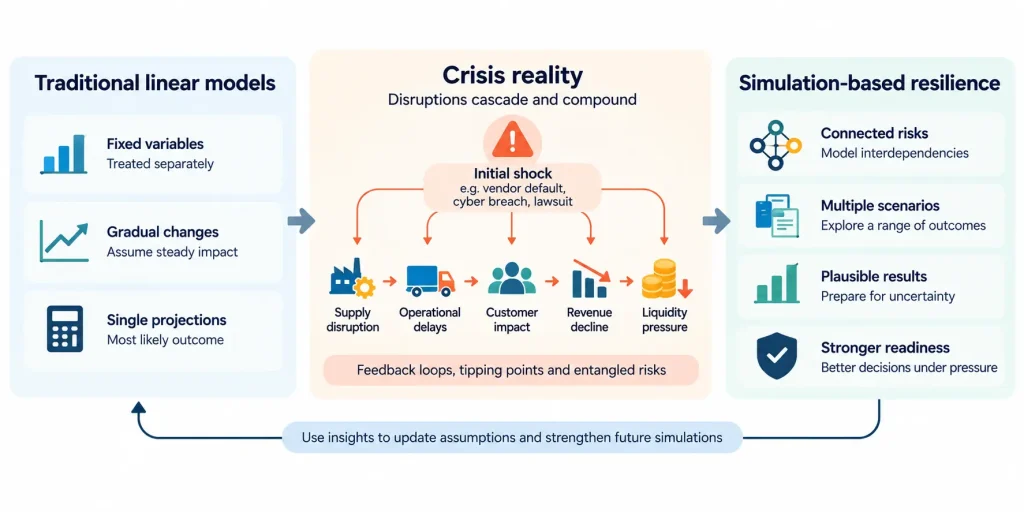
Why Linear Models Fail in Financial Crisis Management
Linear models promise comfort by assuming tomorrow will resemble yesterday within tolerable variance. Real crises do not behave in such an orderly way. They cascade, compound, and entangle, leaving traditional spreadsheets far behind events.
Crises Are Nonlinear Events
A conventional crisis model might cut revenue by a set percentage, hold costs steady, draw on a revolver, and plan for outside financing. That approach is sensible but leaves out how crises spread. It assumes customers churn evenly, vendors behave rationally, and regulators wait their turn. In reality, fear spreads, systems hit tipping points, and liquidity can disappear almost overnight.
Effective financial crisis management treats the company as a complex adaptive system. One department’s delay becomes a missed shipment, which triggers a customer complaint and a reputational tremor. That tremor lowers pipeline conversion, resets bonus plans, and weakens morale. A useful model captures this chain of consequences, not just the direct P&L impact.
Complexity theory offers three useful lenses for this work. Feedback loops show that every action sends a signal, as when a layoff cuts costs but signals weakness. Adaptation reminds leaders that churn rises as service degrades and pricing power narrows under pressure. Emergence warns that the most damaging effects often come from hidden couplings nobody modeled.
Linear Models Versus Complexity-Based Simulation
| Dimension | Linear Crisis Model | Complexity-Based Simulation |
| Variables | Treated as independent inputs | Linked through feedback and contagion |
| Change | Proportional and gradual | Subject to thresholds and sudden shifts |
| Behavior | Customers and vendors act rationally | Stakeholders adapt, overreact, and recover |
| Time | Stable and predictable | Compressed by panic and delayed by lags |
| Goal | Produce the most likely number | Prepare for a range of plausible outcomes |
Consider a board presentation of a crisis model with multiple scenarios and detailed visuals. A director asks what happens if revenue falls in one region while supply constraints delay fulfillment in another. If the model treats each input separately, it cannot answer. That gap reveals a model built for clarity instead of robustness.
A $127M consumer products company with a supply chain spanning China and Vietnam shows why interdependence matters. Finance managed a logistics P&L covering ocean freight, trucking, last-mile delivery, and warehousing across direct-to-consumer, Amazon, and wholesale channels. Disruption in any link could ripple across channels, which made connected planning essential.
Designing Financial Simulation Models That Behave Like the Business
A strong simulation should behave like the company under pressure. It should hesitate, stumble, and reveal tensions that no single formula captures. Designing one requires resisting the pull of elegance, certainty, and tidy conclusions.
Core Design Principles
Several principles separate useful financial simulation models from static scenario decks:
- Modularity, with linked modules for business units, regions, customer cohorts, and vendor groups
- Lags and memory, so costs, morale, and churn respond with realistic delays
- Thresholds, so effects change once variables cross tipping points
- Conditional logic, so specific triggers activate defined responses
- Exogenous shocks, such as tighter credit or competitor moves, to test graceful failure
Thresholds deserve particular attention when designing a crisis model. Inventory reduction may improve working capital up to a point, then cause stockouts, then raise churn, and then reduce customer lifetime value. A good model shows these effects in sequence, revealing how efficiency can turn into exposure.
Monte Carlo methods add another useful dimension to crisis planning. Running thousands of variations of a crisis scenario shows outcomes as distributions instead of single points. Leaders can then ask whether the company could survive the fifth-percentile outcome and what it would sacrifice to do so.
Surfacing Hidden Assumptions
Every variable, correlation, and boundary in a model reflects a belief. Before modeling begins, teams should state their priors about timing, responsiveness, and behavior under stress. Unexamined assumptions are the most dangerous part of any simulation.
Imagine a simulation of a demand collapse triggered by a regulatory change. The first version assumes sales fall evenly across regions. A team member then asks why two regions with different exposure would react the same way. Adding regional variance, compliance delays, and different churn sensitivities changes both the output and the quality of the conversation.
A cybersecurity and identity SaaS company with about $30M in ARR shows the value of driver-based modeling. A driver-based forecasting engine and capacity model kept actuals within plus or minus five percent of forecast for 8 consecutive quarters. Explicit drivers give leaders a foundation they can stress-test when conditions change.
Simulation as Inoculation Against Panic
Calm leadership in a crisis rarely comes from temperament alone. It comes from rehearsed judgment, built through exposure to adversity before it arrives. Simulation provides that exposure in a controlled setting.
Training Judgment Under Pressure
Human judgment degrades in predictable ways under threat. Attention narrows, status quo bias hardens, loss aversion intensifies, and groupthink spreads. Financial crisis management must therefore address how people decide, not only how cash moves.
Well-designed simulations include deliberate stressors such as conflicting data, incomplete context, and sudden time pressure. A tabletop exercise might deliver cascading bad news over a few hours. A key vendor defaults, a regulator sends an inquiry, and a covenant breach appears. Teams must respond to all three at once, moving from confusion toward working clarity.
Such exercises let leaders pre-decide difficult choices before a real crisis demands them. Bayesian thinking supports this habit, because every new event should update beliefs instead of confirming old ones. Repeated practice builds the reflex to discard cherished assumptions quickly.
Simulation also surfaces ethical trade-offs before a crisis forces them. Leaders can debate in advance whether to delay payments to small vendors or lean on larger partners. They can also weigh cash preservation against employee equity dilution. Decisions made with open debate are easier to execute with integrity when pressure arrives.
An email marketing SaaS company offers a relevant reference for decisive action under financial pressure. Finance reduced monthly cash burn from $800K to $200K. Cuts of that scale depend on knowing in advance which commitments to protect and which to pause.
Embedding Simulation in the Enterprise
Many simulations are built for the boardroom and then forgotten. They exist as isolated artifacts instead of evolving tools. Lasting financial crisis management requires simulation to become a rhythm, not an event.
Building a Cadence of Readiness
A Simulation Cadence for Financial Crisis Management
| Practice | Frequency | Purpose |
| Scenario drill | Quarterly | Tests responses to a focused shock such as a liquidity squeeze |
| Enterprise-wide rehearsal | Annually | Stresses the full system across functions and regions |
| Red-team review | Semi-annually | Challenges assumptions the core team takes for granted |
| Simulation archive update | After each exercise | Records decisions, surprises, and updated priors |
Repeated exercises reveal the crisis patterns unique to each company. Some organizations fracture at the edges as functions retreat into silos. Others freeze at the center while executives wait for consensus. Seeing these patterns early gives leaders time to address them.
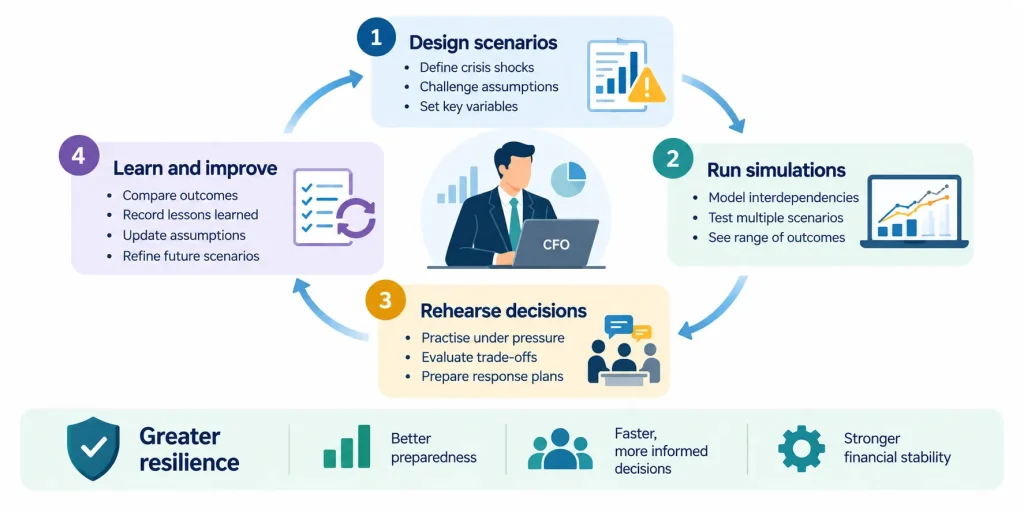
A rotating cross-functional group can own scenario design each quarter, drawing on finance, operations, people, and legal leaders. Inputs from those closest to daily operations, such as support leads and procurement analysts, often reveal how the system behaves. Over time, shared scenario language helps teams respond faster and with more coordination.
A Silicon Valley education and research institution illustrates planning under sustained uncertainty. Finance built multi-year financial models under variable funding conditions and reported to the board and audit committee. Regular scenario work helped leadership prepare for funding shifts instead of reacting to them.
Simulation, practiced this way, becomes part of how the company thinks. The most resilient firms respond to crises as if they have faced them before.
Three Key Takeaways
- Financial crisis management requires models that capture feedback, thresholds, and contagion, because crises unfold in nonlinear ways that linear forecasts miss.
- Effective financial simulation models use modular design, realistic lags, conditional logic, and Monte Carlo ranges, and they expose the assumptions behind each variable.
- Regular drills, red-team reviews, and a simulation archive turn crisis readiness into a reflex that improves judgment under pressure.
Disclaimer: This article is intended for informational purposes only and does not constitute legal, tax, or accounting advice. You should consult your own tax advisor or counsel for advice tailored to your specific situation.
Hindol Datta is a four-time CFO and senior finance executive with over 25 years of leadership experience across cybersecurity, SaaS, gaming, logistics, digital marketing, medical devices, consumer products, and nonprofit organizations. He has led more than $120M in fundraising and over $150M in M&A transactions while building the financial and operational systems that let complex businesses scale with confidence. He is the author of seven books in the Systems CFO Series and holds active CPA, CMA, and CIA credentials.
AI-assisted insights, supplemented by 25 years of finance leadership experience.