
Executive Summary
Scenario planning earns its value when a company’s road bends and the belief that tomorrow will resemble today breaks. Business scenario planning is not a stack of best, base and worst cases, but a discipline of thinking in branches about who the firm must become.
This article explains why organizations miss inflection points and how to design scenarios as narrative logics. It then shows how to deploy them across budgets, capital and hiring, and how to build a culture that holds several futures at once.
Why Scenario Planning Begins Where the Forecast Ends
Every company eventually reaches an hour when the road bends. Sometimes the shift is quiet, as when a new competitor arrives or a cost structure drifts. Other times it is seismic, such as a liquidity crisis or an unexpected acquisition overture.
In that hour, the CFO must become more than a steward of precision. The role turns into that of a mapmaker of the unknown, modeling how the firm would change within each possible future.
Andy Grove popularized the phrase strategic inflection point, and his insight still holds. These moments reward organizational coherence under changing assumptions more than forecast accuracy. The product that once led begins to lag, and the segment that once subsidized growth starts to consume it.
The 2008 downturn offered a vivid lesson in this. Former rivals suddenly sought partnerships, hoping to absorb the contraction together rather than alone. No simulation engine predicted those conversations, which shows that scenarios are choices dressed in timelines.
The Perils of Linear Thinking in Financial Scenario Planning
How Inflection Points Arrive Sideways
Budgets roll forward, hiring plans extend and financial models carry nested assumptions from quarter to quarter. If margin was 42% last quarter, the model expects 41% or 43% next, but rarely 19%.
Structural change rarely arrives with drama and often looks like noise at first. A customer takes longer to convert, or acquisition cost rises without alarm. A CFO trained only in precision may treat that drift as random variance, and unchallenged variance can harden into decline.
Cognitive Inertia and the Physics of Phase Change
Kahneman and Tversky described anchoring bias, the tendency to cling to familiar patterns. Linear extrapolation works as an analytic tool, yet it also serves as a defense against ambiguity.
Complexity theory shows why that defense eventually fails under pressure. Systems behave predictably until thresholds are crossed, and then they shift into a new regime. Sensitivity tables and single-path budgets were never designed to catch phase changes like these. Financial scenario planning therefore begins with humility, naming the dependencies that would unmake the plan if they changed.
Linear Planning Versus Scenario Planning
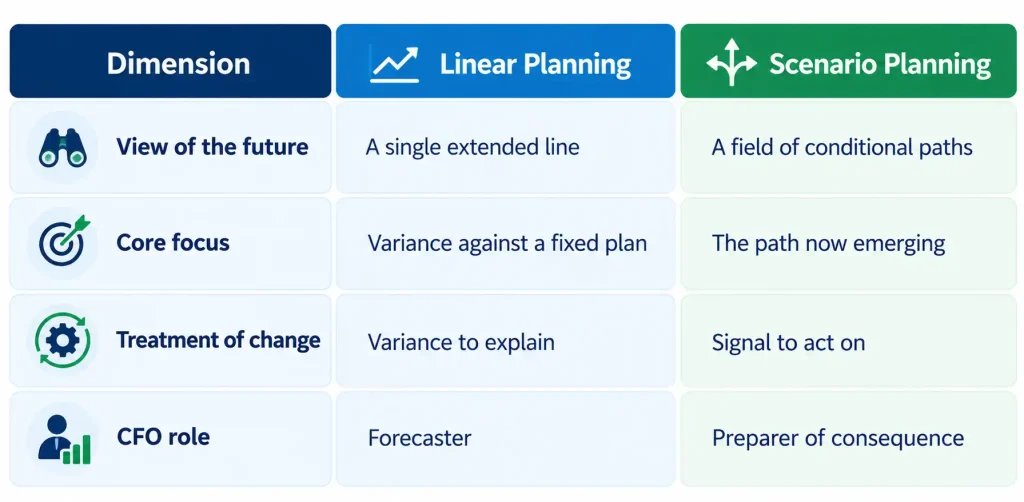
A well-known parable tells of a military unit lost in an Alpine blizzard that found its way home using a map. Only later did the soldiers learn the map showed the Pyrenees. Disciplined action within a scenario saves organizations more often than perfect prediction does.
Designing Business Scenario Planning Around Narrative Logic
Start With Forces, Not Metrics
Many companies equate scenario planning with three versions of the same spreadsheet. The figures shift, yet the underlying logic and behavior stay unchanged across every version. Real scenarios begin with forces such as macroeconomic weather, customer psychology, technological asymmetry and competitive tempo.
Example Scenarios for a SaaS Transition
Consider a software firm moving from perpetual licenses to subscription pricing. This shift inverts cash flow timing, margin structure, sales behavior and renewal culture together.
| Scenario | Narrative | Primary Pressure |
| Delayed Adoption | Enterprise clients resist subscriptions and sales cycles lengthen | Near-term bookings |
| Compression | ARR ramps while onboarding and support costs erode margin | Gross margin |
| Acceleration | Strong vertical fit drives early scale | Implementation and net retention |
Four Qualities of a Useful Scenario
Each scenario should form a narrative logic that leadership can simulate and test. To earn that status, it needs four qualities:
- Internal consistency, so the assumptions do not contradict one another
- Strategic relevance to decisions the firm will face
- Distinctiveness from the other scenarios in the set
- Plausibility under pressure, even when the outcome feels uncomfortable
The Scenario Construction Cascade
| Layer | Focus of Analysis |
| Forces | Shifts in the macro environment, customer behavior and technology |
| Strategic consequences | Whether the cost structure flexes or fractures and revenue rhythm holds |
| Operational implications | Effects on headcount, roadmap, marketing and vendors |
Good scenarios model what happens when a few core truths break, not when everything fails at once. A fintech platform that models a restriction on data portability can trace the impact on underwriting before regulators act.
Decision Triggers as a Shared Language
Scenario planning also works as a social technology for leadership teams. Built together, scenarios create a common language of conditional action. Instead of estimating precise probabilities, wise CFOs define thresholds that cue a response.
| Signal | Threshold | Pre-Agreed Response |
| Expansion CAC | Above 2.5x | Shift focus to high-retention verticals |
| Net revenue retention | Below 105% | Delay Tier 3 product development |
| Onboarding time | Up more than 20% | Release the next wave of success hires |
Three to five scenarios are enough, provided each is distinct and rehearsed. Sales, product and HR should each use them, with finance acting as conductor.
Deploying Scenario Planning as a Strategic Rhythm
The Shadow P&L
Scenario models often die quietly inside board decks and offsite folders. The shadow P&L keeps them alive as a second operating rhythm beside the budget.
It updates each quarter under an alternate path for acquisition, margin or funding. At a $30M ARR cybersecurity SaaS company, driver-based forecasting and scenario modeling held actuals within 5% of forecast for 8 quarters. That consistency came from habit more than from new systems.
Scenario Fluency in Executive Meetings
Scenario fluency changes the tone of executive meetings in a lasting way. Forecast reviews shift away from debates about missing plan and toward identifying the trajectory now emerging.
| Dashboard Color | Pathway | Leadership Posture |
| Green | Base case | Execute the plan |
| Yellow | Constrained expansion | Protect core bets and slow discretionary spend |
| Red | Contraction resilience | Prioritize retention and cash |
Conditional Allocation and Capital Corridors
Conditional allocation links marketing spend ceilings to scenario-bound CAC efficiency. Expansion scenarios justify more acquisition risk, while contraction scenarios put retention economics first. Hiring follows the same logic, with hires staged against validated indicators instead of a fixed calendar.
Capital strategy gains clarity when CFOs build corridors instead of betting on one fundraising outcome. Each corridor models runway, dilution and debt tolerance under three or more credible futures. A Silicon Valley education and research institution used funding scenarios like these to guide a $37M raise across equity and venture debt.
Building a Culture of Scenario Literacy
Language Shapes Response
Elegant models stay inert if the culture cannot absorb uncertainty. Catastrophic vocabulary narrows perception, while manageable framing keeps teams open to design.
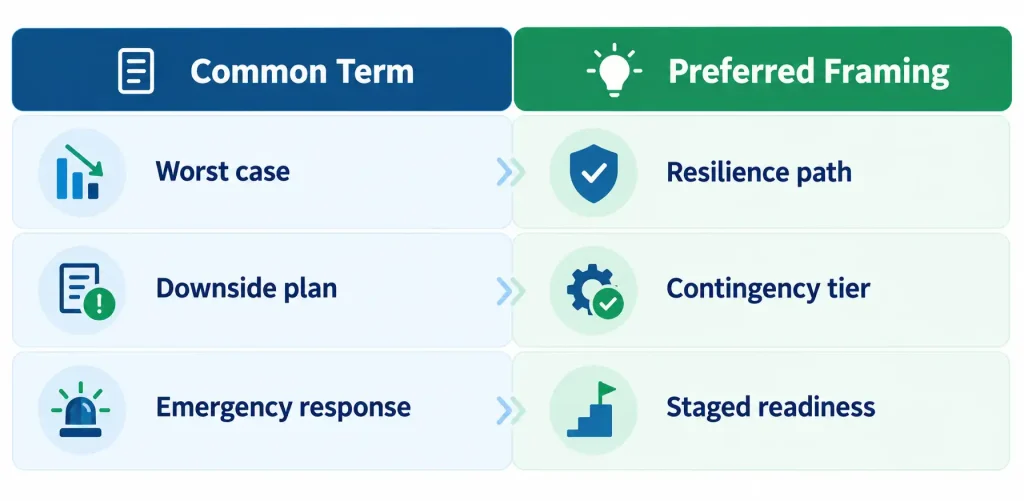
The Quarterly Scenario Rehearsal
Scenario literacy grows through repetition with consequence, not through templates. A quarterly rehearsal asks leaders to inhabit a specific future and assign roles, decisions and trade-offs. Useful rehearsal themes for the session include the following:
- A 15% drop in customer retention and the response it requires
- A funding round that closes six months later than planned
- Growth that doubles and exposes the first delivery constraints to break
An early-stage email marketing technology company showed the value of this preparation. Its turnaround cut monthly burn from $800K to $200K, a shift far easier when contraction was already named.
Skeptic Without Becoming Cynic
The CFO must protect optionality without fueling paranoia across the organization. Over time, scenario culture also reshapes organizational memory, so a deviation from plan is remembered as a prepared response to Scenario B. Scenario mastery does not eliminate volatility, but it turns volatility into an arena of design.
Three Key Takeaways
- Scenario planning works best when it models how the firm must behave under different forces, not when it adjusts numbers in a base, upside and downside spreadsheet.
- Decision triggers, shadow P&Ls and capital corridors turn business scenario planning from a board slide into a live operating rhythm across finance, sales, product and HR.
- Financial scenario planning becomes durable when shared language and regular rehearsal make uncertainty a normal part of planning rather than a source of fear.
Disclaimer: This article is intended for informational purposes only and does not constitute legal, tax, or accounting advice. You should consult your own tax advisor or counsel for advice tailored to your specific situation.
Hindol Datta is a four-time CFO and senior finance executive with over 25 years of leadership experience across cybersecurity, SaaS, gaming, logistics, digital marketing, medical devices, consumer products, and nonprofit organizations. He has led more than $120M in fundraising and over $150M in M&A transactions while building the financial and operational systems that let complex businesses scale with confidence. He is the author of seven books in the Systems CFO Series and holds active CPA, CMA, and CIA credentials.
AI-assisted insights, supplemented by 25 years of finance leadership experience.