
Executive Summary
Working capital in M&A often sits in the margins while EBITDA, synergies, and integration plans take center stage. Yet receivables, payables, and inventory reveal how a target business actually runs, how it funds growth, and how it will behave once ownership changes. Many deals that look sound on the income statement stumble because of cash cycles nobody examined closely.
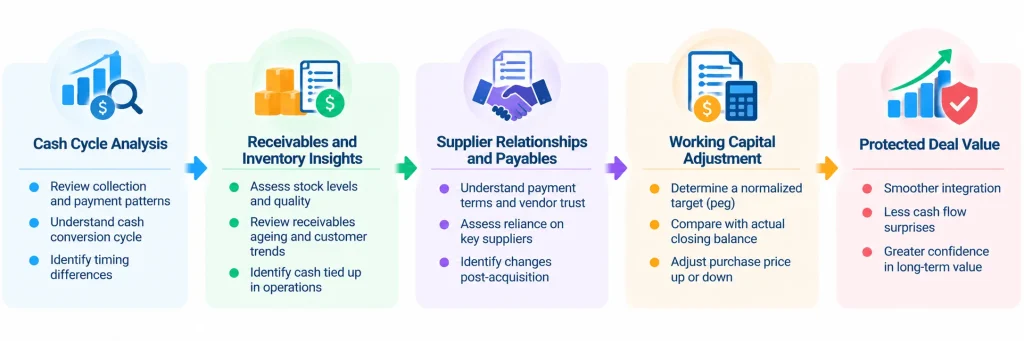
The sections ahead explain how CFOs can use working capital insights throughout a transaction. They cover the collision of cash cultures, the risks hidden in inherited inventory, and the trust embedded in vendor payables. They also address the working capital adjustment in the purchase agreement and a more narrative approach to diligence. Together they show working capital as a leading indicator of deal success, not a closing formality.
Why Working Capital in M&A Shapes Deal Outcomes
Working capital in M&A is more than a ratio; it reflects how a company uses time. A target may look liquid, yet that liquidity may rest on customer habits that will not survive integration. Strong days payable may depend on supplier goodwill that fades once control changes.
The Collision of Cash Cultures
Every company develops its own rhythm of billing, collecting, buying, and paying. A firm that pays suppliers in ninety days but collects in thirty signals a worldview built on leverage. A firm with balanced terms may be encoding relational stability instead. When two such companies merge, these rhythms must integrate along with the financials.
Consider an acquirer with a 22-day cash conversion cycle buying a target with a 63-day cycle. On paper, the gap suggests an opportunity to release cash. In practice, differences in billing cadence, customer expectations, and supplier relationships can create resistance. A sales team used to generous terms may struggle to enforce tighter collection policies with loyal customers.
Diligence should therefore map working capital patterns over time, by customer cohort and vendor class, instead of reviewing aggregate ratios alone. Stable patterns through seasonal cycles suggest a business that will integrate smoothly. Erratic patterns may point to weak processes or hidden dependencies. Even a two-week lag in receivables processing, caused by mismatched billing systems, can create covenant pressure at quarter-end.
A Euronext Paris-listed gaming company that completed more than $100M in cross-border M&A shows why this matters. Finance there led due diligence and post-merger integration across operations in the United States, France, the United Kingdom, Singapore, and South Korea. Integrating businesses across those markets required close attention to differing financial practices and definitions.
The Working Capital Adjustment
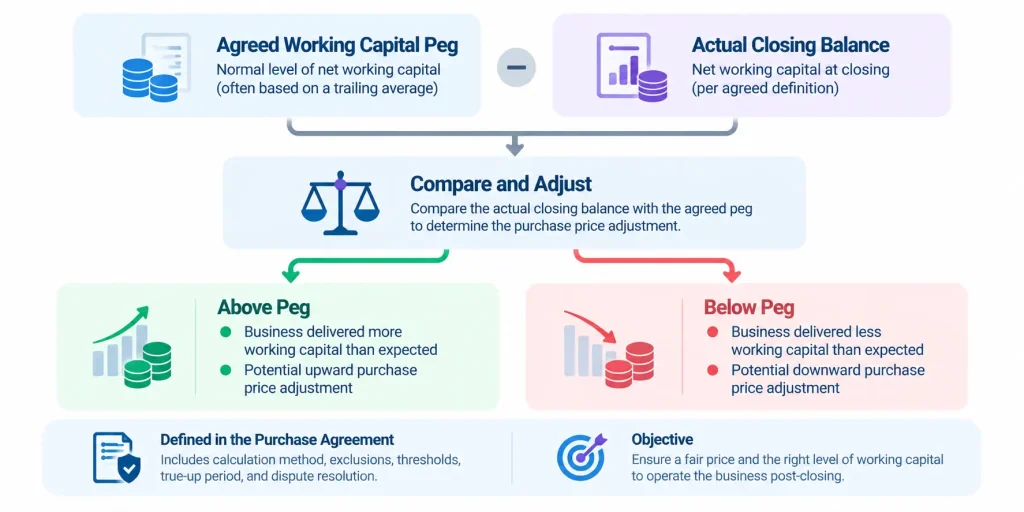
Most purchase agreements include a working capital adjustment that aligns the price with the actual working capital delivered at closing. The mechanism protects both sides of the transaction. The buyer receives a business with enough working capital to operate normally, and the seller earns credit for any excess. Negotiating it well requires a clear view of what normal looks like.
How the Mechanism Works
The parties first agree on a target, often called the peg, that represents a normal level of net working capital. After closing, they compare the actual closing balance with that target and adjust the price up or down.
Key Elements of a Working Capital Adjustment
| Element | What It Means | Common Issue |
| Working capital definition | Which current assets and liabilities count, often excluding cash and debt | Disputes over items such as accrued bonuses or deferred revenue |
| Target or peg | Normal level of net working capital, often based on a trailing average | Seasonality or growth that distorts the average |
| Closing balance | Actual net working capital on the closing date | Year-end or quarter-end timing effects |
| True-up period | Window after closing to finalize the calculation | Delays and disagreements over accounting policies |
| Collar or threshold | Range within which no adjustment occurs | Setting the band too wide or too narrow |
| Dispute resolution | Process and independent accountant for disagreements | Unclear accounting principles in the agreement |
Setting the peg for the working capital adjustment demands care. A trailing twelve-month average may understate needs in a growing business or ignore seasonal swings. Normalization adjustments, such as removing one-time items or aligning accounting policies, often shift the target by a material amount. A seller may also have stretched payables or accelerated collections before closing, which inflates apparent efficiency.
A private equity buy-side quality of earnings engagement for an IT services company illustrates the value of rigorous normalization. The work involved analyzing EBITDA adjustments to establish a credible view of sustainable earnings. The same discipline applies to working capital, where normalized figures form the basis for a fair peg.
The Hidden Risks in Inherited Inventory
Inventory often reveals the gap between deal optimism and operating reality. It carries the sediment of past forecasts, procurement habits, and risk tolerance. When an acquirer buys inventory, it also buys the assumptions behind it.
Reading Inventory as History
Stock that moved quickly within the target’s supply chain may sit idle within the acquirer’s distribution network. Safety stock justified by one strategy may look excessive in a leaner model. Slow-moving items lose information value over time, so the longer they sit, the less they say about real demand.
Changing inventory levels after closing carries its own risk. Cutting safety stock to free cash may cause stockouts, service failures, and customer loss. Keeping inherited levels without questioning them locks the combined company into an outdated posture.
Talking with planners, sales teams, and procurement leads often reveals more than reports alone. They know which SKUs cause lost deals, where waste builds up, and why certain buffers exist. Recalibrating reorder points and safety stock works best once leaders understand those stories.
A $127M global consumer products company with a supply chain spanning China and Vietnam shows what disciplined inventory management can achieve. Demand planning, SKU rationalization, and logistics optimization more than doubled inventory turns from 3x to 7x. Similar rigor applied to an acquired inventory base can turn a hidden liability into released cash.
Payables and the Politics of Vendor Trust
Accounts payable looks like a simple liability on the balance sheet. In practice, it reflects years of negotiation, concessions, and goodwill between a company and its suppliers. Vendors who extend generous terms are effectively funding part of the business.
Protecting Supplier Relationships After Close
Unilateral changes to payment terms can break that trust. Imagine an acquirer that extends terms from 45 days to 90 days across a newly bought business to standardize policy and improve liquidity. Smaller suppliers with thin margins may respond by cutting credit, demanding prepayment, or raising prices. The working capital gain can disappear in stockouts and service delays.
A more measured approach classifies vendors before changing terms. CFOs can segment suppliers using several practical factors before acting:
- Strategic importance of the supplier and the difficulty of replacing it
- Financial resilience of the supplier and its sensitivity to payment timing
- Depth and history of the relationship with the target company
- Readiness to integrate into the acquirer’s systems and policies
High-trust, high-risk relationships can keep their existing terms during early integration while others move toward standard policy. A direct call from finance leadership explaining any change often preserves more goodwill than formal notices.
Rethinking Working Capital in M&A Diligence
Traditional diligence often becomes a checklist: aging reports logged, inventory reviewed, reserves tested. Those steps matter, but they confirm numbers more than they explain them. Effective diligence on working capital in M&A seeks to understand how the business survives day to day.
From Checklist to Narrative
Each working capital figure reflects a decision someone made. A 48-day DSO may echo a credit policy, a sales tactic, or a regional norm. Three months of safety stock may reflect forecasting gaps or scars from a past disruption. Diligence should ask why the numbers look the way they do and how they will behave under new ownership.
Useful diligence questions include why collections flatten at a certain age, why inventory spikes in a recurring pattern, and which payables carry unrecorded disputes. Interviews with credit controllers, warehouse managers, and procurement leads add context that data rooms cannot provide. Scenario modeling can then test how receivables, inventory, and payables will respond to new policies.
Some acquirers capture these findings in a short narrative written jointly by finance and operations. It describes seasonal behavior, supplier dynamics, known anomalies, and open questions. That document can guide integration more effectively than an exhaustive spreadsheet.
A venture-backed digital marketing company that completed three acquisitions while growing from $9M to $180M in revenue offers a relevant reference. Finance grew from a single hire to a team of 12 during that period and completed the company’s first audit. Building that capability alongside acquisitions helped the business absorb each new entity into a consistent financial framework.
Working capital in M&A, read carefully, shows how a company manages time, trust, and risk. When the target’s rhythm fits the acquirer’s, integration proceeds smoothly. When it clashes, no synergy model can fully restore the lost value.
Three Key Takeaways
- Working capital in M&A reveals how a target operates day to day. Diligence should map cash cycles, inventory, and payables over time instead of relying on aggregate ratios.
- A well-negotiated working capital adjustment depends on a clear definition, a normalized peg, and attention to seasonality and pre-closing behavior.
- Protecting supplier trust, reading inventory as history, and writing a working capital narrative help preserve deal value through integration.
Disclaimer: This article is intended for informational purposes only and does not constitute legal, tax, or accounting advice. You should consult your own tax advisor or counsel for advice tailored to your specific situation.
Hindol Datta is a four-time CFO and senior finance executive with over 25 years of leadership experience across cybersecurity, SaaS, gaming, logistics, digital marketing, medical devices, consumer products, and nonprofit organizations. He has led more than $120M in fundraising and over $150M in M&A transactions while building the financial and operational systems that let complex businesses scale with confidence. He is the author of seven books in the Systems CFO Series and holds active CPA, CMA, and CIA credentials.
AI-assisted insights, supplemented by 25 years of finance leadership experience.