
Executive Summary
Every earnings release, capital decision, and budget change sends financial signals that stakeholders read through their own priorities and fears. Shareholders, lenders, boards, employees, and customers see the same numbers, yet each group builds a different story.
This article examines how finance leaders can map stakeholder frames, design coherent signals, re-anchor trust during turbulence, and speak one truth to many audiences. The aim is practical: investor expectations management that rests on credible behavior instead of polished messaging.
Why Financial Signals Never Speak for Themselves
Numbers carry precision, but they rarely carry meaning without help. Financial signals work as gestures, and every audience interprets those gestures through its own lens.
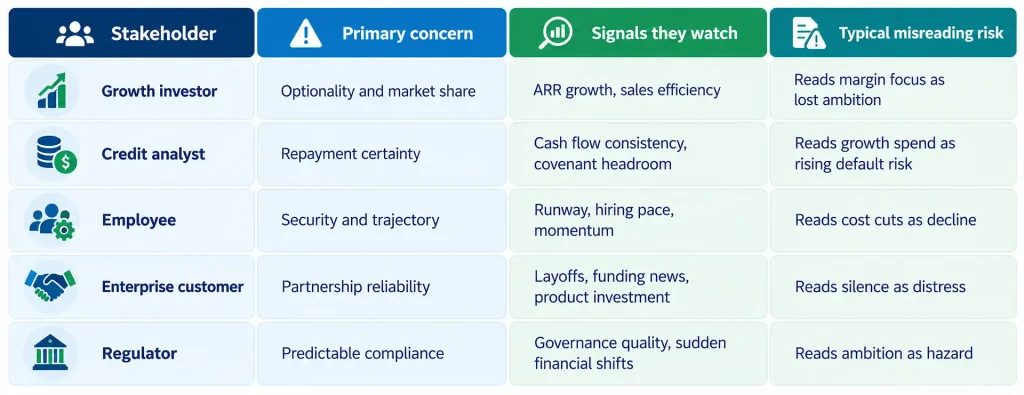
The shareholder looks for return and optionality, while the employee looks for security and direction. Boards want discipline with upside, regulators want predictability, and customers want proof of reliability. Because these expectations rarely align, the CFO’s real task is interpreting financial signals for a portfolio of minds.
The same net margin can signal underinvestment to a growth investor and prudence to a value investor. A rising burn rate may excite a venture funder and alarm a strategic partner at the same time.
Teams often wonder whether the numbers show a company winning or merely surviving louder than rivals. Every finance function should be ready to answer that question with meaning, not a spreadsheet.
Expectation Architecture: How Stakeholders Read Financial Signals
Stakeholder expectations are constructed long before results arrive, and each quarterly print lands filtered through experience, incentives, and psychology. Reading financial signals well requires the CFO to think like an economist and a cognitive anthropologist at once.
The Four Building Blocks of Stakeholder Interpretation
Each stakeholder’s interpretive model rests on four elements:
- Prior experience: what past signals from the company and its peers have taught them to expect
- Incentive alignment: which outcome benefits them most
- Risk exposure: how much they stand to lose if a signal proves misleading
- Narrative appetite: how much context they want alongside the numbers
How Different Stakeholders Interpret the Same Numbers
Anchoring, Bias, and the Cost of a Wrong Frame
Stakeholders update their beliefs as new data arrives, yet they anchor heavily on earlier signals. Kahneman’s work on anchoring explains why a small, unexplained shift can unsettle markets more than a larger, well-reasoned one.
Consider a SaaS company moving toward profitability, where net new ARR dips gently while cash burn improves. Without a narrative that frames this as strategic pacing, stakeholders may conclude that demand is weakening. Once that frame takes hold, even conservative capital deployment starts to look like lost conviction.
The remedy is to model the modelers by segmenting stakeholders and testing financial signals through pre-briefs, scenario-based Q&A, and sentiment review. What does a 20% marketing cut say to investors compared with employees? Asking that question in advance is strategic empathy, not manipulation.
Signal Design: How Financial Decisions Shape Perceived Identity
No number in a financial statement is ever neutral, since the balance sheet records a company’s risk philosophy and the cash flow statement exposes its intentions. Decisions about margins, spend, cash reserves, raises, and buybacks become financial signals of identity.
What Common Financial Signals Can Mean
| Financial signal | Favorable reading | Unfavorable reading |
| Dividend initiation | Discipline and continuity in a cash-rich industrial firm | Strategic confusion in a capital-hungry SaaS firm |
| Strong free cash flow | Maturity and prudence | No high-return reinvestment options left |
| Capital raise | Confidence when raised during momentum | Defensive scramble when raised during contraction |
| High burn multiple | Conviction in land-and-expand economics | Recklessness |
| Exiting a product line | Sharper strategic focus | Capitulation |
| Dropping a KPI from the deck | Simplification | Something is being hidden |
Consistency Over Time Builds Interpretive Trust
Game theory suggests that, under incomplete information, observers predict intent from observed moves. Interpretation depends on what earlier signals established, so consistency across quarters matters more than any single announcement.
A firm that frames reinvestments as experiments can later close unprofitable lines without drama, while one that retreats from proclaimed dominance looks erratic. Information theory agrees: fewer, clearer financial signals carry more weight in a noisy market.
At one high-growth cybersecurity SaaS company with about $30M in ARR, a driver-based forecasting engine held actuals within five percent of forecast for 8 consecutive quarters. That record made each forecast a trusted signal and helped carry the business through acquisition diligence.
Sequencing a Strategic Pivot
When strategy shifts, new signals must read as evolution, not contradiction. A company moving from top-line growth to profit optimization can narrate the pivot through three coordinated moves:
- A deliberate slowdown in sales hiring
- A revised gross margin target in quarterly guidance
- A restructuring of non-core product lines
The key is to present these moves as a scenario on an earlier earnings call, so stakeholders later see planned steps within a known strategic arc. Success depends on how well perception matches strategy, not on the next day’s share price.
Investor Expectations Management During Turbulence
Every firm eventually misses a target, whether revenue falls short, a launch misfires, or capital tightens. In those moments, the CFO must hold the narrative together through reframed coherence, avoiding both bravado and apology.
Resisting Explanation as Atonement
The first instinct after a miss is to flood stakeholders with variance detail. Internal reviews need that specificity, but external audiences want to know what the miss means for strategy and direction.
Suppose enterprise deal closures slip by a quarter. A stronger framing than pipeline math explains that a sales motion built for SMB velocity now meets longer enterprise cycles, turning the miss into a maturation signal.
Replacing Binary Guidance with Scenario Bands
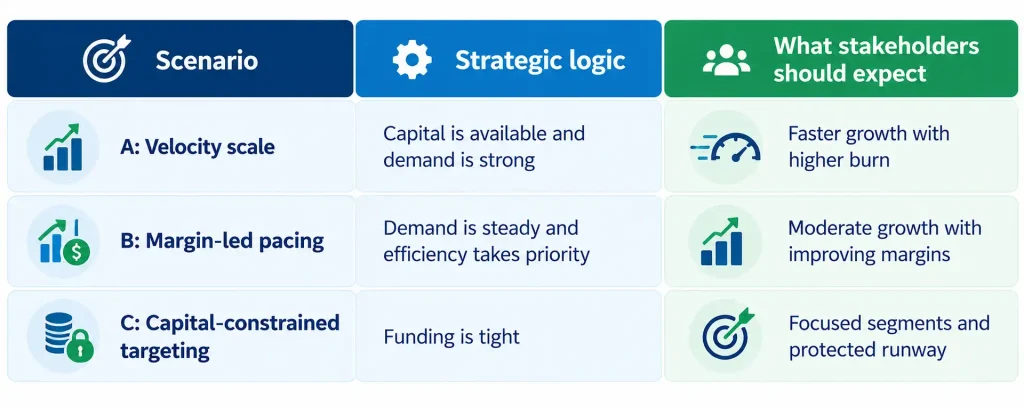
Static beat-or-miss guidance creates fragile expectations, while trajectory bands tied to clear drivers create room to adjust without betrayal. Three pre-seeded scenarios give stakeholders a safe harbor when conditions change.
Reweighting the Signal Hierarchy
Under stress, a CFO can elevate margin stability, retention, and capital efficiency as the leading financial signals. During a growth plateau, cohort profitability can show durable product-market fit even as bookings slow. At one marketplace SaaS company, cohort and unit economics models anchored diligence for a $20M Series B round. When an early-stage digital marketing SaaS company cut monthly burn from $800K to $200K, its efficiency narrative gained credibility because behavior matched the message.
Repositioning has limits, because pivots that pile up too quickly make every new narrative sound like rationalization. A few enduring beliefs about customers, margins, and capital keep identity intact, and when a true reversal is unavoidable, plain speech restores confidence fastest.
Multi-Audience Coherence: One Truth Behind Many Financial Signals
A balance sheet is fixed in form but plural in meaning. One reader sees leverage and worries about default, while another sees investment firepower. Trust also fails to transfer between groups, so a cost program that investors praise may damage morale when employees hear it without context.
Tailoring the Message Without Changing the Truth
Each audience should receive the same financial signals, framed in the grammar of its own logic:
- Board: mechanism, counterfactuals, and probability ranges framed as decision pathways
- Private equity: measurable operating leverage and governance-ready cadence
- Public equity: a growth narrative that can absorb surprises
- Credit holders: certainty and liquidity buffers
- Venture investors: a belief system that justifies near-term losses for long-term optionality
- Employees: transparency anchored in shared purpose
- Regulators: stability, governance maturity, and risk containment
- Customers: enough visibility to trust the partnership’s durability
Using Symbolic Triangulation
A single event can serve several audiences without contradiction. A capex acceleration can read as an efficiency bet to investors, a growth commitment to employees, infrastructure investment to regulators, and product expansion to customers.
This technique only works when the core truth holds, since no firm can promise capital discipline while leaking cash internally. At a publicly listed gaming company operating across five countries, a unified revenue definition across every subsidiary gave all audiences the same foundation. That shared definition made coherent financial signals possible under both IFRS and US GAAP.
Three Key Takeaways
- Map how each stakeholder group reads financial signals before any release, because audiences anchor on prior signals and a wrong frame can persist for quarters.
- Treat financial decisions as deliberate signals of identity, and introduce pivots through pre-communicated scenarios so that difficult moves read as planned evolution.
- Practice investor expectations management through visible behavior as well as words, keeping one truth at the core while adjusting its framing for each audience.
Disclaimer: This article is intended for informational purposes only and does not constitute legal, tax, or accounting advice. You should consult your own tax advisor or counsel for advice tailored to your specific situation.
Hindol Datta is a four-time CFO and senior finance executive with over 25 years of leadership experience across cybersecurity, SaaS, gaming, logistics, digital marketing, medical devices, consumer products, and nonprofit organizations. He has led more than $120M in fundraising and over $150M in M&A transactions while building the financial and operational systems that let complex businesses scale with confidence. He is the author of seven books in the Systems CFO Series and holds active CPA, CMA, and CIA credentials.
AI-assisted insights, supplemented by 25 years of finance leadership experience.