
Executive Summary
A forecasting accountability framework turns projections from polite estimates into commitments that guide strategic execution. Most companies publish forecasts on a steady calendar, review them, and revise them. When reality disagrees, leaders often rationalize those forecasts instead of examining them. The forecast itself matters less than the forecast accountability it implies.
The sections ahead explain how CFOs can build forecast accountability that strengthens execution instead of punishing deviation. They cover forecasts as probabilistic commitments, the architecture of ownership, and the way forecast narratives shape behavior. They also address the culture that sustains accountability over time. Together they show forecasting as a discipline of governance, not a reporting ritual.
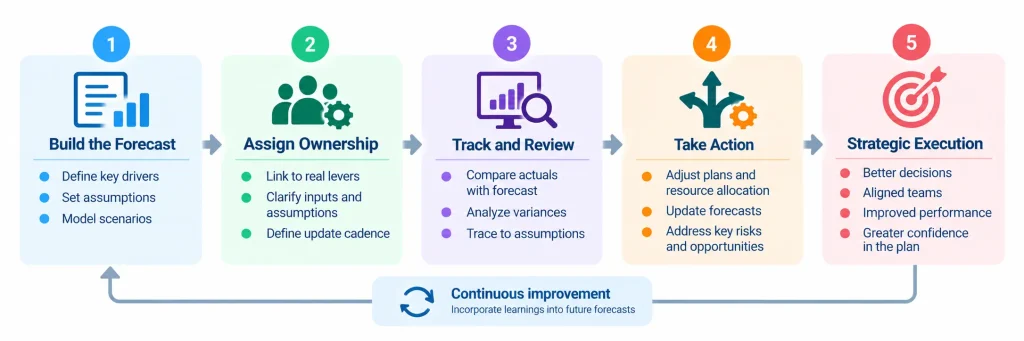
Why a Forecasting Accountability Framework Matters
Strategy allocates resources based on beliefs about future conditions. If leaders excuse every variance and never correct course, strategy stops being executable. It becomes a set of intentions with no consequence attached.
Forecasts as Probabilistic Commitments
Many leaders treat a forecast as a guess with decimal points, shielded by disclaimers. A better view treats it as a conditional statement. If the business acts with coherence, and if conditions stay within expected bounds, a given outcome should follow. That framing links results to both actions and assumptions.
Bayesian reasoning gives this view a practical structure. Forecasters start with priors about seasonality, conversion rates, demand elasticity, and operational throughput. They then integrate new evidence such as pipeline changes, hiring constraints, and market signals. Strong forecasting systems behave as updating engines, and their value lies in how they respond to change.
Even an elegant model fails when nobody believes it. In many organizations, sales presents stretch numbers to secure investment while operations pads estimates for buffer. Finance then triangulates between optimism and caution, so the published forecast becomes a political compromise instead of a belief weighted by probability. When variance arrives, teams abandon the forecast instead of examining it.
The Cost of Weak Forecast Accountability
That erosion produces strategic drift across the business. Managers hedge decisions because they no longer trust the plan. Pricing, hiring, and capital deployment all depend on the forecast. A dishonest forecast therefore miscalibrates every decision built on it, which makes the problem one of governance, not statistics.
Accountability in this sense means coherence between the forecast and the actions that follow. Each projection should come with its causal chain. A team may expect bookings to grow 12% because pricing has stabilized, churn is improving, and sales hiring will accelerate. When the quarter closes, teams return to that chain and ask which assumptions held.
A cybersecurity and identity SaaS company with about $30M in ARR shows what disciplined forecasting can deliver. A driver-based forecasting engine and capacity model kept actuals within plus or minus five percent of forecast for 8 consecutive quarters. Explicit drivers made each variance traceable to a specific assumption.
Forecast Ownership in a Forecasting Accountability Framework
Forecasting processes often grow by accretion instead of design. Teams layer them over fiscal calendars and adapt them to reporting deadlines until they become defensible but not insightful.
Ownership Must Follow Control
In a well-designed forecasting accountability framework, ownership flows from control. The person accountable for a forecast line needs both the levers to influence it and the insight to interpret it. If either is missing, accountability exists in name only.
Saying that sales owns bookings or HR owns headcount is not enough. Leaders should define which inputs each owner controls and which assumptions each forecast embeds. They should also define how owners update their view when new evidence appears. Without that clarity, accountability quickly turns into a search for blame.
Game theory explains what happens when ownership is unclear. One business unit may sandbag to build a cushion. A functional leader may inflate costs to protect optionality. A regional head may submit an optimistic number, expecting someone else to absorb any shortfall. These behaviors are predictable responses to misaligned incentives, not moral failings.
Three Layers of a Forecasting Accountability Framework
| Layer | What It Requires | Warning Sign When Missing |
| Influence | Owners control real levers such as quotas, roadmap priorities, or expense timing | Forecasts read as wishes instead of plans |
| Information | Timely, credible data from internal metrics and external signals | Owners update only on the calendar, not on new evidence |
| Integration | Forecasts shape hiring, procurement, campaigns, and capital allocation | Forecasts live in decks but do not drive decisions |
Cascading Effects in Coupled Systems
Complexity theory shows why leaders must map ownership instead of assuming it. In tightly coupled businesses, a missed sales target affects cash, which constrains hiring, which delays launches and next-quarter bookings. When nobody traces these pathways, corrections arrive late and confidence erodes.
A professional services firm with five business units illustrates the value of clear causal visibility. Finance built engagement-level profitability and utilization analytics from scratch. Those measures showed where each unit created margin and where it leaked, clarifying the levers each leader controlled.
Turning Variance into Learning
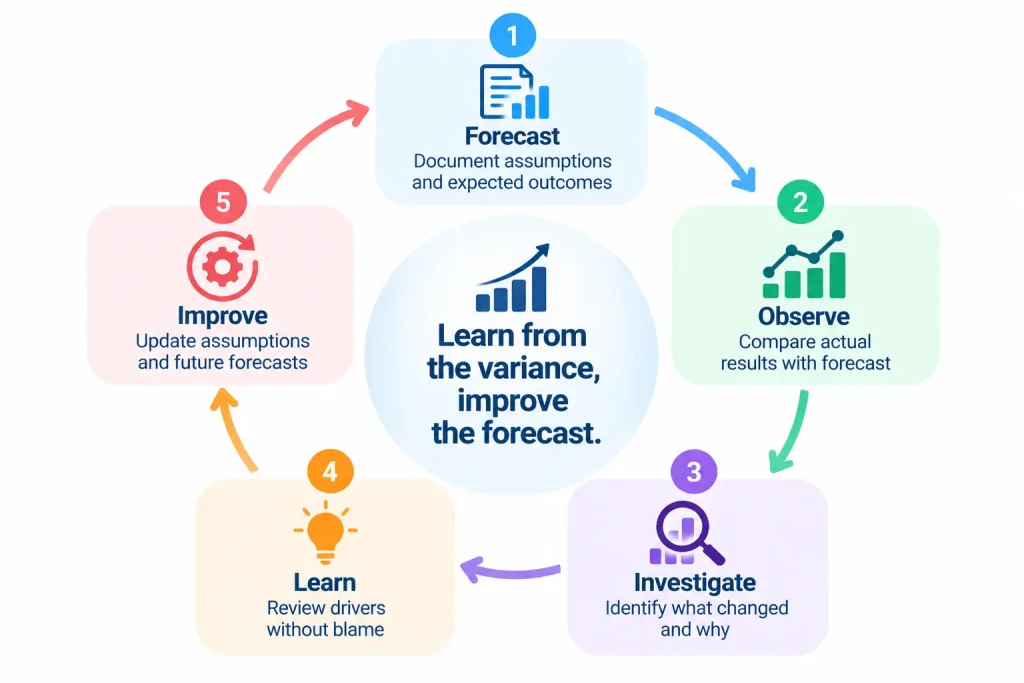
Forecast accountability works best when inquiry replaces judgment in reviews. The useful question is not why a team missed, but what the team believed and where that belief broke down. That shift converts post-mortems from courtrooms into classrooms.
The Variance Narrative Review
One practical mechanism is a monthly variance narrative review held in a non-punitive setting. Forecast owners explain what changed and how their prior assumptions evolved. They also discuss input sensitivities, system constraints, and surprises.
Over several months, patterns emerge across teams, such as recurring overestimates of pricing power or underestimates of hiring time. Those patterns become inputs for better forecasts instead of reasons for blame.
Owners who see learning valued forecast more honestly. They stop optimizing for approval and start optimizing for accuracy.
Punitive Reviews Versus Learning-Oriented Reviews
| Dimension | Punitive Review | Learning-Oriented Review |
| Core question | Why did you miss the number | What did the team believe, and where did it break |
| Owner behavior | Sandbagging and defensive padding | Candid assumptions and early warnings |
| Treatment of variance | Explained away or blamed on external factors | Traced to specific drivers and assumptions |
| Outcome over time | Forecasts lose credibility | Forecast accuracy and trust improve |
The Narrative Power of Forecasts
A forecast functions as a signal as much as a number. Once spoken in a boardroom or planning meeting, it rearranges expectations, behaviors, and incentives.
Why Every Forecast Needs a Story
Forecasts are easy to misread across an organization. One team hears stretch, another hears survival, and a third assumes the number will change anyway. A forecast that feels arbitrary breeds helplessness, while one that feels negotiable invites gamesmanship.
Every forecast should therefore come with a clear story. That story should state what the forecast assumes, what it implies, and what must be true for it to materialize. Leaders should repeat it in operating reviews instead of burying it in footnotes.
Incentives raise the stakes further for every forecast owner. When bonuses and promotions depend on forecast performance, misalignment becomes a moral hazard. Transparency about assumptions, and reviews that test causality instead of culpability, keep the incentive to learn ahead of the incentive to look right.
A Euronext Paris-listed gaming company with subsidiaries in five countries shows how shared meaning supports accountability. A firmwide rollout of Oracle Financials and MicroStrategy created a single definition of revenue across every subsidiary. Teams could then discuss variance using the same language instead of competing definitions.
Building a Culture of Forecast Consciousness
Process alone cannot sustain forecast accountability across a growing enterprise. The deeper goal is a shared awareness that what teams project today, they must deliver tomorrow. That awareness turns forecasting from a submission into a habit of thought.
From Surveillance to Stewardship
Many organizations treat forecasts as compliance instruments to submit, monitor, and police. In those systems, executives forecast what leadership will accept, not what they believe. Risk stays hidden, and accuracy becomes secondary to political survival.
A stewardship model takes the opposite approach to forecasting. A missed forecast becomes informative instead of shameful, and teams revisit the original assumptions. CFOs can reinforce this shift through several practical habits:
- Document, version, and revisit assumptions behind each major forecast line
- Publish a forecast confidence score that rates each line on input clarity and accuracy history
- Invite junior staff to challenge assumptions before plans reach leadership
- Share candid post-mortems after misses instead of quietly revised numbers
- Reference the forecast in hiring plans, marketing budgets, and capital requests
A Silicon Valley education and research institution offers a relevant example of forecasting under uncertainty. Finance built multi-year financial models under variable funding conditions and reported to the board and audit committee. Clear assumptions helped leaders plan despite unpredictable revenue sources.
Trust sustains this culture over the long run. People must believe that leaders will hear honest forecasts and will not punish candor. The CFO earns that belief by being transparent about uncertainty, not by always being right.
A forecasting accountability framework built on these principles changes how strategy lives inside the business. Strategy moves from annual offsites into weekly reviews, and variance becomes a source of insight.
Three Key Takeaways
- A forecasting accountability framework treats forecasts as probabilistic commitments with explicit assumptions, so teams can trace variance and learn from it.
- Forecast ownership must follow control, with owners holding real levers, timely information, and a clear link between forecasts and decisions.
- Forecast accountability lasts when reviews focus on learning, every forecast carries a clear story, and leaders reward candor over defensiveness.
Disclaimer: This article is intended for informational purposes only and does not constitute legal, tax, or accounting advice. You should consult your own tax advisor or counsel for advice tailored to your specific situation.
Hindol Datta is a four-time CFO and senior finance executive with over 25 years of leadership experience across cybersecurity, SaaS, gaming, logistics, digital marketing, medical devices, consumer products, and nonprofit organizations. He has led more than $120M in fundraising and over $150M in M&A transactions while building the financial and operational systems that let complex businesses scale with confidence. He is the author of seven books in the Systems CFO Series and holds active CPA, CMA, and CIA credentials.
AI-assisted insights, supplemented by 25 years of finance leadership experience.



