
Executive Summary
CFO influence on strategy reaches further than most organizations admit. Many companies assign vision and mission to founders, CEOs, and marketers, while finance plays the role of reality check. Yet the CFO sits between long-term capital and short-term cash, and between aspirational story and executable plan. That position lets the CFO see both the outer limit of ambition and the inner mechanics of delivery.
The sections ahead explain how CFOs can use that vantage point to strengthen vision instead of restraining it. They cover how finance shapes what the enterprise believes is possible and how mission becomes real through design. They also address how CFOs can sculpt ambition without shrinking it and what lasting influence looks like. Together they present the CFO as a co-author of strategy, not only a keeper of means.
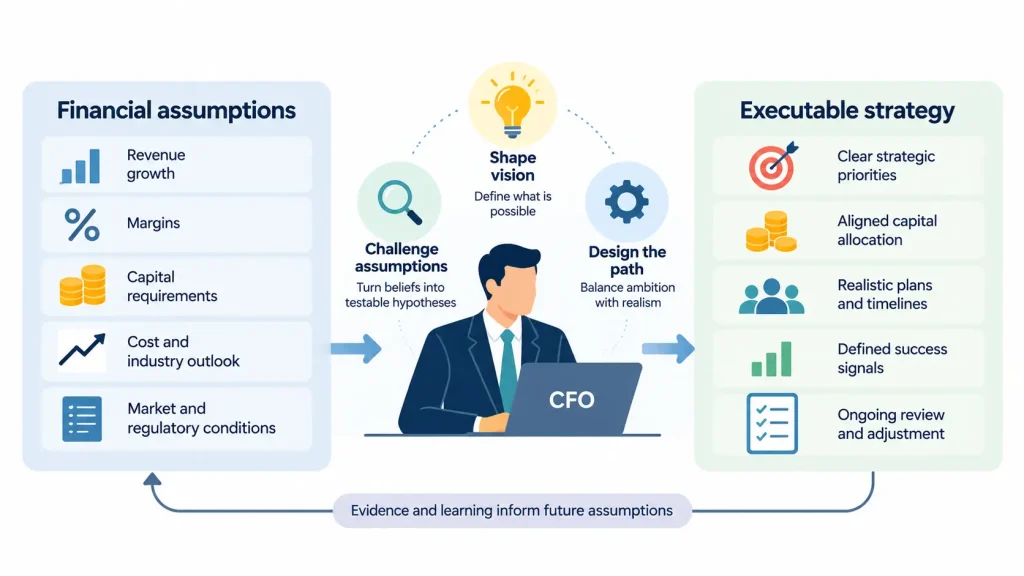
How CFO Influence on Strategy Shapes What Seems Possible
Vision rarely arrives fully formed from a single leader. It grows out of what the organization believes it knows and what it has chosen not to question. Much of that belief lives inside financial models.
Assumptions as the Hidden Architecture of Vision
Every discount rate, margin target, and terminal value carries a judgment about the future. A capital expenditure approval assumes that the funded future is reachable and preferable to the present. A long-term margin target encodes views on industry structure, cost elasticity, and customer behavior. Once embedded in models, these assumptions shape budgets, incentives, and strategy.
This creates a risk that CFOs must recognize. Unquestioned priors can harden into accepted truths, and risk aversion can pass for realism. Vision then narrows through invisible constraint instead of deliberate choice, and the company forgets that it once aimed higher.
The reverse is also possible for a CFO who understands this leverage. Instead of rejecting an ambitious plan, the CFO can ask what would need to be true for it to succeed. That question converts belief into testable hypotheses without inviting fantasy.
Consider a growth plan that assumes expansion into verticals the company has never served. A useful response adds a list of conditions for validity, such as new partnerships, product fit, regulatory approvals, and go-to-market hires. Leaders then rate their confidence in each condition and agree on signals of success or failure. The vision does not shrink; it sharpens into a set of actionable bets.
A pre-Series A AI governance and assurance platform shows how early this discipline can start. Finance built the operating model, multi-year scenarios, and capital strategy alongside go-to-market and partnership economics. Scenario work gave leadership a structured view of which assumptions the strategy depended on.
Gatekeeper Versus Co-Author
| Dimension | CFO as Gatekeeper | CFO as Co-Author of Strategy |
| Response to ambitious plans | Approves or rejects based on past performance | Asks what must be true and tests each condition |
| Treatment of assumptions | Protected inside models | Exposed, debated, and updated with evidence |
| Role in vision | Reality check after the fact | Shapes feasibility while vision forms |
| View of risk | Something to minimize | Something to price, stage, and manage |
| Lasting contribution | Clean books and sound ratios | Clean books plus coherent strategy and culture |
Translating Mission into Design
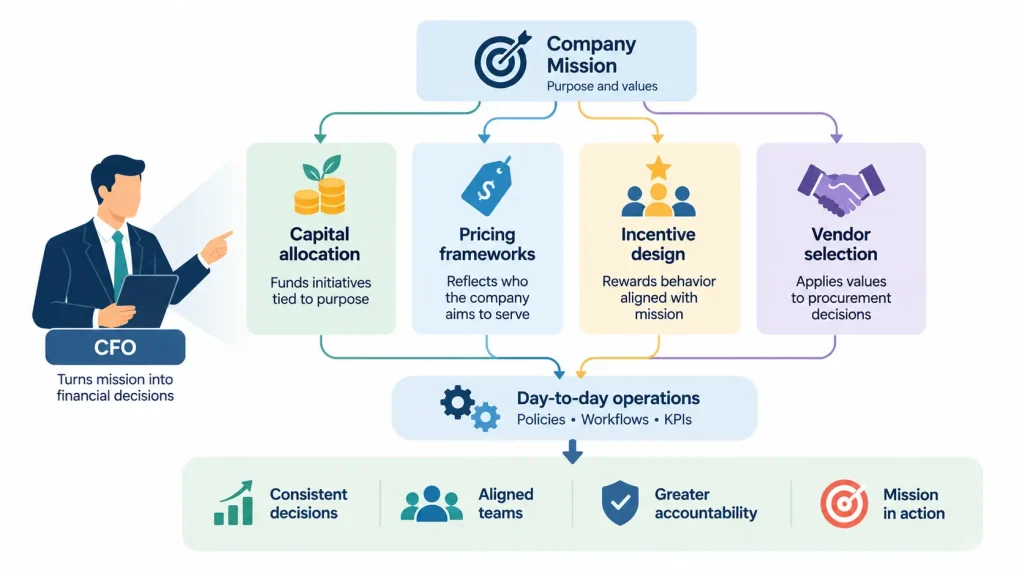
A mission becomes real when it shows up in behavior. The test is whether it shapes how the company prices, hires, and declines opportunities. The CFO controls much of the architecture that makes that possible.
Budgets as Statements of Priority
Every budget, approval workflow, and KPI tells the organization what matters. A mission without funding is a mission in name only. If a company claims sustainability as core but runs procurement on cost alone, the mission is symbolic, not systemic.
The theory of constraints helps frame this role. Every organization operates with limited capital, time, and attention. Strategy decides the trade-offs, and mission supplies the principle behind them. As chief allocator of constraints, the CFO decides what the company will give up to remain what it claims to be.
Levers That Embed Mission in Operations
| Lever | How It Expresses Mission | Risk When Misaligned |
| Capital allocation | Funds initiatives tied to stated purpose | Mission-critical work starves for resources |
| Pricing frameworks | Reflects who the company aims to serve | Short-term revenue contradicts stated values |
| Incentive design | Rewards behavior aligned with purpose | Teams optimize for metrics that erode trust |
| Vendor selection | Applies values to procurement decisions | Cost focus overrides stated commitments |
| Planning cadence | Revisits alignment in each review cycle | Drift goes unnoticed until it becomes costly |
CFO influence on strategy here works through restraint, not evangelism. Finance encodes the mission in policies, investment criteria, and compensation plans instead of preaching it. A well-designed incentive plan often says more about purpose than any press release.
The same levers can also erode the mission when used carelessly. A cost program blind to culture can damage trust, and a growth-at-all-costs push can create internal dissonance. Over time, that misalignment builds into cultural and strategic debt.
Imagine a company whose mission centers on improving conditions for frontline workers. A pricing proposal to raise fees on essential certifications looks strong financially. Yet the lowest-paid employees use those certifications most often. A CFO who declines the proposal and finds savings elsewhere protects the mission at the cost of deferred revenue.
Game theory explains why this consistency pays off. Under incomplete information, trust becomes a strategic asset. Employees, investors, and partners cooperate more readily when capital flows match stated purpose.
Sculpting Ambition Without Shrinking It
Ambitious plans often blend genuine opportunity with ego, precedent, and fear of irrelevance. The CFO meets this ambition in pitch decks, roadmaps, and hiring plans. Meeting it with blunt realism turns finance into an obstacle in the company’s growth story.
The CFO Role in Strategy as Clarifier
A strategic CFO shapes vision instead of shrinking it, which is the core of the CFO role in strategy. Decision theory offers a useful structure for every bold move, from market entry to a platform pivot. The CFO frames the upside, the cost of failure, the duration of uncertainty, and the options each choice preserves or destroys.
Structured self-assessment can turn skepticism into productive self-inquiry. Teams might assign a confidence score to each initiative based on assumptions, timing, and capability. Such conversations often surface dependencies, such as early product hires or marketing velocity the company has never achieved.
Behavioral economics adds another insight for finance leaders. People overweight near-term wins and underestimate compounding complexity. CFOs can respond with practical tools that protect ambition from its own blind spots:
- Stage gates that create reflection points without stalling momentum
- Funding tranches that release capital as uncertainty resolves
- Leading indicators that show whether core assumptions are holding
- Clear ownership of who reads those signals and decides on changes
Tone matters as much as tools in these discussions. The CFO should act as a Socratic partner, not an inquisitor, asking the questions founders may hesitate to ask themselves. An over-calibrated plan can drain energy just as surely as an unfunded one.
A venture-backed digital marketing company that grew from $9M to $180M in revenue in 24 months illustrates disciplined ambition. Finance supported $36.5M in fundraising across three rounds and three acquisitions while building the finance function. Capital discipline helped turn aggressive growth goals into an executable plan.
Legacy and Lasting CFO Influence on Strategy
The final measure of a CFO is whether the company understands itself better at the end of a tenure. Clean audits and a sound capital structure matter. A coherent strategy that outlasts the CFO matters more.
Systems and Successors That Endure
Lasting influence requires systems that outlive individual judgment. Forecasting processes should invite inquiry instead of performance. Investment reviews should explore learning instead of defending bias. Finance teams can learn to ask whether an allocation reflects the company’s future or its fears.
Information theory offers a helpful idea here: signal integrity. The CFO helps ensure that intentions set in the boardroom survive translation into budgets and vendor choices. When financial structures tell the same story as stated values, the work has succeeded.
Candid reflection can reinforce that culture during planning. Business leaders might submit a short memo on what they would have done differently over the past two years. Patterns such as overextended initiatives or misaligned incentives often emerge, and the next budget becomes sharper as a result.
A Silicon Valley education and research institution shows how this kind of stewardship works in practice. Finance led a $37M fundraising effort and oversaw Finance, HR, IT, Legal, and Facilities while reporting to the board and audit committee. Multi-year models under variable funding helped leadership align resources with institutional purpose.
Successors carry CFO influence on strategy forward as well. Financial cultures fade unless someone inherits them, so CFOs must develop people who see rigor and generosity as compatible.
Three Key Takeaways
- CFO influence on strategy begins with the assumptions inside financial models. Finance leaders should expose and test those beliefs openly instead of letting them harden into constraints.
- Mission becomes real when budgets, pricing, incentives, and vendor choices reflect it, which places the CFO at the center of strategic design.
- The CFO role in strategy is to clarify ambition through stage gates, scenario framing, and candid questions. It also includes building systems and successors that sustain coherence.
Disclaimer: This article is intended for informational purposes only and does not constitute legal, tax, or accounting advice. You should consult your own tax advisor or counsel for advice tailored to your specific situation.
Hindol Datta is a four-time CFO and senior finance executive with over 25 years of leadership experience across cybersecurity, SaaS, gaming, logistics, digital marketing, medical devices, consumer products, and nonprofit organizations. He has led more than $120M in fundraising and over $150M in M&A transactions while building the financial and operational systems that let complex businesses scale with confidence. He is the author of seven books in the Systems CFO Series and holds active CPA, CMA, and CIA credentials.
AI-assisted insights, supplemented by 25 years of finance leadership experience.



