
Executive Summary
ERP cash flow forecasting promises a single source of liquidity truth, yet many finance teams still rebuild the cash forecast in spreadsheets every week. Cash flow accuracy depends less on the software than on the behaviors, processes, and judgment around it.
The sections that follow examine why ERP systems were built, how data integrity becomes a cultural habit, and where cash models stumble. A closing framework shows how to blend ERP data with operational judgment.
Why ERP Cash Flow Forecasting Begins with Philosophy, Not Software
Cash flow is the most elemental number a CFO watches, since it shows whether the firm can pay next month. ERP systems arrived promising order, with every transaction linked, reconciled, and visible in real time. In practice, an ERP is also a behavioral map that mirrors the firm’s assumptions and disciplines, or the lack of them.
At one mid-sized manufacturer, SAP had run for three years while receivables, treasury, and the forecast lived in separate spreadsheets. The ERP had become a totem instead of a tool.
ERP systems descend from material requirements planning, which engineers built to get bolts in place before welding. An ERP remembers what it is told and forgets, with complete indifference, what it is not. Cash flow resists static recording, since a receivable on the ledger is not yet liquid. The real question is whether the ERP serves as a nervous system or a filing cabinet.
Data Integrity Is a Behavior, Not an ERP Feature
An ERP does what it is told, and so do the teams that feed it. Cash flow accuracy inside an ERP reflects behavior, incentive, and belief far more than code. Every workflow and validation rule declares how much the company values its own truth.
Even a pristine system cannot survive a team that withholds its attention. The usual sources of decay in an ERP are mundane ones:
- Sales delays contract entry by several days, so expected receipts appear late.
- Accounts payable batches entries weekly, which hides near-term outflows.
- Treasury reconciles cash after the fact instead of in real time.
- Teams keep discounts, disputes, and side agreements outside the system.
Turning the Working Capital Review into a Story
Culture change starts with an old tool, which is storytelling. Finance and operations leads can walk the working capital schedule line by line, acting as narrators instead of auditors. They ask why an invoice is aging, seeking understanding over blame. Over time, sales flags billing errors upstream and the cash forecast tightens week after week. Some teams resist, because transparency exposes delay patterns and informal habits.
Embedding Finance Across Functions
Firms with the strongest cash forecast accuracy embed finance across the business. One global industrial firm replaced its review meeting with a weekly forum where operational leads walked through ERP changes. Despite volatile markets, the company held cash variance under 2% for 6 straight quarters.
The same principle held at a $30M ARR cybersecurity and identity access management company operating across five countries. A NetSuite implementation compressed the monthly close from 18 days to 10. A driver-based forecasting cadence then kept actuals within plus or minus 5% of forecast for 8 consecutive quarters. The software made the data faster, while the reporting rhythm made it trustworthy.
How ERP Cash Flow Forecasting Models Work and Where They Stumble
ERP systems are deterministic engines in love with structure. They capture receivables with forensic precision, yet they miss the heartbeat of the business. An ERP does not know that a customer always pays late in Q4, or that a major client has hinted at postponed orders. Cash flow demands anticipation, and anticipation draws on experience.
Direct vs. Indirect Methods in ERP Cash Flow Forecasting
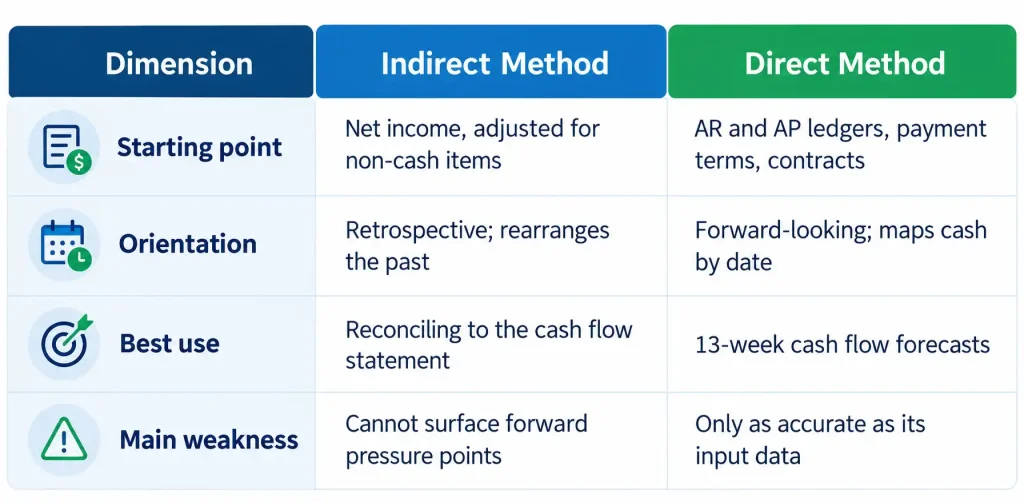
In theory, the direct method can tell a CFO whether the second Tuesday of next month brings surplus or strain. In practice, its value depends on how well the ledger reflects reality.
Where Payment Behavior Breaks the Model
Real counterparties seldom follow the contract, and that gap is where ERP cash flow forecasting breaks most often. Payment terms say 30 days while customers pay in 45, vendors promise shipment on the 10th and deliver on the 20th, and rebates accrue monthly but settle quarterly. Without probabilistic overlays, an ERP cannot infer these patterns, so finance has to teach it. The forecast therefore works as an open loop that needs people who understand the counterparty.
A $127M global consumer products company selling through DTC, Amazon, and wholesale channels faced this daily. With suppliers in Asia, its cash forecast had to absorb ocean freight timing. Inventory turns more than doubled from 3x to 7x, releasing trapped working capital as demand planning data replaced contractual assumptions.
Why the Final Forecast Still Lives in Excel
Many Fortune 100 companies with mature ERP environments still keep the final cash forecast in Excel. ERP cash flow forecasting is not futile, but it works best as one component of a larger design.
The Orchestrated Cash Forecast
| Layer | Source | Contribution |
| Spine | ERP: AR, AP, invoices, terms | Baseline transactional truth |
| Lungs | Operations | Delivery timing and order changes |
| Eyes | Treasury | Bank positions and credit signals |
| Hands | Procurement | Vendor timing and PO cadence |
| Elasticity | Rolling forecasts and scenarios | Ranges and what-if analysis |
One company built a rolling 13-week cash flow model inside its ERP, complete with payment probability curves. It failed quietly because sales entered discounts late and treasury ran a separate model. A logistics firm paired a simple SAP projection with a weekly forum where sales, operations, and procurement revised assumptions live. There, the ERP served as the canvas instead of the forecast, and that made the difference.
The Limits of ERP Fidelity and the Need for CFO Judgment
ERP systems are monumental record-keepers, and despite the marketing, they are not predictive in any robust sense. An ERP describes liquidity with the precision of a photograph, accurate but frozen.
What the ERP Knows and What It Misses
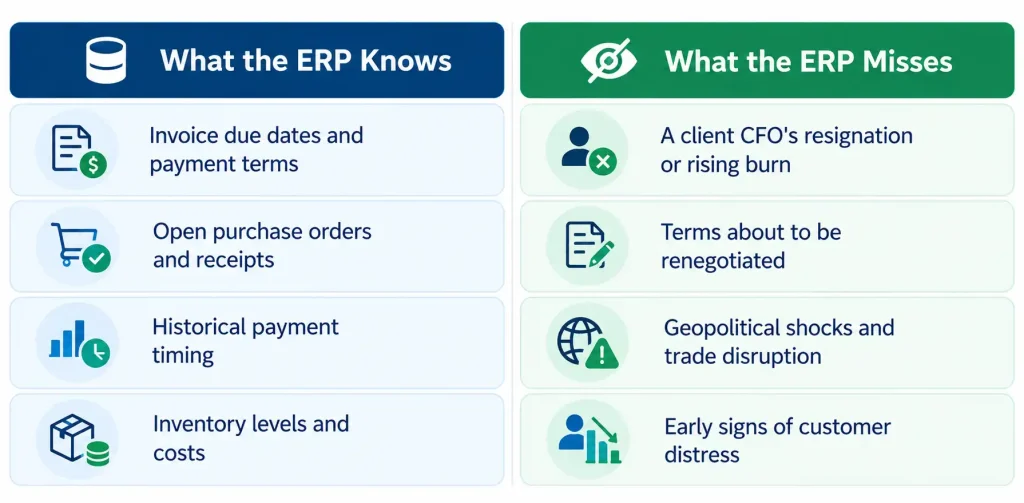
Firms that over-rely on system forecasts miss inflection points, because the ERP knows timing but not temperament. Firms that dismiss the ERP lose the clean substrate on which every credible forecast rests. The ERP works like a telescope showing past light, while the CFO models the present.
A Dual-Practice Approach
A sound approach pairs structure with adaptive judgment, and overriding the ERP when a customer will not pay on time is part of the CFO role. The practice rests on four habits:
- Use the ERP for discipline, traceability, and the factual spine of operations.
- Layer Monte Carlo simulations, regression models, or scenario analyses on top.
- Keep human channels open through standing forecast meetings and judgment calls.
- Document every override so the organization learns when to trust the model.
Integrating ERP Cash Flow Forecasting into a Living Practice
Many teams frame integration as a technical project of linked modules and clean master data. True integration also draws field experience and market intuition into one view of liquidity.
At a Euronext Paris-listed gaming company operating across five countries, a firmwide Oracle Financials and MicroStrategy rollout created one definition of revenue for every subsidiary. Statutory reporting cycles under IFRS and US GAAP shortened as a result.
Finance should treat the ERP as a living environment, enriched with behavioral notes and documented assumptions. Someone must own both the integrity and the meaning of the data. Usually that is the CFO, who sees how a missed delivery becomes a delayed invoice and later a covenant problem.
Ritualizing the Forecast
The best organizations turn integration into a ritual instead of a bureaucracy. A practical cadence, owned by finance, looks like this:
- Weekly: pull the ERP direct-method baseline and flag variances against last week.
- Weekly: hold a cross-functional forum to overlay field intelligence.
- Monthly: review forecast accuracy by customer, vendor, and business unit.
- Quarterly: update behavioral assumptions in the ERP, such as actual days to pay.
Over time, the organization learns which clients pay late, which vendors pad lead times, and which divisions over-forecast collections. That learning becomes a second system held in people and relationships. In this state, people trust the ERP but question it, and the forecast stays clear but never absolute.
Three Key Takeaways
- ERP cash flow forecasting is only as accurate as the behaviors feeding it, so treat data integrity as a cultural discipline owned by finance.
- Use the ERP direct method as the spine of short-term forecasting, then overlay payment behavior, treasury signals, and scenario models the system cannot infer.
- Build a weekly cross-functional forecast ritual and document every override, since cash flow accuracy improves fastest when the ERP becomes a tool for conversation instead of a verdict.
Disclaimer: This article is intended for informational purposes only and does not constitute legal, tax, or accounting advice. You should consult your own tax advisor or counsel for advice tailored to your specific situation.
Hindol Datta is a four-time CFO and senior finance executive with over 25 years of leadership experience across cybersecurity, SaaS, gaming, logistics, digital marketing, medical devices, consumer products, and nonprofit organizations. He has led more than $120M in fundraising and over $150M in M&A transactions while building the financial and operational systems that let complex businesses scale with confidence. He is the author of seven books in the Systems CFO Series and holds active CPA, CMA, and CIA credentials.
AI-assisted insights, supplemented by 25 years of finance leadership experience.