
Executive Summary
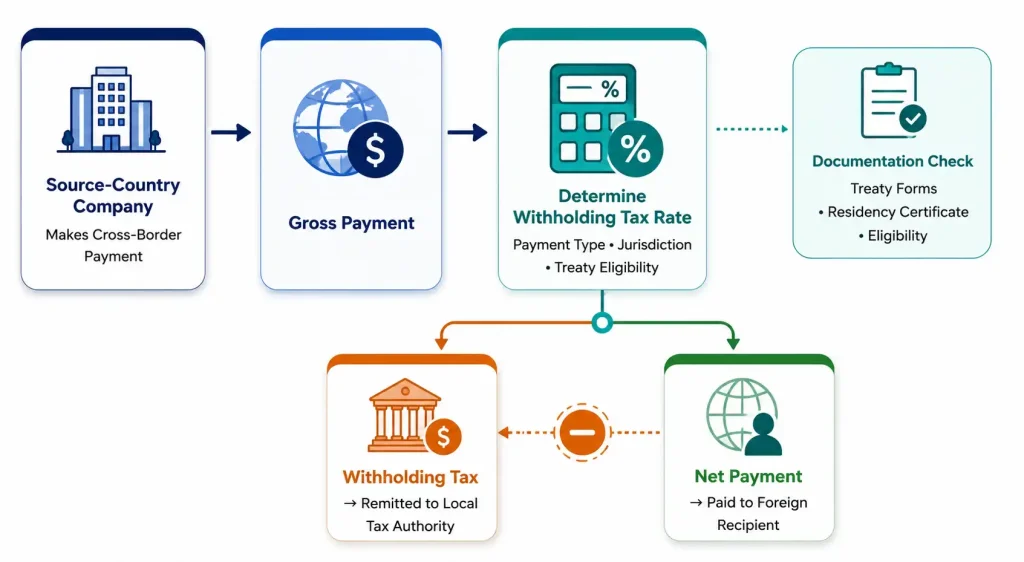
What is withholding tax, in plain terms. It is the portion of a payment that a government requires the payer to deduct at the source. The payer withholds it before cash leaves the country of origin and remits it directly to the local tax authority. The withholding tax meaning is easy enough to state in a sentence. The mechanics behind it are not. They span dividends, royalties, and intercompany service fees, and sit at the center of nearly every multinational finance function. Companies that expand across borders often discover this the hard way. A routine dividend or licensing payment can trigger a tax obligation never modeled into the deal.
This guide walks through what withholding tax means in practice, why it exists, and how finance leaders build the documentation and controls that keep cross-border payments efficient. It draws on engagements across cybersecurity, consumer products, gaming, and nonprofit finance to show what does withholding tax mean in an actual payment run rather than in a textbook.
What Is Withholding Tax and Why Does It Exist
So, what is withholding tax, more precisely. It is a levy that a source country imposes on income generated within its borders but paid out to a recipient elsewhere. Rather than waiting for the recipient to self-report and pay tax later, the government requires the payer, the entity making the transfer, to deduct the tax and remit it before the net amount crosses the border. That is the withholding tax meaning at its core: a tax on movement, not on profit itself.
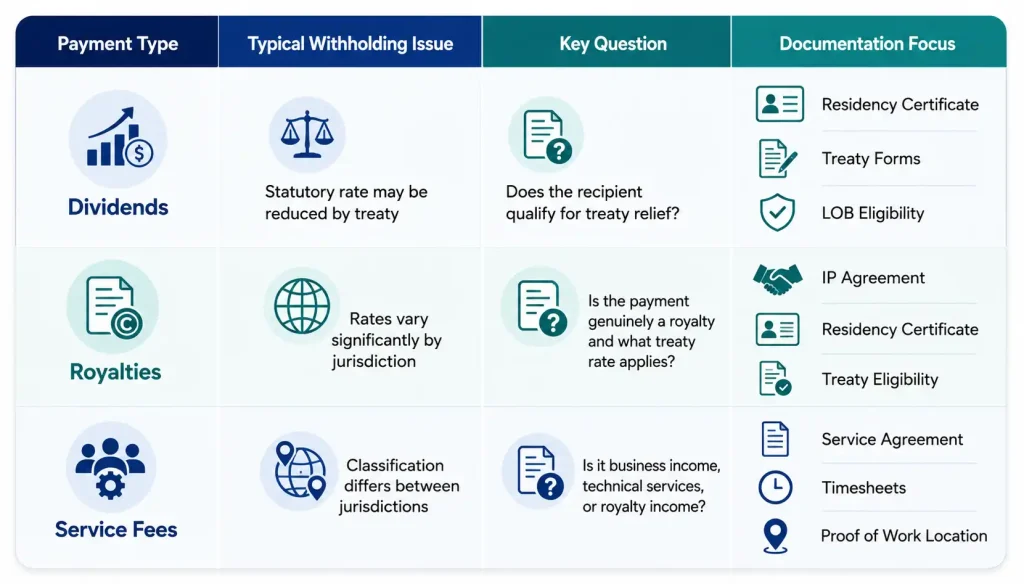
Every jurisdiction sets its own rates, and the variation is where complexity begins. A country’s default statutory rate might tax a dividend at 30%, or a treaty might reduce it to 5%. Royalties might face 10% withholding into one jurisdiction, and full exemption into another. The goal is not to memorize every rate, but to build a system that flags these obligations before a wire transfer starts, not after.
Withholding Tax on Dividends: The First Toll Gate
Dividends are, in theory, a distribution of already-taxed profit. In cross-border structures, they frequently trigger a second layer of tax at repatriation. A Singapore subsidiary paying a dividend to a U.S. parent faces no local withholding at all. The same dividend out of an Indian subsidiary can face a 20% rate unless a treaty reduction is claimed properly. On a $5M repatriation, that gap alone represents $1M in potential leakage.
A Netherlands-anchored structure supporting operating subsidiaries outside the European Union offers a clear lesson: a dividend distribution was hit with the local default rate of 25% because the necessary treaty forms had not been filed in advance. The structure itself was sound. The paperwork was not, and the paperwork is what the tax office reads. That episode reshaped how intercompany dividend planning gets reviewed:
- Confirm available retained earnings and the intended repatriation amount before initiating any transfer
- Map the withholding obligation in the payer’s jurisdiction, including any treaty-reduced rate
- Verify treaty filings and residency certificates are current, not simply on file from a prior year
- Confirm eligibility under any Limitation on Benefits provisions attached to the treaty
Royalties and the Tax on Intellectual Property Movement
Royalties, the payments made for the use of patents, trademarks, software, or know-how, carry their own withholding regime, and the rates diverge sharply by counterparty jurisdiction.
| Payment route | Statutory rate | Treaty-reduced rate |
| Ireland to Japan | 10% | 0% |
| Ireland to Australia | 30% | 10% |
| Ireland to Canada | 25% | 10% |
| India to Ireland | 20% | 10% |
A SaaS structure licensing core intellectual property out of an Irish holding entity into Canadian, Australian, and Japanese affiliates illustrates the range well. Each jurisdiction applies a different statutory rate, and each treaty carves it down differently. A related engagement, a high-growth cybersecurity and identity access management company generating roughly $30M in annual recurring revenue across US, Canadian, Mexican, Indian, and Nepali entities, faced a similar dynamic: a royalty payment into an Irish entity from India was withheld at the full 20% rate rather than the 10% treaty cap, because the residency certificate on file was dated to the prior fiscal year. The cost ran to roughly $300K in non-creditable tax, and it was not a planning failure. It was a governance failure, the kind a centralized document tracker exists to prevent.
Service Fees and the Gray Zone of Classification
Service fees occupy the murkiest category of the three, sitting somewhere between business income and technical royalties. Some jurisdictions tax them only when the recipient has a local permanent establishment. Others classify them as fees for technical services and withhold regardless. A software maintenance fee might be reclassified as a royalty and taxed at 10%, while a marketing services fee with no technical transfer might be exempt.
A management fee arrangement covering centralized finance, HR, and legal support between a U.K. subsidiary and a U.S. parent illustrates the point well. Under the U.S.-U.K. treaty, business income should only be taxable where a permanent establishment exists, yet a local tax authority argued that portions of the arrangement resembled consulting and were therefore taxable. Resolving the position required timesheets, job descriptions, and proof of where the work was performed, a reminder that the same charge can be read as service income, royalty income, or interest depending on how it is documented.
Documentation: The Discipline Behind Reduced Rates
Every reduced treaty rate rests on documentation. For payments out of the United States, the IRS requires a completed Form W-8BEN or W-8BEN-E establishing foreign status and treaty eligibility. An incomplete form, missing the Limitation on Benefits section or citing the wrong treaty article, can cause a reduced rate to be disallowed, triggering backup withholding and a refund process that can run six months or longer.
A centralized withholding compliance tracker addresses this directly:
- Assign ownership of treaty documentation to a specific role within treasury or tax
- Automate reminders ahead of expiring residency certificates and W-8 forms
- Tie treaty rates directly to the ERP vendor master so payment runs apply the correct rate automatically
- Require documentation review as a condition of payment release, not as a follow-up step
Treaty Eligibility and the Limitation on Benefits Test
A reduced treaty rate is a privilege, not a guarantee, and Limitation on Benefits provisions exist to prevent treaty shopping. A Dutch intellectual property holding entity relying on a 0% treaty rate on royalties into the United States can lose that benefit if an auditor determines the entity lacks genuine substance: no real staff, no risk borne, no adequate capitalization. An entity with an office lease, full-time personnel, and regular board meetings can pass that test; one without those elements exposes the payment to the full domestic rate, a difference that can exceed $1M annually on a meaningful royalty stream. Treaty eligibility deserves annual review, not a one-time determination made when a structure was first built.
Foreign Tax Credits, Hybrid Mismatches, and the BEPS Horizon
Withholding tax paid abroad is not automatically lost. It can often be claimed as a foreign tax credit against domestic tax liability, though the IRS scrutinizes sourcing, timing, and documentation before allowing it. A $2.5M withholding tax paid on royalties remitted from India was challenged on exactly these grounds, requiring an amended return and additional certification before the credit was allowed.
Hybrid mismatches compound this risk further, since jurisdictions do not always agree on how an entity should be classified. An entity treated as a corporation in one jurisdiction and as a disregarded entity in another can find a treaty benefit denied outright, on the theory that it is not a qualified resident anywhere. As OECD Pillar Two and global minimum tax rules take hold, non-creditable withholding taxes increasingly distort jurisdictional effective tax rate calculations, which means:
- Model effective tax rate on a jurisdiction-by-jurisdiction basis, including withholding and other levies, not income tax alone
- Review intercompany flows regularly to minimize trapped cash and non-creditable leakage
- Reassess entity classification annually under both local and domestic tax rules to catch mismatches early
Building an Audit-Ready Withholding Tax Program
A cross-border audit is the fastest way to discover how fragile a withholding tax position really is. Tax authorities request intercompany agreements, W-8 forms, residency certificates, and proof of service, and they challenge classification wherever ambiguity exists. Across a $127M global consumer products company with a supply chain spanning China and Vietnam, and a Euronext Paris-listed gaming company operating across five countries, the pattern held: the position that survives an audit is the one with the cleanest documentation trail, not the most aggressive planning.
A withholding tax binder for every major jurisdiction should include intercompany agreements, remittance receipts, treaty eligibility proof, tax authority correspondence, and memos documenting classification decisions. Embedding a tax compliance step into the payment release checklist, so no cross-border payment clears without confirmed treatment and correct gross-up accounting, turns this from a periodic scramble into a durable system.
Three Key Takeaways
- Withholding tax is a tax on the movement of cash across borders, not on profit itself, and the correct rate depends entirely on the payment type, the recipient’s jurisdiction, and whether treaty eligibility has been properly documented and maintained.
- Treaty-reduced rates are privileges that must be earned through substance and preserved through paperwork; a missing form or an outdated residency certificate can turn a 5% treaty rate into a 30% statutory one overnight.
- The finance functions that manage withholding tax well treat it as a shared operational discipline spanning treasury, legal, and accounting, embedded into payment release checklists and ERP systems rather than handled as an afterthought at year-end.
Disclaimer: This article is intended for informational purposes only and does not constitute legal, tax, or accounting advice. You should consult your own tax advisor or counsel for advice tailored to your specific situation.
Hindol Datta is a four-time CFO and senior finance executive with over 25 years of leadership experience across cybersecurity, SaaS, gaming, logistics, digital marketing, medical devices, consumer products, and nonprofit organizations. He has led more than $120M in fundraising and over $150M in M&A transactions while building the financial and operational systems that let complex businesses scale with confidence. He is the author of seven books in the Systems CFO Series and holds active CPA, CMA, and CIA credentials.
AI-assisted insights, supplemented by 25 years of finance leadership experience.