
Executive Summary
Global compliance management is the discipline that separates genuine international operators from address-only global companies. Real cross-border operations carry statutory obligations; a mailing address does not. Value-added tax, payroll tax, statutory audit deadlines, and the BEPS 2.0 framework do not announce themselves loudly. They accumulate quietly in subsidiaries that headquarters rarely visits. A due diligence process, a board question, or a regulator eventually surfaces them, often at the worst possible moment.
This article examines where local tax complexity actually lives and why BEPS 2.0 has closed the door on low-substance entities. It also lays out what a credible global compliance management framework looks like. Finance leaders who have owned the outcome, not advised on it from a distance, build that framework.
The Illusion of Control in Global Subsidiary Operations
Executive teams describing their global footprint tend to reach for confident language. The organizational chart looks tidy. The intercompany matrix is diagrammed with precision, and the investor deck lists a dozen countries as evidence of scale. Underneath that presentation sits a different reality. Every subsidiary operates inside its own regulatory universe. It answers to tax codes, labor statutes, and filing calendars headquarters cannot see from a consolidated dashboard.
Local tax non-compliance is rarely willful. It is almost always the product of a visibility gap between what headquarters believes is happening and what is actually happening on the ground, whether that gap is a staffing change in a regional office, a contractor misclassified by a local HR manager, or a statutory audit skipped because nobody budgeted for it. Left unaddressed, these gaps metastasize into audit risk, blocked cash, and reputational damage that surfaces at the worst possible moment, during fundraising, during an acquisition, or during the run-up to an IPO.
Why Global Compliance Management Belongs on the CFO’s Desk
Global compliance management is not a back-office function to be delegated and forgotten. Hidden liabilities distort valuation, complicate due diligence, and stall exits, which makes compliance a strategic concern rather than a purely statutory one. A pre-IPO audit at a fast-growing company can uncover a dormant subsidiary with three years of unfiled GST returns and a liability under $100K, and the dollar figure is rarely the real cost. The real cost is the question it raises about governance and about whether the rest of the entity structure deserves the same scrutiny, a question that alone can delay a listing by months.
Three consequences tend to follow from weak global compliance management, each reaching well beyond the local finance team: audit triggers and financial restatements that ripple into consolidated reporting, blocked cash flows caused by tax holds in jurisdictions where repatriation depends on clean filings, and loss of strategic optionality in M&A when a buyer discounts price or demands escrow against an exposure nobody had quantified.
In a Euronext Paris-listed gaming and digital entertainment company operating across the United States, France, the United Kingdom, Singapore, and South Korea, the finance organization ran an S-1 and IPO-readiness process with underwriters and Big Four auditors while rolling out a single global platform for financial consolidation, because five countries reporting under both IFRS and US GAAP cannot produce one credible definition of revenue without a shared system underneath them. The lesson carries across company stages: global compliance management is infrastructure work, not an annual checklist item.
Where Local Tax Complexity Actually Lives
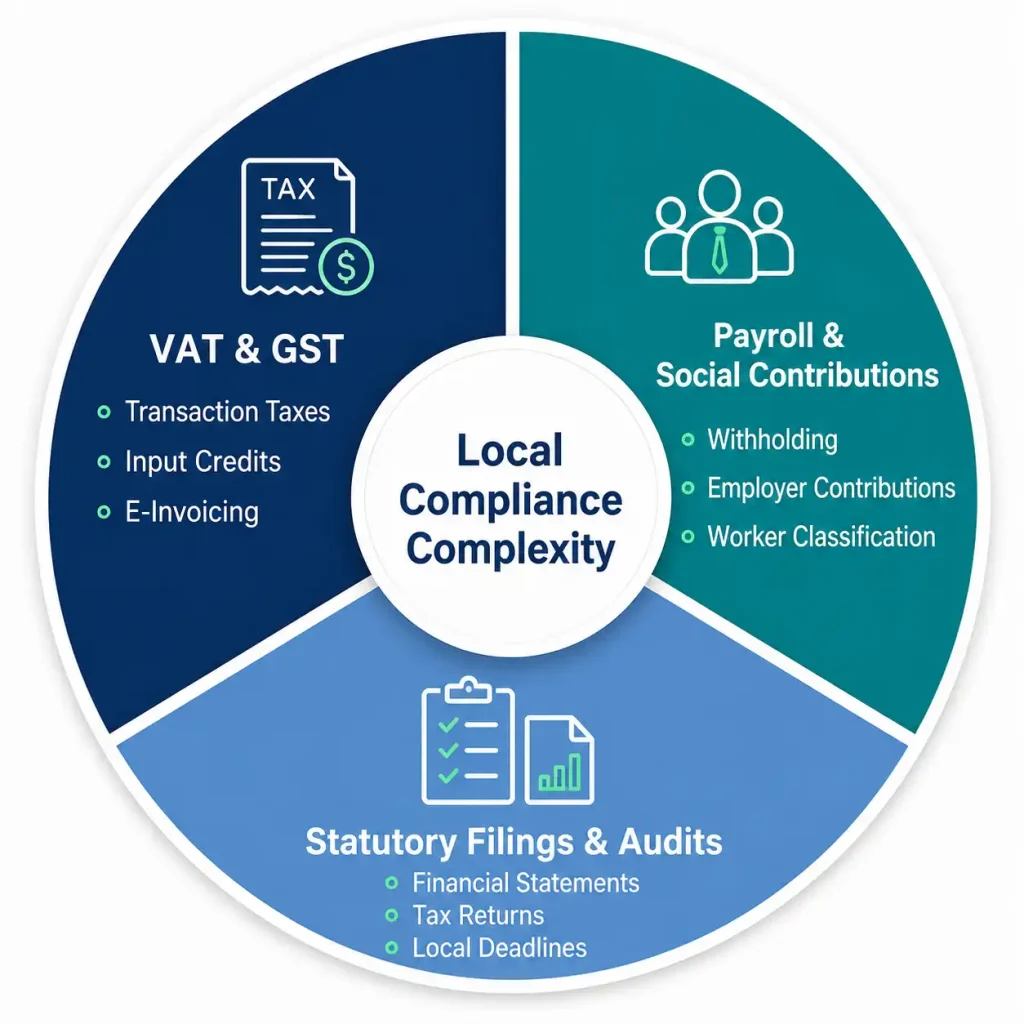
Three categories of obligation consistently generate friction across borders, each deserving its own operating discipline within a broader global compliance management program.
VAT and GST
Value-added tax is self-assessed and transaction-based, which makes it deceptively simple in theory and genuinely difficult in practice. Rates and exemptions vary by country, input credit rules are complex, and reporting timelines run monthly or quarterly rather than annually. Reconciliation mismatches between a corporate ERP system and local statutory books are where most of the damage originates. Brazil layers VAT at federal and state levels with differential rates, while India’s Goods and Services Tax framework penalizes any mismatch between purchase and sales invoices with lost credit and fines, and mandatory e-invoicing has raised the cost of getting this wrong.
Payroll Tax and Social Contributions
Local employment carries statutory obligations that extend well past gross salary: employer contributions to pensions, health insurance, and unemployment funds; labor law requirements around severance, vacation accrual, and bonuses; and income tax withholding thresholds that differ by jurisdiction. In France, employer-paid social charges can exceed 40 percent of gross pay. In China, misreported headcount in certain economic zones can generate backdated liabilities years after the fact. Contractor misclassification, in either direction, remains one of the most common and expensive errors in this category.
Statutory Filings and Audit Timelines
Every jurisdiction mandates its own combination of financial statements, tax returns, beneficial ownership disclosures, and transfer pricing documentation, and deadlines rarely align with a company’s global fiscal calendar. Germany requires local GAAP statutory statements within six months of year-end, while Japan allows more flexibility on timing but imposes steep penalties for delay. Missing a deadline rarely stops at a fine; it can cost good standing and complicate dividend repatriation.
BEPS 2.0 and the End of Compliance Arbitrage
The OECD’s Base Erosion and Profit Shifting framework, and specifically BEPS 2.0, was built to curb aggressive tax planning by demanding transparency, economic substance, and proper allocation of profit across the jurisdictions where value is actually created. Pillar One reallocates taxing rights toward market jurisdictions, which matters most for digital-first businesses. Pillar Two introduces a 15 percent global minimum tax on large multinationals, enforcing alignment regardless of where income happens to be booked.
A company does not need to clear the $750M Pillar Two revenue threshold to feel the effect. Many countries are enacting pre-emptive legislation that embeds the spirit of these rules into local enforcement well below that threshold, which means local disclosures of beneficial ownership, mandatory transfer pricing documentation, and exposure to taxation in jurisdictions with no legal entity at all are now standard expectations. A subsidiary in Ireland or Singapore that once operated quietly is now expected to demonstrate genuine operational substance: employees, functions, and decisions actually happening there, not a mailbox and an annual board resolution.
Building Global Compliance Management Services In-House
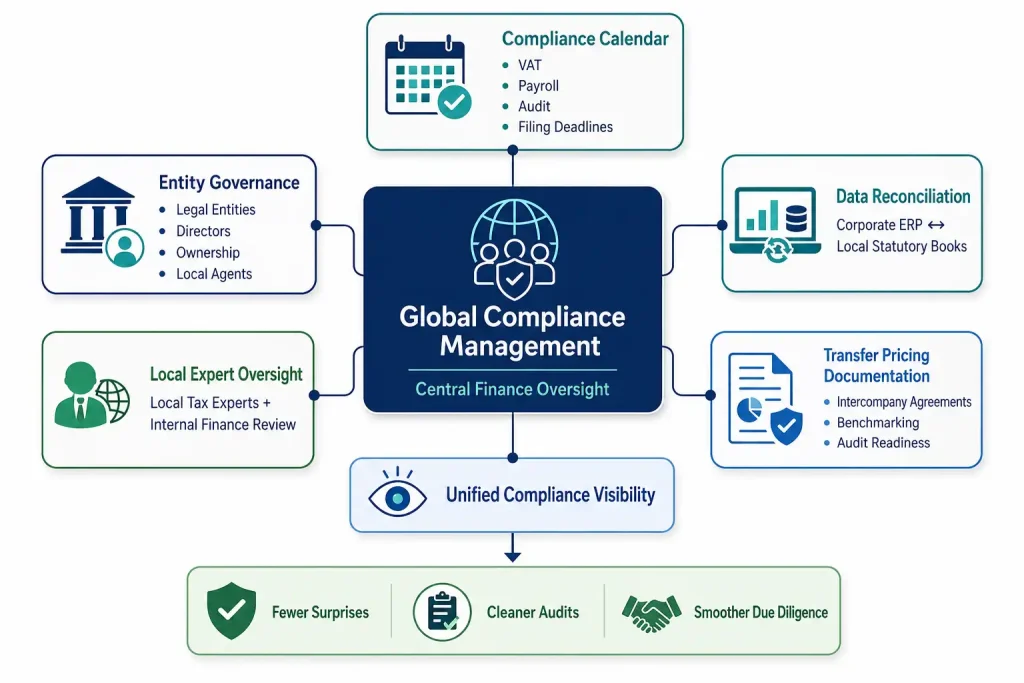
Regaining control over local compliance is a systems problem before it is a staffing problem. Hiring more local providers without a coordinating structure only adds inputs to a process nobody watches end to end. A credible global compliance management framework tends to rest on five pillars.
| Pillar | What It Does |
| Entity governance systems | Digital dashboards tracking legal entities, board composition, shareholding, local agents, and filing deadlines |
| Calendarized compliance tracking | A centralized calendar monitoring VAT returns, payroll submissions, and audit deadlines by country, color-coded for urgency |
| Data reconciliation | Automated matching between corporate ERP and local statutory books to flag mismatches early |
| Outsourced-plus-oversight model | Local tax experts retained in high-risk jurisdictions, reviewed and challenged by internal finance staff |
| Transfer pricing documentation | A central library of intercompany agreements and benchmarking studies, audit-ready within 30 days |
A high-growth cybersecurity and identity access management company, with roughly $30M in annual recurring revenue and more than 230 employees spread across the United States, Canada, Mexico, India, and Nepal, offers a working example of the second and third pillars in practice. A driver-based forecasting engine, a multi-entity finance architecture across five country entities, and a NetSuite implementation that compressed the monthly close from 18 days to 10 gave the finance function the reconciliation discipline needed to carry the business through acquisition diligence without late surprises.
These systems require upfront investment. They pay for themselves through reduced penalties, cleaner audit outcomes, and smoother exits.
A Compliance Dashboard in Practice
A SaaS company operating in Germany, Mexico, and Australia once discovered, through an unrelated statutory audit trigger in Australia, that a local HR manager in Germany had classified contractors as employees, creating retroactive payroll tax exposure. A unified compliance calendar linking HR, finance, and tax workflows caught the issue early, lifted the Mexico VAT reclaim rate by 12 percent, and later helped the company pass a European private equity acquirer’s audit without findings, closing the deal 30 days faster than projected.
A similar pattern showed up at a $127M global consumer products company with direct-to-consumer, Amazon, and wholesale channels, and a supply chain running through China and Vietnam. Four consecutive clean external audits did not happen by accident; they were the product of the same discipline, reconciled books, a documented supply chain P&L, and a compliance calendar the system carried rather than any one person’s memory.
High-Risk Jurisdictions and Warning Signs
Certain jurisdictions demand heightened attention within any global compliance management program:
- Brazil: layered federal and state VAT, heavy documentation mandates, and frequent audits.
- India: a fast-evolving GST framework, e-invoicing mandates, and strict payroll enforcement.
- China: foreign exchange controls, substance requirements, and social insurance obligations.
- France and Germany: rigid labor law, statutory audit thresholds, and assertive tax authorities.
A handful of red flags tend to precede a compliance failure, and they are worth watching for deliberately:
- Subsidiaries with no recent board resolutions or director changes.
- ERP systems showing revenue with no corresponding local VAT filings.
- Large intercompany balances with no formal agreements or transfer pricing documentation.
- Repeated extensions requested for local audits.
Three Key Takeaways
- Global compliance management is a systems discipline, not a delegation exercise. Entity governance dashboards, calendarized filing tracking, and ERP-to-local reconciliation catch problems while they are still cheap to fix, rather than after they have compounded into a diligence finding.
- BEPS 2.0 has ended the era of low-substance entities operating below the radar, and companies well under the $750M Pillar Two threshold are already feeling its effects through local legislation that demands genuine economic substance and transfer pricing documentation.
- Compliance failures rarely originate from willful misconduct; they originate from visibility gaps between headquarters and local operations, and the fix is the same regardless of jurisdiction: unify HR, finance, and tax workflows into one dashboard before a regulator, acquirer, or board member finds the gap first.
Disclaimer: This article is intended for informational purposes only and does not constitute legal, tax, or accounting advice. You should consult your own tax advisor or counsel for advice tailored to your specific situation.
Hindol Datta is a four-time CFO and senior finance executive with over 25 years of leadership experience across cybersecurity, SaaS, gaming, logistics, digital marketing, medical devices, consumer products, and nonprofit organizations. He has led more than $120M in fundraising and over $150M in M&A transactions while building the financial and operational systems that let complex businesses scale with confidence. He is the author of seven books in the Systems CFO Series and holds active CPA, CMA, and CIA credentials.
AI-assisted insights, supplemented by 25 years of finance leadership experience.