
Executive Summary
Intercompany accounting best practices rarely make it onto a board agenda until something has already gone wrong. A denied interest deduction. An auditor’s flag. A withholding tax bill nobody modeled. The loans a parent company issues to a foreign subsidiary sit at the intersection of treasury, tax, and governance. The rules governing them span thin capitalization ratios, IRC §163(j), and the OECD’s BEPS Action 4. Casual documentation no longer holds up under any of them.
This article walks through how intercompany debt functions inside a multi-entity group. It looks at where the enforcement risk concentrates and what a disciplined finance function does differently. The goal is operating discipline. It is what keeps a loan defensible the day an auditor or a tax authority asks to see it.
Why Intercompany Debt Belongs at the Center of Intercompany Accounting Best Practices
Debt has always occupied a privileged place in a CFO’s toolkit. It moves capital without diluting ownership and imposes repayment discipline on the borrowing entity. It often carries a tax profile that equity does not. A parent company can fund a new subsidiary, bridge a market expansion, or capitalize a development team. It can do this without triggering the delay and disclosure that an equity contribution invites.
One cybersecurity and identity access management company built its finance architecture across five countries. These spanned the United States, India, Nepal, Canada, and Mexico. The intercompany funding decisions there were never purely financial. Each transfer had to satisfy a local regulator, a transfer pricing policy, and a consolidated reporting framework. All three had to line up at once. Getting any one of those wrong meant redoing the work under audit pressure months later.
Regulators have grown skeptical of arrangements that appear to serve tax outcomes ahead of business substance. The burden now sits with finance and tax leadership. They must show that a loan is real, its terms are commercial, and its purpose is operational rather than structural. A software company expanding into a new region might prefer a loan over an equity injection. The interest income lands in the parent’s jurisdiction while the subsidiary deducts the corresponding expense locally. That spread reflects transfer pricing principles and the time value of money, not aggressive engineering. The distinction between legitimate arbitrage and disguised equity tends to come down to behavior over time. Was interest actually paid? Was the rate benchmarked? Did the borrower have the earnings to support it?
Thin Capitalization Rules and the Global Enforcement Patchwork
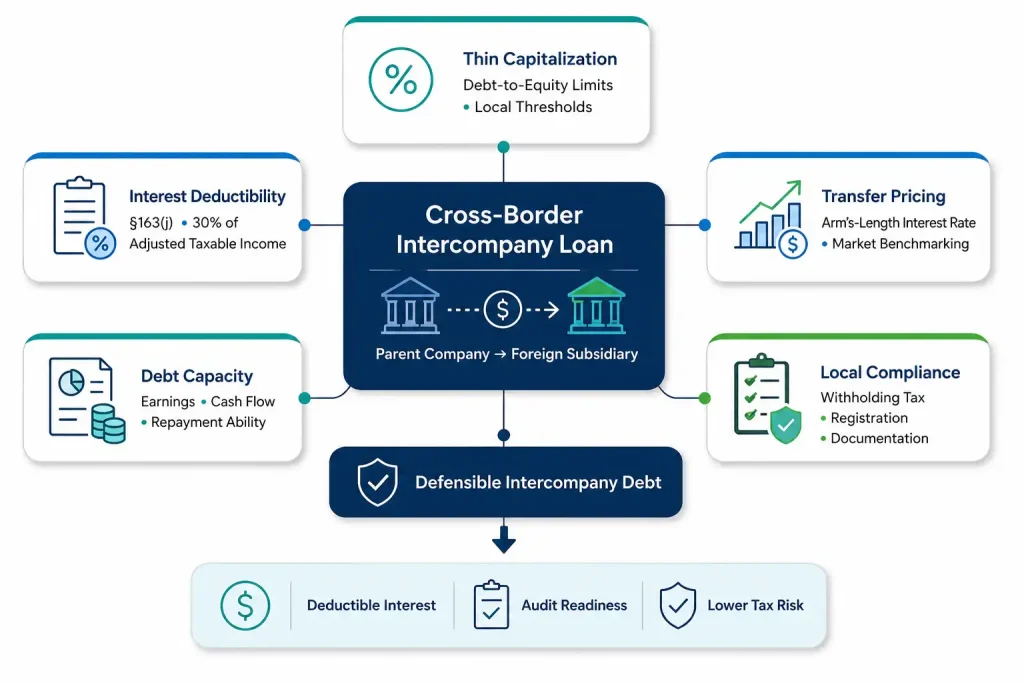
Thin capitalization rules exist to stop a company from eroding its taxable base. They do this by limiting how much debt, versus equity, a subsidiary can carry. The mechanics vary by country, and that variation is where the complexity concentrates for any group operating across borders.
Some jurisdictions rely on a blunt debt-to-equity ratio; interest on debt beyond a 3:1 threshold, for example, may lose its deduction outright. Others apply an earnings-based test: India caps interest deductions on loans from non-resident associated enterprises at 30 percent of EBITDA, and Australia layers arm’s-length testing on top of safe harbor provisions. Germany, Canada, and China enforce their versions strictly and expect contemporaneous documentation to back every position taken.
At a global medical device manufacturer with plants across Copenhagen, Cork, and Taiwan, standard costing had to withstand line-by-line audit scrutiny in a heavily regulated industry, and that same precision is what thin capitalization compliance now demands of intercompany financing. Loan agreements need defined terms, repayment schedules, market-based rates, and demonstrable capacity to service the debt, and where local thin cap thresholds apply, the modeling has to run annually rather than at the moment a loan is issued.
How IRC §163(j) Reshapes Interest Deductibility for US Entities
The Tax Cuts and Jobs Act of 2017 rewired interest deductibility in the United States through Internal Revenue Code Section 163(j), capping the deduction for business interest expense at 30 percent of adjusted taxable income. That base approximated EBITDA through 2021 and has followed an EBIT-based definition since, which tightens the ceiling for capital-intensive or R&D-heavy businesses with uneven earnings.
A US subsidiary paying interest to a foreign parent, if thinly capitalized relative to its earnings, may see that deduction partially or entirely denied. The disallowed amount carries forward rather than disappearing, but the current-year cash tax cost can climb regardless. Section 163(j) applies whether the lender is related or unrelated, domestic or foreign, which removes any temptation to design around it through entity structure alone.
For groups with volatile earnings, the rule creates a timing mismatch: interest gets booked, the deduction does not follow, and effective tax rates skew in ways that can trigger reserves under ASC 740. Consolidated earnings across a group may look sufficient on paper, but each legal entity has to be tested on its own, with loan terms reflecting genuine commercial substance, board approval, and periodic reassessment of debt capacity.
BEPS Action 4 and the Tightening International Landscape
Beyond country-specific statutes, the OECD’s Base Erosion and Profit Shifting project has reset the baseline expectation globally. Action 4 targets interest deductions between related parties directly, recommending a fixed ratio approach similar in spirit to §163(j).
The deeper shift is in what regulators now ask for. A signed agreement no longer suffices; tax authorities across Europe and Asia expect transfer pricing documentation that benchmarks the interest rate against market comparables, along with evidence that funds were genuinely at risk and that local teams held actual authority over the debt they were managing. The S-1 and IPO-readiness process for a Euronext Paris-listed gaming and digital entertainment company operating across the United States, France, the United Kingdom, Singapore, and South Korea involved the same exercise in a different register: consolidating a single definition of revenue under both IFRS and US GAAP so that regulators and underwriters alike received one coherent narrative, not five locally convenient ones.
Building Intercompany Accounting Best Practices into Daily Operations
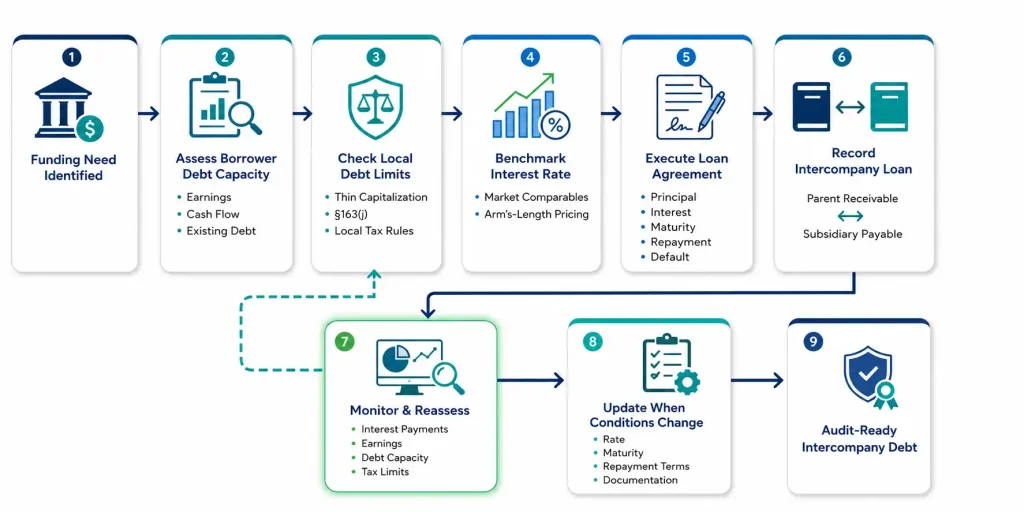
Compliance at this level is a set of habits that finance, tax, legal, and treasury maintain together, month after month, not a document sitting in a folder.
Documentation, Pricing, and Ongoing Monitoring
Every loan needs a signed agreement covering interest, maturity, repayment, and default, reviewed on a cadence rather than left untouched for years. Pricing has to be defensible against market data; a parent lending at 5 percent where comparable borrowing runs 3.5 to 4.5 percent invites the kind of challenge that turns a routine loan into an audit finding. Debt levels and deductibility limits deserve modeling under multiple scenarios, especially when earnings soften or new debt layers onto existing balances.
At a $127M global consumer products company with a supply chain spanning China and Vietnam, securing $12M in growth financing meant managing lender relationships with the same rigor applied to intercompany pricing internally: lenders and tax authorities alike test whether the numbers hold up under scrutiny, not merely whether they exist.
Common Pitfalls Worth Naming Directly
- Issuing backdated or undocumented loans, especially at year-end
- Funding a subsidiary before testing its earnings capacity to service debt
- Applying one interest rate across every jurisdiction without local benchmarking
- Leaving agreements unchanged when terms shift, such as rolling interest or extended maturity
- Overlooking local registration or withholding requirements on cross-border loans
Warning signs cluster in predictable ways: growing unpaid balances with no repayment activity, interest payments that outpace the borrower’s cash flow capacity, and one-sided terms that benefit only the lender or only the borrower. What began as a financing decision becomes an audit trigger once the documentation and the behavior stop matching.
Case Study: Restructuring Before the Audit Finds You
A fintech company expanding into Southeast Asia had issued undocumented intercompany loans into Singapore and Indonesia at 8 percent, well above market norms. By the time the company prepared for a growth round, auditors flagged the loans as disguised equity, a finding that would have disallowed the interest expense and exposed the subsidiaries to withholding assessments.
The finance team moved quickly: formal agreements replaced the informal ones, jurisdiction-specific rates were set against a transfer pricing study, and debt service plans were documented. The auditors cleared the structure and the raise proceeded on schedule. The lesson holds across industries: the debt itself was never the problem, the absence of discipline behind it was.
Three Key Takeaways
- Intercompany debt remains one of the most useful tools available to a multinational CFO, but its defensibility depends on whether the loan behaves like real debt: priced at arm’s length, documented consistently, and tested against local thin capitalization and §163(j) limits on a recurring basis rather than once at inception.
- Compliance is a cross-functional habit, not a single filing; tax, legal, treasury, and FP&A need a shared cadence for reviewing rates and updating agreements whenever terms or earnings shift, because regulators increasingly judge the behavior behind the paperwork rather than the paperwork alone.
- The cost of getting this wrong rarely arrives quietly; it surfaces during a raise, an audit, or a diligence process, at the moment a company can least afford the delay, which is the strongest argument for building intercompany accounting best practices into ordinary monthly operations well before anyone asks to see them.
Disclaimer: This article is intended for informational purposes only and does not constitute legal, tax, or accounting advice. You should consult your own tax advisor or counsel for advice tailored to your specific situation.
Hindol Datta is a four-time CFO and senior finance executive with over 25 years of leadership experience across cybersecurity, SaaS, gaming, logistics, digital marketing, medical devices, consumer products, and nonprofit organizations. He has led more than $120M in fundraising and over $150M in M&A transactions while building the financial and operational systems that let complex businesses scale with confidence. He is the author of seven books in the Systems CFO Series and holds active CPA, CMA, and CIA credentials.
AI-assisted insights, supplemented by 25 years of finance leadership experience.