
Executive Summary
For any company building revenue across borders, learning how to avoid permanent establishment risk is not a legal footnote. It is an operational discipline that sits at the intersection of finance, HR, and legal decision making. Permanent establishment, often shortened to PE, is a tax principle. It lets a country tax a foreign company once that company’s presence becomes economically substantive. This happens once the presence goes beyond mere convenience and extends within that country’s borders. Mere convenience is not enough to trigger it.
This article walks through where PE exposure actually originates. It explains why the threshold is far lower than most finance teams assume. The article also lays out what a defensible global operating model looks like in practice. It draws on real cross-border engagements spanning cybersecurity, gaming, manufacturing, and marketplace technology. These engagements show how PE risk moves from theory into audit reality. They also reveal what structures hold up when tax authorities come asking.
What Permanent Establishment Actually Means
Permanent establishment originates in international tax treaties, most of them modeled on the OECD framework. Tax authorities generally treat a foreign enterprise as having a PE if it maintains a fixed place of business. Activity must be carried on there, wholly or partly. They also treat it as having a PE if a local agent habitually signs contracts on its behalf. The simple language hides enormous nuance. What matters is not whether a company formally registers somewhere, but whether its actual behavior resembles that of a resident business.
In a high-growth cybersecurity and identity access management company operating across the United States, Canada, Mexico, India, and Nepal, this distinction surfaced repeatedly during multi-entity finance work. Local teams operated for delivery, yet as revenue operations matured, questions kept returning to who approved pricing and who actually concluded contracts. Tax law rewards structure only when structure matches substance, and everyday behavior shapes substance, not the entity chart sitting in a data room.
The Gap Between Structure and Behavior
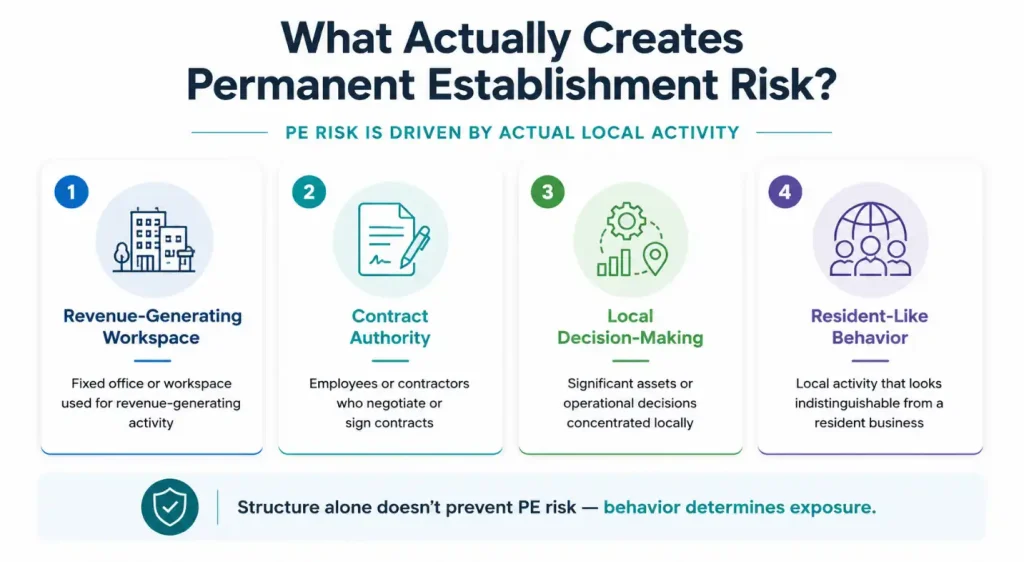
A company can incorporate a support entity cleanly and still create PE exposure if the people inside it are quietly doing sales work. Common triggers include the following.
- A fixed office or workspace used for revenue generating activity, even when the entity was formed for support only
- Employees or contractors with real authority to negotiate or sign contracts
- Significant assets or operational decision making concentrated in the local market
- A pattern of behavior that, on the ground, looks indistinguishable from a resident business
Tax Residency Is the Other Side of the Same Coin
Permanent establishment determines whether a foreign company is taxable somewhere. Tax residency determines where the company lives for tax purposes, and the triggers vary widely by jurisdiction. The United States leans on incorporation, the United Kingdom looks at place of effective management, and India can assert residency based on where the company actually exercises control and management, regardless of where the entity is legally domiciled.
In a Euronext Paris listed gaming and digital entertainment company with operations spanning the United States, France, the United Kingdom, Singapore, and South Korea, this question came up directly during IFRS and US GAAP consolidation work. Decision rights on paper sat with one board, but regional leaders increasingly drove pricing, hiring, and engineering priorities. Dual residency exposure and double taxation are the practical consequences when documentation and operational reality drift apart, and treaty protection only holds when both tell the same story.
Dependent Agents and the Authority Trap
One of the least understood PE triggers involves dependent agents. Under most treaties, a foreign enterprise is deemed to have a PE if a local representative habitually exercises authority to conclude contracts in the company’s name, regardless of that person’s job title or contractor status. A country manager style role that negotiates terms, approves pricing, and signs distributor agreements from a permanent desk can create exposure even when no local entity has been formed and no local revenue has been reported.
Tax authorities are not only asking where income is booked. They are asking where it is earned, and the two answers frequently diverge in fast growing companies that expanded through talent rather than through formal incorporation.
Remote Work Has Lowered the Threshold Further
The shift toward distributed teams has added a layer of complexity that did not exist a decade ago. An employee working permanently from a foreign country, performing revenue generating activity or key management functions, can constitute a fixed place of business in the eyes of a local tax authority. A senior engineer relocating and continuing to shape architecture, manage sprint planning, or approve budgets from abroad raises the same red flags as a formally opened office, even without a signature on a single contract.
Designing for Permanent Establishment Risk Mitigation
Most PE exposure does not arrive through a single bad decision. It accumulates through operational drift, gradual changes in employee roles, authority, and customer engagement that nobody flagged as a tax question at the time. Learning how to avoid permanent establishment risk starts with the assumption that tax authorities examine behavior, not entity charts, and that entity formation, HR planning, and legal agreements need to move together rather than in sequence.
Building Firewalls Between Local Activity and Taxable Nexus
Separating decision making authority from local delivery is one of the most reliable mitigation tools available. In a global medical device manufacturer with plants in Copenhagen, Cork, and Taiwan, operations controllership work required precise boundaries between cost accounting functions performed locally and strategic pricing decisions retained centrally, a distinction that mattered enormously once regulators began asking who actually controlled outcomes at each site.
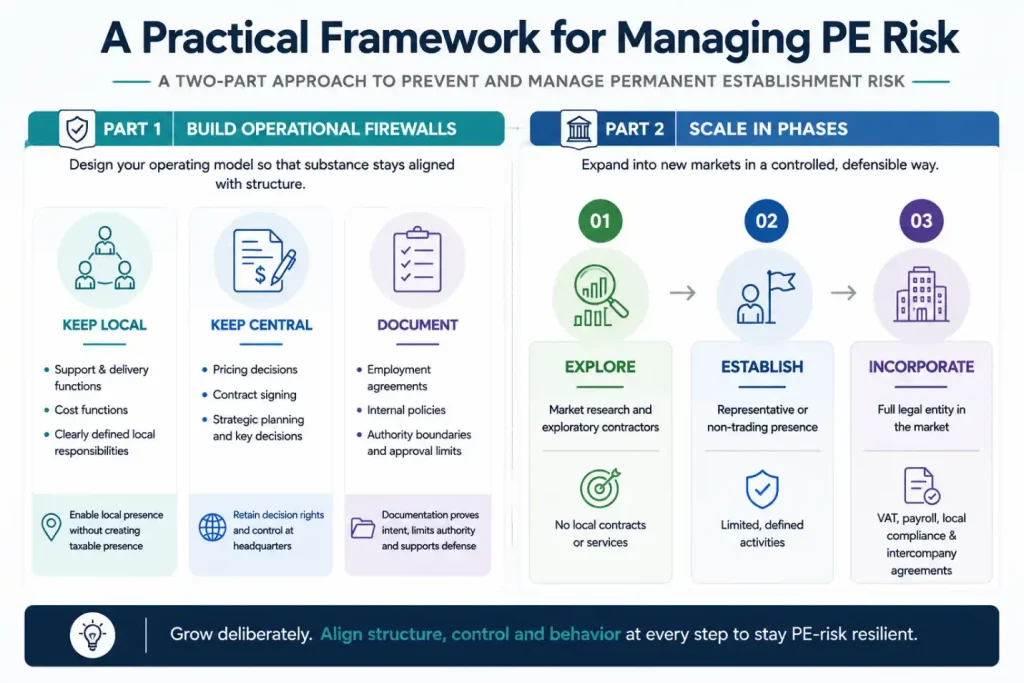
A workable firewall generally includes the following elements.
- Local teams restricted to support, delivery, or cost functions rather than customer facing sales
- Pricing and contract signing authority retained centrally and documented as such
- Strategic planning kept outside the local entity’s scope of work
- Employment agreements and internal policies that describe these boundaries explicitly rather than implicitly
A Phased Approach to Entity Formation
Incorporating too early adds compliance cost without matching revenue. Waiting too long risks PE exposure or local labor violations. A tiered model generally works better than an all-at-once decision.
- Phase one, market research and exploratory contractor work with no local contracts or services delivered
- Phase two, a representative office or non-trading presence limited to defined activities
- Phase three, full legal incorporation with VAT registration, payroll, and intercompany agreements in place
A marketplace SaaS platform operating across the United States and Poland used this staged logic while consolidating financial reporting ahead of a Series B raise, keeping cohort economics and reporting boundaries clean enough to survive investor diligence without raising cross-border tax questions.
Documentation Wins or Loses the Argument
PE determinations are decided on facts, but the facts are proven through documentation. Intercompany service agreements, board resolutions, organizational charts, and email policies together form a coherent narrative that should match the filings and the operational reality. Treaty protections against double taxation only apply once residency and functional activity can actually be demonstrated, not merely asserted.
Audit experience across multiple countries points to the same pattern. Authorities ask for proof that intercompany charges reflect real services rendered, that cost sharing agreements match actual local contribution, and that final decision-making authority sits where the paperwork says it does. Organization charts, meeting minutes, system logs, and workflow trails are what withstand scrutiny, and none of them can be built the week before an audit begins. They have to be built every quarter as a matter of routine.
Cross-Functional Governance Closes the Gap
PE compliance rarely fails because of one bad decision. It fails because legal, finance, HR, and sales make decisions independently without seeing the tax consequence of each other’s choices. A quarterly governance review that brings these functions together to examine international headcount changes, contracting models, and tax implications catches problems while they are still cheap to fix, and it educates the people making day-to-day calls before those calls compound into exposure.
Three Key Takeaways
- Permanent establishment risk is triggered by behavior rather than paperwork, so any assessment of how to avoid permanent establishment risk has to start with what people actually do locally, including who signs contracts, who sets pricing, and who makes the calls that shape revenue.
- Remote work and dependent agent arrangements have pushed the PE threshold lower than most finance leaders assume, which means a single relocated employee or a contractor with informal authority can create the same exposure as a fully staffed foreign office.
- Documentation built quarterly, not reactively, is what separates companies that survive an audit inquiry from those that scramble to reconstruct a defensible story after the fact, so treat organizational charts, intercompany agreements, and governance reviews as ongoing infrastructure rather than one-time compliance tasks
Disclaimer: This article is intended for informational purposes only and does not constitute legal, tax, or accounting advice. You should consult your own tax advisor or counsel for advice tailored to your specific situation.
Hindol Datta is a four-time CFO and senior finance executive with over 25 years of leadership experience across cybersecurity, SaaS, gaming, logistics, digital marketing, medical devices, consumer products, and nonprofit organizations. He has led more than $120M in fundraising and over $150M in M&A transactions while building the financial and operational systems that let complex businesses scale with confidence. He is the author of seven books in the Systems CFO Series and holds active CPA, CMA, and CIA credentials.
AI-assisted insights, supplemented by 25 years of finance leadership experience.