
Executive Summary
Every multinational structure carries an entity somewhere in its chart that nobody looks at. That entity often becomes the reason for an audit letter. In more than one five-country entity build, a disregarded subsidiary has sat quietly for years, filing nothing locally. Then a treaty claim depended on its residency, and the whole position came apart. Entity classification determines effective tax rate, audit posture, and the ability to move capital home. BEPS compliance is no longer a background concern that tax counsel handles once a year. It sits on the same desk as the forecast and the board deck.
This piece walks through disregarded entities, hybrid entities, treaty mismatches, and the arrival of Pillar Two. It closes with the governance discipline that keeps a global structure defensible rather than merely legal. Base erosion and profit shifting was, for a long stretch of corporate history, something structures were built to exploit. It is now the framework every CFO has to build around.
The Entity You Ignore May Be the One That Hurts You Most
Entity classification should, in theory, be a matter of local legal filing and internal bookkeeping preference. In practice, the same legal entity can be viewed one way by the country where it operates. The country that owns it may view it entirely differently. That asymmetry is where the risk lives. When a company exploits the gap deliberately, tax authorities call it arbitrage. When a company stumbles into it without noticing, they call it noncompliance. The financial exposure looks similar either way. Both versions have shown up inside the same organization within eighteen months of each other.
Disregarded entities and hybrid entities sit at the center of this. They offer real planning flexibility, and in a coordinated global enforcement environment, they also generate real risk. Regulators have grown sharper about structures that lack economic coherence. That means a legal entity with no staff, no decision-making authority, and no operational footprint beyond a mailing address. Consider a CFO managing a five-country entity map. It spans a cybersecurity and identity access management company operating across the United States, Canada, Mexico, India, and Nepal. Understanding how each jurisdiction actually perceives each entity is not a compliance nicety. It is the difference between a clean audit and a surprise liability.
Disregarded Entities: Simplicity With a Catch
A disregarded entity is ignored for U.S. federal income tax purposes. It remains a separate legal entity under local law. The most common examples are a single-member LLC or a foreign subsidiary that has elected disregarded status on Form 8832. Its income rolls into the parent’s return. There is no separate entity-level taxation, no requirement for intercompany agreements, and often no transfer pricing documentation between the two. That simplicity is genuinely useful, and it has kept consolidation clean during periods of rapid multi-entity growth in more than one organization.
The catch is that the entity still exists locally, which means it may still owe local filings, statutory audits, and local tax payments regardless of how the U.S. parent treats it. If nobody at headquarters is tracking that obligation, the entity drifts out of compliance quietly, and the first anyone hears of it is a penalty notice or a blocked repatriation.
Cross-border payments compound the problem. A disregarded entity paying a third party in a treaty country may not qualify for treaty benefits at all, because most treaties require the beneficial owner of the income to be a resident of a contracting state. If the disregarded entity fails that residency test locally, the withholding exemption disappears. This is not theoretical. European authorities in particular apply strict beneficial ownership tests, and a disregarded entity in Luxembourg making royalty payments to a U.S. parent can lose treaty benefits entirely if it lacks demonstrable substance.
Hybrid Entities: The Engine of Arbitrage, Now Under Siege
A hybrid entity is one that different countries classify differently. A U.S. LLC might be a pass-through for U.S. purposes and a corporation abroad, and that gap was, for years, the mechanism behind a deduction claimed in one jurisdiction with no matching income recognized in the other. It was legal, common, and in some structures actively encouraged by advisors.
That era is closing. The OECD’s BEPS Action 2 targets hybrid mismatches directly, and countries now deny deductions, require income inclusion, or otherwise neutralize the mismatch rather than allow it to stand. The UK and Australia both deny deductions for payments into hybrid entities that go untaxed on receipt. The European Union’s ATAD 2 directive imposes similar restrictions, which has made hybrid arbitrage inside the EU close to obsolete.
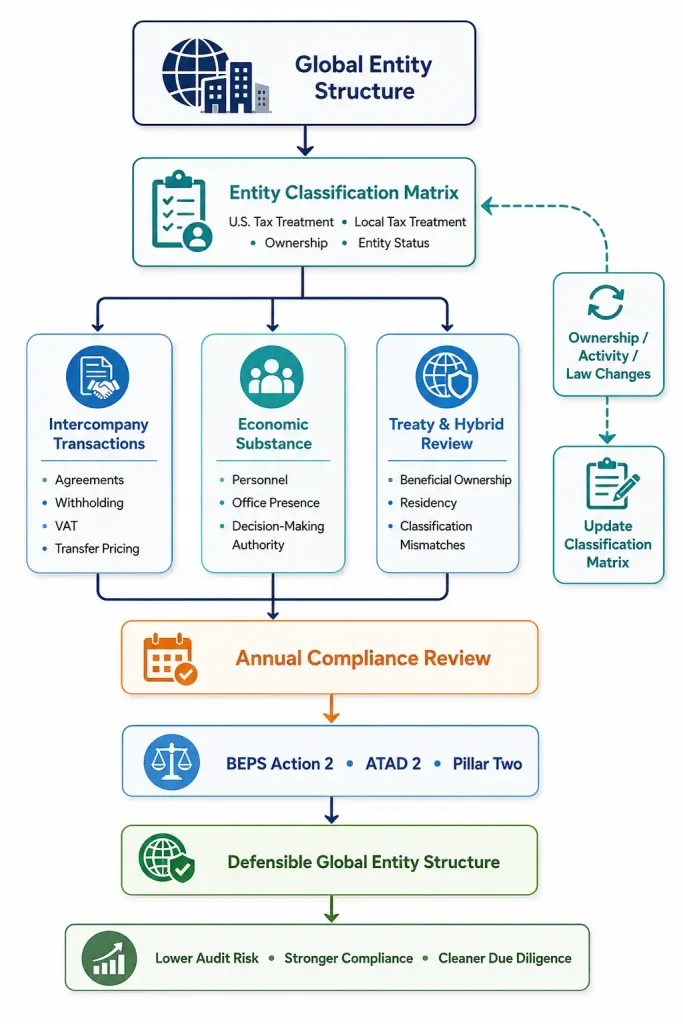
What this means operationally: a legal entity chart is no longer sufficient. A CFO needs a functional tax classification matrix showing how every entity is treated in every jurisdiction where it touches income, because the mismatch that once generated a tax benefit now generates an examination.
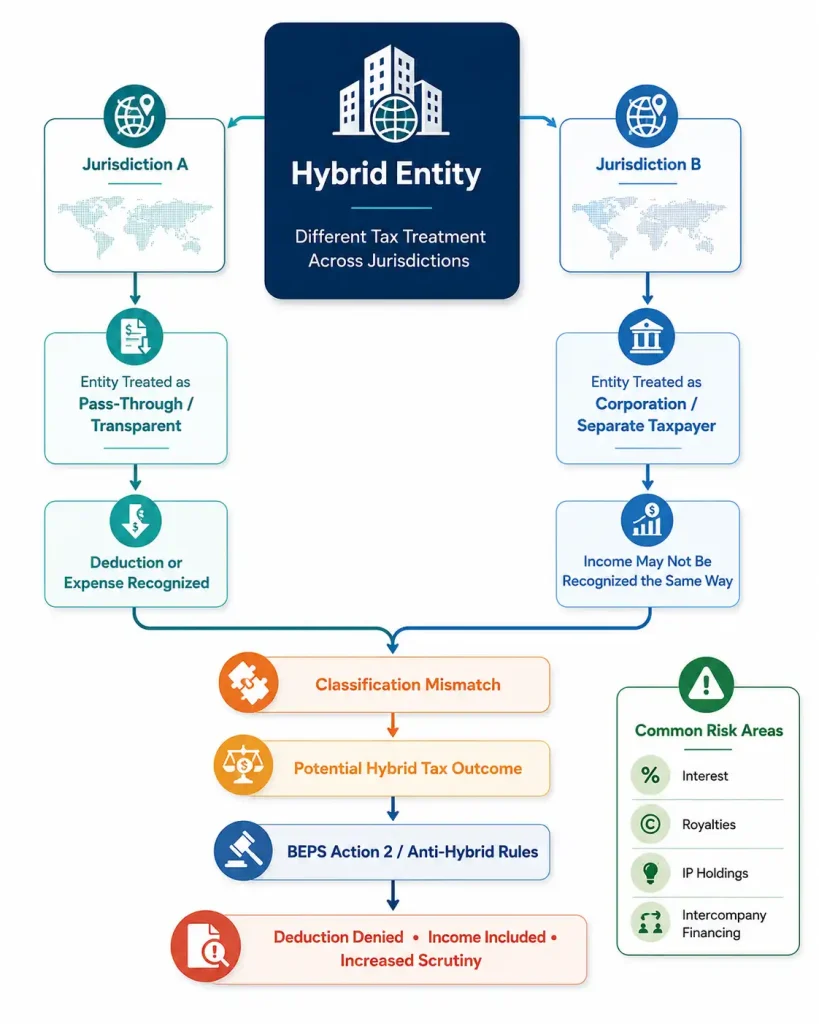
Where anti-hybrid rules commonly bite:
- Interest and royalty payments into an entity that goes untaxed on receipt in its home jurisdiction
- Double-deduction structures where the same expense is claimed against income in two countries
- IP holding entities that pay royalties up a chain without matching local substance
- Financing arrangements layered through disregarded or fiscally transparent intermediaries
Treaty Mismatches and the Beneficial Ownership Problem
Beneficial ownership has become the fulcrum of international tax enforcement. Reduced withholding on dividends, interest, and royalties depends on the receiving entity actually being the beneficial owner of that income, and inserting a disregarded or hybrid entity into the chain is exactly what breaks that claim. If the entity does not qualify as a resident under the treaty, or lacks the substance to support the claim, tax authorities deny the benefit and apply the full statutory withholding rate, often 20 to 30 percent, which can materially alter the economics of a structure built around a lower treaty rate.
U.S. treaties add limitation on benefits clauses that require the recipient to pass specific ownership and activity tests, and hybrid entities owned through chains of disregarded entities routinely fail them. In one buy-side diligence engagement, a quality-of-earnings review traced a licensing structure back to an entity with no staff and no documented decision-making, and the finding directly changed how the buyer valued the target’s effective tax position.
BEPS, Pillar Two, and Where Entity Classification Is Heading
The direction of travel is unambiguous. BEPS compliance and the OECD’s Pillar Two global minimum tax are steadily closing the gaps that classification differences used to create. Under Pillar Two, multinational groups with consolidated revenue above €750M face a global minimum tax of 15 percent, calculated on a standardized basis regardless of whether a given entity is disregarded in one jurisdiction or recognized as a partnership in another. The advantage that used to come from classification arbitrage shrinks accordingly.
Enforcement is also becoming harder to outrun. Tax authorities are investing in data-sharing agreements and digital cross-referencing tools that surface classification mismatches far faster than a paper-based audit ever could. What used to take years to discover is now visible in a data match.
At a Euronext Paris-listed gaming and digital entertainment company, financial reporting was consolidated across five countries under both IFRS and U.S. GAAP and run through Big Four auditors during an S-1 process. That level of scrutiny made one thing clear: a structure that depends on inconsistent classification to work does not survive first contact with a serious audit. Structures built for genuine coherence do.
Operationalizing Entity Governance
Managing this risk is a governance discipline, not a one-time legal review. The practices that have held up across these structures are consistent:
- Maintain a centralized entity classification matrix – Document how every entity is treated for U.S. and local tax purposes, and review it annually or whenever ownership, activity, or local law changes.
- Align intercompany agreements with actual classification – A payment that needs no formal agreement for U.S. purposes may still require documentation locally for withholding or VAT compliance.
- Match substance to function – An entity holding IP or receiving royalties needs personnel, office presence, and real decision-making authority, or it reads as a shell regardless of what the paperwork says.
- Train legal and finance staff regularly – Classification rules, treaty application, and documentation standards, since most noncompliance is accidental rather than intentional.
Conclusion
Disregarded and hybrid entities are not inherently problematic, and they still offer real advantages in reducing friction and optimizing cash flow. What has changed is the margin for error. The gray zones that made hybrid structures useful are narrowing under BEPS Action 2, ATAD 2, and Pillar Two, and the entities a company stops paying attention to are increasingly the ones that draw the closest scrutiny from auditors, regulators, and acquirers. Entity classification has moved from a technical footnote to a board-level question, and the CFOs who treat it that way are the ones who keep their structures both efficient and defensible.
Three Key Takeaways
- A disregarded or hybrid entity that made sense five years ago may no longer hold up under BEPS Action 2, ATAD 2, or Pillar Two, so the classification matrix needs an annual review, not a one-time build.
- Treaty benefits depend on beneficial ownership and real substance, and an entity with no staff or decision-making authority will fail that test the moment it is examined, regardless of how clean the paperwork looks.
- Pillar Two’s 15 percent global minimum is compressing the value of classification arbitrage across the board, which means the structures worth keeping are the ones built for coherence rather than the ones built for the gap.
Disclaimer: This article is intended for informational purposes only and does not constitute legal, tax, or accounting advice. You should consult your own tax advisor or counsel for advice tailored to your specific situation.
Hindol Datta is a four-time CFO and senior finance executive with over 25 years of leadership experience across cybersecurity, SaaS, gaming, logistics, digital marketing, medical devices, consumer products, and nonprofit organizations. He has led more than $120M in fundraising and over $150M in M&A transactions while building the financial and operational systems that let complex businesses scale with confidence. He is the author of seven books in the Systems CFO Series and holds active CPA, CMA, and CIA credentials.
AI-assisted insights, supplemented by 25 years of finance leadership experience.