
Executive Summary
Foreign subsidiary sale tax planning rarely begins where it should, which is months before a term sheet exists. Most divestitures start as a strategic conversation about focus or capital allocation. Only later does the finance function step in. It explains why a transaction that looked clean on a whiteboard is generating a dividend nobody declared. Three issues explain most of the gap: Section 1248 recharacterization, basis tracking failures, and foreign exchange surprises. Each one causes a foreign subsidiary sale to underperform its modeled outcome. Each one is preventable with enough lead time.
This article walks through the structural choice between a stock sale and an asset sale. It covers the mechanics of Section 1248 and the Section 245A dividends received deduction. It also covers the discipline required to track tax basis across years of Subpart F and GILTI inclusions. And it covers the planning levers available to a finance team preparing to exit a foreign operation. The purpose is not to replace tax counsel. It is to lay out enough command of the terrain for a finance leader. That way, the right questions get asked before the parties sign the term sheet, not after.
Two Paths to Exit: Stock Sale Versus Asset Sale
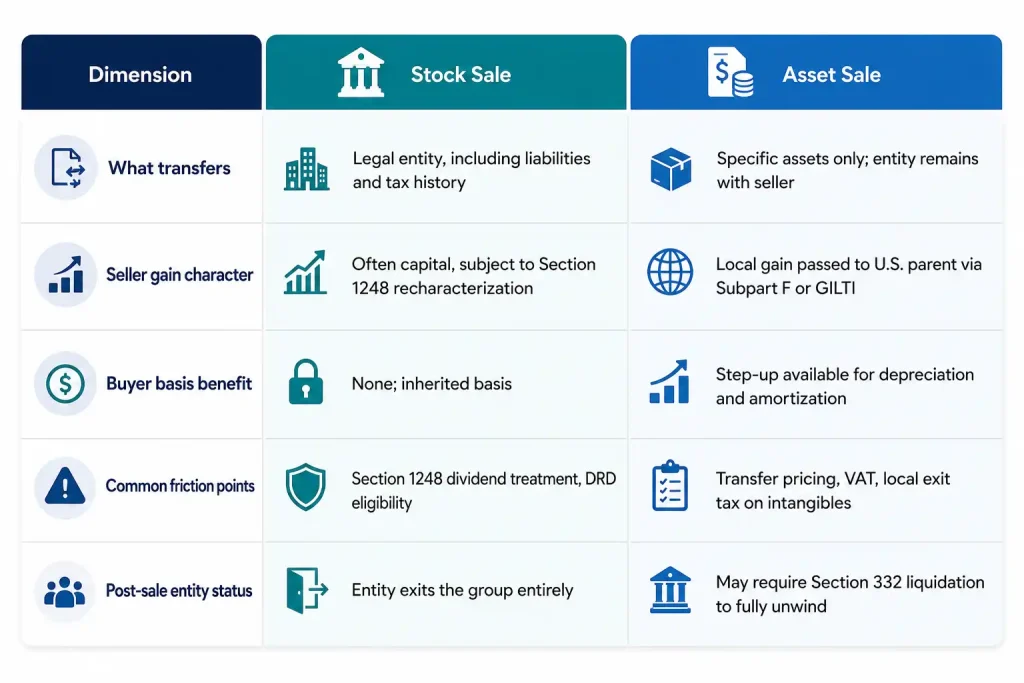
Every cross-border divestiture reduces to a single structural question early in the process. Does the buyer acquire the shares of the subsidiary? Or does the subsidiary sell its underlying assets while the legal entity stays behind? A stock sale transfers the entity itself, along with its tax attributes, historical liabilities, and local operating history. An asset sale carves out specific components, such as customer contracts, intellectual property, or real property. The shell remains with the seller.
Buyers frequently prefer an asset structure because it produces a step-up in basis on the acquired assets. That step-up generates future depreciation and amortization. Sellers frequently prefer a stock sale because the exit is cleaner and the gain is, in principle, capital in nature. That preference gap is where negotiation leverage lives. It is also where the U.S. parent’s actual tax outcome can diverge sharply. What either side assumed at the outset often does not survive contact with the deal.
Where the Modeling Usually Breaks
A gaming and entertainment company listed on Euronext Paris operated in five countries. Its footprint spanned the United States, France, the United Kingdom, Singapore, and South Korea. Its cross-border M&A execution exceeded $100M, and that work made one thing clear. A deal’s true after-tax value depends on which entity in the ownership chain is selling what, and to whom. A structure that looks identical on a signing table can produce materially different outcomes. It depends on whether the target jurisdiction respects the deemed dividend treatment the seller is counting on. It also depends on whether the U.S. parent’s ownership chain even qualifies for the relief the model assumes.
Section 1248 and the Dividend Recharacterization Trap
When a U.S. corporation sells the stock of a controlled foreign corporation, the instinct is to expect capital gain treatment. Most corporate sellers do not receive preferential capital gain rates in the first place. The full corporate rate typically applies to the gain regardless. The deeper complication is Section 1248. It recharacterizes gain as a dividend to the extent of the foreign subsidiary’s accumulated earnings and profits. Congress wrote the rule to stop companies from using stock sales to sidestep tax. Otherwise, a distribution would trigger that same tax.
The Section 245A dividends received deduction can exempt that recharacterized portion from U.S. tax. It applies only if the ownership chain satisfies specific holding period thresholds and clears the anti-hybrid rules. A deal team should never assume DRD eligibility. Skipping that check against the ownership structure means building a valuation on shaky ground. A mission-driven education and research institution structured a capital raise across equity and venture debt. Documenting the ownership and governance chain with precision anticipated exactly this kind of downstream scrutiny. A capital structure built loosely in year one becomes a liability. That liability surfaces the moment a transaction depends on qualifying for relief in year five.
The recharacterization also opens a path to foreign tax credits. A deemed dividend can absorb creditable foreign taxes the subsidiary already paid. That path is not automatic. It depends on earnings and profits analysis by entity and on basket limitations. It also depends on whether the parent has U.S. tax liability available to absorb the credit.
Asset Sales: Local Tax First, U.S. Consequences Second
When the foreign subsidiary sells its own assets, the local jurisdiction taxes the gain first, and Subpart F or GILTI rules later pass that result up to the U.S. parent, depending on the nature of the assets and the entity’s classification. Intangible-heavy sales draw transfer pricing scrutiny in nearly every jurisdiction, and several require exit tax valuations or pre-clearance before the transaction can close. Where services or licenses are part of the deal, VAT exposure can appear unless the structure has been negotiated in advance.
Asset sales followed by a Section 332 liquidation can allow the U.S. parent to recover cash or remaining assets without immediate additional tax, provided the qualification rules are met precisely. This combination, local gain recognition followed by liquidation, is often the more tax-efficient path when the alternative is an uncertain DRD qualification under a stock sale structure, even though it demands more modeling up front.
Basis, Currency, and the Ledger That Gets Overlooked
The most underappreciated variable in foreign subsidiary sale tax planning is basis. Legal book value is not tax basis, and treating the two as interchangeable is the fastest route to a miscalculated gain. U.S. tax basis in a foreign subsidiary reflects original investment cost, adjusted over time for undistributed earnings, prior losses, Subpart F and GILTI inclusions, and capital contributions, and it shifts every year the entity operates.
A high-growth cybersecurity and identity access management company operating across the United States, Canada, Mexico, India, and Nepal illustrates the discipline this requires. Building a multi-entity finance architecture across five countries, alongside a driver-based forecasting engine and an ASC 606 revenue recognition framework, meant that basis, intercompany balances, and entity-level earnings had to be reconciled continuously rather than reconstructed under deadline pressure once a sale process began. Companies that skip this discipline tend to discover their basis problem during diligence, at the point where it is most expensive to fix.
Currency adds a second layer. Gains or losses under Sections 987 and 988 depend on the functional currency of the subsidiary relative to the parent’s reporting currency, and a subsidiary sold after years of currency appreciation can generate a foreign exchange gain even when the deal is flat in local terms. A consolidated reporting framework spanning U.S. and Polish operations during a Series B raise made this dynamic visible early: unit economics that looked stable in dollars shifted when translated, and a sale executed without that translation modeled in advance produces a tax provision surprise that surfaces well after the transaction has closed.
Planning Levers Before the Term Sheet
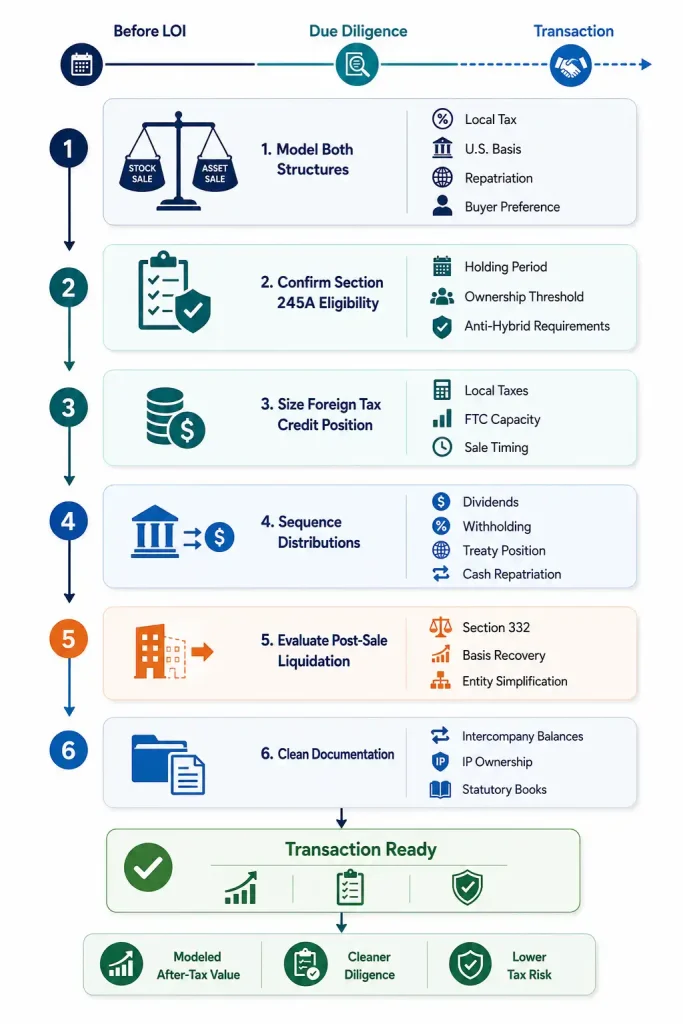
The following actions, taken in sequence well before a letter of intent, determine whether a foreign subsidiary sale closes at its modeled after-tax value or well below it.
- Model both structures in parallel – Run stock sale and asset sale scenarios side by side, incorporating local tax, U.S. basis, repatriation mechanics, and known buyer preferences, so the negotiation starts from an informed position rather than the buyer’s preferred structure.
- Confirm Section 245A eligibility before assuming it – Verify holding period, ownership threshold, and anti-hybrid requirements against the actual entity chain, and restructure ownership pre-sale if a gap exists.
- Size the foreign tax credit position – Determine whether FTC capacity exists to absorb local taxes paid, and where possible, align the sale’s timing with a year of forecasted U.S. income that can use the credit.
- Sequence distributions deliberately – If sale proceeds will move from the foreign subsidiary to the parent, plan the dividend mechanics, withholding exposure, and treaty position before the cash moves, not after.
- Evaluate post-sale liquidation – A Section 332 liquidation following an asset sale can recover basis and simplify the entity structure, but only within the specific conditions that qualify it for tax-free treatment.
- Clean the documentation trail early – Reconcile intercompany balances, confirm IP ownership by entity, and bring statutory books current before diligence begins rather than during it.
A Composite Case
A U.S.-based SaaS company with subsidiaries in Ireland and Germany initially modeled the German exit as a stock sale expected to yield a $12M gain. Preliminary analysis showed $7M of that gain would be recharacterized as a Section 1248 dividend, of which only $3M cleared the DRD threshold given the existing ownership chain. Restructured instead as an asset sale through the German entity, followed by a Section 332 liquidation, the transaction deferred most of the U.S. gain recognition, avoided the dividend classification entirely, and allowed foreign taxes paid to be credited against a distribution timed to available FTC capacity. The blended effective tax rate on the transaction moved from 23 percent to under 11 percent, and the entity structure was left clean for the next round of capital deployment.
Three Key Takeaways
- The choice between a stock sale and an asset sale is not a formality decided by buyer preference; it is the single decision that most determines whether Section 1248 recharacterizes a meaningful share of the gain as a dividend, and it deserves parallel modeling months before negotiation begins.
- Tax basis in a foreign subsidiary is a moving figure shaped by years of Subpart F, GILTI, and earnings history, and a company that does not maintain a continuously reconciled basis ledger will discover its exposure during diligence, when the cost of correcting it is highest.
- Section 245A relief, foreign tax credit capacity, and Section 332 liquidation treatment are each conditional on technical requirements that must be verified against the actual ownership chain well ahead of signing, not assumed from the general shape of the structure.
Disclaimer: This article is intended for informational purposes only and does not constitute legal, tax, or accounting advice. Readers should consult their own tax advisor or counsel for advice tailored to their specific situation.
Hindol Datta is a four-time CFO and senior finance executive with over 25 years of leadership experience across cybersecurity, SaaS, gaming, logistics, digital marketing, medical devices, consumer products, and nonprofit organizations. He has led more than $120M in fundraising and over $150M in M&A transactions while building the financial and operational systems that let complex businesses scale with confidence. He is the author of seven books in the Systems CFO Series and holds active CPA, CMA, and CIA credentials.
AI-assisted insights, supplemented by 25 years of finance leadership experience.