
Executive Summary
A workable Pillar Two tax strategy no longer starts with U.S. adoption of the OECD’s global minimum tax. It starts instead with a jurisdiction-by-jurisdiction map of where a company’s subsidiaries sit. The Qualified Domestic Minimum Top-Up Tax now reaches U.S.-parented groups regardless of what Washington decides. That exposure exists independent of any federal legislation. The OECD’s January 2026 Side-by-Side package gave U.S. multinationals meaningful relief from two of the three GloBE rules. It left the domestic top-up taxes collected by more than twenty implementing jurisdictions fully intact.
This article works through the GloBE mechanics and the practical effect of the Side-by-Side safe harbor. It also covers the reporting infrastructure a finance organization needs to calculate effective tax rates on a per-jurisdiction basis. A final section walks through a restructuring case. It shows how exposure plays out when intellectual property sits in a low-tax jurisdiction lacking operational substance.
The Pillar Two Tax Strategy Shift: From Arbitrage to Alignment
For decades, multinational tax planning operated inside a wide margin of structural creativity. Low-tax jurisdictions, entity classification elections, and carefully documented transfer pricing arrangements let companies manage effective tax rates across geographies. That latitude gave finance teams a fair amount of room to operate. Pillar Two has narrowed that margin under a fifteen percent global minimum tax. The rate applies to profits of large multinational enterprises with annual revenue above €750M.
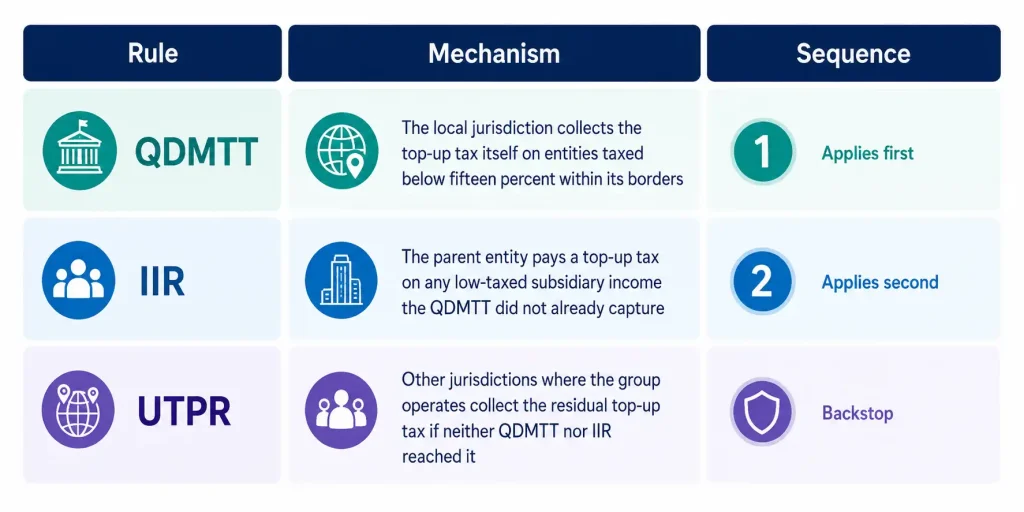
More than 140 countries under the OECD/G20 Inclusive Framework have agreed to the framework in principle. Implementation is well underway across Europe and parts of Asia. The United States has not enacted the Income Inclusion Rule or the Undertaxed Profits Rule into domestic law. The January 2026 Side-by-Side guidance formalized a different arrangement instead. U.S.-parented groups can now elect relief from both rules. That relief applies to fiscal years beginning on or after January 1, 2026. It does nothing to change the Qualified Domestic Minimum Top-Up Tax. That tax continues to apply as the first layer of taxation in every jurisdiction that has adopted it. A Pillar Two tax strategy built only around U.S. non-adoption misses the larger part of the exposure. The real gap sits between political relief and operational reality. That gap now defines the Pillar Two impact on U.S. companies with meaningful foreign footprints.
Understanding the GloBE Mechanics: IIR, UTPR, and QDMTT
Pillar Two operates through three interlocking rules, applied in a defined sequence rather than as independent options. The calculation itself is based on financial statement income adjusted under the GloBE rules, not on taxable income under local statutory systems, which is precisely why the compliance burden falls as heavily on controllership as it does on the tax department.
In a high-growth cybersecurity and identity access management company operating entities across the United States, Canada, Mexico, India, and Nepal, building a reporting cadence that could hold actuals within a tight forecast band required a multi-entity finance architecture designed from scratch. That same architecture, extended to track covered taxes and deferred tax positions at the jurisdiction level, is close to what a Pillar Two ETR calculation now demands of any company with a comparable geographic footprint.
The Side-by-Side Safe Harbor: What It Changes for U.S. Companies
The Side-by-Side package addressed a specific problem. The G7 had agreed in principle that the U.S. corporate tax system, including the corporate alternative minimum tax, achieves outcomes broadly aligned with Pillar Two, and the OECD’s central record now lists the United States as operating a qualified Side-by-Side regime. Groups with a U.S. ultimate parent entity can elect a deemed top-up tax of zero under both the IIR and the UTPR across their domestic and foreign operations, an outcome that removes a significant share of the double-taxation risk that had been building since 2024.
What the Safe Harbor Does Not Cover
Three limits matter for anyone assessing the Pillar Two impact on U.S. companies this year.
- The safe harbor applies to fiscal years beginning on or after January 1, 2026. Financial years 2024 and 2025 remain fully subject to the original GloBE framework, and GloBE Information Return filings for those years are coming due even as the new relief takes effect.
- QDMTTs are unaffected. A subsidiary taxed below fifteen percent in Ireland, Singapore, or the United Kingdom still triggers a local top-up tax, safe harbor election or not.
- The safe harbor is conditional. If the United States were to lower its corporate rate or repeal the alternative minimum tax, the qualifying status could be withdrawn.
Building a Compliance-Ready Pillar Two Tax Strategy
Compliance with Pillar Two is not a filing exercise layered onto existing tax returns. It requires a centralized, consolidated reporting framework built on accounting standards, assembled across systems that were rarely designed with jurisdiction-level granularity in mind.
Data, Systems, and Governance
Four requirements tend to surface in nearly every implementation.
- Jurisdictional ETR calculations that reconcile adjusted financial income and covered taxes on a country-by-country basis, often diverging from both local GAAP and U.S. GAAP.
- Deferred tax tracking that can disaggregate the portion of deferred tax that counts toward the minimum tax calculation from the portion that does not.
- Data granularity sufficient to enhance country-by-country reports with Pillar Two metrics, which frequently means modifying ERP systems, tax engines, and consolidation tools rather than bolting on a spreadsheet.
- Documentation built in real time, since GloBE Information Returns will face audit scrutiny across multiple jurisdictions simultaneously.
A Euronext Paris-listed gaming and digital entertainment company operating across the United States, France, the United Kingdom, Singapore, and South Korea faced a related version of this problem well before Pillar Two existed: five countries, two accounting standards, and a board that needed one unified definition of revenue. Rolling out a single financial platform across every subsidiary was what made statutory reporting under both IFRS and US GAAP tractable. A durable Pillar Two tax strategy asks for that same discipline, applied to tax data instead of revenue data.
Strategic Implications for Entity Structure and Global Tax Planning
Pillar Two reorders the incentives that have guided entity structuring for a generation. A low-tax jurisdiction offers little unless it also brings operational efficiency, talent access, or market proximity, since the tax benefit alone is now capped at fifteen percent before a top-up applies somewhere in the chain.
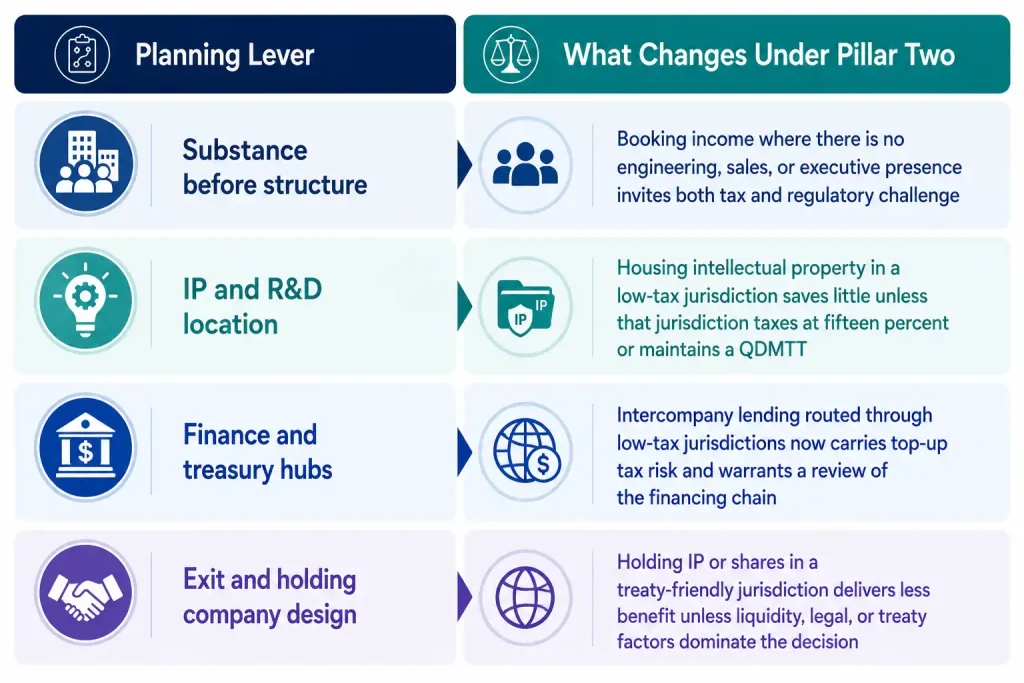
In a $127M global consumer products company selling through direct-to-consumer, Amazon, and wholesale channels with a supply chain spanning China and Vietnam, the entities that carried real inventory risk, real logistics decisions, and real working capital exposure were the ones that could defend their profit allocation under scrutiny. That same logic, substance carrying the tax position rather than the tax position dictating where substance gets booked, is what Pillar Two now enforces at a structural level.
Case Study: Restructuring Ahead of Pillar Two Exposure
A U.S.-based hardware company with subsidiaries in Hungary, Singapore, and Ireland had historically held its intellectual property in Bermuda and licensed it to affiliates. As Pillar Two gained momentum, a cross-functional assessment modeled the top-up tax exposure across every jurisdiction in the structure.
The findings were direct. Bermuda-sourced profits carried a $22M top-up tax exposure, collectible under Singapore’s QDMTT. Intercompany interest deductions in Hungary were partially disallowed under local rules, which pushed the blended effective rate higher still. The company relocated its intellectual property to Ireland, aligned research and development headcount with the entity holding the IP, and established a principal trading structure with genuine operating substance. Bermuda was wound down entirely.
Because QDMTT exposure sits outside the reach of the Side-by-Side safe harbor, this restructuring logic holds regardless of IIR and UTPR relief. Singapore would still collect its QDMTT on the Bermuda profits under the current 2026 rules. The company improved its forecasting accuracy for investor reporting and positioned itself more favorably ahead of a planned public offering, since underwriters read a cleaned-up structure as a sign of operational maturity.
Three Key Takeaways
- The Side-by-Side safe harbor removes a meaningful share of IIR and UTPR exposure for U.S.-parented groups electing relief from 2026 forward, but it leaves QDMTT obligations fully in place, so any Pillar Two tax strategy still needs a jurisdiction-by-jurisdiction map of where local top-up taxes apply.
- The compliance burden is a data and systems problem before it is a tax problem, and the companies that treat GloBE reporting as an extension of their consolidation architecture, rather than a bolt-on spreadsheet exercise, will file with less friction and less audit risk.
- Entity structures that separate economic substance from booked profit are the ones most exposed under the new rules, which means the highest-value planning work now lies in aligning intellectual property, treasury, and holding company decisions with where the underlying operations actually sit.
Disclaimer: This article is intended for informational purposes only and does not constitute legal, tax, or accounting advice. You should consult your own tax advisor or counsel for advice tailored to your specific situation.
Hindol Datta is a four-time CFO and senior finance executive with over 25 years of leadership experience across cybersecurity, SaaS, gaming, logistics, digital marketing, medical devices, consumer products, and nonprofit organizations. He has led more than $120M in fundraising and over $150M in M&A transactions while building the financial and operational systems that let complex businesses scale with confidence. He is the author of seven books in the Systems CFO Series and holds active CPA, CMA, and CIA credentials.
AI-assisted insights, supplemented by 25 years of finance leadership experience.