
Executive Summary
Finance teams frequently model cross-border M&A as a financial exercise, and it frequently fails as one. The valuation may be sound, and the multiple may be fair. Yet the deal can still unravel within eighteen months of close. Dealmakers treated tax nuance, regulatory timelines, and cultural friction as diligence footnotes, not as the load-bearing structure of the transaction. Across cybersecurity, gaming, consumer products, and professional services, the same pattern repeats. The numbers sign the deal, but structure, compliance sequencing, and human integration decide whether it holds together.
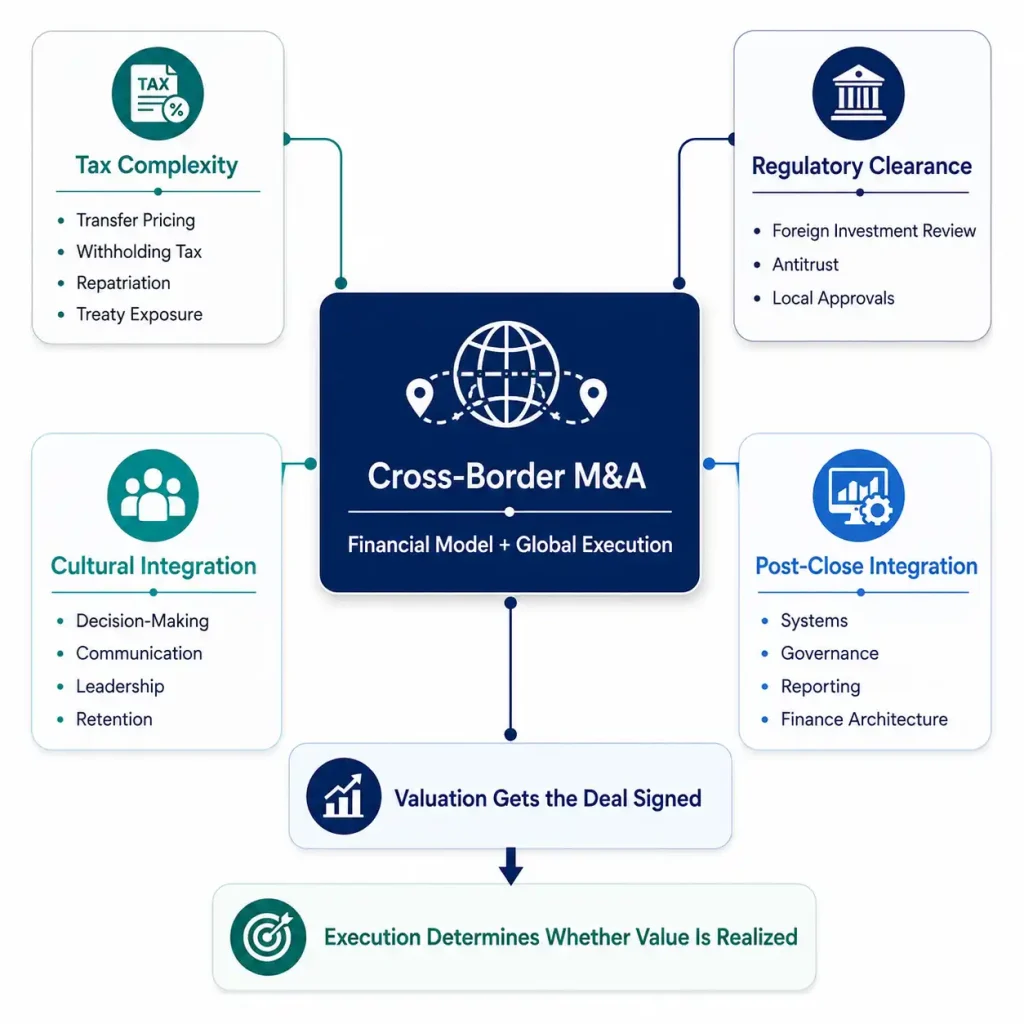
This article walks through the four forces that most often decide the outcome of cross-border mergers and acquisitions. Tax exposure rarely behaves the way domestic models predict. Regulatory clearance functions as a gating item rather than a formality. Cultural misalignment erodes value long after the ink dries. Integration planning must start during diligence, not after signing. The goal is not to make cross-border M&A simpler. It is to make the complexity visible early enough to manage.
Why Cross-Border Mergers and Acquisitions Are Never Just a Spreadsheet Exercise
Dealmakers can build a domestic acquisition model almost entirely from comparable transactions and a discounted cash flow. A cross-border merger and acquisition cannot. The spreadsheet does not natively account for the tax treaty in play. It misses the regulatory body with jurisdiction, or the operating culture the acquiring company is about to inherit. The deals that hold together post-close tend to share one trait. Finance treated jurisdictional complexity as a design constraint from the first diligence call. It was not a problem to solve after signing.
One Euronext Paris-listed public gaming company operated across the United States, France, the United Kingdom, Singapore, and South Korea. Its finance organization executed more than $100M in cross-border M&A. It held due diligence and post-merger integration responsibility rather than delegating it entirely to outside advisors. That structure embeds finance in the deal mechanics rather than having it react to them. This tends to separate deals that create value from deals that merely close.
Tax Complexity: Where the Real Risk in Cross-Border M&A Hides
Tax exposure in a cross-border deal is rarely linear. Dealmakers often need to evaluate transfer pricing, withholding tax, permanent establishment risk, and treaty eligibility across every subsidiary. This applies not only in the parent’s jurisdiction. A software company with subsidiaries in five countries can carry tax exposure no single-entity model captures. A clawback provision buried in local law will not surface in a standard diligence checklist. Spain, for instance, requires that R&D incentives be forfeited unless headcount and entity continuity are preserved for three years.
Central European acquisitions carry a similar trap. Accumulated tax loss carryforwards can look like a straightforward asset. Then the local tax code requires continuity of operations to preserve them, and an org chart redesign becomes the price of the benefit. A modeled 3% tax benefit over five years can fall to zero without that adjustment. This is why tax structuring belongs in the earliest diligence workstream, not in a closing checklist.
Repatriation and the Trapped Cash Problem
Even a well-structured acquisition can trap value if profits cannot be upstreamed without triggering excessive withholding tax or adverse consequences under provisions such as Section 956 or GILTI. A financing structure built around a Brazilian operating entity may need to be redesigned entirely once it becomes clear that cash generated there cannot move freely to the parent, and that redesign changes both valuation and working capital assumptions before the deal closes.
Regulatory Compliance Across Borders Is a Gating Item, not a Checkbox
Every jurisdiction carries its own regulatory temperament. Europe leans data-privacy forward, the United States is disclosure-driven, and procedural timelines in markets such as India or China can extend well beyond what a domestic deal calendar assumes. A medical device acquisition with German operations can stall for months on CE mark registration rather than on financing. A transaction involving a Chinese counterparty may hinge on MOFCOM approval, or on a single clause in the articles of association, such as super-voting rights held by a foreign investor, that forces a full shareholder-structure revision before a regulator will move forward.
The regulatory landscape has only grown more layered. Foreign direct investment screening regimes, CFIUS in the United States, the Foreign Investment Review Board in Australia, and equivalent bodies across the EU and UK, increasingly treat national security review as a strategic variable rather than a procedural step, particularly in technology, critical infrastructure, and advanced manufacturing. These reviews commonly run six to twelve months and sit squarely on the critical path.
Common gating items that belong on the deal calendar from day one:
- Foreign investment review: CFIUS, FIRB, or an EU member state’s national screening regime, in sensitive sectors especially
- Antitrust and competition clearance: often required in multiple jurisdictions simultaneously
- Local investment board consent: required in markets including South Africa and Indonesia
- Sector-specific approval: CE mark registration, MOFCOM review, or equivalent bodies depending on industry
Underestimating the time and cost of securing these approvals is one of the most common ways a close date becomes a moving target.
Cultural Friction: The Invisible Headwind in Cross-Border M&A
Deals fail after close more often because of culture than because of arithmetic. A merger between a California technology company and a Japanese manufacturing firm can clear every financial hurdle, with synergies fully validated, and still see attrition surge and project velocity collapse within six months, because the acquiring side operated on an action-biased decision model while the acquired side operated on consensus. Integration in that kind of scenario tends to stall until governance is deliberately split into two tracks: one for execution, one for deliberation, so that neither operating culture is forced to abandon its instincts overnight.
Communication norms, risk tolerance, conflict resolution style, and even calendar assumptions can quietly derail collaboration long before anyone calls it a cultural problem. A cross-border merger and acquisition is as much an exercise in organizational anthropology as in finance, and treating it that way from diligence onward separates integration plans that work from playbooks that sit in a binder.
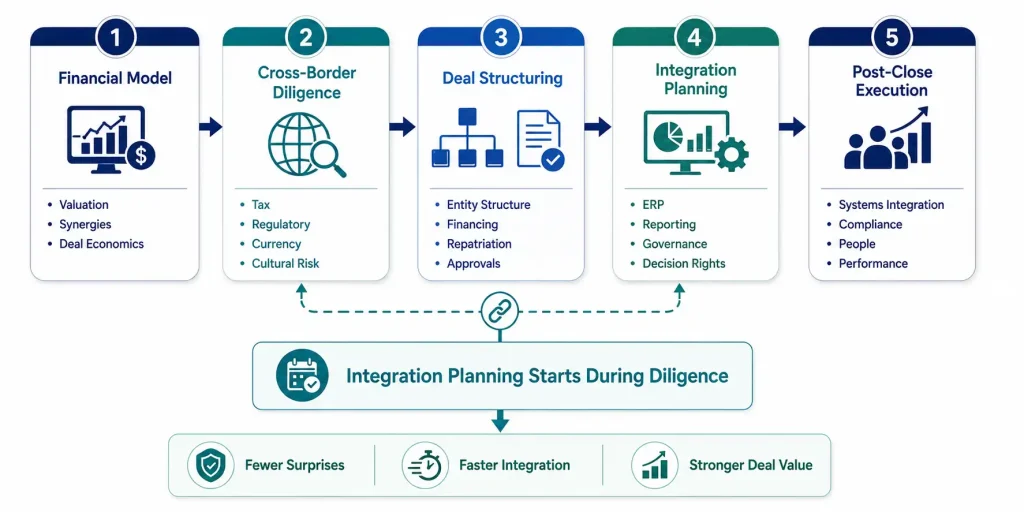
Integration Must Begin at Diligence, Not After Signing
Waiting until the ink is dry to plan integration is already too late. Which systems will be harmonized, what reporting will change, what tax exposure follows from combining payroll or balance sheets, need answers before signing. In one cross-border SaaS acquisition, a basic revenue recognition mismatch, one side recognizing on delivery and the other on a ratable basis, was not discovered until diligence was well underway, and the resulting restatement pushed integration back four months.
Systems, Governance, and the Architecture of Post-Close Success
Mismatched ERP systems, fragmented data standards, and inconsistent charts of accounts can cripple integration long after the deal is considered a success on paper. In a high-growth cybersecurity and identity access management company operating across the United States, Canada, Mexico, India, and Nepal, building a single multi-entity finance architecture, rather than allowing five country entities to run on five different systems, compressed the monthly close cycle and gave leadership one consistent view of the combined business rather than five partial ones.
Governance deserves the same early attention. Who holds decision rights post-close, who has hiring authority, and which board retains oversight are questions that, left unanswered, produce paralysis regardless of how well the purchase agreement was drafted. A governance track belongs in every integration playbook, complete with escalation procedures and a communications protocol, well before it becomes urgent.
Financing Structure and Currency Risk in Cross-Border Deals
Debt covenants, currency translation adjustments, and intercompany loan arrangements behave unpredictably once multiple legal entities and currencies enter the picture. Hedging strategies that are routine domestically often do not translate cleanly to a multi-currency structure, and a modest currency devaluation can erase a meaningful share of projected first-year margin if it was not modeled as a sensitivity from the outset.
A $127M global consumer products company with a supply chain spanning China and Vietnam illustrates the same principle from the operating side: doubling inventory turns and transforming cash conversion required treating currency and logistics exposure as one integrated forecasting problem, not two-line items reviewed by two separate teams.
Conclusion: The New Arbitrage in Cross-Border M&A Is Execution
Cross-border M&A success used to be attributed primarily to getting the price right. Increasingly, it depends on getting the structure, the compliance sequencing, and the cultural integration right, since the arbitrage available in multiples has narrowed while the cost of poor execution has not. The finance function’s role has shifted accordingly, from validating the model to translating global complexity into a plan the organization can actually execute.
The deal begins with a financial model, but it closes, or fails, in the nuance of tax law, the patience required by regulatory bodies, and the willingness of people who were never in the room during negotiation to work together afterward. Managing that terrain is not a post-close add-on. It is the substance of cross-border mergers and acquisitions.
Three Key Takeaways
- Tax and regulatory exposure in cross-border M&A must be modeled at the subsidiary level and treated as a gating item on the deal calendar, since a single overlooked local provision, whether a clawback rule, a foreign investment screening requirement, or a repatriation constraint, can change both valuation and timeline.
- Cultural and organizational integration deserves the same diligence rigor as financial and legal review, because deals that clear every financial and regulatory hurdle can still fail post-close when decision-making norms and communication styles were never reconciled.
- Integration planning, covering systems, governance, and financing structure, should begin during diligence rather than after signing, since the questions that determine whether synergies materialize are the same questions that are cheapest to answer before the deal closes.
Disclaimer: This article is intended for informational purposes only and does not constitute legal, tax, or accounting advice. Readers should consult their own tax advisor or counsel for advice tailored to their specific situation.
Hindol Datta is a four-time CFO and senior finance executive with over 25 years of leadership experience across cybersecurity, SaaS, gaming, logistics, digital marketing, medical devices, consumer products, and nonprofit organizations. He has led more than $120M in fundraising and over $150M in M&A transactions while building the financial and operational systems that let complex businesses scale with confidence. He is the author of seven books in the Systems CFO Series and holds active CPA, CMA, and CIA credentials.
AI-assisted insights, supplemented by 25 years of finance leadership experience.