
Executive Summary
Fair value measurement sits at the intersection of accounting rule and market judgment. Few line items expose that tension as plainly as an earnout or a convertible note. A preferred share block in a private company works just as well. Under ASC 820, and under its international counterpart IFRS 13, fair value is defined as an exit price. It is the price a market participant would accept to sell an asset, or pay to transfer a liability. That definition sounds precise, until the asset in question has no observable market at all. Finance leaders often treat fair value measurement as a year-end formula rather than an operating discipline. That approach tends to surface the gap at the worst possible moment. That moment is usually an audit, a funding round, or a board meeting. That is when the gap becomes most expensive to close.
This guide walks through the fair value hierarchy and the three valuation methods practitioners rely on. It also covers the governance structures that keep Level 3 estimates defensible. It closes with the connections between fair value measurement and the standards it touches most. Those standards include purchase accounting, stock compensation, and goodwill impairment testing.
What Fair Value Measurement Actually Means
The fair value meaning embedded in ASC 820 is narrower than the colloquial use of the term. It is not book value, not replacement cost, and not the price a motivated buyer might pay under duress. Instead, it is a market-based exit price, observed or estimated. That price reflects what a rational, unpressured counterparty would transact at on the measurement date. IFRS 13 defines fair value in nearly identical terms. The two frameworks are substantively converged on the hierarchy itself. They differ mainly in disclosure presentation, and in how certain financial instruments are treated at the unit-of-account level.
That convergence matters for any organization operating across borders. A gaming and digital entertainment company listed on a European exchange reports results across five countries. Those countries include the United States, France, the United Kingdom, Singapore, and South Korea. The company has to produce one internally consistent definition of fair value that satisfies both IFRS 13 and US GAAP. Reconciling those two frameworks across five jurisdictions is a materially different exercise than applying ASC 820 in isolation.
The Three-Level Fair Value Hierarchy
ASC 820 and IFRS 13 both organize fair value measurement into a hierarchy. That hierarchy is based on how observable the underlying inputs are:
- Level 1: Quoted prices in active markets for identical assets, requiring no adjustment and carrying the least judgment.
- Level 2: Observable inputs other than quoted prices, such as interest rates, yield curves, or comparable market transactions.
- Level 3: Unobservable inputs built from the entity’s own assumptions, used when no active market exists for the asset or liability being measured.
The deeper an item sits in the hierarchy, the heavier the documentation burden becomes. A Level 3 measurement is rarely disputed on the mathematics. It is disputed on the support behind the inputs. Reconciling those inputs during an audit of earnout liabilities tied to post-acquisition performance can consume weeks rather than days.
Where Judgment Concentrates
Three categories of Level 3 items recur across most fair value measurement exercises: earnout liabilities, convertible notes with embedded derivatives, and preferred share valuations in private companies. Each of these forces a defense of assumptions that a Level 1 or Level 2 item never requires. During a Series C round, it is common for a company’s 409A valuation to diverge from the fair value of preferred shares recorded on the balance sheet, and the delta usually traces back to option preferences, liquidity assumptions, and anticipated IPO timing, all defensible individually but all subjective in combination. Unsubstantiated Level 3 inputs are one of the most reliable sources of audit delay, which is why cross-functional review, spanning legal, tax, and outside valuation advisors, belongs in the process before the number ever reaches the balance sheet rather than after an auditor flags it.
Fair Value Methods: Income, Market, and Cost Approaches
Every fair value method in active use traces back to one of three approaches, and most valuation professionals blend more than one depending on the asset class involved.
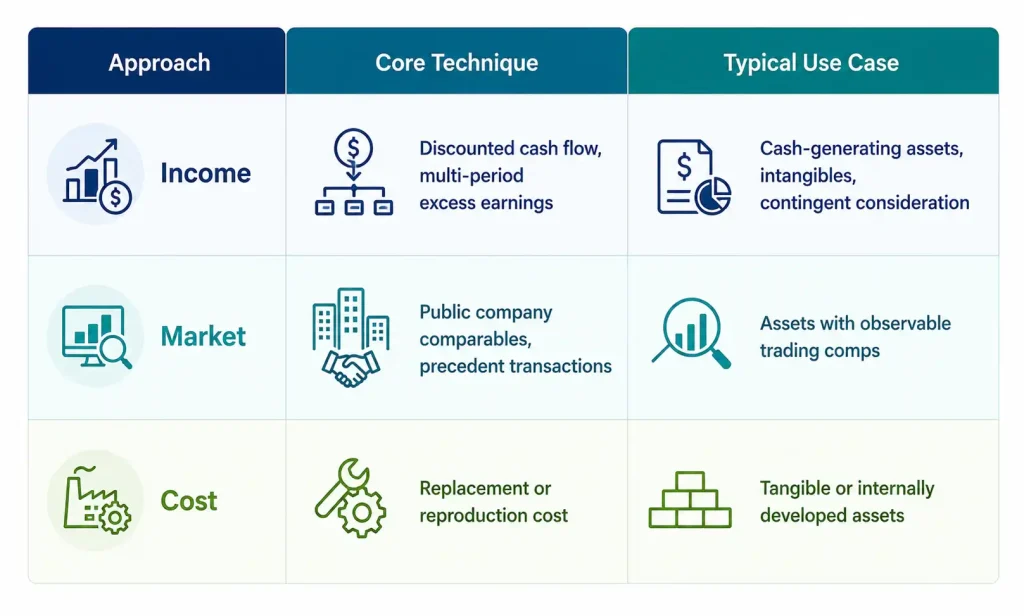
For contingent liabilities such as earnouts, a probability-weighted expected return model or a Monte Carlo simulation is often the default fair value method, because both are built to handle the sensitivity of discount rates, volatility assumptions, and scenario probabilities rather than forcing a single deterministic outcome.
Contingent Consideration and Monte Carlo Modeling
Monte Carlo simulations are sometimes dismissed as black-box modeling, but for contingent consideration tied to revenue growth, they tend to outperform deterministic approaches precisely because deterministic models create blind spots in volatile environments. In one SaaS-adjacent acquisition scenario, valuing an earnout tied to annual recurring revenue growth required modeling more than 10,000 possible paths using volatility estimates drawn from comparable public companies, and the difference between a 15 percent and an 18 percent volatility assumption produced a swing of roughly $2M in the recorded liability. That kind of sensitivity is exactly why clean inputs matter more than model sophistication. A Monte Carlo engine fed unreliable assumptions will still produce a confident-looking number, and a confident-looking number is not the same as a defensible one.
Contingent consideration also surfaces where sellers and buyers disagree on allocation. When a seller pushes for a higher trade name value because it lowers post-close amortization and improves reported margins, running parallel models under both a relief-from-royalty and an excess-earnings approach tends to settle the argument through comparative analysis rather than negotiation posturing, which shortens the path to close considerably.
Governance and Disclosure as Strategic Narrative
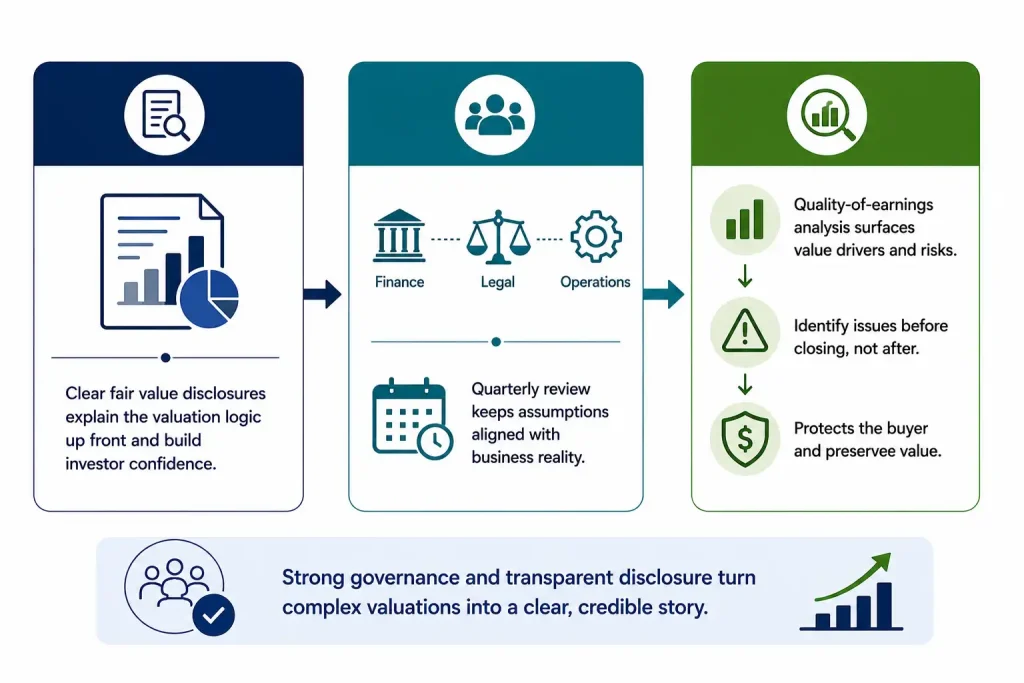
ASC 820 requires robust disclosure for Level 3 assets, including valuation techniques, the specific inputs used, changes in assumptions period over period, and a rollforward of balances. Treating these disclosures purely as a compliance obligation misses their real function. A well-constructed fair value footnote in a 10-K can walk investors through the valuation logic behind a large earnout liability before anyone asks the question, and that kind of anticipatory disclosure tends to prevent the reactive clarification calls that erode confidence during earnings season.
Governance structure reinforces this. A standing valuation committee, chaired by finance but including legal and operations, reviewing every significant fair value estimate on a quarterly cadence rather than a year-end scramble, keeps assumptions tied to business reality rather than to whatever number was easiest to defend twelve months earlier. In a mission-driven education institution that raised $37M across equity and venture debt, the finance function sat inside the same governance structure as the audit committee and board, and that proximity made it far easier to keep funding assumptions, valuation inputs, and board expectations aligned as philanthropic and earned-revenue conditions shifted year to year. The same discipline applies during buy-side diligence: quality-of-earnings analysis on an IT services acquisition target routinely surfaces EBITDA adjustments that trace directly back to fair value assumptions embedded in prior periods, and catching those adjustments before close protects the buyer far more than catching them after.
How Fair Value Measurement Connects to ASC 805, 718, and 350
Fair value measurement rarely operates in isolation. It feeds directly into:
- ASC 805 – purchase price allocation in mergers and acquisitions.
- ASC 718 – stock-based compensation expense, where volatility, expected term, and risk-free rate assumptions drive recognized cost.
- ASC 350 – goodwill impairment testing, where the fair value of acquired intangibles determines amortization and downstream impairment exposure.
Executing more than $100M in cross-border merger and acquisition transactions across a multi-country gaming platform makes the cascade visible in a way that a single-country transaction rarely does. The fair value assigned to acquired customer contracts determines not only the intangible asset value on day one but also the amortization expense that flows through earnings for years afterward, and that amortization schedule directly shapes the base against which future goodwill impairment testing is measured. A modest change in discount rate assumptions at the point of acquisition can surface as earnings volatility two fiscal years later, long after the original deal team has moved on to the next transaction.
Stock-based compensation carries a parallel risk. Underestimating volatility in an ASC 718 valuation understates expense for years, and the eventual correction tends to ripple into board-approved grants, option repricing decisions, and unwelcome SEC correspondence, all of which are avoidable with a defensible volatility assumption at the outset.
Three Key Takeaways
- Fair value measurement under ASC 820 and IFRS 13 is fundamentally a market-based exit price framework, and the deeper an asset sits in the three-level hierarchy, the more the accuracy of the number depends on the quality of documentation behind it rather than on the sophistication of the model itself.
- Income, market, and cost approaches each serve a distinct purpose, and Monte Carlo simulation or probability-weighted modeling becomes essential once contingent consideration or earnout liabilities introduce meaningful sensitivity to volatility and discount rate assumptions.
- Fair value measurement cascades into purchase accounting, stock compensation expense, and goodwill impairment testing, which means governance structures such as a standing valuation committee and proactive footnote disclosure are not compliance overhead but risk management for earnings volatility that can surface years after the original estimate was recorded.
Disclaimer: This article is intended for informational purposes only and does not constitute legal, tax, or accounting advice. You should consult your own tax advisor or counsel for advice tailored to your specific situation.
Hindol Datta is a four-time CFO and senior finance executive with over 25 years of leadership experience across cybersecurity, SaaS, gaming, logistics, digital marketing, medical devices, consumer products, and nonprofit organizations. He has led more than $120M in fundraising and over $150M in M&A transactions while building the financial and operational systems that let complex businesses scale with confidence. He is the author of seven books in the Systems CFO Series and holds active CPA, CMA, and CIA credentials.
AI-assisted insights, supplemented by 25 years of finance leadership experience.