
Executive Summary
Tax due diligence is frequently treated as a compliance checklist. In practice, it determines whether a target’s stated tax assets survive contact with the deal. A rigorous section 382 limitation review, paired with disciplined basis step-up analysis, separates deals that create durable value. Without that pairing, deals quietly erode value after closing. Net operating losses, deferred tax assets, and interest deduction carryforwards can look substantial on a balance sheet. Yet once an ownership change caps their usable amount, that balance can be worth only a fraction of the stated figure.
This article works through the mechanics of a section 382 analysis, the structural choices that determine whether a buyer can step up asset basis, and the practical discipline required to translate these findings into pricing, structuring, and post-close financial reporting decisions.
Net Operating Losses and the Mechanics of Section 382 Limitation
Net operating losses appear attractive on paper: they promise to offset future taxable income with losses already incurred, effectively lowering the acquirer’s future cash tax bill. That promise depends entirely on whether IRC Section 382 has already capped the losses before the deal even closes.
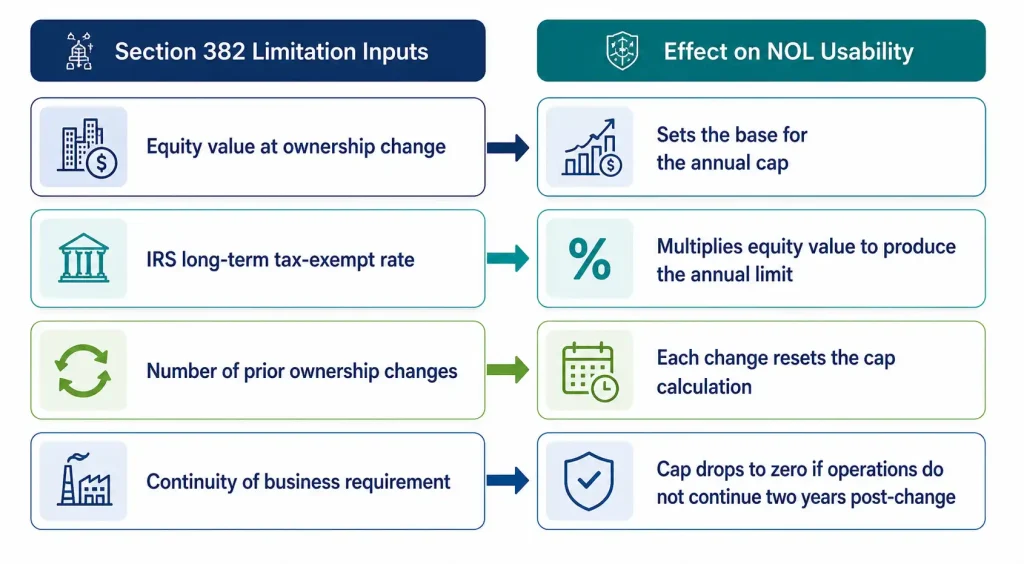
Under Section 382, an ownership change occurs when 5 percent shareholders increase their aggregate ownership by more than 50 percentage points over a rolling three-year testing period. Crossing that threshold caps the annual usable amount of pre-change NOLs: the company’s equity value multiplied by the IRS long-term tax-exempt rate sets the ceiling, a figure that has moved from under 1% to well above 3% in recent years and therefore changes the size of the cap depending on when the change occurred.
What Triggers an Ownership Change
Ownership changes are not confined to a single acquisition event. Layered funding rounds, secondary sales, and even the accumulation of smaller equity shifts across a testing window can independently cross the 50-percentage point threshold. A target may have already used up its Section 382 headroom years before an acquirer arrives, and no one at the company may have noticed.
A buy-side engagement supporting due diligence on an IT services acquisition illustrated this pattern directly: quality-of-earnings work and integration risk mapping surfaced material adjustments between reported and economic earnings, the kind of gap a section 382 analysis exists to catch before it becomes the buyer’s problem.
Modeling the Cap
Reconstructing ownership history across multiple funding rounds is laborious, particularly in venture-backed companies with layered preferred stock. Historical cap table modeling, reaching back several years and tracking every 5 percent shareholder, is the only reliable way to determine whether prior rounds already triggered a change. Skipping this step means pricing a tax asset that may already be a fraction of its stated value.
Basis Step-Up: The Quiet Driver of Post-Close Cash Flow
Where Section 382 constrains value, basis step-up can create it. When a buyer revalues acquired assets to fair market value, depreciation and amortization rise accordingly, reducing taxable income for years after close. In one technology acquisition scenario, the ability to step up basis on developed software and customer relationships translated into a meaningful multi-year tax savings figure, narrowing the valuation gap between buyer and seller before a single negotiating session on price.
Election Mechanics and State Conformity
Asset deals allow a step-up naturally. Stock deals do not, unless a Section 338(h)(10) or 336(e) election is available, and both require seller cooperation along with specific eligibility conditions, including that the target be a subsidiary of a corporation. Even when the election is available, the benefit is uneven. State conformity with 338 elections varies widely: some states accept the federal treatment, others do not, producing divergent basis schedules that complicate purchase accounting and ERP integration long after the deal papers are signed.
Beyond NOLs: Section 382 Limitation on Built-In Losses and Section 163(j)
Section 382 does not stop at net operating losses. It also constrains built-in losses and interacts with the interest deduction limitations under Section 163(j). For leveraged acquisitions built around distressed assets or pre-revenue targets, this combination can erode value from two directions at once, since the buyer may expect to use both NOLs and interest deductions to manage post-close tax expense, only to watch Section 382 and Section 163(j) restrict both at the same time.
Building a Joint Limitation Model
A joint limitation model, run before signing rather than after, quantifies this interaction precisely. Executive teams that build this model into the standard diligence workflow avoid the scenario where a deal looks attractive on an unadjusted NOL balance and turns out, after the section 382 analysis, to deliver only a marginal annual benefit.
What Great Section 382 Analysis Looks Like in Practice
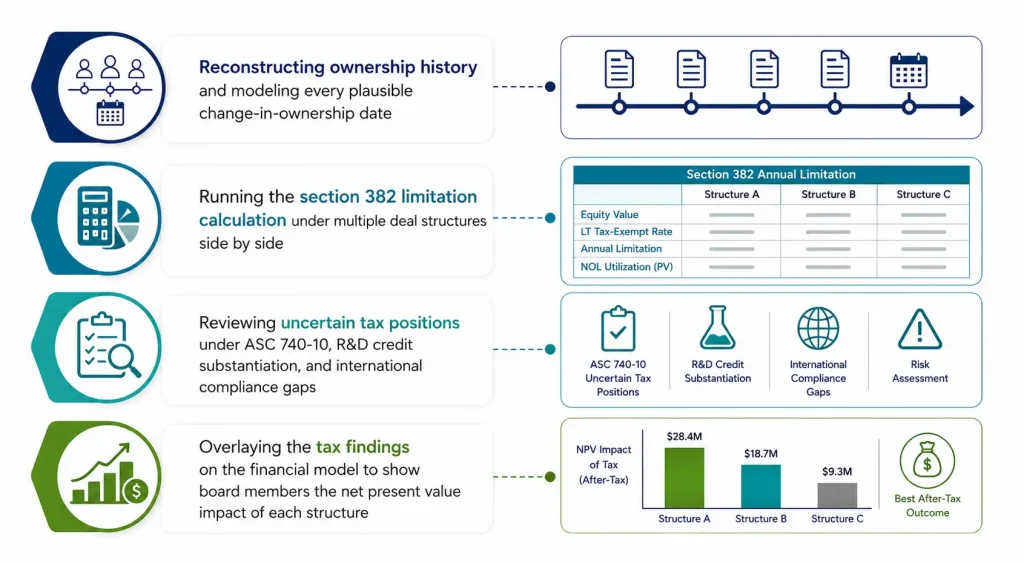
Turning Analysis into Board-Ready Findings
A finance function scaling a high-growth cybersecurity and identity access management company built exactly this kind of board-grade reporting and controls environment, work that later carried the business through acquisition diligence without the scramble that undocumented tax positions typically produce. In a separate engagement inside a venture-backed digital marketing organization, the finance team led three acquisitions end to end, each requiring its own tax attribute review before integration began, a reminder that this discipline does not get easier with repetition; it gets more consequential.
Coordinating Diligence with Financial Reporting
The findings from a section 382 analysis do not stay confined to the deal team. Impaired NOLs force a write-down of deferred tax assets. Executing a 338 election requires the opening balance sheet to show goodwill and deferred tax liabilities correctly. Disconnects between the diligence findings and the accounting treatment are a common source of restatement risk and audit friction.
Why the Coordination Cannot Wait
Leading a Euronext-listed gaming and digital entertainment company through more than $100M in cross-border M&A, with full due diligence and post-merger integration responsibility, made this coordination unavoidable: a single definition of revenue and a consolidated reporting framework across IFRS and US GAAP left no room for tax findings to sit outside the financial statements those findings needed to inform.
Tax due diligence, done well, is not a stack of memos. It is a strategic narrative that shapes negotiation, pricing, and structure, translating risk into escrow provisions when liabilities are unknown, into price adjustments when NOLs are limited, and into shared benefit arrangements when a step-up is achievable.
Three Key Takeaways
- A section 382 limitation calculation should begin in the first week of diligence, with full cap table access, because ownership changes triggered years earlier can silence a target’s entire NOL balance before the acquirer ever arrives at the table.
- Basis step-up availability is a structural question, not a formality, and the choice between an asset deal and a stock deal with a 338(h)(10) or 336(e) election deserves the same scrutiny as revenue synergies, including a clear-eyed look at state conformity gaps.
- Section 382 findings only create value when they are connected to financial reporting and negotiation strategy, turning impaired NOLs, constrained interest deductions, and step-up opportunities into concrete adjustments to price, escrow, or deal structure instead of footnotes that surface after close.
Disclaimer: This article is intended for informational purposes only and does not constitute legal, tax, or accounting advice. You should consult your own tax advisor or counsel for advice tailored to your specific situation.
Hindol Datta is a four-time CFO and senior finance executive with over 25 years of leadership experience across cybersecurity, SaaS, gaming, logistics, digital marketing, medical devices, consumer products, and nonprofit organizations. He has led more than $120M in fundraising and over $150M in M&A transactions while building the financial and operational systems that let complex businesses scale with confidence. He is the author of seven books in the Systems CFO Series and holds active CPA, CMA, and CIA credentials.
AI-assisted insights, supplemented by 25 years of finance leadership experience.