
Executive Summary
Every acquisition carries a second negotiation that rarely makes the press release: the net working capital adjustment. Both sides agree on the headline purchase price. Long after that, the working capital purchase price adjustment still has work to do. It determines whether that number survives contact with the business as it actually exists on closing day. That is not the business as it appeared in a data room three months earlier. For finance executives on either side of the table, this is not a technical footnote. Finance teams build, time, and defend the M&A working capital adjustment. How well they do it shapes whether the deal delivers what both sides thought they signed up for. It is the mechanism that separates a fair deal from a quiet transfer of value.
This article walks through how finance teams set normalized net working capital targets. It covers how the adjustment process unfolds between signing and closing, and where the common pitfalls sit. It also covers what disciplined finance teams do to keep the number honest. The frameworks below draw on transactions spanning technology, consumer products, professional services, and public-company M&A.
Why the Net Working Capital Adjustment Exists
A net working capital adjustment exists for a simple reason. The business a buyer acquires on a given date is rarely the business that due diligence teams reviewed months earlier. Buyers collect receivables or watch them pile up. Inventory moves or stalls. Sellers pay down payables or deliberately stretch them. The adjustment reconciles the agreed purchase price with the operational reality of the company as delivered. Neither party should absorb a shift in short-term assets and liabilities they did not bargain for.
A $127M global consumer products company generated revenue through direct-to-consumer, Amazon, and wholesale channels. Its supply chain spanned China and Vietnam. Inventory turns improved from three times to seven, releasing capital that had been sitting quietly on shelves and in transit. That kind of transformation becomes the baseline a buyer eventually measures against. It is exactly why the definition of normalized net working capital matters as much as the number itself. If working capital lands above target at closing, the seller is typically paid the difference. If it comes in below target, the buyer is compensated dollar for dollar. In one manufacturing transaction, a seller quietly delayed vendor payments in the weeks before closing, inflating cash and understating payables, and the working capital adjustment corrected for it, reducing the purchase price by $2.4M.
Setting the Normalized Net Working Capital Target: Not a Formula, a Judgment Call
Arriving at a defensible normalized net working capital target is part analysis and part negotiation. It typically requires trailing twelve-month averages, seasonal adjustments, exclusion of non-recurring items, and a clear view of whether recent revenue spikes or dips distort the baseline.
Building the Baseline
In one buy-side engagement supporting due diligence on an IT services acquisition, quality-of-earnings analysis and EBITDA adjustment work surfaced items that reshaped the deal terms before the purchase agreement was finalized, a reminder that the working capital purchase capital adjustment and the earnings quality review are close cousins rather than separate exercises. A rolling six-month average, excluding a one-time inventory buy, has in practice avoided overpayment that a simple most-recent-month approach would have produced. Where a seller argues for using the most recent month because it reflects current operating rhythm, that framing deserves scrutiny: a promotional campaign or a seasonal trough can distort a single month beyond recognition, and a normalized trailing twelve-month average with seasonal correction is usually the more defensible position.
Timing and Mechanics of the M&A Working Capital Adjustment
The working capital adjustment in M&A follows a fairly consistent sequence, though the pressure it places on finance teams is often underestimated until a deal is already moving.
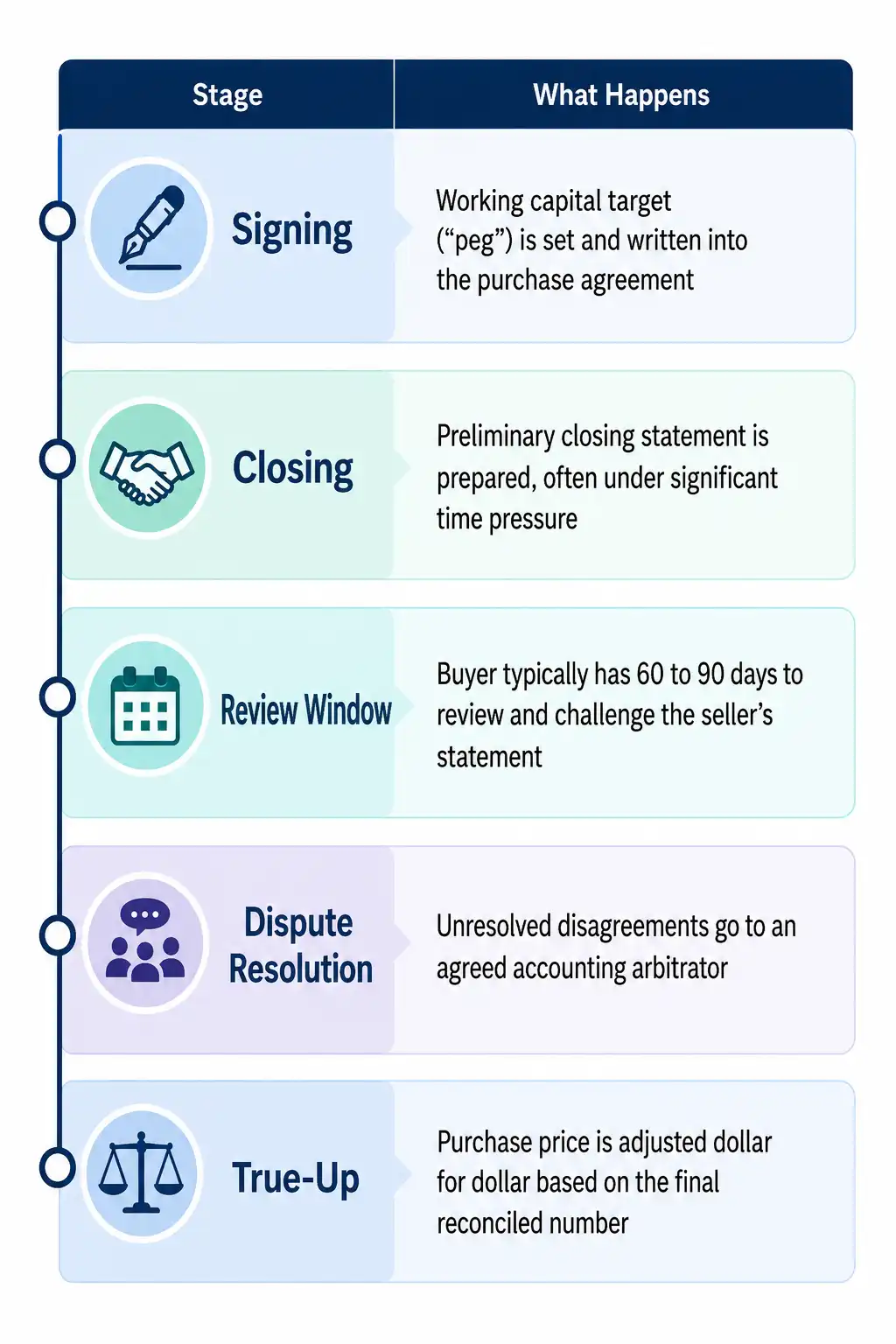
At a cybersecurity and identity access management company generating approximately $30M in annual recurring revenue, board-grade financial reporting and a forecasting discipline that held actuals within five percent of plan for eight consecutive quarters proved its value well beyond routine board meetings; that same reporting rigor carried the business cleanly through acquisition due diligence, including the working capital review that followed. A mock close performed before signing, simulating the closing statement with the data actually available, tends to surface the gaps and judgment calls that would otherwise appear for the first time under deadline pressure.
Common Pitfalls in the Net Working Capital Adjustment (and How to Avoid Them)
Most disputes trace back to a small set of recurring issues, each with a known fix.
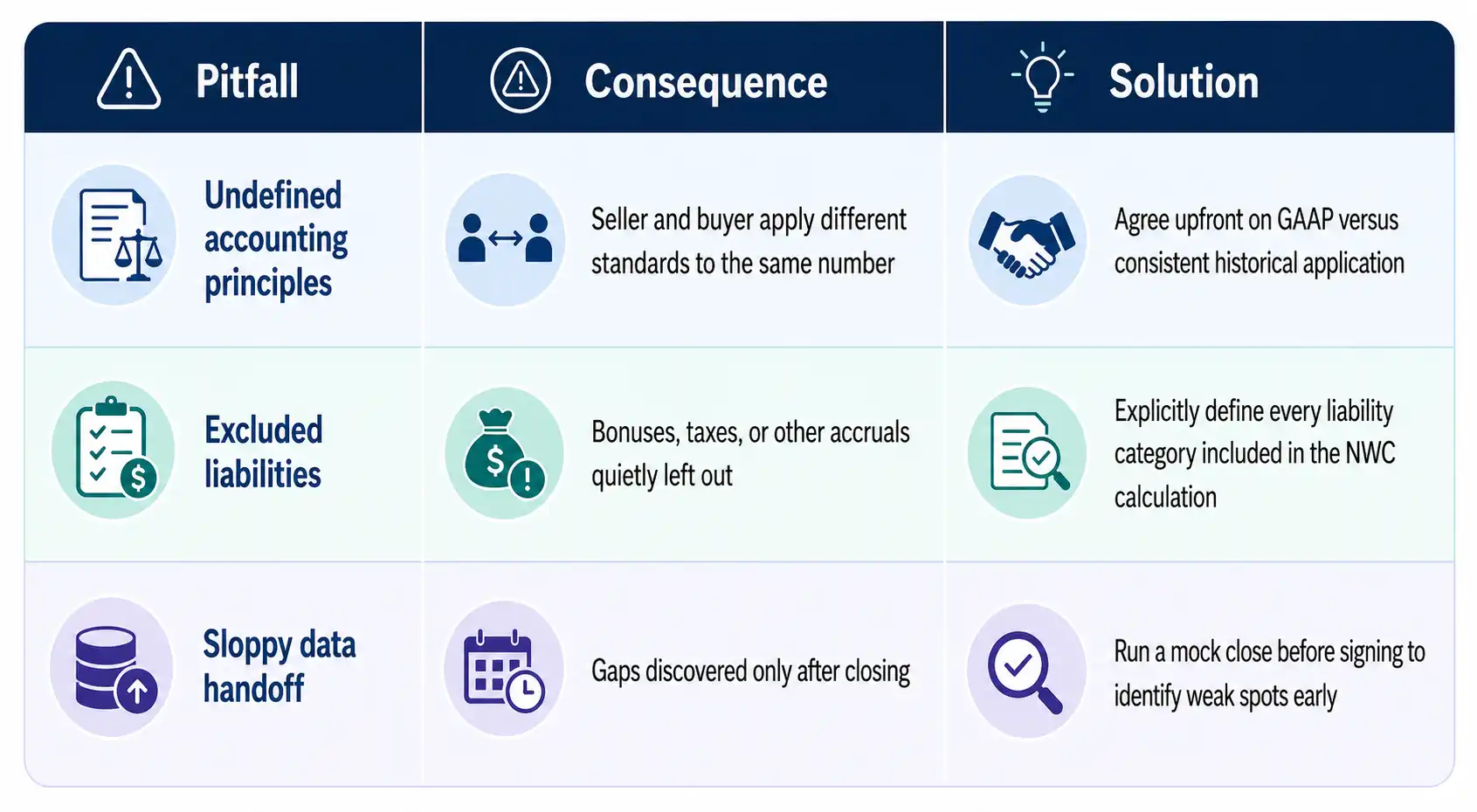
In one instance, a seller excluded accrued bonuses from the working capital target without disclosure, creating a $900K discrepancy that took months of negotiation to resolve. The adjustment process caught the gap, but the delay and legal cost that followed illustrate why precise drafting matters more than any single clause in the purchase agreement.
Escrows and Dispute Resolution: Containing the Risk
Escrow arrangements tied to the working capital adjustment reduce the likelihood that a disagreement escalates into a prolonged dispute. Escrowing 5% to 10% of purchase price pending finalization of the adjustment is common practice, and tying escrow release to auditor sign-off has, in several transactions, aligned both sides toward a faster and more good-faith resolution. Cross-border M&A execution exceeding $100M at a Euronext Paris-listed gaming and digital entertainment company, spanning operations across the United States, France, the United Kingdom, Singapore, and South Korea, underscored how a poorly defined working capital peg can create friction across multiple accounting standards and jurisdictions simultaneously, making a clear pre-negotiated dispute resolution mechanism, including the choice of arbitrating accounting firm and its scope of review, a necessity rather than a formality.
Best Practices for Managing the Working Capital Purchase Price Adjustment
Finance teams that manage this process well tend to share a common set of habits:
- Involve operations, accounts receivable, and accounts payable teams early in working capital modeling, rather than treating it as a finance-only exercise
- Build a reusable playbook of templates, sample clauses, and diligence red flags so deal teams are not reinventing the process each time
- Insist on a clearly drafted dispute resolution clause in the purchase agreement before signing
- Stress-test seasonality and receivables timing assumptions against multiple scenarios rather than a single base case
- Run sensitivity models showing the plausible range of the final adjustment, and size escrow accordingly
Sellers, understandably, sometimes try to manage the outcome: slowing payables, accelerating receivables, or trimming inventory ahead of a measurement date. Sensitivity modeling that quantifies the range of potential swings, sometimes several million dollars on a mid-sized deal, feeds directly into how escrow and price protection are structured.
Three Key Takeaways
- The net working capital adjustment is not an accounting afterthought but the mechanism that reconciles headline purchase price with the operational reality of the business at closing, and it deserves the same rigor applied to revenue recognition or deferred tax accounting.
- A defensible normalized net working capital target depends on trailing average methodology, seasonal correction, and explicit definition of included liabilities, and disputes are far more often a drafting failure than an accounting one.
- Escrow structures, pre-negotiated dispute resolution mechanisms, and a mock close performed before signing consistently reduce both the size and the duration of post-closing working capital disputes.
Disclaimer: This article is intended for informational purposes only and does not constitute legal, tax, or accounting advice. You should consult your own tax advisor or counsel for advice tailored to your specific situation.
Hindol Datta is a four-time CFO and senior finance executive with over 25 years of leadership experience across cybersecurity, SaaS, gaming, logistics, digital marketing, medical devices, consumer products, and nonprofit organizations. He has led more than $120M in fundraising and over $150M in M&A transactions while building the financial and operational systems that let complex businesses scale with confidence. He is the author of seven books in the Systems CFO Series and holds active CPA, CMA, and CIA credentials.
AI-assisted insights, supplemented by 25 years of finance leadership experience.