
Executive Summary
A startup audit is rarely about compliance alone. It is the clearest signal a founder can send to investors, acquirers, and lenders that the company is controlled, credible, and built to last. In the earliest years, speed and improvisation carry a company forward. By the time Series B arrives, investors look past vision toward evidence. Audit discipline supplies that evidence. It confirms that revenue is recognized consistently, that obligations are tracked, and that leadership welcomes scrutiny rather than avoiding it. Auditors, in turn, form a view of the organization that reaches investors long before any formal report is written. Founders who invest early in audit readiness tend to gain speed, leverage, and valuation confidence rather than losing them.
Why Audit Discipline Matters at Scale
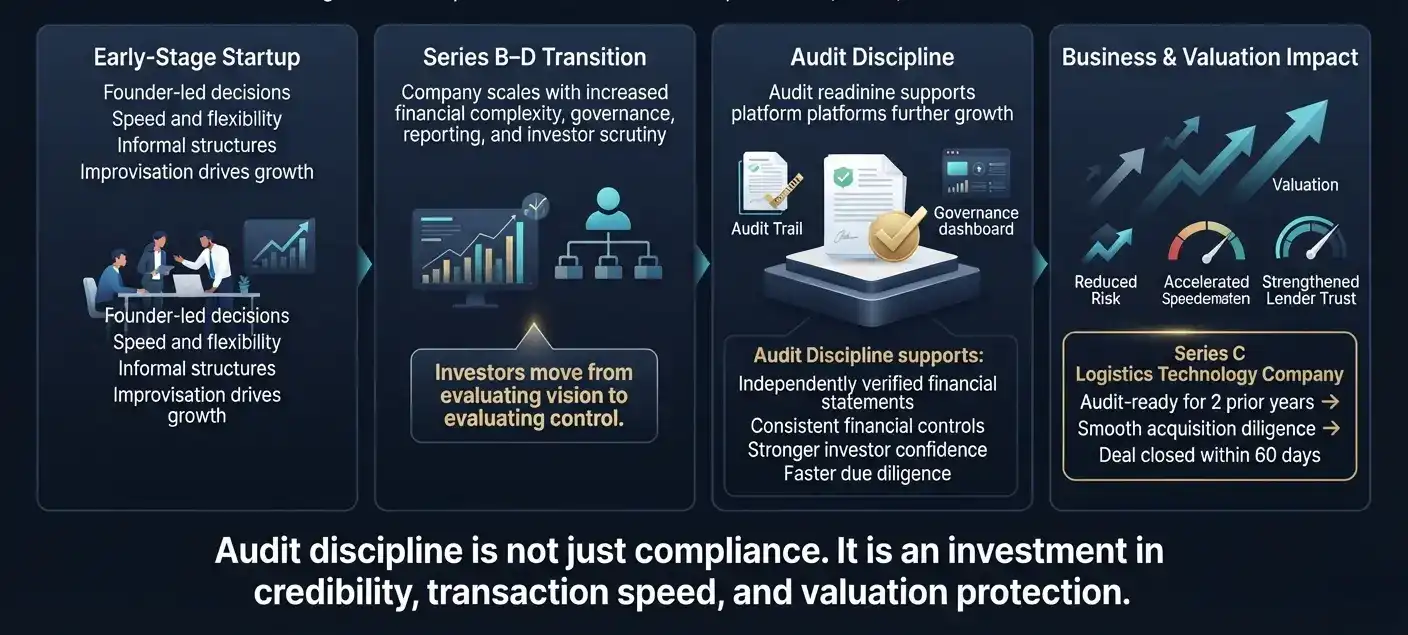
Founders build the earliest version of a company on instinct. Decisions move quickly. Structures stay flexible. Everyone carries more than one responsibility, and improvisation becomes an advantage rather than a liability. Somewhere between Series B and Series D, though, the calculus shifts. Investors stop evaluating only the vision behind the company. They begin evaluating control.
At that moment, a startup audit stops being a formality. It becomes a foundation. Institutional investors, strategic acquirers, and lenders all depend on financial statements that can be verified independently. The audit provides that verification, not only for the current year but for the company’s entire trajectory.
An Audit Protects Valuation, Not Just Compliance
In one logistics technology company at the Series C stage, the founder initially viewed the audit as a costly distraction. When a potential acquirer later requested audited statements for the prior two years, the company was ready. There was no delay and no credibility drag. Diligence moved smoothly, and the acquisition closed within sixty days. That speed was not an accident. It was a dividend paid by prior audit discipline, and it protected both valuation and the founder’s equity.
Shareholders Need More Than Vision
Early investors buy into a story. By Series B, they look for proof that the company can report financials without drama, recognize revenue accurately, and manage compliance with integrity. Audit discipline answers those questions directly. It signals that management understands accountability, and it confirms that the finance function operates as a strategic partner rather than a purely transactional one.
Boards need to see that leadership is prepared not only to grow but to be examined closely. That willingness builds trust, and trust tends to translate into better capital access and stronger footing in negotiations.
Audit Quality Reflects Management Quality
Auditors do more than opine on numbers. They form a view of the organization itself, shaped by its processes, its responsiveness, and its documentation. That view reaches investors, often without a formal report attached to it. An audit that completes on time, with minimal findings, tells a board that leadership is in control. An audit that drags or requires repeated post-close adjustments introduces friction, and friction tends to tighten capital rather than ease it.
I have seen term sheets revised downward when audit findings eroded the perceived quality of a finance organization, even where no fraud or major error existed. The lack of discipline alone introduced enough doubt to change the outcome.
Discipline Is Not Bureaucracy
Some founders equate audit discipline with red tape, fearing that audit-ready systems will slow innovation. That fear is understandable, though it rarely matches reality. Audit discipline is about clarity. It means contracts are signed, books are closed on schedule, equity is reconciled, and revenue is recognized on consistent principles.
Discipline does not preclude speed. It tends to enable it. When systems are built to scale, teams move faster through fundraising, through diligence, and through everyday decision making.
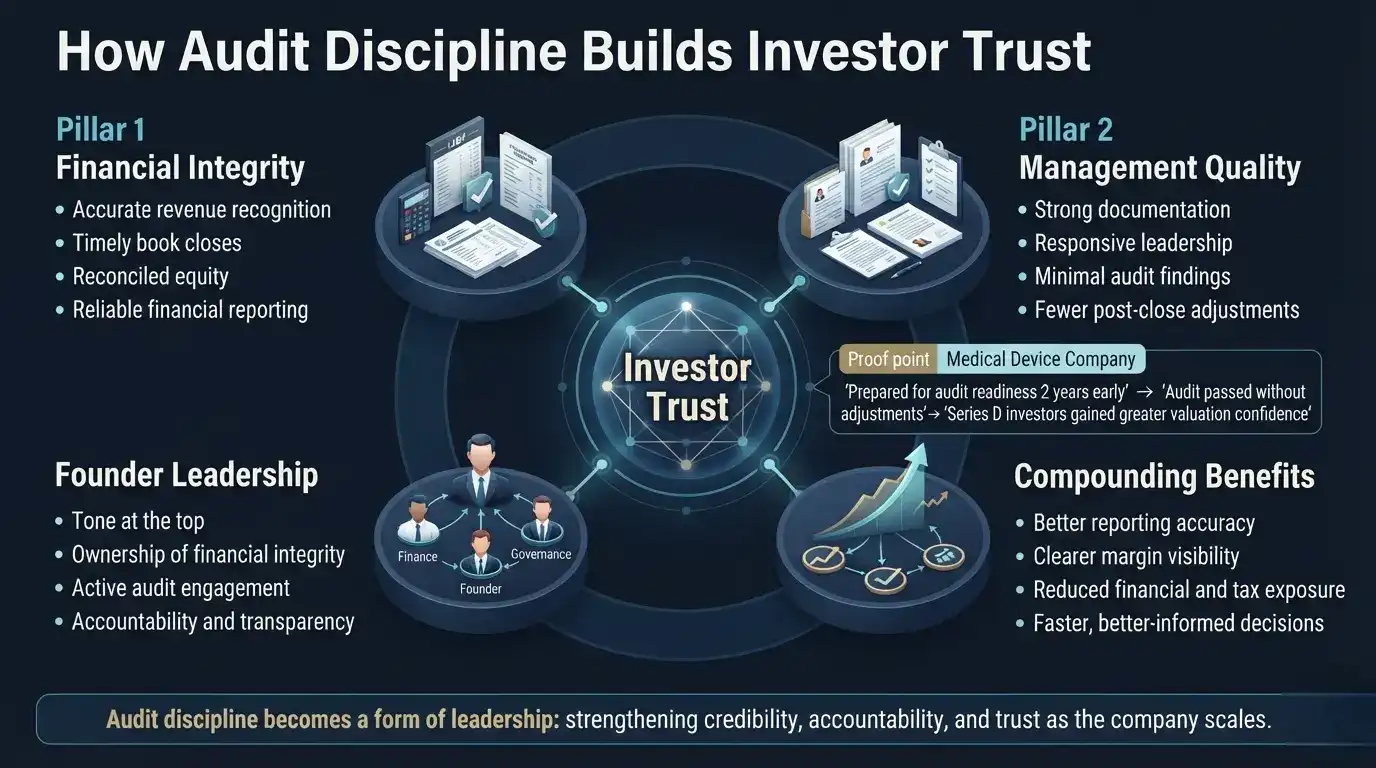
While supporting a medical device company through audit readiness two years ahead of its first formal audit, the shift to accrual based books and stronger revenue tracking systems meant the audit passed without adjustments. Series D investors later cited that audit quality as a factor in their valuation comfort.
Founders Set the Tone
Audit success starts with tone at the top. Founders who speak openly about financial integrity, support their finance teams, and stay engaged in audit preparation set the cultural baseline for the rest of the organization. When a founder joins kickoff calls, answers business model questions directly, and owns an explanation of a revenue recognition adjustment rather than delegating it, the board tends to notice. Stewardship of that kind earns trust, and trust tends to raise capital.
The Benefits Compound Over Time
Audit readiness is not a single project. It is an ongoing process that pays compounding returns. It improves reporting accuracy, clarifies margin drivers, reduces tax exposure, and prepares a company for the inevitable questions that accompany growth. Cleaner closes lead to better decisions, and better decisions tend to lead to stronger outcomes across every function, not only finance.
A skilled startup auditor becomes, in this sense, less of an external examiner and more of a partner in building the systems that let a company scale with confidence.
Conclusion
Audit discipline is not the end point of a startup’s journey. It is confirmation that the company is being built in a way others can trust. Founders who invest early gain speed rather than losing it, since audit-ready systems remove friction from fundraising and diligence alike. They gain leverage in negotiations, because credibility rarely needs to be defended when it has already been demonstrated. Across sectors as varied as logistics, medical devices, SaaS, and digital marketing, the pattern holds. Companies that treat the audit as a foundation rather than a formality tend to move through growth stages with fewer surprises and stronger investor confidence. That discipline, once embedded, becomes difficult to separate from leadership itself. It is not merely compliance. It is one of the clearest forms of stewardship a founder can offer the people who have placed their capital, and their trust, behind the company.
Disclaimer: This blog is intended for informational purposes only and does not constitute legal, tax, or accounting advice. You should consult your own tax advisor or counsel for advice tailored to your specific situation.
Hindol Datta is a seasoned finance executive with over 25 years of leadership experience across SaaS, cybersecurity, logistics, and digital marketing industries. He has served as CFO and VP of Finance in both public and private companies, leading $120M+ in fundraising and $150M+ in M&A transactions while driving predictive analytics and ERP transformations. Known for blending strategic foresight with operational discipline, he builds high-performing global finance organizations that enable scalable growth and data-driven decision-making.
AI-assisted insights, supplemented by 25 years of finance leadership experience.