
Executive Summary
Forecast narratives determine whether investors read a set of numbers as conviction or as guesswork. A forecast is not a promise, and treating it as one invites either false certainty or unnecessary alarm. This article explains how CFOs build forecast narratives that earn investor trust, how digital tools sharpen those narratives without replacing judgment, how budget variance feeds back into strategy, and how the same communication discipline carries into M&A integration.
Every one of these areas depends on the same skill: translating operational reality into a story that is honest, specific, and useful to the person hearing it. Readers will find the balance between transparency and vision, the role of technology in planning, the discipline that turns variance into strategy, and the communication work that determines whether an acquisition truly integrates.
Building Forecast Narratives That Earn Investor Trust
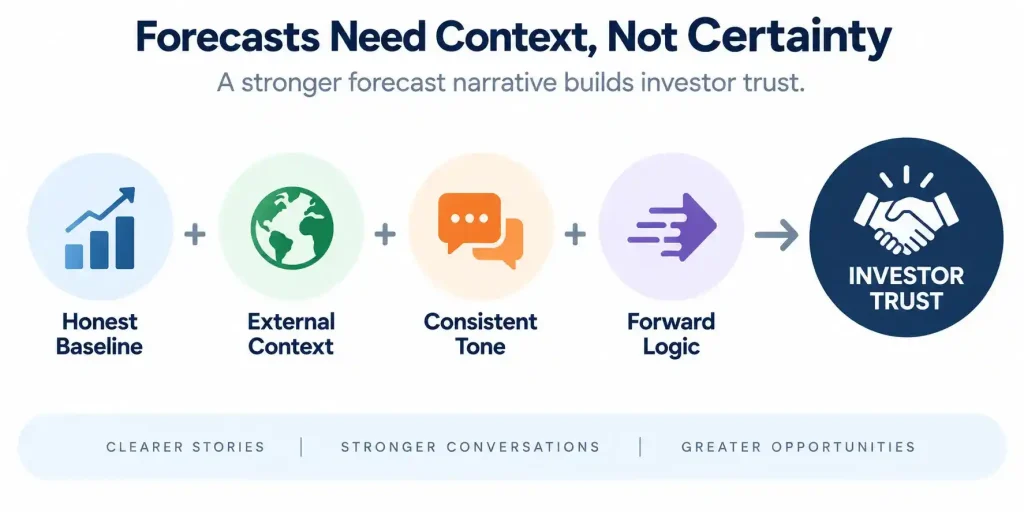
Forecast narratives are the bridge between a company’s numbers and investor belief. A forecast is a map built with the best available instruments, not a covenant. Investors sometimes treat a forecast as a promise. That confusion creates real risk when conditions shift. Framing the forecast as a narrative, rather than a fixed number, sets the right expectation from the outset.
Balancing Transparency and Vision
Overexplaining a forecast drowns investors in detail. It hides the actual story. Underexplaining breeds suspicion. Investors are sophisticated readers who want both the what and the why behind a projection. They can usually detect false optimism as easily as unwarranted panic.
Tone carries as much weight as the underlying data in any forecast narrative shared with investors. The same set of numbers delivered with hesitancy can trigger fear. A firm, honest voice can make an uncertain outlook feel grounded instead. During the early days of the global financial crisis, one earnings call carried numbers that were genuinely difficult. The narrative anchored in the company’s history of weathering downturns and its disciplined balance sheet. That framing turned fear into cautious confidence rather than panic.
Acknowledging Forces Beyond Company Control
Forecast narratives function as translation. They convert operational reality into something legible for markets. Investor sentiment is shaped by macroeconomic currents, geopolitical disruption, and regulatory shifts that a company does not control. Pretending otherwise undermines credibility. The stronger approach positions the company as a capable navigator of a complex environment. It is not an isolated actor immune to that environment.
| Narrative element | Risk if missing | What it should convey |
| Honest baseline | Investors lose trust when reality diverges | What the company actually expects, plainly stated |
| External context | Sentiment reads as company-specific failure | How macro and geopolitical forces shape the numbers |
| Consistent tone | Hesitancy reads as hidden bad news | Steadiness that matches the facts, not more or less |
| Forward logic | Forecast looks arbitrary | Why the destination is worth the uncertainty of the path |
The most effective forecast narratives combine analytical rigor with a clear point of view. They offer evidence for skeptics and direction for believers at the same time. Humility supports this more than confidence does. A forecast narrative that openly shares the reasoning behind its assumptions gives investors a way to partner with the company’s thinking rather than simply grade its output.
Digital Tools That Strengthen Forecast Narratives
Digital planning tools do not replace the judgment behind good forecast narratives. They extend that judgment instead. This gives finance teams more time to interpret the numbers instead of assembling them.
From Manual Assembly to Scenario Thinking
Monthly cycles once required pulling data from disparate systems by hand. That work has shifted toward simulation. Scenario builders and AI-assisted forecasting tools model pricing elasticity, margin shifts, and demand seasonality. This work now takes a fraction of the time manual assembly once required. This lets finance engage with the business in dialogue, rather than working in isolation to produce a static report.
No algorithm captures the judgment behind a founder’s strategic bet. None captures the fragility of customer behavior during a geopolitical shock either. The strongest tools respect that limitation. They surface uncertainty rather than mask it. They collaborate with judgment rather than override it. Predictive analytics woven into planning tools let a team test an assumption while it is still forming. This beats testing it months after it has hardened into a plan.
Asking Better Questions
Optimization is less about feeding a tool the right data. It is more about feeding it the right question. A top-line forecast can be technically sound. It can still lack any real tension between risk and ambition. Counterfactual scenarios can reveal that a plan is defensible but uninspired. That forces a team to ask what kind of growth it is defending against, and what kind it is too cautious to pursue. The tool does not answer that question. It only surfaces it. The answer still requires human judgment.
The clearest benefit digital tools provide is time. That includes time to rehearse decisions before they become irreversible. Tools should not replace the collaborative sessions where teams debate tradeoffs together.
Turning Budget Variance into Strategic Direction
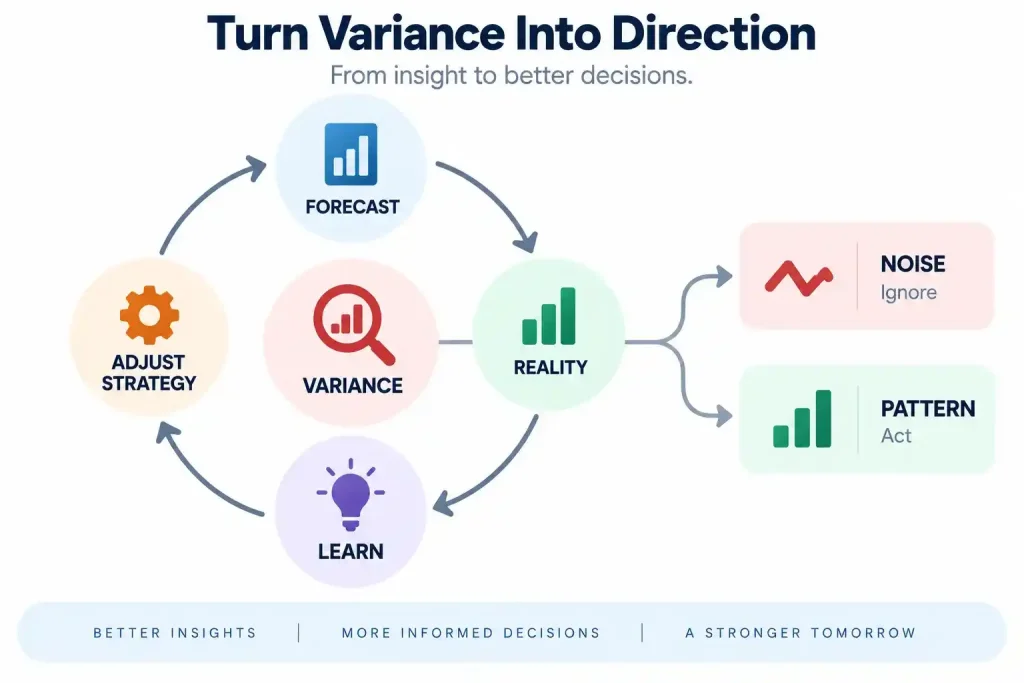
A variance report is often read as a simple list of deviations. It functions more like feedback from the business. The purpose of financial planning is not to enforce compliance with a static plan. It is to extract meaning from where reality and forecast diverge from each other.
Reading Variance as Signal, Not Failure
Every line item that drifts hides a decision. A marketing spend that ran ahead of plan might be recklessness or foresight. A revenue dip could reflect market contraction, sales execution, or a genuine shift in demand. Treating variance as evidence of complexity, rather than as something to defend or punish, opens the door to better analysis of what actually happened.
An operations team once overspent on logistics, breaking through quarterly thresholds by a wide margin. The initial instinct was punitive. A closer analysis showed that demand in a specific region had grown faster than any model anticipated it would. The overspend reflected a failure of anticipation, not a failure of discipline. Pairing the variance report with field-level interviews and external benchmarks led to a new distribution strategy. It centered on micro-fulfillment centers placed near the fastest-growing zones. What started as a budget problem became a strategic proposition instead.
Distinguishing Noise from Pattern
Not every deviation carries strategic weight. Some are simple noise, timing artifacts, or spreadsheet errors. A CFO needs the discipline to separate those from genuine patterns. Digital overlays help trace causal chains and link variances to specific operational levers. No tool can determine intent on its own.
A business that hits every forecast number with unusual precision is often either sandbagging its targets or stagnating. Growth is rarely symmetrical. Cross-functional review strengthens this analysis considerably. Bringing operations, sales, and marketing into the conversation means finance edits and clarifies the story, rather than writing it alone.
Applying the Same Discipline to M&A Integration
Mergers and acquisitions look like exercises in valuation and synergy modeling on paper. The real test comes after close, in how two organizations learn to operate together. No spreadsheet accounts for a company’s hidden culture. None forecasts how quickly trust travels between two groups either.
Beyond Cost Synergies
Integration is often treated as the domain of operations and HR. Finance’s role is assumed to end at closing the books and rationalizing expenses. A stronger view puts finance at the center of translating the abstract promise of synergy into operational choreography. That means identifying what is working, what is resisting, and what needs adjustment.
In one acquisition, a founder-led firm with fluid processes and informal networks combined with a more structured, process-driven acquirer. An integration plan built around imposing the acquirer’s systems looked sound on paper. It ignored how the target company actually functioned. Within the first 90 days, key talent left. Projects slowed as well. The approach shifted toward identifying where the target firm’s informal working capital and pricing practices outperformed the acquirer’s own. Adopting elements of those practices, rather than replacing them outright, stabilized retention and restored momentum.
Quantifying the Hard-to-Quantify
Financial models for a deal rarely include the cost of cultural friction. They rarely include the erosion of goodwill or the paralysis that follows unclear authority. These are real costs even though they resist a clean formula. A thorough integration plan should name them alongside cost synergies and revenue overlap.
| Integration dimension | Typical model coverage | Often missing |
| Cost synergies | Modeled explicitly | Timing risk of realizing them |
| Revenue overlap | Modeled explicitly | Customer perception of the change |
| Systems integration | Planned in detail | Speed at which knowledge actually moves |
| Culture | Rarely modeled | Cost of dissonance and lost trust |
Patience matters as much as planning discipline. Teams need time to find new working rituals. The promise behind a deal needs time to become reality. Closing the books quickly can happen alongside a slower, more deliberate approach to integrating identities. That difference in pace often determines whether the deal’s original thesis survives contact with reality.
Three Key Takeaways
- Build forecast narratives around honest baselines, acknowledged external forces, and consistent tone, since investors read conviction and evasion just as easily as they read numbers.
- Use digital planning tools to create time for judgment and better questions, not as a substitute for the human reasoning behind a forecast.
- Treat budget variance and M&A integration challenges as feedback rather than failure, and bring cross-functional voices into both to convert friction into a workable strategy.
Disclaimer: This article is intended for informational purposes only and does not constitute legal, tax, or accounting advice. You should consult your own tax advisor or counsel for advice tailored to your specific situation.
Hindol Datta is a four-time CFO and senior finance executive with over 25 years of leadership experience across cybersecurity, SaaS, gaming, logistics, digital marketing, medical devices, consumer products, and nonprofit organizations. He has led more than $120M in fundraising and over $150M in M&A transactions while building the financial and operational systems that let complex businesses scale with confidence. He is the author of seven books in the Systems CFO Series and holds active CPA, CMA, and CIA credentials.
AI-assisted insights, supplemented by 25 years of finance leadership experience.