
Executive Summary
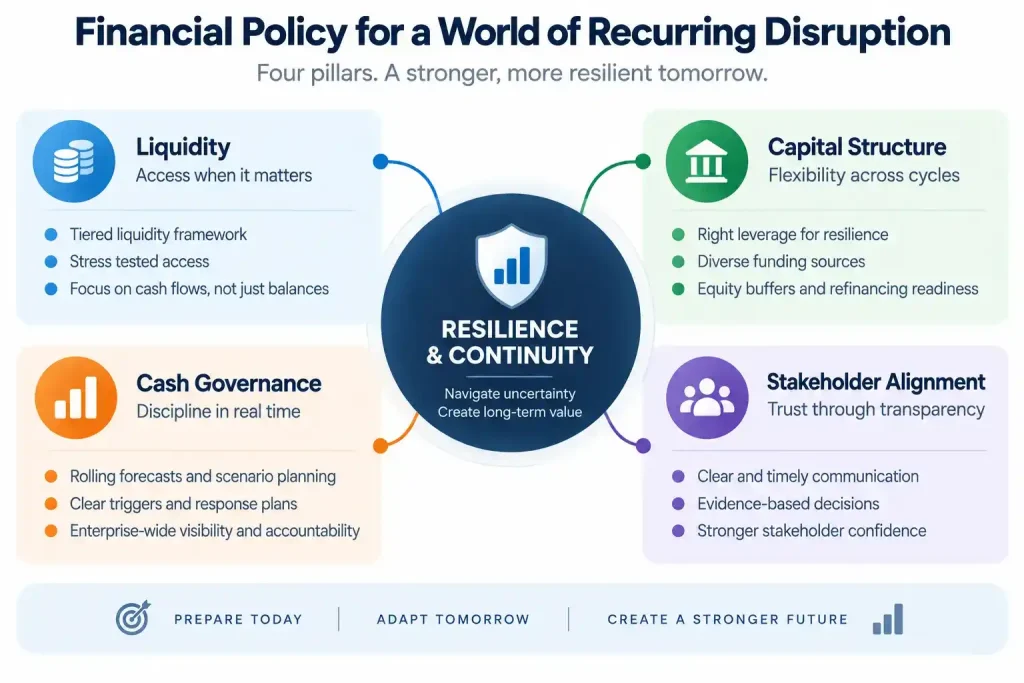
The COVID-19 crisis exposed vulnerabilities in liquidity, capital structure, cash governance, and stakeholder trust that had long gone underappreciated. Financial policy strategy stopped being a compliance afterthought and became the scaffolding through which an enterprise manages continuity and confidence. This article explains how CFOs can rebuild that scaffolding for a world where disruption is recurring rather than exceptional.
A sound financial policy strategy treats liquidity as a system of flows, capital structure as a source of flexibility, cash governance as a real-time discipline, and stakeholder communication as a signal of integrity. Readers will find the frameworks that make each of these durable.
Liquidity and Risk in a Modern Financial Policy Strategy
Before the pandemic, liquidity was a conservative buffer. Risk stayed confined to familiar categories such as credit exposure and interest rate moves. A global shock exposed both assumptions within weeks. Post-COVID financial policy strategy must treat liquidity and risk as central strategic levers, not tactical metrics.
From Static Buffers to Tiered Liquidity
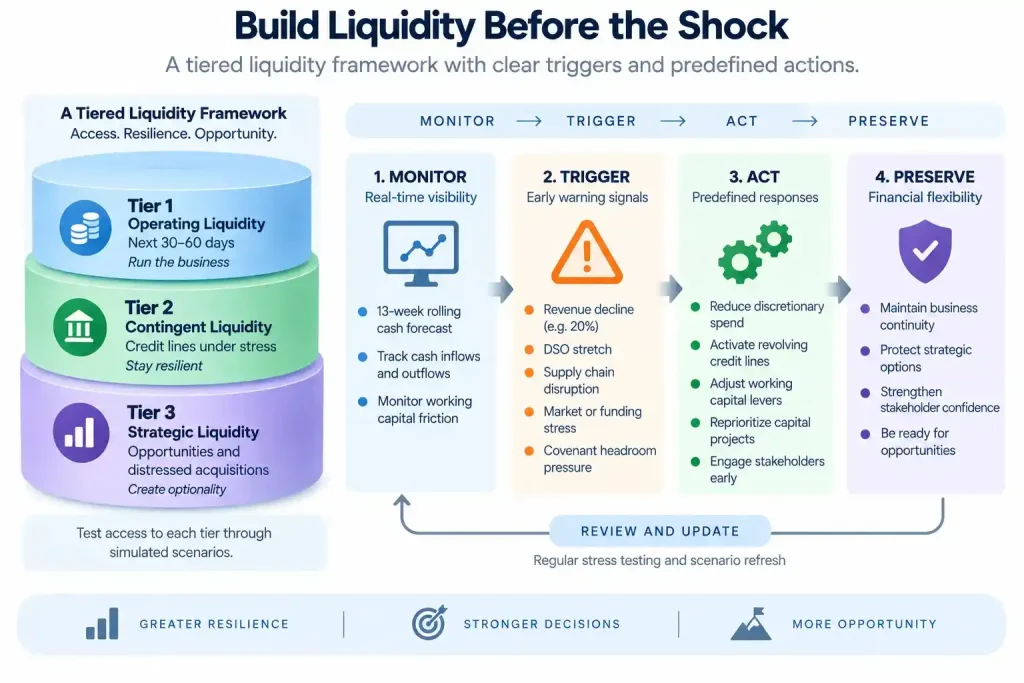
Access to cash determined survival for many firms once revenue vanished while payroll remained in place. The lesson was that liquidity must be governed dynamically. A tiered liquidity framework now fits better. It includes immediate operating liquidity for the next 30 to 60 days. It also includes contingent liquidity through credit lines under stress, and strategic liquidity reserved for distressed acquisitions. A mature policy tests access to each tier through simulated scenarios. It does not simply assume that access will be there.
Cash velocity deserves as much attention as cash balance. CFOs need to understand how quickly cash moves in and out of the system. They need more than a snapshot of how much sits on the balance sheet. This requires modeling inflows and outflows under various conditions. It also requires tracking working capital friction in real time.
Systemic Risk and Stress Testing
COVID-19 showed that health crises, geopolitical tension, and infrastructure failures are systemic. They are not exogenous. Financial policy strategy must move beyond siloed risk registers. Real-time risk governance should involve operations, IT, legal, and HR together.
Risk correlation modeling matters more than before. Supply chain risk, labor availability, and capital market access moved together during the crisis. Traditional frameworks failed to capture that interdependence. Predictive analytics and simulation were once confined to trading desks. They now belong in liquidity and capital allocation decisions.
Stress testing should become a core part of internal policy cadence. It should not stay only a regulatory exercise. Leadership teams should evaluate performance at least semi-annually against adverse but plausible scenarios, such as a 20% revenue drop or a prolonged supply interruption. The results should connect to covenant management and debt maturity planning. Insurance strategy needs the same scrutiny. Pandemic losses revealed gaps in business interruption coverage that parametric structures can help close.
Capital Structure Flexibility as a Financial Policy Strategy Priority
Capital structure functioned as the load-bearing beam during the crisis. Firms discovered that access to capital markets is not constant, even when models assume it is. Post-COVID financial policy strategy treats capital structure as a design for resilience across shocks rather than optimization for a single stable state.
Leverage, Funding Mix, and Equity Buffers
Leverage thresholds now need evaluation in the context of refinancing risk and market liquidity stress. A standalone view is not enough. An acceptable debt-to-EBITDA ratio in calm conditions may become unacceptable if maturities coincide with systemic uncertainty. Funding mix diversity matters just as much. A blend of short and long-term instruments, public and private sources, and revolving facilities protects continuity. It matters when any single channel becomes inaccessible.
| Capital lever | Pre-crisis approach | Post-crisis financial policy strategy |
| Leverage targets | Standalone debt-to-EBITDA | Adjusted for refinancing and maturity risk |
| Funding sources | Concentrated in one instrument type | Diversified across term, revolver, and public and private |
| Equity capital | Seen mainly as dilutive | Valued as a buffer and source of flexibility |
| Capital return | Payouts as a routine signal of confidence | Payouts tied to liquidity thresholds |
Equity capital deserves reassessment as well. Equity buffers, whether on the balance sheet or in untapped authorization, gave companies maneuverability during disruption periods. Dividend and buyback policy should link explicitly to liquidity thresholds and risk-adjusted profitability. It should not serve only as a fixed signal of confidence.
Scenario Planning and Governance
Treasury should formalize dynamic capital allocation playbooks. These need pre-approved investment bands and hurdle rates that flex with macro conditions. Scenario planning carries real weight in this context. Funding capacity under a 30% revenue decline is no longer a theoretical question, nor is debt coverage under a prolonged cost spike.
Currency and jurisdictional risk matter too. Repatriating cash or rolling over local facilities was not always frictionless for multinational firms. ESG factors now influence the cost of capital as well. Financial policy strategy should account for ESG-adjusted funding costs and access to sustainability-linked instruments. All of this should live in a document reviewed semi-annually at board level. Transparency about capital intentions builds trust, and trust becomes its own form of capital.
Cash Flow Governance Inside a Financial Policy Strategy
Cash is managed in calm periods and governed in a crisis. Historical trend analysis and variance reporting served steady-state operations well. They fall short when conditions shift faster than the close cycle.
Forecasting and Scenario-Based Decisions
Cash flow governance belongs in financial policy strategy as a strategic area. It is not only a reporting function. This includes protocols for inflows and outflows, approval thresholds, and cash allocation mechanisms that reach into procurement, sales, and operations, not only treasury.
Rolling 13-week cash forecasting should run at the corporate level and at key subsidiaries. It should blend actual receivables and payables with modeled revenue. These forecasts need frequent refresh, weekly during volatility, and should drive decisions rather than sit unused.
Scenario-based decision frameworks build directly on this forecasting. Predefined responses, such as cutting discretionary spend or triggering revolving lines, should be attached to specific triggers like a 15% revenue decline or a 10-day DSO stretch. Investment governance benefits from the same logic, since the hurdle for capital allocation becomes risk-adjusted optionality and not only ROI.
Ownership, Tools, and War Rooms
Cash flow owners across business units should be responsible for forecasting and for influencing outcomes, working with sales on revenue timing and procurement on payment terms. Real-time visibility tools integrated with banking APIs and ERP systems let treasury monitor positions down to the account level without lag.
Vendor and customer engagement also deserves formal policy guidance, since flexible terms and early payment discounts served as shock absorbers during the pandemic without permanent cost increases. Liquidity councils or war rooms, cross-functional teams that can activate quickly, proved valuable enough during COVID-19 to become standing governance mechanisms rather than one-time crisis responses.
Stakeholder Alignment as the Outward Face of Financial Policy Strategy
Financial policy strategy carries a dual purpose now. It sets internal guardrails, and it signals discipline and trustworthiness to stakeholders who have grown more skeptical and more interconnected since 2020.
Investors, Lenders, and Employees
Equity investors increasingly prefer predictable policy over maximum payout. A stated intent to return a defined share of free cash flow only after liquidity coverage exceeds a set threshold communicates intentional stewardship rather than a number alone.
Debt holders read policy as a trust mechanism. Firms that engaged lenders before covenant breaches occurred, and that communicated candidly about downside planning, emerged strongest. A mature financial policy strategy includes scenario-based covenant management guidelines with board-approved mitigation actions such as capex deferral or equity injection.
Employees respond to internal transparency about the logic behind financial decisions. When staff understand why hiring is frozen or why an investment is paused, engagement tends to hold even during contraction. At an early-stage email marketing technology company, a turnaround that reduced monthly burn from $800K to $200K depended on this kind of clear internal communication about financial priorities.
Vendors, Ratings, and Consistency
Vendors and supply chain partners assess corporate financial behavior as part of their own risk management, and firms that pay consistently and communicate early often earn better terms. Consistency between stated policy and actual behavior matters enormously, since firms that declared conservative cash policy and then pursued aggressive M&A shortly after eroded trust quickly.
Rating agencies look past ratios to the discipline behind stated intent, and firms operating within published leverage bands tend to receive more favorable treatment when requesting exceptions. Communication itself needs to evolve too, with investor materials and annual reports articulating capital philosophy and not only historical results.
Three Key Takeaways
- Treat liquidity as a system of flows and risk as an interconnected, systemic variable, and build a tiered liquidity framework tested through regular stress scenarios.
- Design capital structure for flexibility across shocks by diversifying funding sources, reassessing equity buffers, and linking payouts to liquidity thresholds.
- Govern cash flow in real time with cross-functional ownership and scenario triggers, and use financial policy strategy as a transparent signal of discipline to every stakeholder group.
Disclaimer: This article is intended for informational purposes only and does not constitute legal, tax, or accounting advice. You should consult your own tax advisor or counsel for advice tailored to your specific situation.
Hindol Datta is a four-time CFO and senior finance executive with over 25 years of leadership experience across cybersecurity, SaaS, gaming, logistics, digital marketing, medical devices, consumer products, and nonprofit organizations. He has led more than $120M in fundraising and over $150M in M&A transactions while building the financial and operational systems that let complex businesses scale with confidence. He is the author of seven books in the Systems CFO Series and holds active CPA, CMA, and CIA credentials.
AI-assisted insights, supplemented by 25 years of finance leadership experience.