Executive Summary
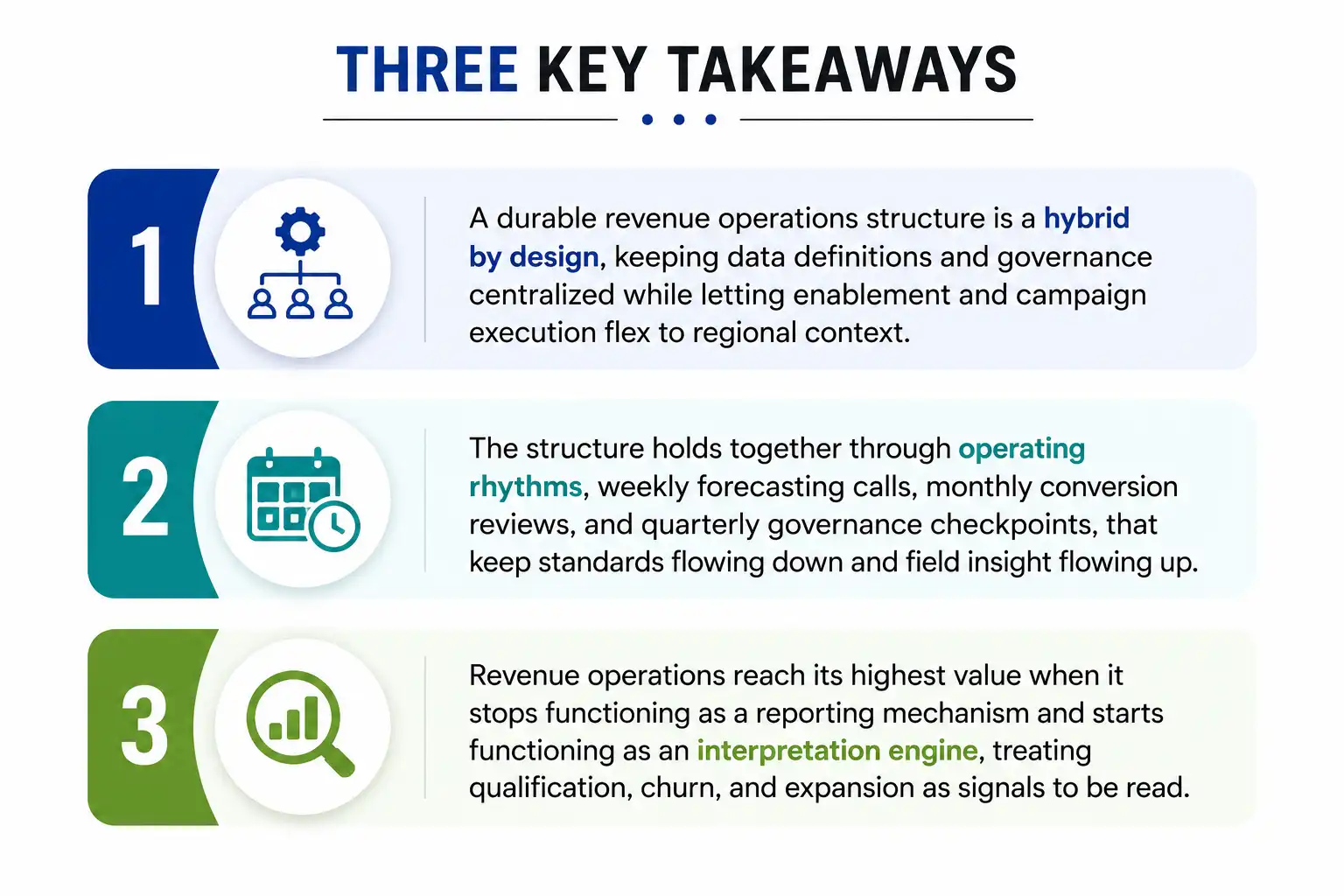
Every organization that outgrows its earliest go-to-market model confronts the same design question. Should the revenue function centralize for consistency, or distribute across regions for speed and customer proximity? A well-designed revenue operations structure does not choose a side. It blends both, governed by shared standards and disciplined operating rhythms rather than rigid hierarchy, and that blend is what lets a business absorb complexity without losing coherence.
What follows works through how that structure gets built in practice: which functions belong at the center, which belong at the edge, and how a revenue operations structure matures from a reporting mechanism into an early warning system for the business.
The Core Tension at the Heart of Every Revenue Operations Structure
The debate sharpens once a company operates across borders, languages, and uneven growth cycles. In the earliest stages, revenue operations tends to be the work of a few resourceful generalists, and centralization feels natural. As complexity multiplies across products and regions, the centralized model begins to strain: approvals slow, local teams work around the system, and the function drifts toward process purity and away from the customer.
Distribution appears to fix this. Regional teams gain ownership of their tools, campaigns launch faster, and local insight sharpens decisions in ways a distant central team cannot match. Left ungoverned, though, distribution carries its own cost, since metrics diverge across regions and reconciliation cycles lengthen. Centralization optimizes for control, distribution optimizes for relevance, and organizations that scale well refuse to choose only one.
Where Centralization Strengthens the Structure
Centralized revenue operations remain the right home for functions that demand consistency: reporting, analytics, process governance, and tool administration. When these sit in one place, redundancy shrinks, licensing costs stay controlled, and headcount planning gains precision. Centralization also protects data integrity, since regions that define a qualified lead differently produce dashboards that cannot be compared and forecasts that lose credibility one missed quarter at a time.
In one high-growth cybersecurity and identity access management company operating across the United States, Canada, Mexico, India, and Nepal, a NetSuite implementation across 5 country entities, paired with a single ASC 606 revenue recognition framework, compressed the monthly close from 18 days to 10 and gave the board a consolidated view it had not previously trusted. In regulated, multi-entity environments, a centralized quote-to-cash system also makes compliance auditable in a way distributed tooling rarely manages.
Where Distribution Multiplies Insight
Functions that benefit from contextual proximity belong closer to the business unit: enablement, deal support, campaign execution, and field feedback. Regional operators hear objections firsthand and surface insight a centralized team would take weeks to uncover. In one global organization, forecast accuracy improved by 20 percent once regional teams owned early-stage qualification analysis, since they understood vertical nuance, a central model could not see. Distribution should not replace centralization; proximity is a performance multiplier once paired with governance.
Building a Revenue Operations Team Structure Around Function, Not Politics
A well-designed revenue operations team structure starts from purpose rather than org chart convenience. Before deciding where a role sits, the more useful question is what revenue operations exists to achieve, and three responsibilities are non-negotiable:
- Signal clarity, meaning the revenue engine works from the same data ontology, attribution logic, and forecasting definitions, regardless of geography.
- Execution reliability, meaning deals move through the funnel with predictability, compliance, and speed, supported by scalable tooling.
- Operating leverage, meaning each incremental dollar of revenue costs slightly less to acquire, support, and retain over time.
When these principles guide the design, functions that demand consistency stay central. Functions that benefit from context move to the field. The two layers connect through operating rhythms, not reporting lines. Revenue operations stop behaving like a department. It starts behaving like a system.
The Hybrid Revenue Operations Team Structure: Orchestrated Autonomy
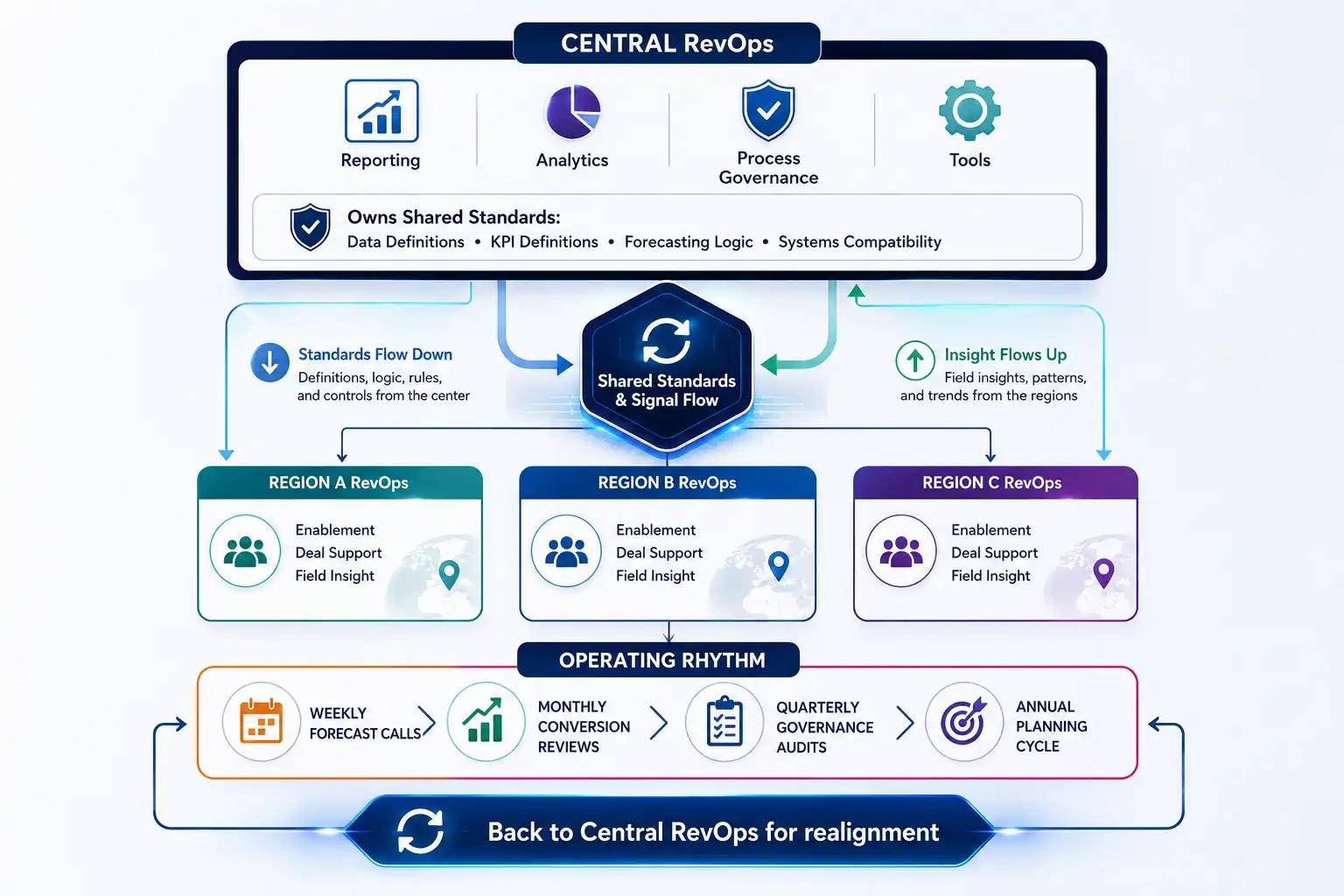
The most resilient model blends functional coherence with operational adaptability. Consistency in data, process, and reporting stays fixed, while workflows and go-to-market execution flex to local conditions. This is best described as orchestrated autonomy: every node in the structure plugs into a shared platform of definitions and signal standards, while retaining real freedom over execution.
How the Two Layers Actually Connect
The relationship is easiest to describe as a simple flow, with standards moving down and insight moving up, and a rhythm underneath both that keeps the layers synchronized:
- Standards flow down, meaning shared data definitions, forecasting logic, and system-of-record rules originate centrally and apply everywhere.
- Insight flows up, meaning regional qualification patterns and buying behavior feed back into central models and playbooks.
- Rhythm holds it together, meaning recurring forecasting calls and governance checkpoints keep the two layers from drifting apart.
This discipline ties directly to resource allocation. A region requesting headcount must show that its local reporting aligns with global standards, and a function proposing a new tool passes through a systems compatibility review. In one enterprise environment, enforcing a common data model for deal lifecycle tracking across 6 regional teams saved more than $1.2M annually in rework, without slowing regional agility.
Operating Rhythms That Keep the Center and the Edge in Sync
Structure without rhythm tends toward inertia. A hybrid model stays coherent through weekly forecasting calls where regional leaders interpret numbers rather than report them, monthly reviews of conversion data, quarterly governance checkpoints, and annual planning cycles where revenue operations own the integrity of funnel assumptions.
Building a Revenue Operations Org Structure Around Accountability
A revenue operations org structure holds together only when every layer answers to a measurable outcome, and each leader participates in joint planning rather than reacting after the fact:
- Central analytics owns forecast accuracy and the integrity of the data model behind it.
- Systems own platform uptime, integration coverage, and tooling governance.
- Enablement owns rep ramp time and the consistency of the sales motion across regions.
- Regional teams’ own conversion velocity and CRM data hygiene within their territory.
Hiring follows the same logic as investment modeling: every role should map to a clear return, whether improved conversion visibility, pipeline risk detection, data integrity, or automation throughput.
One venture-backed digital marketing organization scaled from $9M to $180M in revenue over 24 months. Its finance and revenue operations function grew from a single person to 12, and every hire mapped to a specific gap, ranging from customer acquisition cost visibility to the reporting infrastructure needed to support $36.5M raised across 3 funding rounds and 3 acquisitions.
From Structure to Intelligence
Once a revenue operations structure stabilizes, the next transformation concerns function rather than form. Clarity without insight remains static, and the highest-value teams evolve from reporting mechanisms into interpretation engines.
Aligning Metrics Across the Revenue Chain
Sales tracks win rate, customer success tracks net revenue retention, marketing tracks sourced pipeline, and finance tracks customer acquisition cost. Each metric is coherent in isolation and largely incoherent together. In a professional services engagement spanning five business units, building engagement-level profitability analytics from scratch supported a scale from $12M to $63M in revenue within eight months, showing leadership where margin was leaking. A single GTM metric stack turns several departments justifying past performance into one shared narrative:
- Lead velocity, tracking the rate at which qualified pipeline is generated over time.
- SQL-to-close ratio, tracking how efficiently qualified opportunities convert to closed revenue.
- Customer health score, tracking usage, engagement, and renewal risk in a single composite view.
- Time-to-cash, tracking the full cycle from signed deal to collected revenue.
Qualification, Churn, and Expansion as Signal
Pipeline qualification is one of the more consequential and subjective decisions in the revenue chain, since a single rep-entered opportunity reverberates through forecasting and executive dashboards. Qualification can instead be treated as a signal-processing problem, drawing on stakeholder engagement, response rates, and conversation velocity, replacing rep confidence with behavioral evidence and producing a probability heat map that sales leaders can coach against.
Retention and expansion behave the same way. NPS data, ticket velocity, and usage telemetry can be connected into a single view, with playbooks tiered by risk band. In one case, accounts tied to a particular onboarding path churned at 3.4 times the average rate, and a retrained playbook corrected it within 2 quarters.
Revenue Operations as Strategic Infrastructure
Revenue operations is still too often viewed as overhead to trim when budgets tighten, and that view misreads its purpose. It is the only function that sees the entire revenue lifecycle, from lead to renewal, bridging product and pipeline, marketing and collections. A well-built revenue operations structure reduces surprises before they become expensive, converting transactional data into strategic foresight rather than backward-looking reports.
Underinvestment tends to hide until it does not: bookings look solid, pipeline grows, and then a quarter misses. Early maturity in a revenue operations org structure is a risk hedge, worth the same rigor applied to any capital decision. Ad hoc arrangements suffice early on, but as complexity grows, structure becomes destiny, and that structure must be designed rather than inherited.
Disclaimer: This article is intended for informational purposes only and does not constitute legal, tax, or accounting advice. You should consult your own tax advisor or counsel for advice tailored to your specific situation.
Hindol Datta is a four-time CFO and senior finance executive with over 25 years of leadership experience across cybersecurity, SaaS, gaming, logistics, digital marketing, medical devices, consumer products, and nonprofit organizations. He has led more than $120M in fundraising and over $150M in M&A transactions while building the financial and operational systems that let complex businesses scale with confidence. He is the author of seven books in the Systems CFO Series and holds active CPA, CMA, and CIA credentials.
AI-assisted insights, supplemented by 25 years of finance leadership experience.