Executive Summary
Capital expenditure in a scale-up is more than a line item; it is a commitment that hardens into the structure of the company. Every facility, system, and long-lived asset bets on growth before the market has fully proven that growth. The central question for finance leaders is not whether an investment is good, but whether the company is ready for it yet.
The sections ahead cover four dimensions of capital expenditure discipline: readiness, strategy design, execution and governance, and identity. Together they show how CFOs can fund ambition while protecting the flexibility that scale-ups need to survive.
Knowing When a Company Is Ready for Capital Expenditure
A familiar stillness settles over the leadership room before a major capex decision. The forecast looks promising, the operating team is impatient, and every signal seems to say go. Yet capital expenditure welds the balance sheet to belief, and no one builds a casual data center or signs a part-time lease.
Why Readiness Matters More Than Enthusiasm
Many scale-ups have learned this lesson the hard way. A gleaming warehouse sits underused, or a third office opens in a city the company barely understands. Sometimes a hiring plan loads before the org chart even stabilizes. Pressure from customers, stakeholders, and internal fatigue drives these choices, yet no company can borrow real readiness from enthusiasm.
One simple question cuts through the optimism: what will this investment prevent the company from doing later? A second question follows naturally, asking what the team might learn next quarter that could change the plan. When no one can answer confidently, the investment may be sound but premature.
Three Signals of Capex Readiness
Finance leaders can test readiness before committing to permanent spend, and a few consistent signals make that test practical:
- Repeatability: demand drivers that recur across time and context instead of one large order
- Resilience: a decision that still holds if the forecast drops by 10 percent or capital markets tighten
- Cultural maturity: an organization that treats constraint as a signal instead of a failure to escape
Over-caution carries real costs too, including missed windows and teams that feel starved. The answer is a readiness framework with leading indicators, risk buffers, and scenario ranges, so that capital expenditures reflect evidence instead of instinct alone.
Designing a Capital Expenditure Strategy That Preserves Optionality
Approving spend is not the whole decision, because capital carries shape and inertia that expense does not. Every capex dollar rests on an assumption about how the future will unfold, and those assumptions are guesses dressed in decimal points. A sound strategy therefore protects the right of the company to change its mind.
Building Flexibility into Every Commitment
The capital expenditures that create outsized value tend to keep future decisions alive. Modular implementation, staged deployment, variable resourcing, and flexible contract terms all preserve room to adapt. A scale-up planning three new facilities at once might instead pilot one, negotiate exit ramps in its leases, and scale staffing with volume. That phased path may raise near-term cost slightly, but it buys flexibility and credibility with investors.
Early FP&A work in rail and transportation logistics offers a useful lens on this trade-off. Freight economics, route profitability, and capacity utilization all reveal how fixed infrastructure costs interact with variable throughput. That interplay shapes whether an asset-heavy investment creates margin or quietly destroys it.
Scoring for Leverage and Shared Ownership
Capital should unlock ecosystems, not just buy assets. A new warehouse should improve fulfillment and also yield data that tightens inventory turns. Scoring each proposal on adjacency leverage, meaning its second-order returns in insight and agility, shifts internal conversations from ownership toward orchestration.
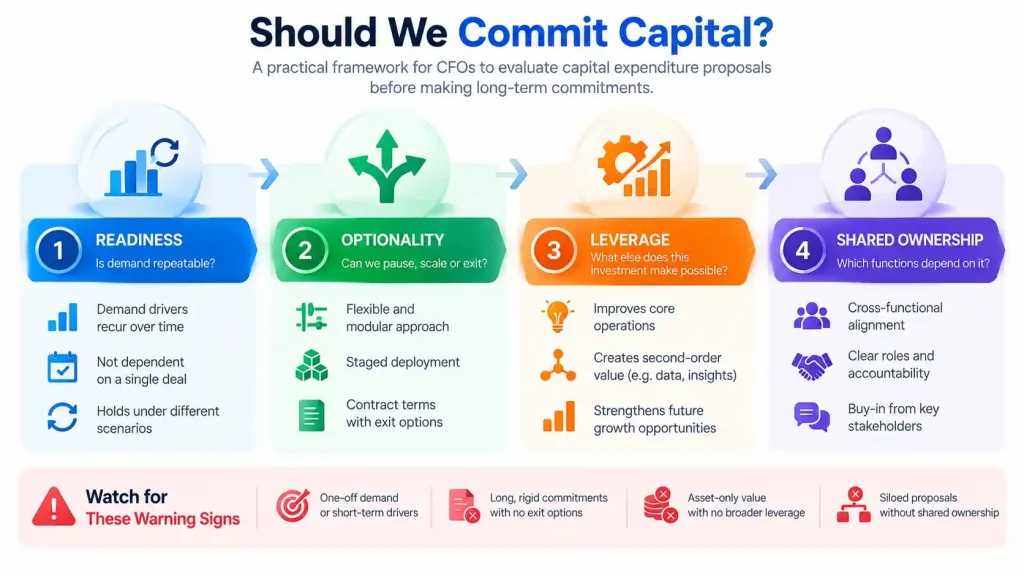
Capital Expenditure Evaluation Framework
| Criterion | Key Question | Warning Sign |
| Readiness | Are demand drivers repeating consistently? | The case rests on one deal or one quarter |
| Optionality | Can the company pause, scale, or exit later? | Long, rigid commitments with no exit ramps |
| Leverage | What else does this investment make possible? | Value limited to the asset itself |
| Shared ownership | Which functions depend on this investment? | A proposal built and defended in a silo |
| Timing | Is the team ready to absorb what it builds? | Systems installed before processes are stable |
Cross-functional working groups for large investments surface dependencies early and treat finance as a co-designer instead of an approver. A quarterly scorecard that tracks delivery against expected outcomes, with honest notes on what worked and what did not, builds trust across the organization.
Governing Capital Expenditures Without Losing Agility
Approving an investment is one thing; living with it is another. Once deployed, capital shapes how teams move and how expectations rise. Governance can fail in two directions, either through reviews so heavy they stall progress or oversight so light that spending drifts unexamined.
Visibility, Rhythm, and Clear Triggers
Visibility works best as a rhythm, not a report. Finance teams that embed with capital projects tend to catch problems early. They walk the floor before equipment arrives and keep asking how success will show up. A standing monthly review of active projects, focused on lessons learned as well as variance, turns governance into a conversation.
Governance of capital expenditures must also protect momentum. Pre-approved execution windows let teams proceed once agreed triggers are met, such as volume markers or headcount thresholds. Each major project also benefits from a senior internal steward who stays accountable for outcomes long after approval.
A $170M global medical device manufacturer with plants in Copenhagen, Cork, and Taiwan shows why disciplined oversight matters. Operations controllership there covered manufacturing, research, and supply chain budgets, along with standard costing and inventory controls. That precision had to withstand line-by-line audit scrutiny in a heavily regulated industry.
The Courage to Stop
Sometimes the right governance decision is to unwind a project midway. Market shifts, supply chain volatility, or regulatory changes can undermine a case that once looked airtight. Walking back a commitment after a candid mid-cycle review often earns more trust than doubling down on sunk costs.
What Capital Expenditure Reveals About Company Identity
Capital plans are among the most revealing documents a company produces. They show what leadership chose to build, own, and make permanent. When capital expenditure clashes with culture, it wastes money and can also warp identity. An agile company that commits to slow, rigid infrastructure risks losing its edge.
Building Scaffolds Instead of Monuments
A campus expansion, for example, can reflect managerial prestige or genuine operating needs. Designing for flexibility, modularity, and collaboration turns a building into a scaffold for growth instead of a monument to past success. Tangible investments can also lift morale, since teams feel belief when the company builds something lasting. Wasted or underused assets send the opposite signal and erode confidence in leadership judgment.
A $127M global consumer products company shows how capital and operations connect. Inventory turns more than doubled from 3x to 7x through demand planning, SKU rationalization, and logistics optimization, releasing trapped working capital. The same company secured $12M in growth financing while managing the full logistics P&L across ocean freight, trucking, and warehousing.
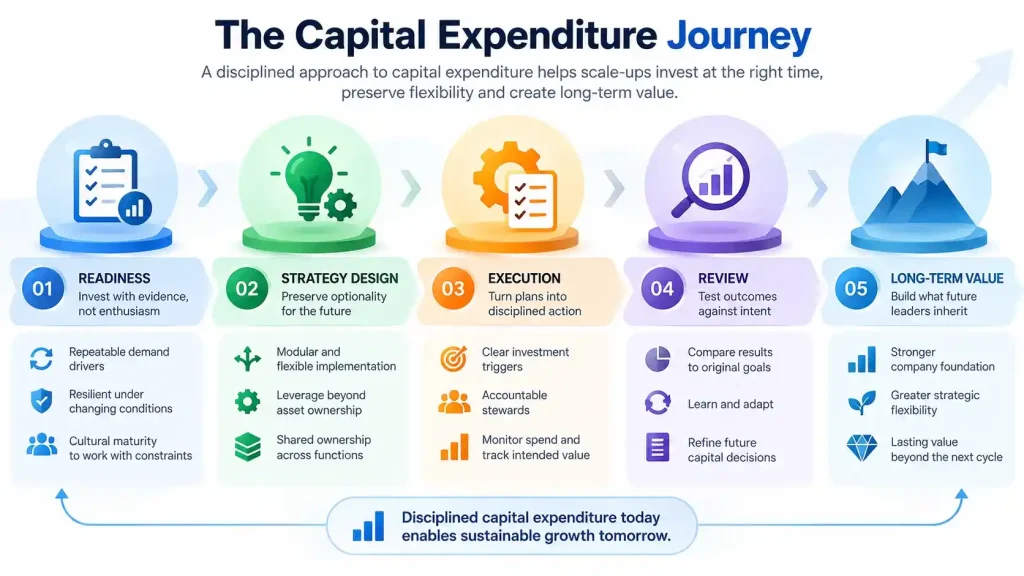
The Capital Expenditure Lifecycle
| Readiness | Design | Execution | Review | Legacy |
| Confirm repeatable demand | Preserve optionality and leverage | Deploy with clear triggers and stewards | Compare outcomes to intent | Consider what future leaders inherit |
Capital outlasts strategies and the leaders who approve it. Finance leaders must think in footprints as well as quarters. Each asset raises questions about what it will demand years from now and what it will signal to future leaders.
Three Key Takeaways
- Capital expenditure readiness depends on repeatable demand, resilience under stress, and cultural maturity. Spending should follow evidence of necessity, not the pressure to appear decisive.
- A strong capital expenditure strategy preserves optionality through staged deployment and flexible terms. Each investment should also earn a score for the leverage it creates beyond the asset itself.
- Effective governance balances visibility with momentum, using clear triggers, accountable stewards, and the willingness to stop projects when the original case no longer holds.
Disclaimer: This article is intended for informational purposes only and does not constitute legal, tax, or accounting advice. You should consult your own tax advisor or counsel for advice tailored to your specific situation.
Hindol Datta is a four-time CFO and senior finance executive with over 25 years of leadership experience across cybersecurity, SaaS, gaming, logistics, digital marketing, medical devices, consumer products, and nonprofit organizations. He has led more than $120M in fundraising and over $150M in M&A transactions while building the financial and operational systems that let complex businesses scale with confidence. He is the author of seven books in the Systems CFO Series and holds active CPA, CMA, and CIA credentials.
AI-assisted insights, supplemented by 25 years of finance leadership experience.