Executive Summary
Valuation gets the headline in every fundraising conversation, but the option pool is where founders often lose ground without noticing. An option pool sets aside a block of equity for future employee grants. Its position in the cap table, before or after the new money comes in, decides who actually pays for it. Most investors ask founders to carve out the pool on a pre-money basis. That means founders absorb the dilution while new investors avoid it entirely.
This article breaks down how pre-money and post-money option pools work. It also covers why negotiations rarely explain the difference in plain language. It lays out what a disciplined approach to sizing, refreshing, and governing the pool looks like once the round closes. Finance leaders who have sat across the table from term sheets built this way know the pattern well. The goal here is to make that pattern visible before it costs a founder more equity than it should.
What an Option Pool Actually Is and Why It Matters
An option pool is not a talent perk buried in the fine print. It is a structural concession. In early-stage negotiations, it often becomes the mechanism through which founders give up more ownership than the headline valuation suggests. The pool sits inside the cap table as unallocated equity reserved for future hires. Sizing and timing decisions change the math for everyone at the table except the investor writing the check.
CFOs at the Series A or B stage carry responsibility for protecting founder equity. That job extends well past negotiating the price of the round. It includes managing the pool’s size and timing, plus the structure that governs how it flows through future rounds. In cybersecurity and SaaS companies preparing for institutional capital, this is often where a first-time founder discovers something. A percentage on a term sheet does not mean what they assumed.
Pre-Money Versus Post-Money Option Pools
The mechanics are easier to see with numbers. Assume a company is raising $5M at a $20M pre-money valuation, and the investor asks for a 15 percent unallocated option pool as part of the round.
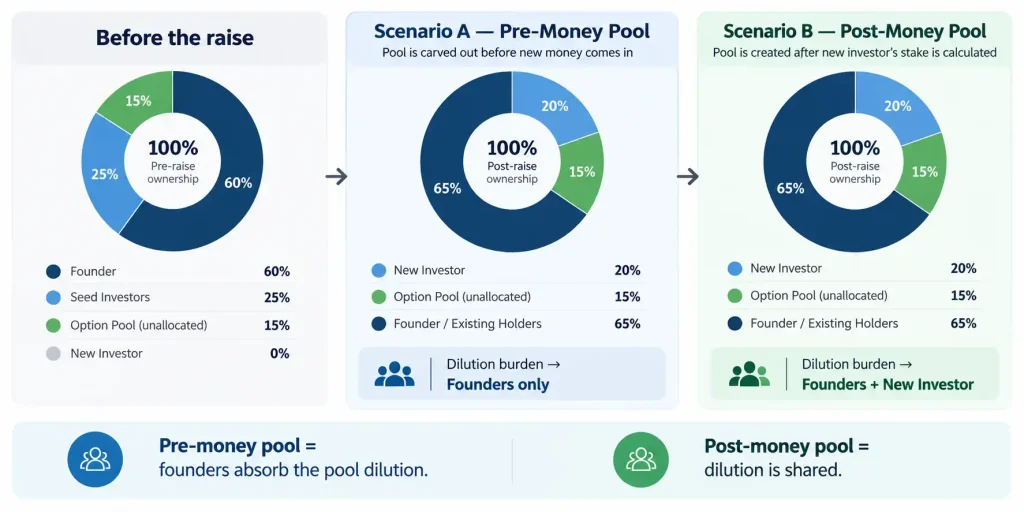
In Scenario A, the pool is carved out of the pre-money valuation, which means the founders alone give up the 15 percent, not to the investor, but to future employees who have not been hired yet. The investor still lands their full 20 percent, untouched. In Scenario B, the pool is created after the investor’s stake is calculated, and the dilution gets shared. The gap between these two outcomes has nothing to do with the valuation printed on the term sheet, and everything to do with four words buried in the definitions section.
The Term Sheet Language That Matters
Investors rarely write “we want you to absorb the dilution” in bold letters. Instead the preference shows up in language such as “the company will have a 15 percent unallocated option pool on a fully diluted basis immediately prior to closing.” That phrase, prior to closing, is what places the burden on the founders rather than sharing it across the new capital structure.
The practical response is to negotiate the pool size after investor ownership has been calculated, or to size the pool to what the hiring plan actually requires rather than accepting an arbitrary 15 percent default. A marketplace SaaS company raising a $20M Series B, for instance, is in a very different hiring position than a pre-Series A platform still proving its GTM motion, and the pool should reflect that difference rather than a template borrowed from the last deal the investor closed.
Sizing and Refreshing the Pool with Discipline
An option pool is a strategic lever, not just a mechanical line item. Too small, and the company cannot hire the people it needs to grow. Too large, and the founders dilute themselves for equity that sits unused.
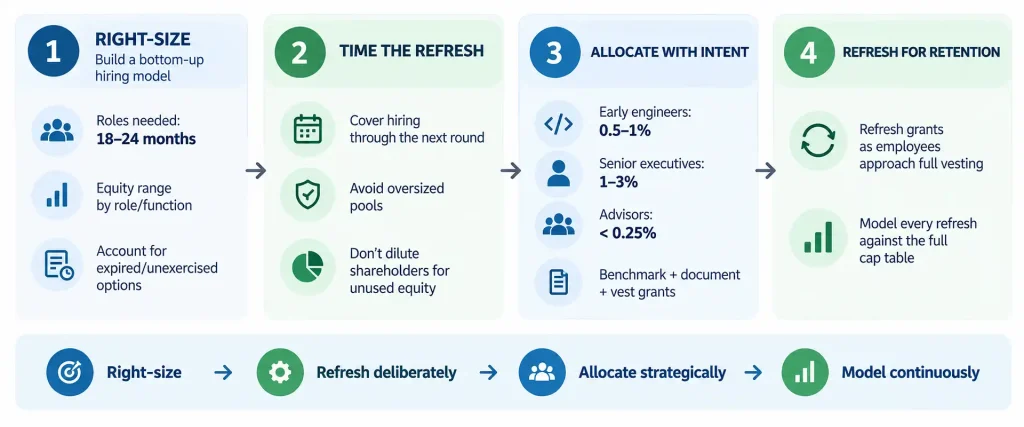
Right-sizing the pool starts with a bottom-up hiring model rather than a default percentage. That means building out:
- The roles needed over the next 18 to 24 months
- The equity range appropriate for each role, by level and function
- The expected slippage from unexercised or expired options
Finance leaders who have built the forecasting and hiring model from scratch, as is often required in an early-stage company where the finance function did not previously exist, know that this bottom-up approach is the only way to justify a pool size that matches reality rather than convention.
Timing the refresh is the second discipline. Many term sheets require a refresh as a financing condition, but that does not mean it needs to be oversized. A refresh should cover hiring through the next round, and anything beyond that creates unused equity that dilutes current shareholders for no strategic gain.
Allocating with intent is the third. Early engineers might receive 0.5 to 1 percent, senior executives 1 to 3 percent, and advisors typically fall below 0.25 percent. Grants should be benchmarked, documented, and tied to vesting, because too many companies over-allocate early and leave nothing for the growth hires that come later, while others hoard equity and under-incentivize the people they most need to retain.
Refreshing for retention rounds out the discipline. As employees near full vesting, refresh grants become necessary to keep them engaged, but every refresh needs modeling against the full cap table so it does not create dilution nobody anticipated.
Modeling, Communication, and Governance
A well-run financing round includes a full scenario model covering pre- and post-money ownership, the effect of pool sizing, dilution through future rounds, and exit scenarios layered against the preference stack. This is not internal paperwork. It is the tool that builds investor alignment and gives the board confidence that management understands its own capital structure. Boards at a public gaming company or a mission-driven institution running a multi-year capital raise tend to ask for exactly this kind of model before they approve a round, and the CFOs who have built it once rarely go back to guessing.
Employees deserve the same clarity. Option pool mismanagement is a leading cause of disillusionment among staff, and people need to understand how their options convert to equity, what the strike price and exercise window actually mean, and how liquidation preferences affect what they eventually take home. Finance, working alongside HR, should own that education rather than treating a grant letter as the end of the conversation.
Governance closes the loop. Every option grant needs board approval, proper documentation, and an accurate entry in the cap table software of record. Equity promised verbally, or issued without paperwork, is a legal and operational liability waiting to surface at the worst possible moment, usually during diligence for the next round or an acquisition.
Aligning Incentives Across the Cap Table
The purpose of the option pool is not to minimize founder dilution at any cost. It is to make sure the company can attract and keep the talent required to build something worth owning. A well-structured pool balances founder ownership, investor return expectations, and employee incentives, and it reflects strategic coherence rather than pure arithmetic. In high-functioning companies, the pool is treated as a component of organizational design, one that signals how the business values its people and prepares itself to scale rather than an afterthought bolted onto the term sheet at the last minute.
Three Key Takeaways
- A pre-money option pool shifts the cost of future hiring onto the founders alone, while a post-money pool shares that cost with the incoming investor, and the difference is negotiable long before the term sheet is signed.
- The right pool size comes from a bottom-up hiring plan built around actual roles and equity ranges, not from an arbitrary 10 or 15 percent default that investors present as standard practice.
- Strong governance, clear cap table modeling, and honest communication with employees about how their equity works are what separate companies that use the option pool as a strategic asset from those that let it become a source of quiet resentment.
Disclaimer: This article is intended for informational purposes only and does not constitute legal, tax, or accounting advice. You should consult your own tax advisor or counsel for advice tailored to your specific situation.
Hindol Datta is a four-time CFO and senior finance executive with over 25 years of leadership experience across cybersecurity, SaaS, gaming, logistics, digital marketing, medical devices, consumer products, and nonprofit organizations. He has led more than $120M in fundraising and over $150M in M&A transactions while building the financial and operational systems that let complex businesses scale with confidence. He is the author of seven books in the Systems CFO Series and holds active CPA, CMA, and CIA credentials.
AI-assisted insights, supplemented by 25 years of finance leadership experience.