Executive Summary
A GTM tech stack assembled by impulse becomes a liability once a company scales past the size where founders can hold every customer relationship in their heads. I treat the go-to-market tech stack as a designed system, not a collection of tools, since every disconnected platform is a claim on capital finance must justify. Feature comparison never answers the question a board asks: whether the stack moves cash faster than the one it replaced.
What follows draws on work inside cybersecurity, education, digital marketing, and public-company gaming organizations, where I watched stack hygiene and clear ownership hold a forecast together, or let it unravel. It covers where artificial intelligence strengthens signal fidelity, how a unified quote-to-cash process shapes customer experience before it reaches the financial statements, and why velocity, not volume, is the real measure of a scale-ready stack.
Reframing the GTM Tech Stack as a System, not a Collection of Tools
Growth-stage organizations tend to accumulate technology the way a household accumulates furniture: one purchase at a time, each reasonable on its own, until the room no longer functions as intended. Sales adopts a cadence tool after a compelling demo. Marketing licenses intent software because a competitor seemed faster. Legal introduces redline automation because contract turnaround had become an embarrassment in board meetings. Each decision solves a symptom on its own terms, and no owner ever models the system those decisions create together.
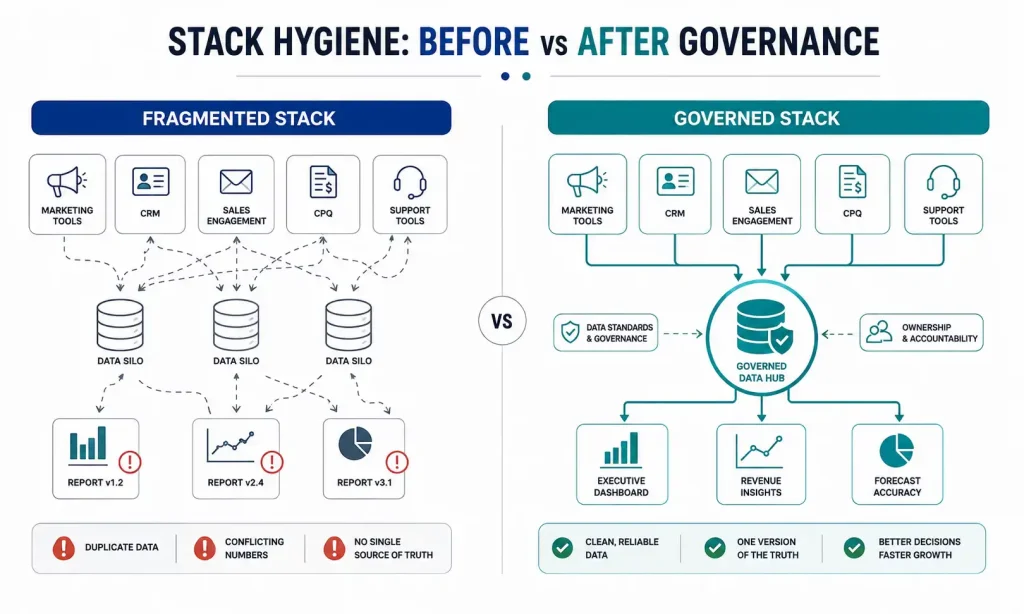
The consequence is not simply a rising software bill, though that bill is worth tracking. It is strategic debt. Every disconnected platform generates its own field definitions, data silos, and reporting logic, and that divergence compounds until forecasts stop matching what the business actually experiences. A mature GTM tech stack function as infrastructure built for flow, carrying signal from first contact through renewal with minimal friction.
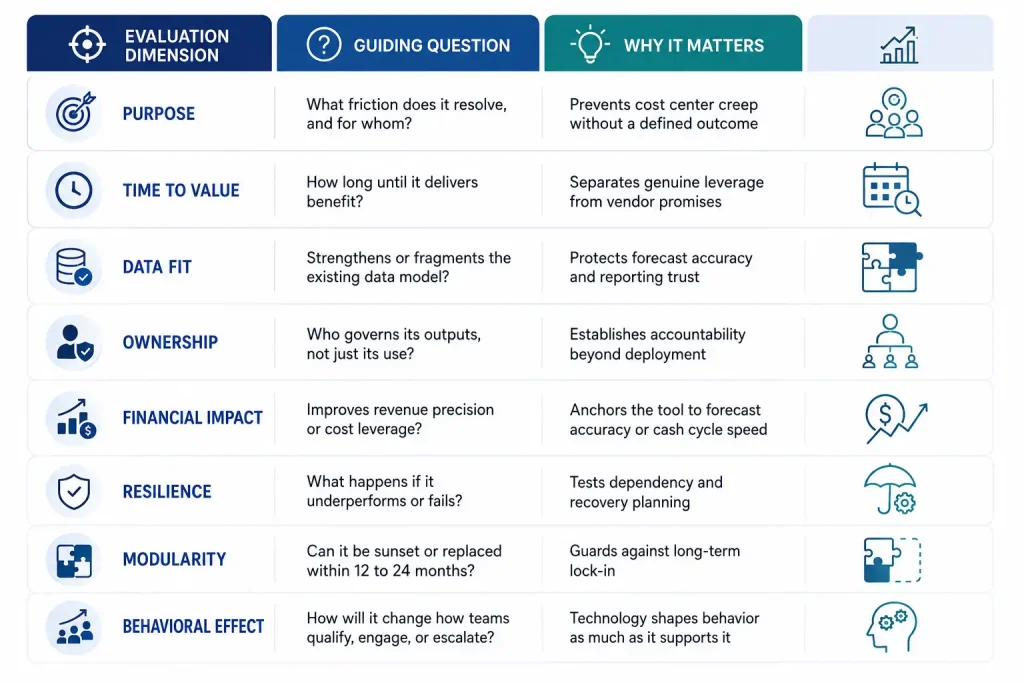
Before approving a new platform, three questions separate durable investment from simple accumulation.
- Which part of the customer journey does this tool accelerate, and for which team specifically
- Where does the signal it generates surface downstream, and who is accountable for acting on it
- Under what condition should the company retire this tool, and who owns that decision
Capital Discipline as the Foundation of GTM Technology Investment
Every dollar committed to a GTM tech stack trades off against capital efficiency elsewhere. Finance leaders across sectors as varied as cybersecurity, SaaS, gaming, logistics, digital marketing, medical devices, and nonprofit education arrive at the same conclusion from different directions: capital allocation discipline transfers directly onto technology decisions. As CFO of a mission-driven education institution in Silicon Valley, I raised $37M in equity and venture debt, and that raise held together because every technology purchase, GTM tooling included, was framed by what it displaced, not what it added.
That discipline reframes stack evaluation as a cash flow question, not a features conversation. Does the tool raise forecast confidence enough for the board to notice, and does it cut deal desk rework visibly? A platform saving four hours per representative weekly carries little value if it takes six months to deploy.
Time to Value as the Real Hurdle Rate
The most useful hurdle rate for GTM technology is not the return-on-investment figure in a vendor’s marketing deck. It is internal leverage, measured by how quickly a tool converts into usable throughput. I saw speed to benefit under real pressure directing finance at an early-stage digital marketing and community technology company, where monthly burn fell from $800K to $200K during an operational turnaround. The tools that earned their place produced usable output within weeks, not the ones with the longest feature list. Modeled this way, the GTM tech stack behaves like a balance sheet asset with a measurable return, not an operating expense line.
Stack Hygiene: Governance Before Growth
Most dysfunction inside a GTM tech stack hides behind familiar phrases: the system did not update, that number lives in another platform, that is how the other team reports it. These phrases signal an absence of shared definitions, not technology failure. Fields, funnel stages, and metrics accumulate local interpretations until an organization is data-rich yet functionally data-blind, and nobody notices until a board question exposes the gap.
At a cybersecurity and identity access management company near $30M in annual recurring revenue across the United States, Canada, Mexico, India, and Nepal, I built the forecasting engine, capacity model, and reporting cadence from nothing. Actuals held within plus or minus five percent of forecast for 8 consecutive quarters, built on one accepted definition per metric: one source of truth, one accountable owner.
Common symptoms of a fragmenting stack include the following.
- Two teams reporting different pipeline totals for the same quarter, each convinced their number is correct
- A qualified lead defined one way by marketing and another way by sales, with no documented reconciliation
- Reports that require a manual export and a spreadsheet before anyone trusts the number
- A metric that changes definition when a new hire joins the team responsible for it
Signal Fidelity: Applying Artificial Intelligence to the GTM Tech Stack
A scale-ready GTM tech stack should interpret behavior, not merely log events. Artificial intelligence has a genuine role in detecting deal decay: when engagement slows, a champion goes quiet, or buying intent softens in ways a representative might miss. The risk is a model dictating action without context, a risk growing as the stack becomes AI-assisted by default.
Any predictive tool entering a GTM tech stack should pass a systems integrity check before it influences territory, pricing, or headcount.
- Data sufficiency, to confirm the model has enough history and volume to generalize
- Bias review, to confirm the training data does not systematically favor one segment, region, or representative
- Historical validation, to confirm predictions have been tested against outcomes that already happened
- Interpretability, to confirm a human can explain why the model reached its conclusion
Tools that explain variance carry more long-term value than tools that only predict an outcome. A team acting on the reason behind a signal builds judgment over time; a team acting blindly on a score builds dependency. Layered onto a disciplined stack, artificial intelligence turns signal into strategy, and territory, staffing, and compensation can be recalibrated within one planning cycle.
Quote to Cash: Where the GTM Tech Stack Meets the Customer
Customers rarely evaluate a company’s value proposition apart from the process behind it. They experience the mechanics directly, from proposal to signed contract to first invoice, and a fragmented quote-to-cash motion, where configuration, pricing, legal review, and billing each run on different logic, translates into friction regardless of product.
As CFO of a Euronext Paris-listed gaming and entertainment company across the United States, France, the United Kingdom, Singapore, and South Korea, I faced this problem at scale. Each region had its own reporting logic and definition of revenue, and closing the books under IFRS and US GAAP meant hand-reconciling differences every quarter. Rolling out Oracle Financials and MicroStrategy firmwide created one unified definition of revenue across every subsidiary, compressing the reporting cycle because quote, contract, and invoice finally agreed.
The pattern holds across other environments I have worked inside. In one global operating structure, regional teams each used a different quoting method, discount approvals bottlenecked unpredictably, and collections lagged. Unifying the quoting architecture, guided selling logic, and usage-based pricing in the forecast model dropped days sales outstanding by 18 days and lifted renewal rates. This is the quiet value of stack integrity, visible in sentiment and retention before it reaches the profit and loss line.
A Practical Framework for Evaluating the GTM Tech Stack
Velocity, Not Volume: Where the GTM Tech Stack Is Heading
Coverage and logo count are receding as measures of a strong GTM tech stack, and velocity is taking their place.
- Pipeline health is increasingly judged by signal strength rather than raw size
- Attribution is shifting from first touch toward sustained engagement across the buying cycle
- Segmentation is moving from static personas toward behavioral clusters that update continuously
- Forecast accuracy, not forecast optimism, is becoming the metric boards actually reward
Finance’s role in this shift is to fund adaptability. No tool needs to be flawless, but the stack must stay modular enough to sunset point solutions, pilot new platforms, and absorb new data without corrupting the system. Every new input should enrich the decision graph and leave a signal trail worth analyzing.
Three Key Takeaways
- Evaluate every GTM tech stack investment as a capital allocation decision first, a features decision second. The tools that survive a downturn are the ones finance can defend on cash flow, cycle time, and retention.
- Treat shared data definitions as the real governance layer of a GTM tech stack. One accepted definition per metric, backed by one accountable owner, does more for forecast accuracy than another dashboard.
- Judge the health of a GTM tech stack by velocity, not volume. Signal strength, sustained engagement, and forecast accuracy show whether the stack still serves the business or is simply accumulating.
Disclaimer: This article is intended for informational purposes only and does not constitute legal, tax, or accounting advice. You should consult your own tax advisor or counsel for advice tailored to your specific situation.
Hindol Datta is a four-time CFO and senior finance executive with over 25 years of leadership experience across cybersecurity, SaaS, gaming, logistics, digital marketing, medical devices, consumer products, and nonprofit organizations. He has led more than $120M in fundraising and over $150M in M&A transactions while building the financial and operational systems that let complex businesses scale with confidence. He is the author of seven books in the Systems CFO Series and holds active CPA, CMA, and CIA credentials.
AI-assisted insights, supplemented by 25 years of finance leadership experience.